
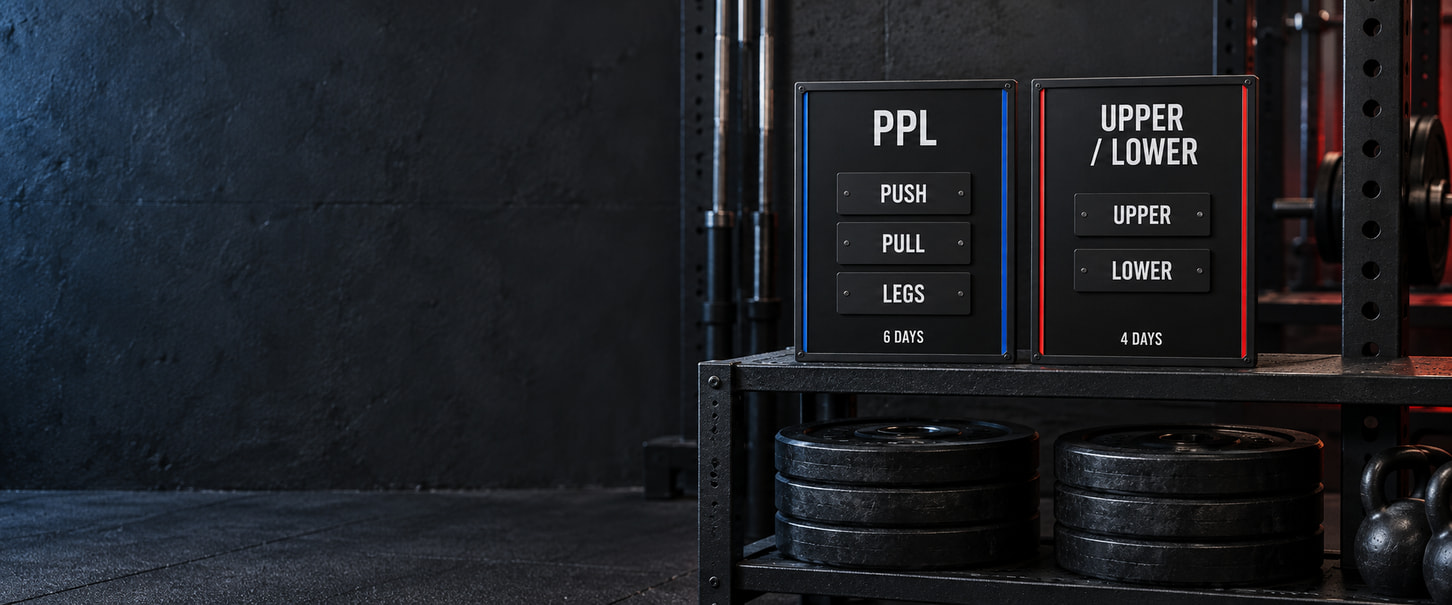
PPL or Upper/Lower? Start Here
If four training days are reliable but six are not, the standard Upper/Lower plan is the more practical of these two schedules, provided its full sessions and recovery pattern fit your week. Consider six-day PPL when the extra visits are realistic, you prefer separate push, pull, and leg workouts, and its workload suits your training experience and recovery. Having six available days does not mean you need to use them all. This comparison uses Elevated Muscle's standard four-day Upper/Lower and six-day weekly Push Pull Legs (PPL) workout plans. Upper/Lower combines upper-body pressing and pulling in the same sessions, with separate lower-body workouts. PPL separates pressing and related chest, shoulder, and triceps work from pulling and related back and biceps work, alongside dedicated leg sessions. Both plans use different A and B workouts. Other schedules are separate variants, not the main comparison here. The two routines are not identical work spread over different numbers of days. Compare the exercises, prescribed sets, and effort targets against your goal and the work you currently complete. Allow time for warm-ups, rest between sets, and travel as well as the exercises themselves. More visits do not automatically mean shorter sessions or greater muscle and strength gains, and a four-day routine can still contain more work than you can recover from. Check the weekly schedules next to see which fits your actual training slots. If both fit, compare workload, session length, and recovery before choosing. A single missed workout is not, by itself, a reason to replace an otherwise suitable plan.
Compare the Weekly Schedules
Use the table to check whether the training days and rest pattern fit your actual week. It pairs the standard four-day Upper/Lower Split Workout Plan with the six-day weekly Push Pull Legs Workout Plan; their other variants are separate choices. Rest means no session from that workout plan, not complete inactivity. Any cardio or sport still needs to fit the plan's recovery guidance.
| Day | Four-day Upper/Lower | Six-day PPL |
|---|---|---|
| Monday | Upper A | Push A |
| Tuesday | Lower A | Pull A |
| Wednesday | Rest | Legs A |
| Thursday | Upper B | Push B |
| Friday | Lower B | Pull B |
| Saturday | Rest | Legs B |
| Sunday | Rest | Rest |
Upper/Lower has two upper and two lower sessions, separated into pairs by Wednesday's break. PPL has two push, two pull, and two leg sessions across six consecutive training days. Both schedules restart with their first A session the following Monday, after Sunday's rest. Keep the A/B distinctions when opening the routines. The two upper workouts have different exercise selections and prescriptions, as do PPL's A/B sessions. Training a broad region or category twice does not mean practicing every individual exercise twice.
When only two or three days are available
With three reliable days, compare the plans' three-day variants rather than simply dropping their final workouts. The PPL guide places Push A, Pull A, and Legs A on Monday, Wednesday, and Friday in Week 1, then the B sessions on those days in Week 2. Each category has one dedicated session per week; the six different workouts span two weeks, not one. The three-day Upper/Lower variant rotates through Upper A, Lower A, Upper B, and Lower B without resetting each Monday. Lower B therefore opens the second week after Upper B ends the first. All four workouts remain in the sequence, but they no longer fit into every calendar week. For two weekly slots, or a three-day option that combines upper- and lower-body work at each visit, compare the Full Body Workout Plan. It includes a two-day adjustment alongside its three-day A/B/C routine. Follow the chosen variant's workload and spacing instructions; fewer available days are not a reason to combine several complete workouts.
When the cycle is longer than a week
In the eight-day PPL rotation, a rest day follows each three-session A or B block. Six workouts therefore take eight days. Repeated without extra days off, that schedules an average of 5.25 sessions per seven days, not six. The weekdays assigned to each workout change as the rotation continues. A rolling sequence keeps the next session tied to your place in the workout order rather than a particular weekday. Check the following cycle as well as the first so a moved leg session or rest day does not collide with a fixed commitment. Keep the chosen variant's session order and recovery pattern instead of skipping ahead to restore Monday's label. Completing all sessions over a longer cycle does not preserve their original weekly frequency or workload.
Compare Workload, Session Length, and Recovery
Six-day PPL contains more listed working sets across the week than the standard four-day Upper/Lower routine. That difference matters when comparing the work you would take on, but it does not tell you which plan produces better results or how long each visit takes.
Count the prescribed work consistently
The totals below count the working sets in every exercise row, including calf and core work. Use one listed alternative per row, exclude warm-up sets, and do not add optional exercises or substitute a different set prescription. For unilateral work, one round completed on both sides counts as one listed set here, not two. Excluding warm-ups from the count does not remove them from the session.
| Workout plan | Working sets by session | Working sets per week |
|---|---|---|
| Four-day Upper/Lower | Upper A: 17; Lower A: 15; Upper B: 17; Lower B: 17 | 66 |
| Six-day PPL | Push A: 15; Pull A: 15; Legs A: 16; Push B: 16; Pull B: 16; Legs B: 19 | 97 |
PPL has 31 additional listed working sets per week in this comparison. Its sessions range from 15 to 19 sets, versus 15 to 17 for Upper/Lower. These are two different prescriptions, not a volume-matched workload distributed over more or fewer days. A calf-raise set, a deadlift set, and a cable-crunch set each add one to this tally, although their demands differ. These are not weekly sets for each muscle or a measure of total weight lifted. They do not establish equal training stimulus or predict a proportional difference in muscle growth.
Separate muscle exposure from lift practice
Look beyond the A/B labels to the actual exercises. Choosing the flat barbell bench press in Push A does not give you another flat barbell bench session in Push B, which uses different pressing variations. Two push sessions describe a category's frequency, not the practice frequency of each lift. Consider direct and supporting work when reviewing a muscle. Curls target the biceps directly, while rows and pulldowns also use them. Presses involve the triceps alongside chest or shoulder work, before any dedicated triceps exercise. These exposures are not interchangeable, and the involvement of several muscles does not turn one exercise set into several sets in the table above. The Workout Volume Calculator can organize exercise sets and weekly frequency into direct, secondary, and weighted muscle totals. Check its exercise mappings and use consistent counting settings when comparing plans. Its weights are accounting assumptions, not exact fractions of muscle stimulus. Its seven-day display spreads work through a model; it is not your actual calendar or a recovery forecast.
Allow time for the whole session
PPL's Legs B contains more listed sets than any of the four Upper/Lower sessions, so six-day PPL cannot be assumed to mean shorter visits. Even a workout with fewer sets can take longer when its exercises need more preparation or longer rest periods. Build a time estimate from the prescribed repetitions, tempo, rest periods, and equipment changes. A squat's ramp-up sets take time, and a unilateral exercise needs time for both sides even though the count above treats the round as one set. Allow for loading plates, moving between stations, and waiting for equipment. Shortening prescribed rest to fit a slot can change the loads or reps you can sustain, not just the finishing time. Check the longest session against its available slot, then add up the weekly commitment. When every workout involves a gym trip, six-day PPL also means two more trips than four-day Upper/Lower, with the associated travel and changing time. Use your recent experience with comparable sessions to estimate what fits without cutting prescribed work or preparation.
Check overlapping work and recovery demands
Different session names do not separate every recovery demand. If Pull B uses barbell rows and Legs B uses Romanian deadlifts, those consecutive PPL sessions both load the lower back and challenge grip. Upper/Lower also places upper-day pulling before lower-day hinges. Within either plan's pressing sessions, bench and shoulder presses share triceps and front-shoulder work; dedicated arm exercises add to that exposure. Read each plan's effort targets alongside its set counts and rest periods. Reps in reserve is an estimate of how many more technically sound repetitions you could complete. Taking sets to failure can extend recovery compared with stopping short, so a manageable-looking set count is not permission to make every set an all-out attempt. Keep the effort guidance attached to the chosen exercise and plan. Use normal warm-ups and comparable session results as practical checks: can you maintain the intended technique, range of motion, and performance at the expected effort? If overlapping work repeatedly interferes with those, follow the plan's recovery and adjustment guidance rather than forcing the calendar. Account for demanding cardio or sport in the gaps too. Neither a fixed number of hours nor a calculator total can guarantee readiness for the next session.
Choose for Your Goal and Experience
Start by naming the result that matters most: developing particular muscles, getting stronger in chosen lifts, or supporting sport. Then compare how the selected four-day Upper/Lower and six-day PPL routines serve that priority within your real schedule.
For muscle growth, compare the work you can progress
Check the exercises, effort targets, and progression for the muscles you want to develop. Upper/Lower combines pressing and pulling within each upper session. PPL gives those movements separate sessions, with chest emphasis in Push A and shoulder and triceps emphasis in Push B. That organization may suit your priorities and preferences, but a dedicated day does not establish a larger growth response. Upper/Lower is a reasonable choice when its existing work covers your priorities and the complete sessions fit. Consider PPL when its additional work suits your current training capacity and the extra visits are dependable. Don't select it just to get the larger weekly set total, or add sets to Upper/Lower merely to make the totals match. Muscle growth does not require six gym days or an exact twice-weekly threshold for every muscle. Frequency helps distribute the work; changing it can also change how much work you complete. Neither split label makes a routine inherently more anabolic or establishes a fat-loss advantage. Choose according to the actual prescription rather than treating attendance as an outcome.
For strength, match the exercises to the goal
For general strength, check whether your priority lifts receive suitable loading, a useful place in the session, and a progression rule you can follow. The standard Upper/Lower routine uses strength-biased A sessions and hypertrophy-biased B sessions. PPL also includes lower-repetition compound work. Those emphases are not exclusive: neither routine is only for strength or only for muscle size. Competition goals need a more specific check. Both routines allow a hack squat in the main squat slot, but choosing it is not the same as practicing a barbell back squat. Check the exact lifts, their practice frequency, and whether the plan prepares you for the test or meet you intend to enter. If the required lift practice or preparation for a fixed competition date is missing, neither unmodified template automatically meets that need. Choose guidance designed for that task rather than attaching extra heavy sessions to a general routine.
Match the routine to your current experience
Judge readiness by the training you can already perform, not which split sounds more advanced. Check that you can set up the chosen exercises, maintain technique at the intended effort, understand when to progress, and complete comparable work without repeatedly losing performance later in the week. Years spent attending a gym do not answer those questions on their own. For a newer lifter still learning the main movements, neither four full Upper/Lower sessions nor six PPL sessions is automatically the right starting workload. Review the guides' beginner adjustments and the lower-frequency schedule options. Use the chosen variant's instructions rather than improvising cuts to the standard routine. Experienced lifters can also retain four days when that structure serves their goals; experience does not create an obligation to train six.
Fit lifting around cardio and sport
Put fixed practices, runs, rides, and games into the calendar before deciding how much lifting fits. Cardio can coexist with strength and muscle-building goals, but its intensity, duration, and placement still need consideration. When explosive performance is a priority, consider separating demanding aerobic and strength work rather than automatically combining them in one session. No single time gap guarantees compatibility. Four-day Upper/Lower leaves more non-lifting days than six-day PPL, which may provide room to arrange sport and recovery. It does not make every combination suitable. For example, with an important Saturday game, check Friday's Lower B in the standard Upper/Lower schedule; PPL's Saturday Legs B also needs scrutiny. Check the combined demands and use the chosen guide's permitted adjustments, rather than automatically removing leg training or treating sport as a rest day.
Choose a week you can sustain
Compare a normal week, not an unusually clear one. A workable choice leaves time for complete sessions, other commitments, and the plan's recovery pattern without relying on recurring cancellations or repeatedly shortening the same workout. If neither standard template fits, use a suitable variant rather than forcing the comparison to produce a winner. When both fit your goal and capacity, choose the exercises and schedule you prefer without expecting the split name alone to improve your results.
Switch Splits Without Losing Track of Your Training
Treat a switch from PPL to Upper/Lower, or the reverse, as a planned change of workload and exercise targets, not a way to clear missed sessions. Write down why the new plan fits better, such as a lasting change in your available days or training priorities. If the only issue is one missed workout in an otherwise suitable plan, use the missed-workout guide rather than replacing the split.
Plan the first cycle around completed work
Choose the exact variant and assign its first full cycle to realistic training slots, allowing time for warm-ups and complete sessions. Check how it continues into the next week around fixed cardio or sport commitments. Mark the old plan's end date and the new plan's intended start date and first session in your log. Review the last sessions you actually completed before choosing that start. A completed PPL push workout still counts when checking recovery before Upper A's pressing. Check what follows the first new session too, and keep the chosen plan's recovery requirements intact. Move the start if it does not fit. Mark any unfinished old sessions you decide to leave out as uncompleted, rather than adding them to the new cycle or counting them as done.
Use the new plan's starting instructions
Compare its exercises, sets, rep ranges, effort targets, and frequency with your recent completed workload, not just the old written schedule. Moving from four-day Upper/Lower to the six-day PPL template here adds prescribed work as well as visits. Moving the other way does not mean squeezing every former push and pull exercise into an upper day. Use the selected plan's starting guidance or a suitable documented variant; do not import old assistance sets or intensity techniques to fill the new sessions. Changing splits does not automatically require a deload, but fewer visits are not proof that accumulated fatigue has resolved. If comparable performance or warm-up quality is already repeatedly declining, use the plan's fatigue-management guidance before starting its full workload. Any reduction in training should reflect that situation and the plan's instructions, not a compulsory week off or the same percentage cut for everyone.
Keep your history without copying every target
Retain the historical entries and label where the plan changes. Carry an old exercise target forward only when the variation, equipment setup, range, tempo, rest, effort, and set-and-rep prescription are genuinely comparable. A familiar lift with a different rep range needs a target suited to the new range; the old entry remains context, not an instruction to reproduce it. For example, assume you chose the incline dumbbell press in Upper B and retain it in PPL Push A. It moves from the first exercise to after the main chest press. Even with the same equipment and prescription, that order change means the next result is not a like-for-like comparison. Note the new position and establish comparable entries there rather than interpreting a change in reps as proof of gained or lost strength. When equipment or the exercise variation changes, establish a fresh baseline rather than copying a weight or converting between machines and free weights. Follow the new plan's warm-up and starting-load guidance, then use a load that fits its prescribed reps and effort with consistent technique. Record the load, reps completed in each working set, effort, and setup details for that exercise.
Review comparable sessions before judging the switch
Look across repeated occurrences of the same exercises under the new conditions, not one first-session result. Check whether you complete the planned work, maintain the intended technique and effort, and reach later sessions without repeatedly shortening or postponing them. A changed exercise, rep range, or position in the workout can make an old performance target unsuitable; one result does not establish a plateau. Use the new plan's progression criteria for subsequent targets. If a load prevents you from meeting its technique or repetition requirements, follow its load-adjustment guidance rather than forcing the target while waiting for a trend. Then check whether the switch addresses the original reason for changing: more dependable attendance, sessions that fit their slots, or training better matched to your goal. Judge that from completed work, not a newly filled calendar.
PPL vs. Upper/Lower FAQs
Can I follow PPL on fewer than six days a week?
Yes, when the chosen variant's full sessions and rest pattern fit. The three-day version shown earlier alternates the A and B sessions across two weeks, while the eight-day rotation places all six sessions within an eight-day cycle. That rotation is not six workouts every week; its training days shift as the cycle repeats. Use the schedule comparison to check the actual cadence rather than treating either variant as the six-day routine squeezed into fewer visits.
Does four-day Upper/Lower mean less progress than six-day PPL?
Not automatically. Four training days can support muscle and strength gains when the exercises, prescribed work, and progression suit your goal and current capacity. The number of gym visits alone does not tell you which plan will work better. These published templates do not have equal workload: standard six-day PPL contains more listed weekly working sets, and the exercises and prescriptions differ. Choosing Upper/Lower is therefore not just spreading identical work across fewer days. Compare the work and priority-lift practice you would actually complete, without assuming either identical results or a penalty simply for training four days.
Is a PPL/Upper-Lower hybrid covered by this comparison?
No. A workout plan combining push, pull, and leg sessions with upper- and lower-body sessions is a separate arrangement. The schedules and set totals above do not describe its workload. Read that plan's complete cycle, exercise selection, progression, and recovery guidance before evaluating it. Combining the labels does not resolve overlapping work. For example, an upper session may repeat pressing already included on a push day. Don't assemble a hybrid by copying full workouts from both plans and assuming that their original prescriptions still fit together.
What should I change if the schedule is the real problem?
If the sessions themselves fit but the printed weekdays do not, check whether your current plan allows a different arrangement that preserves its sequence and recovery pattern. If the number or length of sessions repeatedly exceeds your available time, compare a suitable variant instead of simply renaming the same workload. One missed session alone is not a reason to replace an otherwise suitable plan. Open the Upper/Lower Split Workout Plan or Push Pull Legs Workout Plan and choose the exact variant that fits your goal and dependable training slots. Check its full cycle, then record the first intended session and date. Follow that variant's starting and progression instructions rather than mixing both plans.