
Biceps Not Growing? Check the Evidence Before Adding More Curls
Biceps that look unchanged do not automatically need more exercises. First check whether your measurements and training records are comparable. Then check the curl itself, the work you actually complete, your effort and rest, and the food and recovery available to support training. A stronger curl, a larger post-workout pump and a larger relaxed upper-arm measurement are different observations. None alone identifies exactly how much biceps muscle you have gained. One difficult session or a few similar photographs cannot tell you which training variable to change. Use the checks below to find the first problem supported by your own record. Keep productive work, correct a clear mismatch and test one suitable change at a time. Sudden pain, bruising, unexpected weakness or a changed arm shape belongs in a medical assessment, not an extra curl session.
Start With the First Relevant Biceps-Growth Check
Work through the first applicable observation rather than choosing the most aggressive fix. Several factors can coexist, but a clear measurement, attendance or technique problem needs resolving before adding another training variable. The table helps organise a decision; it does not diagnose a medical condition or prove why a muscle has not grown.
| What you notice | Check first | First action |
|---|---|---|
| A sudden pop, bruising, new weakness or a changed arm shape | This is not an ordinary training plateau | Stop and obtain assessment. |
| Only the mirror, a pump or one tape reading seems different | The comparisons may not measure the same thing | Establish comparable measurements. |
| The heavier curl uses a shorter range or a growing body swing | The movement standard changed | Audit the curl before treating it as progress. |
| Planned curl sets are repeatedly missed | The recorded training dose differs from the plan | Count completed work and resolve the attendance or scheduling problem. |
| Later sets fall short after rushed rests or a very hard first set | Recovery and effort differ from the intended prescription | Check effort and progression. |
| Both curl performance and wider training are repeatedly declining | Accumulated demand, recovery or symptoms may need attention | Review recovery and food before adding sets. |
| The setup cannot be repeated or the load step is impractical | The chosen exercise may not fit the available equipment | Change the exercise for a specific reason. |
| Comparable training and measurements remain unconvincing despite consistent, manageable work | A bounded training adjustment may be worth testing | Choose one change and define what would justify keeping it. |
When there is not yet a training baseline
A new lifter who is still learning equipment or changing every session has a different problem from an experienced trainee with a well-recorded plateau. Use the Beginner Gym Workout Plan when equipment setup, suitable starting loads and basic records are still the missing skills. Its two-day learning structure is a separate plan, not an arm add-on.
Keep the explanation proportional to the record
Changed lighting, a missed session or one weaker set can justify a better comparison without proving muscle loss. When several problems appear together, address symptoms and unsafe handling first, then restore a workable training and recording process. Do not postpone a necessary safety change merely to keep an experiment tidy.
Measure Arm Size Without Confusing a Pump With Growth
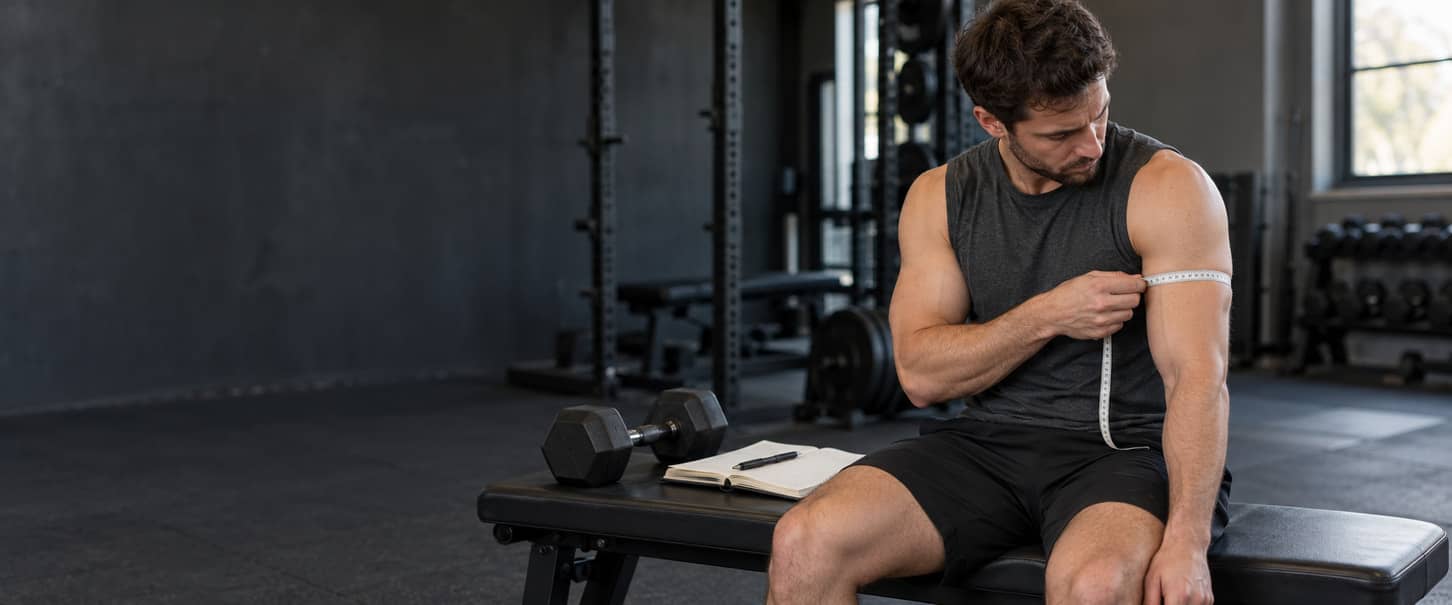
A tape around the upper arm measures the whole arm at that point, including tissue other than the biceps. The triceps, other muscles, fat and fluid can affect the result. A larger circumference is not a direct measurement of biceps muscle thickness, and a smaller circumference during fat loss does not by itself establish biceps loss. A temporary post-exercise change is also different from a resting trend. Research measuring elbow-flexor thickness immediately around a workout illustrates why an acute response is not a long-term growth test. Keep measurements away from an immediate pump and do not interpret unusual swelling as successful training.
A repeatable relaxed upper-arm record
This practical tracking procedure uses a marked midpoint and a relaxed arm. It is not a medical screening test or a way to calculate muscle mass. Use the same procedure each time; do not compare it with a flexed maximum-girth measurement.
- Choose and label the arm. Use a flexible non-stretch tape with readable units. A helper can make the landmark and tape placement more repeatable.
- With the upper arm beside the body and the elbow bent to about 90 degrees, locate the bony tip of the shoulder (acromion) and the point at the back of the elbow (olecranon). Measure between these landmarks and mark the halfway point, then use the same landmarks and method at each check.
- Let the arm hang relaxed by the side. Place the tape level around the marked point, snug against the skin without squeezing it. Do not flex to increase the reading.
- Remove and replace the tape for three readings, retaining all three and their units. Use the middle reading as a simple summary. When they vary because the procedure changed, correct the procedure and repeat rather than selecting the largest number.
- Repeat under similar resting conditions, at a similar time and comparable point in the training week, noting time since upper-body training and unusual soreness or swelling. A practical review every two to four weeks is more useful here than repeatedly measuring a pump; no fixed interval guarantees that all exercise effects have disappeared.
- Keep arm-size observations separate from exercise performance. Optional photographs need the same pose, distance and lighting. Record body-weight context without trying to manipulate food or hydration to obtain a larger reading.
| Checkpoint | Recorded readings (cm) | Middle reading (cm) | Interpretation |
|---|---|---|---|
| Baseline, before exercise | 32.4, 32.5, 32.4 | 32.4 | Start a consistent record; this is whole upper-arm circumference. |
| Immediately after a curl session | 33.1; one reading only | Not calculated | A different exercise state and sampling method; do not compare it as permanent growth. |
| Week 4, matched resting setup | 32.4, 32.6, 32.5 | 32.5 | Only 0.1 cm above the baseline middle reading, with overlapping readings. |
| Week 8, matched resting setup | 32.5, 32.4, 32.5 | 32.5 | Still overlapping; the record does not establish a clear isolated biceps change. |
These numbers are invented to demonstrate interpretation, not client results or a biological growth threshold. The 0.1 cm difference between the baseline and later middle readings sits within the overlap of the recorded readings. It cannot establish an isolated biceps gain, and the single pumped reading is not part of the resting series. This does not mean every 0.1 cm change is always meaningless; the reliability of the actual procedure matters.
Performance can improve without answering every size question
More controlled repetitions under the same conditions are useful training progress. Skill, execution and familiarity can contribute, so a stronger curl is not a direct percentage measure of muscle gained. Conversely, an unchanged mirror impression does not show that training produced no adaptation. Use the repeated record, not a claim of a universal number of centimetres per month.
Check Whether Your Curl Is Still the Same Exercise
Before blaming an exercise, compare how it is being performed. Record the support, grip, upper-arm position, elbow range, load unit and why each set ends. A material change in these details can make a heavier number a different task rather than progress on the original one. The two examples below give a clear movement standard for common curls. Use the version already selected in your plan; do not add both examples as another workout.
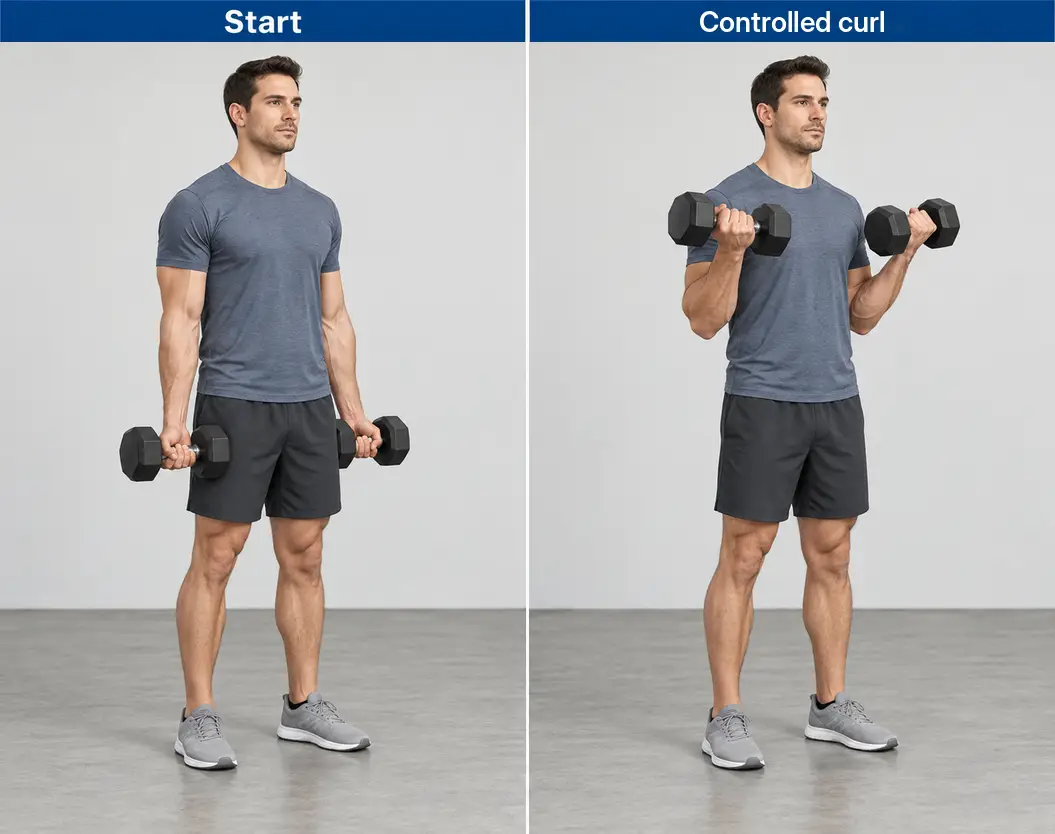
Standing Dumbbell Curl
Use two manageable dumbbells with both palms comfortably forwards and both arms curling together. Supination means turning the forearms towards palms-up; it does not mean folding the wrists backwards. Select a comfortable repeatable range before the working set.
- Inspect both dumbbells and their retention mechanisms. Pick them up through a controlled route and stand on a nonslip surface with clear working and set-down space.
- Hold one in each hand with full grips, aligned wrists, softly bent knees and the upper arms near the torso. Begin with comfortably extended elbows rather than forcing them straight.
- Bend both elbows together while keeping torso movement and upper-arm travel small and repeatable. Do not use growing hip drive, backward lean or wrist bending to move the weights.
- Finish where elbow flexion remains controlled without throwing the elbows forwards or resting the weights on the shoulders. Height alone is not the target.
- Lower to the same comfortable endpoint. Do not snap the elbows straight, force forearm rotation or change grip midway through a difficult set.
- End while both weights can still be lowered and set down securely. One simultaneous curl and return is one repetition, not two.
Record the dumbbell weight used. Choose lighter dumbbells if you cannot maintain proper form. Log different curl variations separately.
Standing Cable Curl
Face one low pulley and use a compatible two-handed bar with a comfortable palms-up or angled grip. This is a bilateral front-facing cable curl, not a behind-the-body version or two-stack movement.
- With the stack resting, inspect the cable, selector, clip and attachment. Set the outlet low and choose a light rehearsal setting.
- Take full grips and establish a stable stance that lets the bar clear the thighs and the cable travel without obstruction.
- Keep the wrists aligned and the upper arms in a repeatable position near the torso. Take up the resistance without leaning back or adjusting a loaded station.
- Curl by bending the elbows, keeping the torso steady and the bar clear of the outlet. Avoid turning the movement into a row or shrug.
- Return through controlled elbow extension to the same endpoint without allowing the stack to jerk the hands down or crash.
- Settle the resistance fully through the rehearsed return route before releasing the bar or changing the setting.
Record the exact machine, attachment, pulley height, stance, displayed units and range. A different stack number or cable setup is not a direct conversion to the dumbbell example; use why gym machine weights differ when the resistance label itself is confusing.
Compare early and late repetitions
A brief recording, where gym rules and other people's privacy permit it, can help compare the first and final repetitions. Keep the camera position comparable and seek a qualified coach's observation when the movement is uncertain. A video cannot diagnose pain or measure the stimulus received by a muscle.
| Observation | What the log can and cannot show | Next action |
|---|---|---|
| More load, but the lower endpoint becomes progressively shorter | A heavier display with a changed range is not the same comparison | Use manageable resistance and restore or deliberately relabel the chosen range. |
| The hips drive and the torso leans farther back on later repetitions | The completed task changes as fatigue rises | End before the change; log the repetitions actually completed to the chosen standard. |
| The wrists fold or the grip changes halfway through the set | Forearm orientation and wrist position are being mixed with elbow flexion | Use a tolerable grip, aligned wrists and a manageable load. |
| The upper arms travel markedly forwards to finish higher | Dumbbell height alone does not describe elbow-flexion range | Keep the selected upper-arm path repeatable; a small natural movement is not automatically an error. |
| Grip, pain or equipment handling ends the set first | The stopping reason is not necessarily the elbow flexors reaching the intended effort | Record the limiter and address fit or symptoms rather than forcing more repetitions. |
Choose a controllable range and keep it repeatable. Do not force extra stretch or prescribe a different partial-range method simply because the last repetitions have shortened. Soreness, a burning sensation or a pump does not tell you that a specific biceps head was isolated.
Count Direct Curls and Pulling Work Separately
Start with the work actually completed, not only the workout written in your notes. Record direct elbow-flexion exercises separately from rows and pulldowns that also involve the elbow flexors. Keep warm-ups, omitted work and deliberate additions visible rather than turning every exercise into an identical biceps-set credit.
Two source curl allocations, not a new arm routine
The Upper/Lower Split Workout Plan supplies this example. The table quotes the final curl row from Upper A and the sixth exercise from Upper B. Each row is one choice between the named options. Their different repetition ranges and tempos remain separate.
| Session and original row | Exercise | Sets & Reps | Rest | Tempo | Target Muscles | Notes |
|---|---|---|---|---|---|---|
| Upper A, exercise 7 of 7 | EZ-Bar or Cable Curl | 2 sets of 8–12 reps | 60–120 sec | 2-1-1-1 | Biceps, Brachialis | Keep the shoulder position stable and complete the chosen range consistently. |
| Upper B, exercise 6 of 7 | Incline Dumbbell or Cable Curl | 2 sets of 10–15 reps | 60–120 sec | 3-1-1-0 | Biceps | Use a position that keeps tension on the elbow flexors without shoulder discomfort. |
The original rows leave cable attachment, pulley height and arm-count details unspecified. The practical examples here select the taught bilateral Standing Cable Curl for each cable choice while retaining that session's own prescription. Keep the two session histories distinct because their order, preceding work and tempos differ.
Look at the full week without inventing equivalent sets
| Completed schedule or labelled example | Direct curl sets | Compound pulling sets involving elbow flexors | What the figures mean |
|---|---|---|---|
| One Upper A | 2 | 6 | Three chest-supported-row sets plus three pull-up/pulldown sets; do not call them eight identical biceps sets. |
| One Upper B | 2 | 6 | Three pulldown/pull-up sets plus three cable/machine-row sets, recorded separately from curls. |
| One Upper A plus one Upper B | 4 | 12 | This is the selected work in the standard four-day week when both upper sessions are completed. |
| Authored trial: one extra Upper A curl set; Upper B unchanged | 5 | 12 | Three Upper A curl sets plus two Upper B curl sets. This is a deliberate modification, not the published baseline. |
The first three ledger rows assume the standard four-day schedule with one completed Upper A and one completed Upper B. A rolling three-day version needs its own completed-cycle or dated ledger; do not automatically assign these totals to every calendar week. The last row is an optional authored modification explained later, not a requirement to increase the published plan. With bilateral curls selected, the baseline contains four curl work bouts, and each arm participates in four sets. It is not eight bouts because two arms move. The twelve pulling sets stay in a separate category: adding twelve and four produces sixteen exercise-set entries, not sixteen measured equivalent biceps sets. A fixed half-set conversion is also a model assumption, not a known property of every row. Use the guide to counting workout sets for wider bookkeeping conventions. Counts organise the review; they do not diagnose a personal minimum, maximum or optimal dose.
What the evidence does and does not settle
Direct and compound work are not interchangeable by a simple rule. Gentil and colleagues' study in untrained men did not detect a between-group elbow-flexor growth difference between its pulldown and curl conditions. Mannarino and colleagues' smaller within-person study found greater elbow-flexor thickness gains with its curl condition than its dumbbell-row condition. Different exercises and methods prevent a universal conversion or a promise that replacing every row with curls will improve a complete plan.
Check Effort, Rest and Progression Before Adding Sets
A set can stop because the elbow flexors are challenged, because grip or positioning fails, or because discomfort or breathlessness ends the task. Record that reason. Reaching the printed repetition count is not enough to show that the selected load and effort fit the plan. Reps in reserve estimates how many more repetitions of the same intended quality might be possible. It is not a precise measurement of a muscle's stimulus. Research on machine-based exercise found that prediction accuracy varied with proximity to failure and set number; that is not an instruction to use failure tests to troubleshoot every session.
Restore the intended rest and execution
Time the actual recovery rather than assuming the conversation between sets lasted the prescribed interval. In the Upper A curl example, 45 seconds is below the source's 60–120 sec interval. An authored comparison using 120 seconds restores an allowed rest choice; it does not add a third set. Record the changed rest and compare later sessions under the corrected conditions rather than calling the immediate difference proof of new muscle. Follow the selected workout plan's intended effort and warm-up rules; another plan may use different requirements. A stable curl does not require forced repetitions or an uncontrolled final return.
A two-set progression example with a named exercise
The following hypothetical log belongs only to the unmodified Upper A Standing Cable Curl choice: two sets of 8–12, 60–120 sec rest and 2-1-1-1 tempo. Exposures A to D use the same station load, attachment, range, exercise order, selected rest within that interval and intended effort. E is one possible response to an appropriate increase.
| Comparable exposure | Set 1 | Set 2 | Decision |
|---|---|---|---|
| A | 10 | 9 | Keep the load and build repetitions at the same standard. |
| B | 11 | 10 | Keep the load; neither set has yet reached the upper boundary. |
| C | 12 | 11 | Keep the load; the second set still needs to reach 12. |
| D | 12 | 12 | Consider the smallest practical increase only when setup, range, rest and planned effort also qualify. |
| E, after a suitable increase | 9 | 8 | One possible result within the prescribed range, not a promised outcome. |
Here, 12/11 is not enough: both working sets must reach 12 and the other conditions must also qualify. This workout plan allows consideration of an increase once those conditions are met. Other plans may require repeated qualifying exposures; follow the one you are actually using. Upper B has its own 10–15 range and 3-1-1-0 tempo, so do not progress that slot because the Upper A log reached 12/12. In 2-1-1-1, lower for two seconds, pause for one at the lower endpoint, curl for one and pause for one at the top. The first movement from an arms-lowered start is the curl even though the notation lists lowering first. Upper B instead uses a three-second lowering phase and no deliberately timed top pause. These are the source's execution cues, not claims of one optimal growth tempo.
A short final set is a finding, not a diagnosis
A result such as 10/7 misses the eight-repetition floor in the second set but still records two performed sets and seventeen completed repetitions. Review the stopping reason and recovery. An isolated final-set shortfall may justify repeating a suitable load; an early miss, persistent decline or insecure handling requires reassessment. The article on why reps drop between sets explains that distinction. Do not erase a short set or add forced repetitions to make the log look complete.
Keep Productive Curls and Change Only What Does Not Fit
Changing exercises is useful when it resolves a real constraint, not simply because the biceps still look similar this week. Support, forearm orientation, shoulder position, resistance direction and available load steps can change the task. A different exercise starts a different comparison even when both are called curls.
| Verified constraint | A useful selection question | What must be recorded |
|---|---|---|
| The torso repeatedly moves despite manageable resistance | Would a correctly fitted supported curl make the chosen arm path easier to reproduce? | Support, upper-arm position, range and the new load baseline. |
| A fixed bar forces an uncomfortable wrist position | Would independent dumbbells or a compatible angled handle fit better? | Grip and forearm orientation; do not claim identical loads. |
| The next permitted weight increase repeatedly leaves a working set below the minimum prescribed repetitions | Does the equipment allow a smaller permitted step, or is another manageable implement needed? | Actual increment, units, repetitions and why the comparison changed. |
| A changed shoulder position is being added only because it is advertised as essential | Does it solve fit or provide a deliberately selected training task that the current plan lacks? | Exercise-specific technique and a separate comparison if the setup materially changes. |
Use the arm exercise selection guide for the full standing, incline, preacher and hammer-curl instructions. A hammer curl still uses the biceps alongside other elbow flexors; it is not a way to switch one muscle entirely off or isolate another perfectly. A supported curl is not automatically better, and maximal shoulder extension is not a required milestone.
A longer-looking stretch is not a universal solution
A 2026 within-person cable-curl study compared neutral and maximally extended shoulder positions while matching key resistance and elbow-range features. Among the participants who completed the ten-week intervention, it found no clear hypertrophy advantage for the maximal-extension condition. That specific finding does not prove all curls equivalent, but it does argue against treating the greatest possible shoulder extension as compulsory. Keep a useful exercise long enough to collect comparable records. Change it when fit, handling or available progression remains unsuitable. An unusually strong sensation, a larger pump or a novel attachment is not by itself a reason to replace a productive movement or add another full allocation.
Review Recovery and Food Without Guessing a Diagnosis
Check whether the problem is local to one curl or part of a wider pattern. Repeated declines across several exercises, disrupted sleep, more sport or physical work, missed meals and a changing body-weight trend can affect the training you can complete. These observations deserve review, but none alone identifies a hormone problem, an injury or an overtraining diagnosis.
Review the training week you actually lived
Include pulling sessions, direct curls, demanding grip work, unusual manual tasks and unplanned finishers. A scheduled rest day is not proof that the arms received no demanding work. Restore a manageable schedule and regular sleep opportunity before adding more work to an already deteriorating week. When an exercise is painful or weakness is unexpected, obtain assessment rather than treating recovery advice as permission to continue it.
Check food consistency before buying another supplement
Look at ordinary meals and the direction of body weight across several comparable observations. Dietary protein supports the response to resistance training, but a supplement does not replace suitable training, sufficient food or recovery. Use the nutrition guide to review protein and energy intake for your goal. This article does not diagnose low protein from a small-looking arm or prescribe a compulsory calorie surplus. Fat loss can make the arm's circumference smaller even while some training performance is maintained. Rapidly increasing food to chase a tape number can also enlarge the arm without identifying which tissue changed. Judge the goal, food record and training together. Unexplained weight loss, persistent fatigue or other concerning changes warrant appropriate individual advice. Treat genetics and age as context, not a conclusion drawn from a few weeks of photographs. Different starting points, body composition and anatomy make comparisons with someone else's arm shape unreliable. Do not use an appearance plateau as a reason to self-prescribe hormones, drugs or injury treatment.
Choose One Change With Clear Entry and Exit Rules
Write down what the record supports before changing the plan. A useful trial identifies the primary adjustment, the observations that should improve and the reason to reverse it. Keeping other conditions comparable helps interpretation, but a personal training trial still cannot prove a single biological cause.
| Finding that supports the choice | Primary adjustment | Keep comparable | Review or exit |
|---|---|---|---|
| Actual rests or repetitions do not follow the existing plan | Restore the stated prescription and record actual rest and completed work | Exercise order, equipment, set allocation and intended technique | Keep the correction when execution and completion become reliable; do not attribute it automatically to muscle growth. |
| Extra unplanned work accompanies repeated early-set decline or poor recovery | Remove the unplanned addition and reassess the complete workload | The original planned exercises where they remain suitable | Seek help if decline or symptoms persist; do not force the baseline when it no longer fits. |
| A repeatable, tolerable curl cannot be achieved with the current setup | Replace that curl with one properly learned alternative | Its allocated work and the wider plan, unless a change is explicitly needed | Start a new exercise baseline; abandon an option that remains painful or insecure. |
| Completed work, technique, effort and recovery are consistent, but progress remains unconvincing over a meaningful review period | Consider the bounded one-set trial described below | Other weekly allocations, frequency, exercise order, nutrition target and comparable measurement procedure | Remove the trial addition if quality, comfort or recovery worsens; do not keep adding sets because a date passed. |
A bounded one-set trial, not a compulsory specialisation routine
Consider this example only after completed sessions, movement, planned effort and recovery are consistent, relevant symptoms have been excluded, and the current review still supports considering more direct work. Do not use it to compensate for missed sessions or an unresolved grip, pain, food or rest problem. In the standard four-day Upper/Lower example, add one set to the selected Upper A cable curl only. That modified allocation becomes three sets of 8–12, with the same 60–120 sec rest and 2-1-1-1 tempo. Keep the chosen Upper B curl at two sets of 10–15 with 60–120 sec rest and 3-1-1-0 tempo. The direct-curl total changes from four to five sets for one completed A/B pair; the twelve separately recorded pulling sets remain unchanged. This is an authored optional modification of the reader's training, not the published source prescription or a claim that five is the best weekly number. Retain exercise order and the rest of the plan. Begin the additional set with manageable resistance and the intended execution standard rather than adding a set and forcing a larger load at the same time. The new three-set Upper A task needs its own comparison. Under the same all-working-sets progression logic, 12/12/10 does not qualify for a load increase; 12/12/12 is the numerical requirement, with execution, rest and planned effort also qualifying. The earlier two-set log describes the original two-set prescription, not this three-set trial. Review quality at each exposure and the repeated trend over several weeks. Remove the extra set if it repeatedly compromises execution, next-session performance, comfort or recovery. When the baseline itself no longer fits, seek a broader adjustment rather than insisting that removing one set is sufficient. More additions are not the automatic next step after an inconclusive result.
When the complete plan needs a different decision
A change that repeatedly displaces higher-priority work, creates an unmanageable schedule or requires many exceptions may be a plan-fit problem. Use when to change your workout plan for that wider decision instead of attaching endless arm fixes to an unsuitable routine.
Use an Eight-Week Review Window Without Promising Eight-Week Growth
An eight-week window can organise records and decisions, but it does not guarantee a visible change or define a universal plateau. Use existing reliable records rather than repeating a baseline unnecessarily. Stop or change course earlier when symptoms, poor execution or a clearly unsuitable plan require it.
| Illustrative window | Task | Evidence to retain | Decision |
|---|---|---|---|
| Weeks 1–2 | Establish or confirm a usable baseline | Completed curl and pulling work, setup, actual rest, effort estimates and comparable resting measurements | Correct a known execution or safety problem immediately; existing good records may shorten this stage. |
| Weeks 3–4 | Run one suitable primary change, or keep the productive plan unchanged | What changed, what stayed comparable and the first training responses | Do not add a second intervention simply because appearance has not changed yet. |
| Weeks 5–6 | Check adherence, execution, comfort and recovery | Repeated comparable performances and whether the planned change was actually followed | Retain a useful change or reverse an unhelpful addition; symptoms override the calendar. |
| Weeks 7–8 | Review the accumulated record | Resting measurement conditions, performance, body-weight context and practical fit | Continue, reassess with qualified help or choose a better-fitting plan. An inconclusive record is not proof of genetic failure. |
A better record may show that the first problem was inconsistent rest, missing work or incomparable measurements. A useful trial may improve performance without establishing a measurable isolated biceps change. An unchanged or noisy tape record may require more consistent observation or qualified review rather than another automatic increase in volume. The decision at the end is not simply success or failure. Continue a manageable plan that is producing useful progress, retain a change that clearly improves practical performance, reverse an unhelpful addition, or obtain help when the pattern remains unclear. Record an inconclusive outcome honestly. No amount of calendar completion establishes medical clearance or guarantees future growth.
Keep a Biceps Review Record You Can Actually Compare
Use a notebook or an ordinary digital note. For each exercise, record the date and session, exercise version, equipment and settings, resistance and units, completed set results, actual rest, estimated effort and stopping reason, relevant preceding work, and the next decision. Keep arm measurements in a separate dated series with the side, landmark, resting state and all readings. Copy this record format: Date/session; exercise/version; equipment/settings; load/unit; planned sets and rep range; actual set results; actual rest; estimated effort and stopping reason; relevant preceding work; primary change being tested; next decision. For measurements, use: Date/time; arm and landmark; position; time since training; readings and units; unusual swelling or other condition notes.
Worked interpretation: the third set must not disappear
Suppose the optional modified Upper A curl produces 12, 12 and 10 repetitions with the intended range and rest. Record three sets and thirty-four repetitions. The first two sets reaching twelve does not qualify the three-set allocation. Retain or reassess the manageable resistance according to execution and recovery, not an edited log that omits the third set. If an exercise or set was not attempted, record that rather than inventing repetitions. If an exercise changed halfway through the allocation, retain the work already completed and label the different comparison. Corrected records make later decisions more useful; they do not turn a personal observation into proof that one variable caused muscle growth.
When Arm Symptoms Need Assessment Instead of More Training
Stop the exercise and obtain prompt medical assessment after sudden arm or elbow pain with a pop, bruising, a new visible bulge or gap, or unexpected weakness when bending the elbow or turning the palm upwards. These can occur with a biceps tendon injury, but this guide cannot determine the diagnosis. Do not use a heavier curl, forceful stretch or self-administered tendon test to find out. Persistent or worsening pain, numbness, a marked loss of function or a new unexplained difference between arms also needs appropriate assessment. A longstanding difference in appearance is not itself the same as a sudden change after injury. Pain that settles does not establish that an injured tendon is intact. A qualified coach can help with nonmedical setup and training decisions. A suitable healthcare professional assesses symptoms and treatment needs. The review window does not delay care, and changing grip or removing one set is not rehabilitation or permission to train through an unresolved injury.
Biceps Growth and Plateau FAQs
Why are my biceps not growing even though I train them?
The record may reflect a measurement problem, inconsistent completed work, changing curl technique, unsuitable effort or recovery, or a plan that no longer fits. Start with the first supported finding rather than assuming all these explanations apply. Appearance alone does not identify the cause.
Why am I getting stronger without seeing bigger arms?
Performance and appearance are different outcomes. Technique, familiarity and other adaptations can improve a curl, while small size changes may be difficult to distinguish with a tape or photographs. Compare repeated measurements and performances without converting strength gains into a percentage of muscle gained.
Does a pump mean my biceps are growing?
A pump is an immediate response, not a measurement of permanent growth. Keep post-exercise readings separate from resting measurements. Unusual swelling, pain or weakness requires a different response from chasing a larger pump.
Should I add more biceps sets?
Not automatically. Check completed work, technique, effort, rest and recovery first. The one-set example is an optional trial for a specific situation, not a universal minimum or an instruction to add sets every week.
Do rows and pulldowns count as biceps training?
They involve the elbow flexors, but their sets are not automatically equivalent to direct curls. Keep direct and compound work visible in separate records rather than treating a fixed fraction as a measured biological fact.
Should I train biceps every day?
A plateau does not establish a need for daily curls. Review the full schedule and recovery before changing frequency. The worked Upper/Lower example retains its two upper sessions and does not add a daily arm session.
Do I need to take every curl set to failure?
No compulsory failure test is part of this review. Follow the selected plan’s intended effort and end before technique, symptoms or handling make continuation unsuitable. An RIR estimate is useful context, not a diagnosis or guarantee.
Are incline or behind-the-body curls essential?
No single shoulder position is compulsory. Choose support, grip, range and equipment that fit, and learn the selected exercise. The matched cable study discussed above does not establish maximal shoulder extension as universally superior.
Can hammer curls build my biceps?
Hammer curls involve the biceps and other elbow flexors, but their neutral forearm orientation makes them a different recorded task from the palms-forward curl. They do not completely isolate one muscle or automatically correct a plateau.
How long should I wait before changing something?
Act immediately on symptoms or an obvious execution problem. For a suspected performance or size plateau, first obtain repeated comparable records over a meaningful period. The eight-week framework organises review; it is not a required waiting period or a growth guarantee.
Can genetics explain my arm shape?
Anatomy and starting characteristics affect appearance, but a short or poorly controlled training record cannot diagnose a genetic limit. Do not compare your tape reading or muscle shape with someone else’s as though the starting conditions were identical.
What should I do when one arm suddenly looks smaller or weaker?
A new unexplained change, particularly after pain, a pop or bruising, needs appropriate medical assessment rather than extra sets for that side. A longstanding asymmetry is a different situation, but symptoms or marked functional differences should still be assessed.