
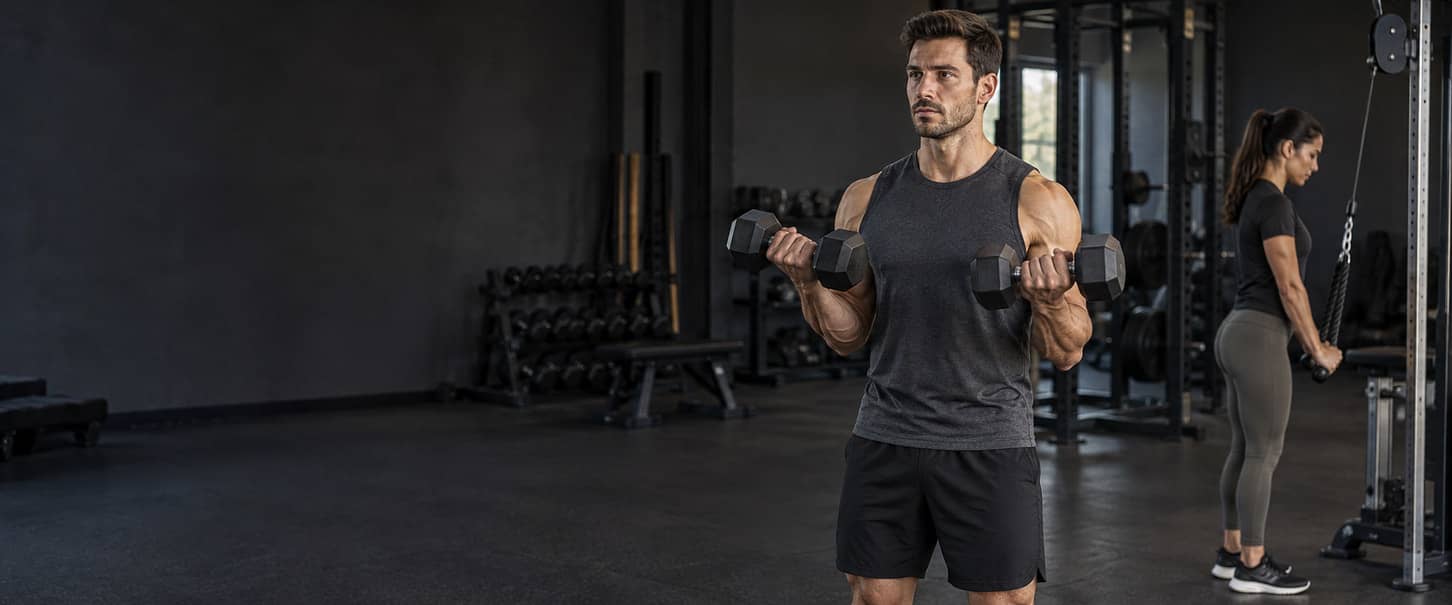
Choose Arm Exercises That Fit Your Workout
Choose one controllable elbow-flexion option and one elbow-extension exercise, or a deliberately selected pressing option, when those roles belong in your workout plan. A Standing Dumbbell Curl or Standing Cable Curl is a straightforward curl choice, and the Rope Triceps Pressdown is a straightforward direct-extension choice. Existing pressing and pulling already involve the arms, so direct work should answer an actual need rather than be added automatically. Choose a hammer curl, a supported incline curl or preacher curl, an overhead cable extension, a floor triceps extension, or a close-grip bench press or close-grip push-up only when its grip, support, arm position, equipment, and progression fit the role. This guide is a menu of thirteen implementations, not a thirteen-exercise workout or a complete arm day. Start with the comparison, then use the exact tutorial for the movement you select. One well-fitted curl and one well-fitted triceps option may be enough for allocated direct arm work; the complete workout plan still controls exercise order, total work, and recovery.
Compare Arm Exercises by Muscle, Equipment, and Arm Position
Compare the joint task first, then the forearm orientation, upper-arm or shoulder position, body support, load handling, and available progression. These differences determine whether an exercise fits the role already assigned by the workout plan. The first practical choice that matches the missing role and can be repeated under control may be retained. This matrix is a selection aid, not a hierarchy of muscle growth and not a thirteen-exercise workout.
| Exercise | Main use | Equipment and support | Useful when | Main check | Progression |
|---|---|---|---|---|---|
| Standing Dumbbell Curl | Elbow flexion with a supinated forearm; biceps and other elbow flexors. | Two manageable dumbbells; stable standing space. | Independent hand paths and simple home loading are useful. | Keep wrists aligned and avoid using hip drive to curl. | Build reps, then increase each dumbbell without changing the curl. |
| EZ-Bar Curl | Shared-bar elbow flexion with an angled forearm grip. | EZ bar, secured plates, and a controllable pickup and return. | A shared implement and its grip fit the task. | Use symmetric comfortable grips and a steady torso. | Increase the recorded total-bar load after repeatable reps. |
| Standing Cable Curl | Elbow flexion against a setup-dependent cable line. | One low pulley and a compatible two-handed bar. | Station increments or its line of pull are useful. | Keep the cable clear and prevent a backward lean. | Progress within the same station, attachment, and distance. |
| Incline Dumbbell Curl | Elbow flexion with supported reclined torso and arms behind it. | Two light dumbbells and a locked adjustable bench. | That shoulder position fits and is deliberately selected. | Avoid forced shoulder stretch or lifting from the pad. | Progress reps and each dumbbell at the same backrest setting. |
| Single-Arm Dumbbell Preacher Curl | Supported per-arm elbow flexion with the upper arm forward. | One dumbbell and a fitted fixed preacher pad. | Upper-arm support or separate arm tracking is useful. | Keep pad contact and control the near-extended endpoint. | Progress both sides at the same pad setting and range. |
| Dumbbell Hammer Curl | Neutral-grip elbow flexion; biceps, brachialis, and brachioradialis contribute. | Two manageable dumbbells and stable standing space. | A neutral forearm position fits better or serves a selected role. | Retain inward-facing palms without torso swing. | Progress this grip in its own per-dumbbell history. |
| Dumbbell Reverse Curl | Pronated-grip elbow flexion with additional grip and wrist-stability demands. | Two light dumbbells and stable standing space. | Pronated elbow-flexion work is deliberately wanted and tolerated. | Do not fold the wrists or lose the full grip. | Use small increases only after repeatable pronated-grip reps. |
| Dumbbell Static Grip Hold | Sustained hand grip with wrist and body-position control. | Two controllable dumbbells and a clear set-down area. | Grip endurance is an allocated need rather than extra fatigue. | End before slipping or loss of set-down control. | Progress recorded hold time or load without changing the standard. |
| Rope Triceps Pressdown | Elbow extension with the upper arms near the torso. | One high pulley and a compatible two-ended rope. | An arm-at-side extension fits shoulder access and load control. | Move mainly at the elbows without dropping the torso. | Add reps, then the station increment at unchanged settings. |
| Overhead Rope Cable Triceps Extension | Elbow extension with elevated upper arms and a distinct long-head length context. | One low pulley, compatible rope, clear overhead travel, and rehearsed handling. | Overhead positioning fits and supplies a useful alternative to arm-at-side work. | Keep the cable off the neck and avoid a growing back arch. | Progress within the same overhead setup and manageable entry/exit. |
| Lying Dumbbell Triceps Extension on the Floor | Elbow extension with floor support and raised upper arms. | Two light secure dumbbells, clear floor space, and manageable entry/exit. | No bench or cable is available and weight handling is secure. | Lower beside the head with unchanged upper-arm position. | Build controlled reps before small per-dumbbell increases. |
| Close-Grip Barbell Bench Press | Compound pressing with elbow extension plus chest and shoulder work. | Flat bench, compatible rack/safeties, bar, and competent spotting. | A triceps-involving press is already allocated and the setup fits. | Use a comfortable full grip and preserve the supported press. | Progress total-bar load within this specific press history. |
| Close-Grip Push-Up | Bodyweight compound pressing with triceps, chest, and shoulder contribution. | Nonslip floor or purpose-designed secure raised hand support. | A controllable bodyweight press fits limited equipment. | Preserve the body line and comfortable narrow hand position. | Build reps, then change the recorded lever or hand elevation. |
Choose one arm exercise in six steps
- Identify the missing role, such as elbow flexion, direct elbow extension, compound pressing, or allocated grip work.
- Review the pressing, pulling, and direct arm slots already present in the workout plan.
- Remove options whose equipment, support, entry, exit, grip, or arm position does not fit.
- Choose one manageable candidate that supplies the needed role without duplicating work automatically.
- Read its complete instructions and rehearse the setup, movement, and return with manageable resistance.
- Fit the selected exercise into the existing allocation rather than appending another arm block.
Keep the first matching choice when its setup, range, load handling, and progression remain repeatable. A different grip or arm position is useful only when it answers a real fit or training need. Replacing an exercise creates a new movement and load record where the setup materially changes. It does not create extra work unless the complete workout plan deliberately adds another allocation.
Biceps, Triceps, Brachialis, and Forearms: What Changes the Task
Choose arm exercises by the joint action and position they use, not by a promise to isolate one visible region. Elbow flexion, elbow extension, sustained grip, forearm rotation, wrist position, shoulder position, and the resistance profile are related but separate variables. Changing one variable can make an exercise fit better or create a different progression record without making the other choices ineffective.
Elbow flexors, forearm rotation, and grip
The biceps brachii contributes to elbow flexion and helps turn the forearm into a palms-up position, which is forearm supination. The brachialis and brachioradialis also flex the elbow, so a curl is not performed by the biceps alone. Supinated, neutral, and pronated describe forearm orientation. A hammer curl uses a neutral forearm position with the palms facing inward; it is not repeated wrist bending. Keep the wrist position controlled rather than folding it to manufacture range. Hand grip depends on muscles of the hand and forearm, but sustaining a dumbbell hold is different from repeatedly flexing or extending the wrist. Grip work, wrist movement, and elbow flexion should be selected and recorded as different tasks.
Triceps heads and upper-arm position
The triceps has long, lateral, and medial heads that contribute to elbow extension. The long head also crosses the shoulder, so changing the upper-arm position can change its length and the overall extension task. An overhead extension places the upper arms in an elevated position, but it does not isolate only the long head or switch the other heads off. A pressdown with the upper arms near the torso remains a useful option when its cable path, shoulder position, and entry and exit fit better. Shoulder angle, elbow action, forearm orientation, and wrist position should not be treated as one combined variable. A different resistance profile can also change where an exercise feels hardest without proving that one setup is universally superior.
What the current evidence supports
One twelve-week within-person cable-extension study found greater triceps growth in its overhead condition than in its neutral-arm condition. That result supports considering a fitting overhead option, but it does not make pressdowns useless or establish the same outcome for every rope, dumbbell, machine, or bilateral setup. Curl research has reported different regional thickness changes in some incline-versus-preacher comparisons, while other matched cable comparisons have found no clear regional advantage from changing shoulder position. The studies used different support, participants, resistance profiles, and measurement methods. The practical conclusion is to avoid a universal shoulder-position ranking. Maximal shoulder extension is not required for curl growth, and neither a curl nor an extension isolates one muscle head completely. Keep a productive exercise when its setup, range, resistance, and progression remain repeatable within the workout plan.
Standing Dumbbell, EZ-Bar, and Cable Curl Technique
Standing Dumbbell Curl
Use two manageable dumbbells for bilateral elbow flexion with the palms comfortably facing forward. Both arms curl together in this version. Supination describes forearm rotation toward a palms-up position; it does not mean bending the wrists backward.
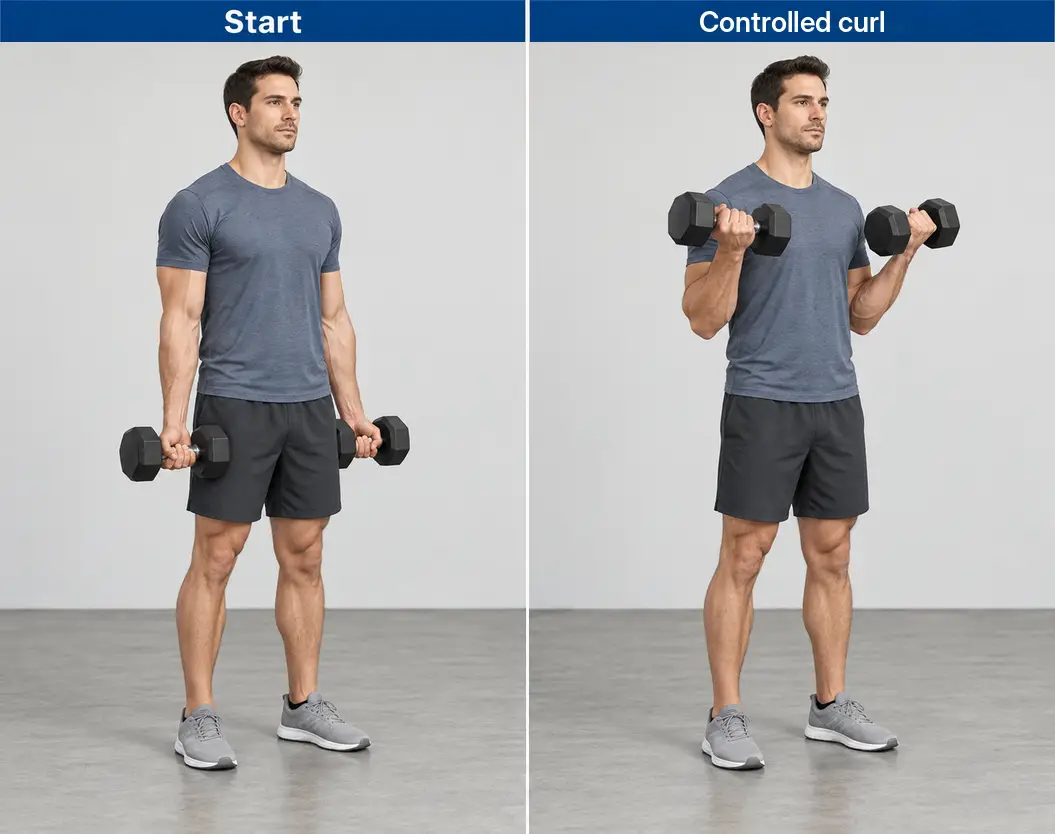
- Inspect both dumbbells and any selector or collar. Pick them up through a controlled route, then stand on a nonslip surface with clear space beside the body for the weights and their later set-down.
- Hold one dumbbell in each hand with a full grip, elbows comfortably extended, wrists aligned with the forearms, and palms facing forward to a tolerable degree. Use a stable stance with soft knees and the upper arms near the torso.
- Bend both elbows together, moving the forearms through the selected curl while keeping trunk movement and upper-arm travel small and repeatable. Do not drive the hips forward, lean back, or bend the wrists to raise the weights.
- Finish where elbow flexion remains controlled without pushing the elbows markedly forward or resting the weights on the shoulders. A higher dumbbell position is not automatically a better repetition.
- Lower smoothly to the same comfortable elbow-extension endpoint. Do not snap the elbows straight, force maximal forearm rotation, or change to a neutral grip halfway through a difficult set.
- End while both dumbbells can still be lowered and set down under control. One simultaneous curl and return is one repetition, not two.
Use lighter dumbbells or a shorter repeatable elbow range when the palms-forward version cannot be maintained. A rotating curl or seated curl is a named change in execution, not an invisible modification of this movement. Record the mass of each dumbbell and the unit, forearm orientation, stance or support, elbow range, and any deliberate upper-arm movement. Keep this palms-forward history separate from hammer curls and other grip choices.
EZ-Bar Curl
Use an EZ bar for bilateral elbow flexion with a fixed angled grip. Follow the bar's actual bends rather than forcing the hands into a fully palms-up position. The angled grip may fit some wrists better than a straight bar, but it does not guarantee comfort or isolate one biceps region.
- Inspect the bar, plates, collars, and pickup area. Select a manageable total load and use a supported pickup or a separately controlled floor pickup. Confirm a clear return route before starting.
- Take matching angled grip positions with the thumbs wrapped. Let the hands follow the bar angles without twisting the wrists, and stand stably with the bar clear of the thighs.
- Establish a repeatable torso and upper-arm position. Curl by bending the elbows while keeping the bar clear of the body instead of dragging it upward through repeated shoulder movement.
- Stop the ascent before backward lean, hip drive, or a large forward elbow swing replaces the selected elbow-flexion task. Keep the wrists supporting the bar rather than folding under it.
- Lower to the same controlled elbow-extension endpoint without bouncing the bar off the thighs or snapping the elbows straight.
- Return the bar to its planned support or set it down deliberately before releasing the hands. End the set before grip or return control fails.
Reduce the total load or choose independent dumbbells or a compatible cable attachment when the bar or grip does not fit. An EZ bar is an option, not a required step toward a straight bar, and neither an extremely narrow nor wide grip is a reliable isolation rule. Record total bar-plus-plate mass and the unit, the exact bar and grip positions, stance, working range, and pickup and return method. Do not infer the bar's mass or convert a dumbbell pair into its working load.
Standing Cable Curl
This bilateral cable curl faces one low pulley and uses a compatible two-handed bar with a comfortable palms-up or angled grip. It is a standing front-facing curl, not a behind-the-body curl or a two-stack crossover variation.
- With the stack resting, inspect the cable, pulley, selector, clip, and compatible attachment. Set the pulley low, choose light resistance for a rehearsal, and keep the cable route and return space clear.
- Grasp both sides of the attachment securely. Face the pulley and take a stable stance far enough away for the bar to clear the thighs and the cable to remain unobstructed through the intended range.
- Keep the wrists aligned with the forearms and the upper arms in a repeatable position near the torso. Take up the resistance without leaning backward or changing the station setting while it is loaded.
- Bend the elbows to curl the attachment while the torso stays steady. Keep the forearms and bar clear of the cable outlet, and do not turn the curl into a row or upward shrug.
- Return through controlled elbow extension without letting the stack jerk the hands downward. Use the same endpoint and keep the plates from crashing.
- Finish by returning the resistance fully to rest through the rehearsed route before releasing the attachment or changing the selector.
Reduce the station load or choose another compatible handle when the selected bar, grip, or range does not fit. A standing dumbbell or EZ-bar curl is an alternative with its own resistance profile and load record. Record the exact station, pulley height, attachment, body distance, displayed load and unit, grip, and elbow range. Cable displays are station-specific, and cable tension is not the same as constant elbow torque or muscle force; see why gym machine weights differ.
Incline Dumbbell Curls and Supported Preacher Curls
Incline Dumbbell Curl
An incline dumbbell curl uses a supported reclined torso while the upper arms hang beside the body. This places the arms farther behind the torso than an upright curl without requiring a forced shoulder stretch or one compulsory bench angle.
- Lock a rated adjustable bench at a comfortable recline and clear the space beside it. Rehearse the arm-hanging position without weight before selecting two light dumbbells. Use a less reclined setting when the shoulders cannot settle comfortably.
- Sit with the dumbbells controlled near the thighs, plant the feet, and recline with the back supported. Guide the weights beside the bench through a manageable route rather than dropping suddenly into shoulder extension.
- Use full grips and a comfortable supinated forearm position. Let the upper arms hang naturally without forcing the shoulders backward or pressing the elbows into the bench.
- Curl both weights by bending the elbows while keeping the selected upper-arm position broadly consistent. Do not lift the shoulders from the pad, thrust the chest upward, or swing the elbows forward to finish.
- Lower to the same comfortable elbow-extension endpoint while the shoulders and torso remain supported. Stop before the lower range pulls the shoulder into an intolerable stretch or changes the grip.
- End with weights light enough to guide back toward the thighs, return upright, and set down through the rehearsed route. Use competent assistance when a secure exit cannot otherwise be maintained.
Regress with lighter dumbbells, a more upright locked backrest, a shorter comfortable elbow range, or the taught standing curl. More shoulder extension is not automatically a better growth stimulus. Record the actual bench setting, support, mass per dumbbell and unit, forearm orientation, upper-arm position, elbow range, and controlled entry and exit.
Single-Arm Dumbbell Preacher Curl
Use one dumbbell with the back of the working upper arm supported on a purpose-built preacher pad. The supported arm stays forward of the torso, which differs from the arms-behind-torso position of the incline curl. The other hand can steady the fixed frame without helping the working repetitions.
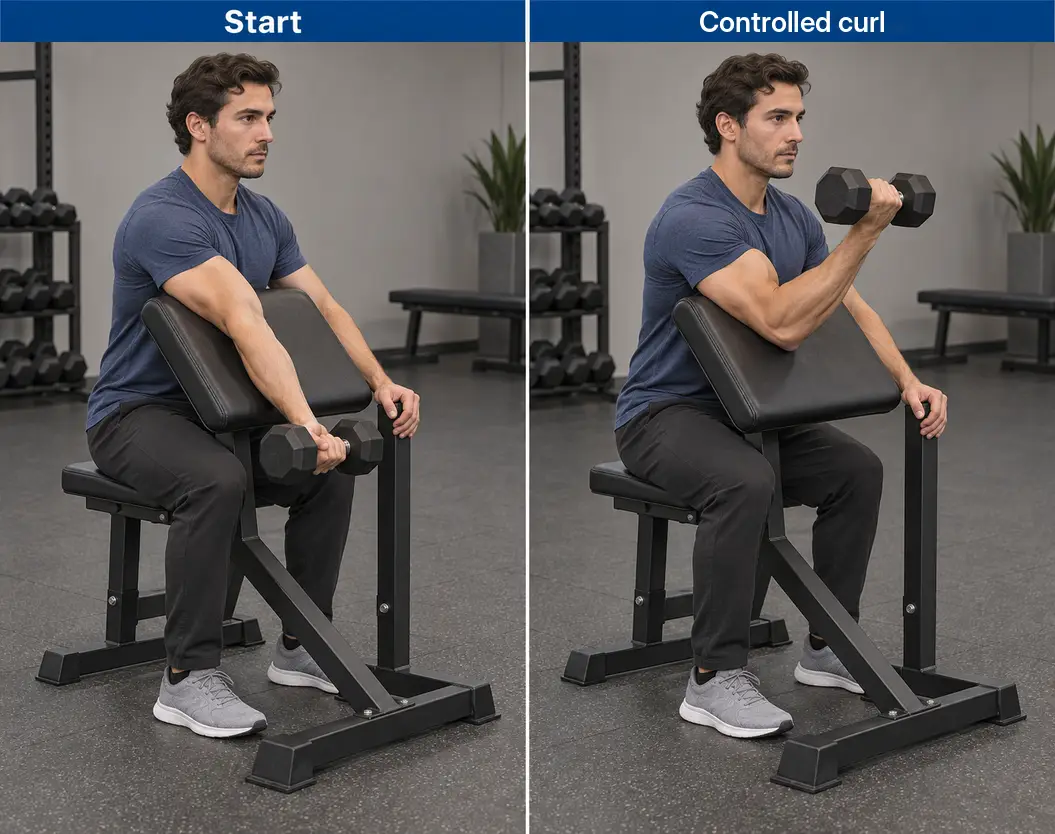
- Fit a stable rated preacher station so the working upper arm rests along the pad without forcing the armpit upward. Keep the elbow clear of a hard pad edge and confirm that the forearm can move without striking the frame.
- For right-arm work, use both hands to position a light dumbbell securely in the right hand while the upper arm is supported. Take a full comfortable supinated grip and keep the right wrist aligned with the forearm.
- Place the left hand lightly on the fixed station for balance, away from the moving weight. Choose a supported near-extended elbow start that remains controllable. Do not force hyperextension or let the dumbbell hang from passive tissues.
- Curl the dumbbell by bending the right elbow while the upper arm remains supported. Stop before shoulder rolling, upper-arm lift, or wrist flexion replaces the curl.
- Lower smoothly through the same supported range. Do not bounce against the pad, snap the elbow straight, or use the free hand to turn a failed repetition into counted work.
- After the set, use the free hand as needed to secure and remove the dumbbell, then set it down. Rest as prescribed and mirror the complete arrangement for the left arm. Entry and exit assistance is not a working repetition.
Regress by reducing the load or working range while retaining upper-arm support. Use a standing curl when the station cannot be fitted. A machine preacher curl uses its own pivot, handles, and resistance record rather than inheriting this dumbbell history. Record the working arm, the mass and unit of the one dumbbell, pad and seat settings, grip, elbow endpoint, and actual rest after each arm.
Count the Preacher Curl by Working Arm
This original standalone illustration uses 2 sets of 8–12 reps per arm, 60–90 seconds after EACH arm, a 2-1-1-1 tempo, and about 2–3 technically sound reps in reserve. It is separate from the bilateral examples and the Upper A source row, not a third arm block or an automatic conversion of that source prescription. At ten repetitions per set, two right-arm sets provide 20 right-arm repetitions and two left-arm sets provide 20 left-arm repetitions. That is four side-specific work bouts and 40 total arm repetitions, not four sets per arm. Complete one arm, settle the dumbbell, rest 60–90 seconds, switch the entire supported arrangement, perform the other arm, and rest again. Repeat until both arms have completed two sets. The same rest applies after the final arm before another exercise. The free hand can assist entry and exit but not the working repetitions.
Choose Support and Shoulder Position by Fit
Incline and preacher curls change shoulder position, support, and resistance conditions. Limited training evidence has reported different regional changes in some comparisons, while other matched comparisons have not shown a clear regional advantage from changing shoulder position. Use those findings to justify comparing suitable options, not to declare a biceps-head isolation winner. Maximal shoulder extension is not required for curl growth. Keep the version whose support, shoulder position, elbow range, handling, and progression remain repeatable in the workout plan.
Hammer Curls, Reverse Curls, and Grip Work
Dumbbell Hammer Curl
Use two dumbbells for bilateral elbow flexion with the palms facing inward throughout. This neutral forearm orientation differs from a palms-up curl. Keep the wrists aligned rather than bending them toward the thumbs or repeatedly flexing and extending them.
- Inspect and pick up a manageable pair, then stand with stable feet and clear space beside the thighs. Hold both dumbbells with full grips and the palms facing each other.
- Keep the wrists aligned with the forearms and the upper arms near the torso. Establish a comfortable lower endpoint without snapping the elbows into a locked position.
- Bend both elbows together and raise the dumbbells through a comfortable path while retaining the inward-facing palms. Do not rotate into a supinated curl, swing the weights across the torso, or use hip drive.
- Finish before the upper arms swing markedly forward or the torso leans back. The dumbbells do not need to touch the shoulders.
- Lower both weights slowly through the same range with the same neutral grip, then repeat or end the set and place the dumbbells down under control.
Reduce the load when the wrists, forearms, upper arms, or torso cannot retain the selected position. Alternating-arm and cross-body hammer curls are different named implementations, not hidden changes to these simultaneous repetitions. Record the load per dumbbell and unit, neutral forearm orientation, stance, elbow range, and simultaneous arm use. Brachialis, brachioradialis, and biceps can all contribute, so the movement is not pure brachialis or forearm isolation and does not have to follow every palms-up curl.
Dumbbell Reverse Curl
This bilateral reverse curl keeps the forearms pronated, with the palms facing backward at the bottom and generally downward as the forearms rise. Pronation changes forearm orientation. It is not wrist flexion, and it does not switch the biceps off.
- Choose two light dumbbells and use secure full grips. Stand stably with the arms beside the torso, the palms oriented backward, and the wrists supported in line with the forearms.
- Rehearse the available pronated position without forcing rotation. Use less resistance rather than compromising the wrists, and do not derive a reverse-curl load from a hammer-curl record.
- Bend both elbows together while keeping the palms in the selected pronated orientation and the upper arms broadly still. Prevent the wrists from folding into flexion to gain height.
- Stop before a shoulder shrug, backward lean, or change to a neutral grip is required. Lower both dumbbells to the same controlled endpoint without dropping them.
- End before grip security changes and place the weights down through the planned controlled route.
Use a lighter pair or a smaller comfortable range when pronation, wrist support, or elbow control cannot be maintained. A neutral-grip hammer curl may fit when the pronated version does not, but it is a separate exercise record rather than a treatment for wrist pain. Record the mass per dumbbell and unit, pronated forearm position, wrist control, elbow range, stance, and any support. Reverse curls involve several elbow flexors and gripping muscles; they do not isolate the wrist extensors or change muscle insertions.
Dumbbell Static Grip Hold
A static dumbbell hold trains the ability to keep a load in the hands rather than repeated elbow flexion or wrist movement. Use it only when grip work has an identified place in the workout plan, because scheduled rows, hinges, carries, and curls may already challenge the hands and forearms.
- Choose two manageable dumbbells and a clear nonslip standing area with a secure set-down route. Inspect their retention systems and use a controlled pickup.
- Stand with one dumbbell at each side, the arms comfortably long, the wrists aligned, and both hands using full grips. Keep the weights clear of the legs without shrugging or curling them.
- Hold the position for the duration assigned by the workout plan while breathing normally. Keep the fingers closed and avoid bending the wrists or leaning to one side.
- End before a handle begins to slip, the fingers start opening, or a controlled set-down becomes doubtful. Do not use a dropped weight to mark the end of the hold.
- Set both dumbbells down deliberately, then record the actual controlled duration and rest. One simultaneous two-hand hold is one work bout.
Use lighter dumbbells or a shorter planned duration when grip or set-down control cannot be maintained. Do not continue by hanging the handles from the fingertips or adding lifting straps to an exercise whose selected purpose is unsupported hand grip. Record the load per hand and unit, handle characteristics, actual hold duration, support and grip standard, rest, and the reason the hold ended. Use duration and observable control rather than invented repetitions or rep-based reps in reserve. Grip work is optional and this static hold does not train every wrist, finger, or forearm action. Hammer curls, reverse curls, and static holds are distinct choices, not a mandatory three-exercise sequence or proof that any one forearm muscle has been isolated.
Rope Pressdowns and Overhead Cable Triceps Extensions
Rope Triceps Pressdown
This bilateral pressdown faces one high pulley. Both hands hold a compatible rope while the upper arms remain near the sides and the elbows extend. The attachment travels downward in front of the body rather than behind the head or forward from an overhead position.
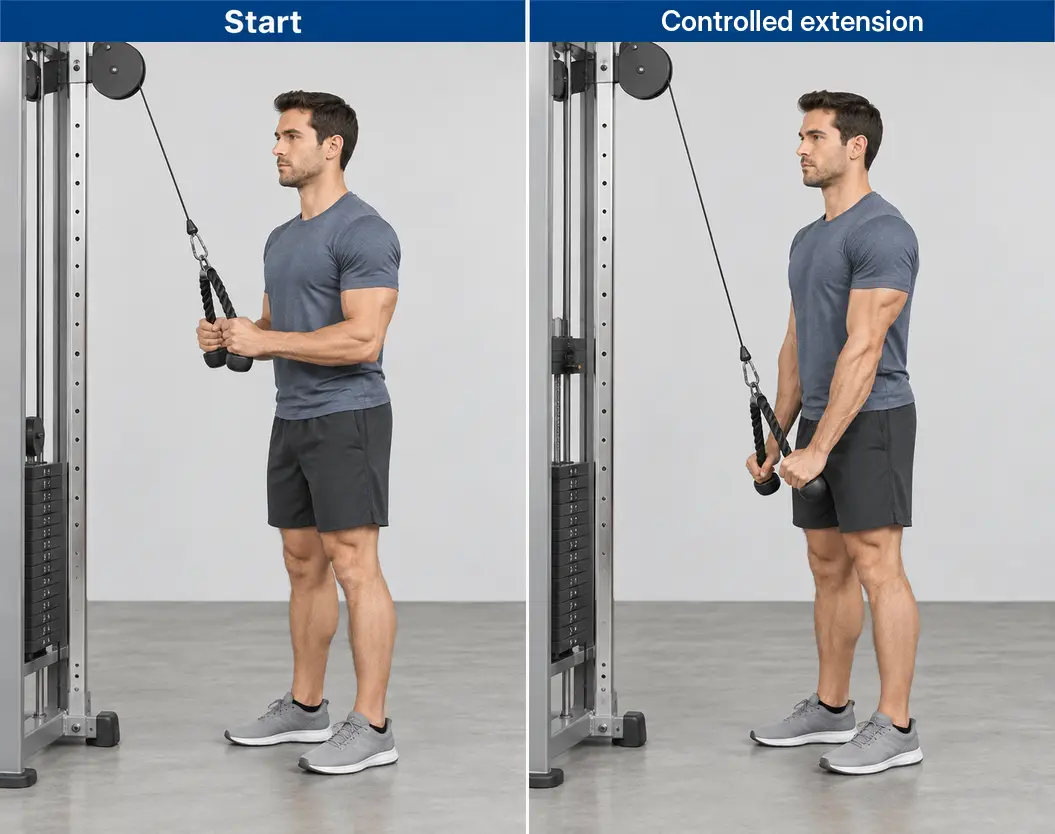
- With the stack at rest, inspect the cable, clip, selector, and rope. Set the outlet high enough for a clear downward pull, choose manageable resistance, and stand facing the pulley with space for the rope and a controlled return.
- Take one rope end in each hand with full secure grips. Set stable feet and use a comfortable slight forward inclination only when needed. Establish the upper arms near the torso and the elbows bent without allowing the stack to pull the shoulders upward.
- Keep the wrists aligned and the shoulders in a natural controllable position. Extend both elbows to bring the hands toward the thighs while the upper arms remain broadly in place. Do not drop the body or turn the exercise into a shoulder-driven pulldown.
- Finish at comfortable active elbow extension. Let the rope ends separate only as much as the natural hand path requires. Do not force an exaggerated outward wrist turn or drive the upper arms behind the torso.
- Allow the elbows to bend during the return while resisting the cable pull. Retain the same stance, upper-arm position, and usable range without letting the stack crash or lifting the elbows to gain another repetition.
- Return the resistance fully to rest through the planned route before releasing the rope or changing the selector. End the set while that return remains controlled.
Reduce the load or use a compatible straight or angled handle when that attachment fits better. Record the change rather than treating every handle as the same exercise. An overhead extension is another shoulder-position choice, not a required addition after pressdowns. Record the exact station, high pulley setting, rope or handle, displayed load and unit, stance, upper-arm position, elbow range, and controlled return. All three triceps heads can contribute, and separating the rope ends is not an isolation switch.
Overhead Rope Cable Triceps Extension
This bilateral version faces away from one low pulley, with the upper arms raised in a comfortable overhead position and the rope behind the head at the bent-elbow start. The cable must travel clear behind the body. Learn a manageable entry, handoff when needed, and controlled return before selecting working resistance.
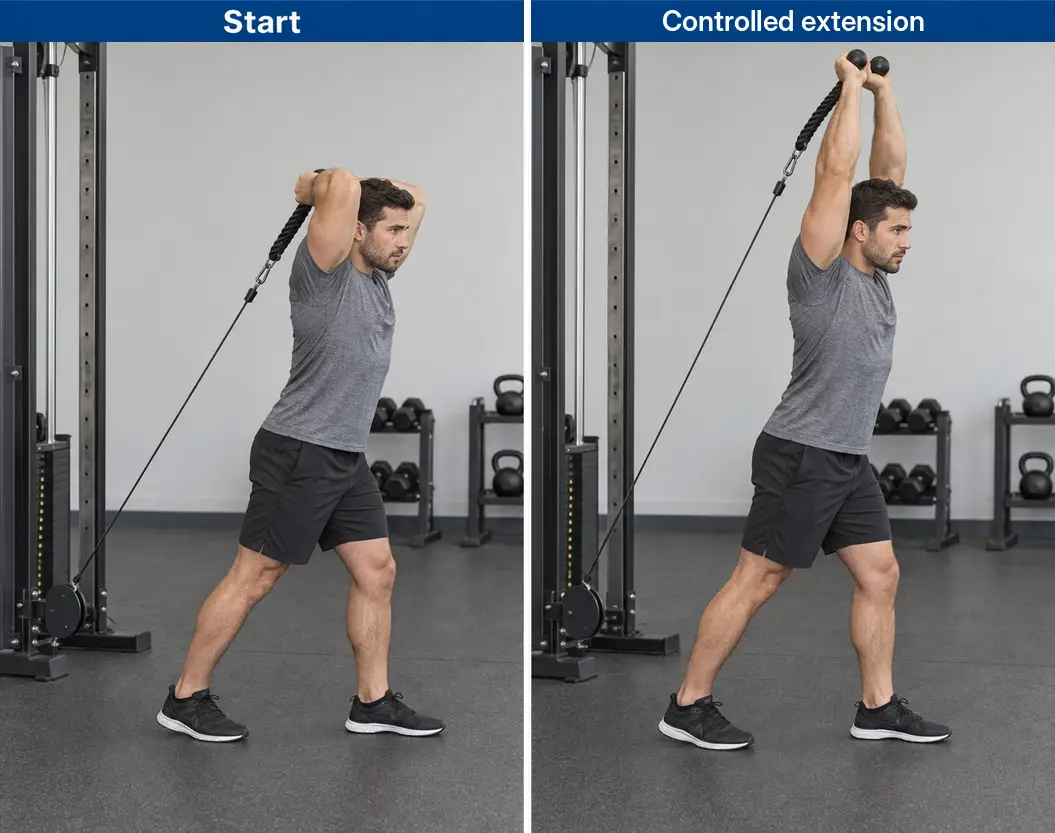
- Inspect the low cable station and a compatible rope that is long enough for the intended path while the stack rests. Clear the route behind and above the body. Rehearse a light station-specific entry and exit, including how the rope reaches and leaves the overhead position. Use a demonstrated handoff when needed instead of making a heavy blind turn under tension.
- Face away from the pulley in a stable staggered stance and use only the modest forward inclination needed for clearance. Hold one rope end in each hand with the upper arms raised comfortably and the elbows bent so the hands are behind the crown. Keep the cable and rope from rubbing across the neck, head, back, or elbows.
- Keep the wrists aligned, the ribs and pelvis controlled, and the shoulders in a sustainable position. Do not force the upper arms against the ears or create a greater overhead reach by flaring the ribs and increasing the lower-back arch.
- Extend the elbows to move the hands upward along a clear arc while retaining the selected upper-arm position. Allow natural shoulder-blade positioning rather than pinning the shoulder blades down, and do not use a forward body lunge to move the rope.
- Bend the elbows to return behind the head only as far as cable clearance, grip, shoulder position, and control remain intact. Do not force the deepest stretch or let the stack pull the arms abruptly backward.
- Finish before handling control fails. Use the rehearsed route or a competent handoff to return the resistance fully to rest and lower the rope before releasing it or turning toward the station. Choose a pressdown or the taught floor extension when overhead access, entry, or exit cannot be controlled.
Use lighter resistance, a shorter comfortable elbow range, or an arm-at-side extension when the overhead position does not fit. More shoulder elevation is not compulsory, and the setup should not be forced through symptoms. Record the station, low outlet, rope length, displayed resistance and unit, stance, body distance, upper-arm position, elbow range, and handling route. A changed pulley position, attachment, or entry method creates a different comparison. A within-person training study found greater triceps growth in its tested overhead cable condition than in its arm-at-side condition. That supports considering a fitting overhead option, not declaring it universally superior, isolating only the long head, or assuming every rope, dumbbell, machine, unilateral, and bilateral setup is equivalent. Pressdowns and overhead extensions are selectable alternatives. Use the one that fits the assigned role, equipment, shoulder position, and handling in the workout plan rather than automatically performing both.
Lying Dumbbell Triceps Extensions Without a Bench
Lying Dumbbell Triceps Extension on the Floor
Use two light dumbbells for bilateral elbow extension while the head, upper back, and pelvis remain supported on the floor. Both hands keep neutral full grips, and each weight lowers through clear space beside the head rather than over the face. The floor simplifies the support surface, but secure load retention and a planned entry and exit still determine whether the exercise fits.
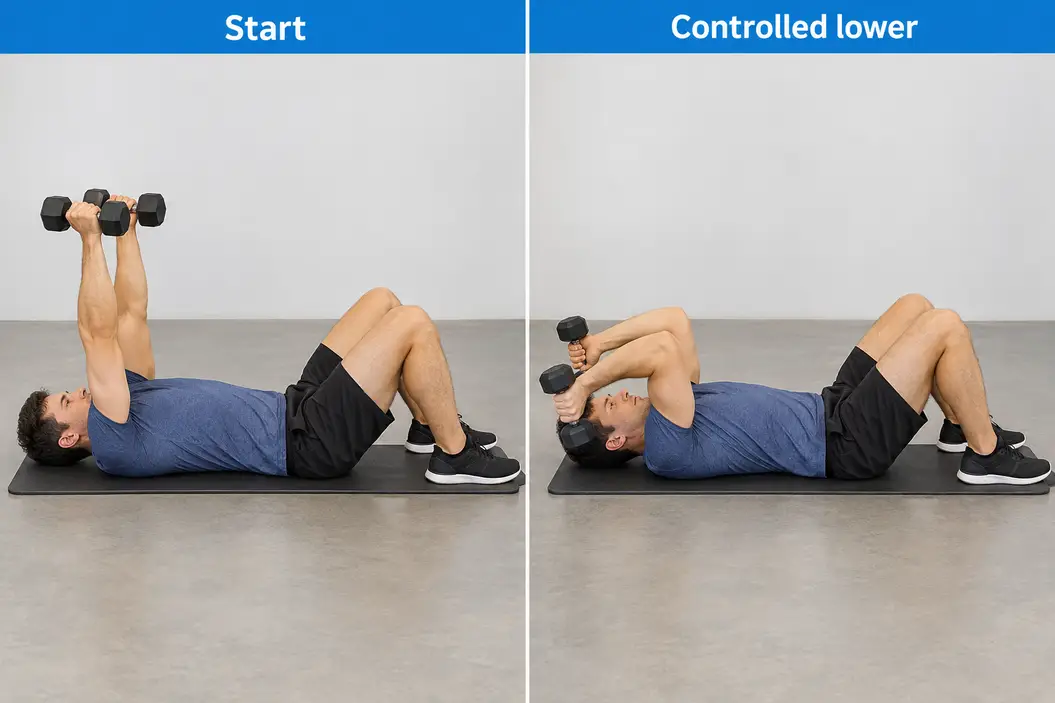
- Inspect both dumbbells and confirm that each selector, collar, or other retention mechanism is secure and suitable for the intended orientation. Clear the space beside the head and shoulders, then rehearse the path with very light weights.
- Sit with the dumbbells controlled near the thighs. Use a deliberate two-weight entry, or competent assistance, to lie back without twisting or dropping either weight. Set both dumbbells under control above the shoulder region with the knees bent, feet planted, and head, upper back, and pelvis supported.
- Use inward-facing palms, full grips, and wrists aligned with the forearms. Choose a comfortable upper-arm angle that gives both dumbbells room to travel beside the head without pointing them toward the face or forcing the shoulders backward.
- Bend both elbows under control while the upper arms remain broadly stable in their selected position. Keep each dumbbell clear of the head, floor, and opposite weight, and reverse before contact or an elbow range that cannot be controlled.
- Extend both elbows to return the dumbbells to the same controlled top position. Keep the shoulders supported and do not turn the repetition into a floor press, pullover, or movement driven by rolling the upper arms forward.
- End well before grip or handling failure. Bring both dumbbells into a controlled position beside the torso through the rehearsed exit, settle both weights securely, and only then sit up or leave the floor position. Use assistance when needed; do not drop the weights beside the head or twist beneath suspended loads.
Regress by reducing the load or using a shorter comfortable elbow range while preserving head and floor clearance. A close-grip push-up is a separate compound alternative when this two-dumbbell handling does not fit. Do not force failure or improvise a bench version merely to extend the set. Record the mass and unit of each dumbbell, neutral grip, upper-arm position, elbow range, head and floor clearance, and entry and exit method. The two weights are recorded per hand rather than as one unlabeled combined load. This implementation uses two independently controlled dumbbells. It is not a single shared-dumbbell extension, floor press, pullover, or bench-supported version, and none should inherit this exercise's performance history automatically. Use it only when this direct-extension role belongs in the workout plan.
Close-Grip Bench Presses and Push-Ups
Close-Grip Barbell Bench Press
A close-grip bench press is a compound press involving the triceps, chest, and shoulders. Use a comfortable grip that is narrower than your usual bench grip when that position fits, not hands forced together. It is not a pure elbow-extension exercise or a compulsory arm-building lift.
- Set a stable flat bench inside a compatible rack with secure hooks and appropriately tested safety supports. Arrange a competent spotter and agree on lift-off and rerack signals. Rehearse with a manageable bar, and do not remove protection to force an arbitrary chest depth.
- Lie with the head, upper back, and pelvis supported and the feet securely planted. Take a symmetric full overhand grip that lets the wrists support the bar and the elbows travel through a controllable path. Choose the spacing by fit rather than a thumb-to-thumb rule or hands-touching target.
- Unrack under control, using the agreed assistance when needed, and move the bar clear of both hooks before lowering. Settle it over a balanced upper-body position while retaining the chosen torso and foot support.
- Lower toward a repeatable chest-region endpoint that fits the grip, build, and available safety position. Keep the forearms supporting the bar. Do not force the elbows against the ribs, flare them unpredictably, bounce from the chest, or direct the bar toward the neck.
- Press to controlled elbow extension without lifting the pelvis, changing the grip, or altering the torso position to manufacture the finish. Keep the bar balanced over the supported upper body.
- End while an orderly return remains available. Guide the bar into both hooks, confirm that both sides are fully supported, and only then release the hands. Safeties and spotting are backups, not instructions to rehearse failed solo repetitions.
Regress by reducing the total load or using a manageable training bar. Select the taught close-grip push-up when a rack, suitable bar, safeties, or competent assistance is unavailable. A floor press or machine press changes the support and movement path and needs its own technique and load record. Record total bar-plus-plate mass and unit, exact grip spacing, bench and rack position, safety settings, lower endpoint, and spotting or handling convention. A standard-grip bench record does not create a load conversion for this narrower-grip press.
Close-Grip Push-Up
This bodyweight compound press uses a comfortable narrower hand spacing, not a compulsory diamond or hands-touching position. The triceps, chest, shoulders, and trunk all contribute. Hand spacing, body support, lever length, and range define the version being performed.
- Choose a nonslip floor and place the hands at a comfortable narrower-than-usual spacing that permits stable palms and wrists. Rehearse from the knees or against a purpose-designed securely fixed raised support when the toes-supported version is too demanding.
- Establish the selected toe-supported, knees-down, or raised-hand body line. Spread the fingers comfortably, keep the trunk controlled, and leave the head and neck unloaded. Do not balance the hands on round dumbbells or movable furniture.
- Bend the elbows and lower the body as a coordinated unit through a usable repeatable range. Let the elbows follow a comfortable path rather than clamping them against the ribs, and do not let the hips sag or drop to gain depth.
- Press through the hands to return while allowing normal controlled shoulder-blade movement. Finish without forcing a shrug, lifting the hips ahead of the torso, or changing the hand spacing during the repetition.
- Continue only while the same support, body line, hand position, and range remain controllable. Exit by bringing the knees to the floor or stepping safely toward the fixed raised support before releasing the hands.
Regress with the recorded knees-down version, a purpose-designed secure raised-hand support, or a shorter controlled range. Moving the hands into an extreme diamond is not the default progression, and a loose dumbbell should not be placed on the back. Record hand spacing, toe, knee, or raised-hand support, support height when used, body lever, range, and completed repetitions. Do not assign a barbell-equivalent load or treat a geometry change as unchanged progress. These two presses are alternatives when a compound triceps-involving press belongs in the workout plan. They do not automatically follow the direct-extension work taught earlier. Use the chest exercise selection guide when the wider pressing role, rather than arm-specific selection, is the main question.
Arm Exercises at Home and With Limited Equipment
Choose arm work from the resistance, support, and handling you can actually reproduce. Being at home does not make an improvised setup secure, and owning a dumbbell does not mean every dumbbell exercise can be performed with that exact number or shape of weights.
| Available setup | Practical choice | Important limit |
|---|---|---|
| Nonslip floor; no external resistance | The taught close-grip push-up or its recorded regression. | This is a compound press, not a complete loaded elbow-flexion or forearm solution. |
| One suitable dumbbell | The taught curl or hammer-curl pattern one arm at a time, with explicit per-side work. | The bilateral blocks do not silently become per-side prescriptions; overhead handling is not assumed. |
| Two suitable dumbbells; no bench | Standing curl, hammer or reverse curl; floor triceps extension when handling fits. | One pair may not suit all movements; floor-extension head clearance and secure retention still matter. |
| Dumbbells and fitted rated supports | Incline curls or preacher curls when the actual support fits. | An adjustable bench does not automatically become a preacher station. |
| Fitted cable station | The taught low-pulley curl, high-pulley pressdown, or low-pulley overhead extension. | Attachments, travel, starting resistance, and entry/exit must fit the exact station. |
With one suitable dumbbell, adapt the taught curl or hammer-curl pattern only when the workout plan states the work per arm. One working hand controls the dumbbell while the nonworking hand stays relaxed or makes light contact with a suitable fixed support. Complete one arm, settle the dumbbell, take the stated rest, switch the entire setup, and complete the other arm. Do not silently halve a bilateral repetition target, double its sets, or assume that changing sides supplies enough recovery. The floor triceps extension taught here uses two dumbbells; a single-weight floor or overhead extension is a different setup. Those arrangements change load placement, retention, entry, and exit and require their own complete handling instructions. Do not stack loose weights, trap a dumbbell in an unsupported position, or improvise a different tutorial from the equipment name alone. With no external resistance, the taught close-grip push-up can supply a compound pressing task. It does not recreate loaded curls, repeated wrist work, static grip loading, or every forearm action. Do not build anchors from doors, towels, table edges, sofas, loose weights, or unstable furniture. A compatible intact resistance band may be useful with its own secure setup and instructions, but the options taught here do not require one. Fixed dumbbells can create a loading ceiling. More repetitions, a controlled range, or a deliberate pause can extend useful work, but extra tempo does not create unlimited resistance. Change the exercise or equipment when the available load no longer fits the assigned role instead of manufacturing instability. The 5-Day Dumbbell Workout Plan provides an existing complete five-session schedule for readers who want a dumbbell-based week. Follow its complete schedule and prescriptions rather than adding it on top of your current arm work.
Count Direct Arm Sets and Pressing or Pulling Overlap
Count the working sets assigned to each exercise first, then note which arm muscles assist. In one Upper A occurrence, the selected ledger contains five pressing exercise sets with triceps involvement, six pulling exercise sets with elbow-flexor involvement, two direct triceps sets, and two direct elbow-flexor sets. Warm-up, rehearsal, and ramp-up sets remain outside this working-set ledger unless the workout plan explicitly counts them. The two lateral-raise sets and the rest of the Upper A session are also outside this selected extract.
| Work in one Upper A occurrence | Exercise sets | Arm relationship |
|---|---|---|
| Bench-press choice plus overhead-press choice | 3 + 2 = 5 | Pressing sets involving the triceps; not five additional isolated triceps sets. |
| Chest-supported row plus pull-up/pulldown choice | 3 + 3 = 6 | Pulling sets involving elbow flexors; not six additional isolated biceps sets. |
| Cable Triceps Extension | 2 | Direct elbow-extension exercise sets. |
| EZ-Bar or Cable Curl | 2 | Direct elbow-flexion exercise sets; choose one source option. |
Keep exercise-set bookkeeping separate from muscle involvement
Adding 5 + 6 + 2 + 2 gives 15 exercise-set entries in this selected ledger, not 15 equal arm-growth sets. Pressing involves the triceps, and pulling involves elbow flexors, but those compound sets are not interchangeable with direct extensions or curls. Do not convert every compound set into a fixed one-half arm set or another universal fraction. The guide to counting workout sets explains the wider bookkeeping choices and their assumptions. This ledger also does not prove that every trainee needs both direct rows. Existing pressing, pulling, exercise selection, effort, and recovery can change how much direct arm work belongs in the complete workout plan.
State how both sides are counted
A simultaneous bilateral curl, pressdown, press, or row counts as one exercise set when both arms perform the prescribed set together. Do not double that set merely because two arms moved. Alternating repetitions can also remain one bilateral set when the prescription defines one set as completing the required repetitions for both sides inside that set. Record the alternating convention so the total is not later mistaken for separate sets per arm. One-side-at-a-time work needs an explicit side rule. A prescription of two sets per arm gives each arm two sets and usually creates four side-specific work bouts when the arms are completed separately. A prescription of two total sets that alternate sides means something different. State whether the number applies per arm, per alternating set, or across both sides before comparing records. The table describes one Upper A occurrence only. Its frequency, repetition across the week, other sessions, and recovery belong to the actual complete plan, so do not multiply this extract into an invented weekly total. The exact curl and extension prescriptions appear in the workout-plan example below.
Two Focused Arm-Training Blocks and How to Progress
These are two alternative original examples for direct arm work already allocated by a complete workout plan. Each block contains four bilateral working sets. Choose Block A or Block B when it fits the available equipment and assigned role; do not combine them into eight sets, treat either as a complete session, or append one automatically to Upper A.
Block A: Cable curl and pressdown
| Exercise | Sets & Reps | Rest | Tempo | Target Muscles | Notes |
|---|---|---|---|---|---|
| Standing Cable Curl | 2 sets of 10–15 reps | 60–90 seconds | 2-1-1-1 | Biceps, brachialis; forearm muscles assist | Use one low pulley and a two-handed bar; keep the upper arms controlled. |
| Rope Triceps Pressdown | 2 sets of 10–15 reps | 60–90 seconds | 2-1-1-1 | Triceps; grip and trunk assist | Face one high pulley and extend the elbows without dropping the torso. |
Block B: Dumbbells without a bench
| Exercise | Sets & Reps | Rest | Tempo | Target Muscles | Notes |
|---|---|---|---|---|---|
| Standing Dumbbell Curl | 2 sets of 8–12 reps | 60–90 seconds | 2-0-1-1 | Biceps, brachialis; forearm muscles assist | Curl both weights together with comfortable palms-forward grips; record mass per hand. |
| Lying Dumbbell Triceps Extension on the Floor | 2 sets of 10–15 reps | 90–120 seconds | 2-1-1-0 | Triceps; shoulder and grip muscles assist | Use two light secure dumbbells; preserve head clearance and a controlled exit. |
Apply effort, rest, and tempo to the selected block
Begin with a light movement rehearsal and non-fatiguing ramp-up sets as needed; these are separate from the working-set totals. Use fewer working sets or lighter resistance while learning the setup and handling. Select a load that permits the lower repetition target with approximately 2–3 technically acceptable reps in reserve, supported wrists, a consistent range, and a controllable finish. Grip, equipment, or handling failure ends the set even when the target muscle could continue. Perform straight sets in the table order. Take the listed rest after every working set, including the final set before a following exercise: 60–90 seconds for both Block A rows and Block B's curl, and 90–120 seconds for Block B's floor extension. Take more recovery when needed and record the actual interval. Neither block contains a hidden superset or a required failure test. Both arms work together in every row. One complete elbow action and controlled return is one repetition, not two because two arms or two dumbbells are involved. Keep each load convention separate: cable displays are station-specific, and dumbbell loads are recorded per hand. Tempo is eccentric-pause-concentric-pause. For Block A's 2-1-1-1 curl, lower through elbow extension for two seconds, pause for one second at the lower endpoint, curl for one second, and hold the controlled upper endpoint for one second. For the pressdown, return upward through elbow flexion for two seconds, pause at the bent-elbow start for one second, extend downward for one second, and hold comfortable elbow extension for one second. Block B's 2-0-1-1 curl has a controlled two-second lowering phase, no deliberately prolonged lower pause, a one-second curl, and a one-second controlled finish. Its 2-1-1-0 floor extension lowers beside the head through elbow flexion for two seconds, pauses for one second within safe clearance, extends the elbows for one second, and has no deliberately prolonged top pause. Zero does not mean bounce, rush the setup, or omit normal breathing, and the first repetition may begin with the concentric action despite eccentric-first notation.
Progress Block A's two-set Rope Triceps Pressdown
The following constructed example applies only to the Rope Triceps Pressdown from Block A, 2 sets of 10–15 reps. Exposures A through C use the same station load, rope, stance, upper-arm position, elbow range, typical rest, and intended effort. Exposure D is one possible result after a suitable station increase, not customer data, a calendar promise, or a measured strength gain.
| Exposure | Set 1 | Set 2 | Decision |
|---|---|---|---|
| A | 12 | 11 | Keep the load and build repetitions at the same range and effort. |
| B | 15 | 14 | Keep the load; the second set has not reached 15. |
| C | 15 | 15 | Consider a small increase only when setup, range, rest, and intended effort also qualify. |
| D | 11 | 10 | One possible result after a suitable station increase, not a promised outcome. |
Add technically acceptable repetitions within the selected range. When both sets reach 15 with the same setup, range, rest, and intended effort, consider the smallest practical station increase. One qualifying exposure is the original teaching rule for this example; another complete workout plan may use its own progression criterion. When the available increase prevents the lower target or controlled return, use a smaller available step or retain the manageable load. Do not preserve the larger number by heaving, shortening the range, removing rest, or adding forced replacement repetitions. Record the work actually completed. Keep one concise shared record: exercise and implement, correct load unit or convention, meaningful support and grip settings, range, completed repetitions, actual rest, estimated effort, and the factor that ended the set. An ordinary load increase under the same setup remains in the same exercise history. A changed attachment, shoulder position, support arrangement, or limb-use convention requires a labeled comparison.
Fit Arm Exercises Into Your Existing Workout Plan
The Upper Lower Workout Plan supplies the source application. The table below quotes only rows 6 and 7 from one occurrence of Day 1: Upper A: Strength-Biased Upper Body, after the two presses, two pulls, and lateral-raise choice. It is not the whole session or a new arm block.
| Exercise | Sets & Reps | Rest | Tempo | Target Muscles | Notes |
|---|---|---|---|---|---|
| Cable Triceps Extension | 2 sets of 8–12 reps | 60–120 sec | 2-1-1-1 | Triceps | Choose a pressdown or overhead angle according to elbow and shoulder comfort. |
| EZ-Bar or Cable Curl | 2 sets of 8–12 reps | 60–120 sec | 2-1-1-1 | Biceps, Brachialis | Keep the shoulder position stable and complete the chosen range consistently. |
The source names a generic Cable Triceps Extension and permits a pressdown or overhead angle through its note. It does not prescribe a rope attachment, require both angles, or replace the generic row with one pictured implementation. The curl row similarly means EZ-Bar or Cable Curl as one choice, not two allocations and not a dumbbell or preacher-curl prescription. Both selected exercises retain 2 sets of 8–12 reps, 60–120 sec rest, and 2-1-1-1. Follow the source's own warm-up and planned-effort guidance. Keep setup, range, tempo, and rest comparable, add repetitions across comparable sessions, and consider the smallest practical load increase only after both working sets for the selected exercise reach 12. The qualifying result is 12/12, not the separate Block A pressdown example's 15/15. These are the final two rows from one Upper A occurrence. Keep the preceding Upper A rows, every Upper B and lower-body allocation, the source schedule, frequency, recovery guidance, and its wider progression rules intact within the complete workout plan.
Replace one option without adding another allocation
| Choice in Upper A | Direct triceps exercise sets | Selected direct arm sets including the unchanged curl |
|---|---|---|
| Pressdown selected for Cable Triceps Extension | 2 | 2 extension + 2 curl = 4 |
| Overhead cable extension selected instead | 2 | 2 extension + 2 curl = 4 |
| Both triceps versions performed for the full allocation | 2 + 2 = 4 | 4 extension + 2 curl = 6; two sets have been added |
Selecting the overhead cable angle instead of a pressdown preserves two extension sets and the unchanged two curl sets, for four selected direct arm exercise sets. Performing both triceps versions for the full prescription creates four extension sets plus two curl sets, or six selected direct arm sets, so two sets have been added. Choosing the EZ-Bar Curl instead of the Cable Curl, or the cable option instead of the EZ bar, is also a replacement. Performing both creates another allocation rather than preserving the source row. Rehearse the actual attachment, bar, station, and handling, then select a manageable load for that implementation. Do not convert a pressdown stack to an overhead stack, a cable display to an EZ-bar load, or one machine's number to another. Preserve the source sets, repetition range, rest, tempo, and progression instead of importing the original four-set blocks or silently adapting this bilateral source to unilateral work.
Common Arm-Training Mistakes and Elbow-Comfort Checks
Use the selected exercise standard as the reference. Small natural movement is not automatically cheating, but a material change in grip, wrist position, support, upper-arm path, range, or load handling means the repetition is no longer directly comparable.
| Observed problem | Practical correction |
|---|---|
| Hip drive or backward lean replaces the curl | Reduce the load or range and repeat the chosen elbow-flexion task. |
| The wrists bend to raise the weight | Keep the wrist supported in line with the forearm; choose a tolerable grip and load. |
| The shoulder or upper arm changes markedly as fatigue rises | Re-establish the selected arm position rather than claiming the altered repetition is unchanged progress. |
| A cable extension becomes a bodyweight drop or shoulder pulldown | Use manageable resistance and move mainly through the intended elbow action. |
| Head clearance or load retention becomes doubtful | Settle the load; reduce demand or choose a setup with a controllable entry and exit. |
| Every grip or attachment receives another full allocation | Keep useful alternatives as alternatives unless the full plan genuinely needs more work. |
| Pressing and pulling sets are counted again as identical isolation sets | Record compound involvement separately from direct arm exercise sets. |
| Repeated performance loss is met with more arm work | Check setup, rest, earlier fatigue, recovery, and symptoms before adding volume. |
Review fit before replacing productive work
When the elbows, wrists, or shoulders repeatedly limit an exercise, review the grip, upper-arm position, support, range, resistance, entry and exit, and fatigue from earlier pressing, pulling, or direct arm work. Choose the version that lets you repeat the intended task without forcing a joint position. Sensation or next-day soreness does not diagnose tendinopathy, prove that a muscle is inactive, or establish that an exercise is superior. Retain a productive exercise long enough to compare performance under similar conditions. Change it when the equipment, fit, handling, progression, or allocated role remains unsuitable, not merely because another attachment or grip exists. A normal resistance increase with the same setup remains progression; a materially different grip, support, arm position, or range starts a labeled comparison. When repetitions repeatedly fall across comparable sessions, check the actual rest taken, preceding presses and pulls, direct arm work, load, range, setup, sleep and nutrition availability, and other recovery demands. The guide to why reps drop between sets provides the broader fatigue checks. Restore recovery or reduce unproductive additions before adding another arm variation. One difficult session is not proof that the exercise stopped working, and the complete workout plan controls frequency.
Stop when handling or concerning symptoms change
Stop and settle the resistance when support, grip, head clearance, retention hardware, cable travel, or control fails. Sharp, worsening, or radiating pain, numbness, or unexpected weakness warrants appropriate assessment rather than forced repetitions, an intensity technique, or repeated exercise changes used as a diagnostic test.
Arm Exercise and Workout FAQs
What are the best arm exercises for muscle growth?
Choose controllable elbow-flexion and elbow-extension exercises, or a deliberately allocated compound press, that fit your equipment and the rest of the workout plan. A standing dumbbell or cable curl and a rope pressdown are straightforward starting choices. Hammer, supported, overhead, floor, and close-grip options are useful when their grip, support, arm position, and loading fit better. The best choice is one you can repeat and progress, not every grip or all thirteen exercises.
How many arm exercises, sets, and sessions per week do I need?
Use the complete plan and count the pressing, pulling, and direct arm work already assigned. The two original four-set arm blocks in this guide are alternatives for existing allocations, not eight combined sets or a universal weekly dose. The Upper A source example separately contains two direct triceps sets and two direct elbow-flexor sets in one occurrence. Frequency, recovery, and whether more direct work is useful belong to complete workout plans, not a fixed rule for every trainee.
Do rows, pull-ups, and presses replace direct arm training?
Rows and pull-ups involve elbow flexors, while presses involve the triceps, but those compound sets are not automatically identical to curls or extensions. Direct arm work can be retained when it serves a clear role, fits recovery, and progresses without unnecessary duplication. It can also be reduced when the existing compounds and current goals already provide enough arm work.
Are overhead extensions better than pressdowns?
Neither is universally better. The triceps long head crosses the shoulder, and one tested overhead cable condition produced greater triceps growth than its tested arm-at-side comparison. That supports considering a fitting overhead option, not claiming complete long-head isolation, making pressdowns ineffective, or extending the result to every rope, dumbbell, machine, and bilateral setup. Choose the shoulder position and handling you can reproduce.
Should I use incline curls or preacher curls?
Incline curls support a reclined torso with the upper arms behind it, while preacher curls support the working upper arm forward on a pad. They differ in shoulder position, support, resistance profile, handling, and lower endpoint. Current evidence does not establish one universal winner or require maximal shoulder extension. Keep the version that fits and remains comparable across sessions.
Do hammer curls and reverse curls isolate the brachialis or forearms?
No. Hammer curls use a neutral forearm orientation, and reverse curls use a pronated orientation, but the biceps, brachialis, brachioradialis, gripping muscles, and other stabilizers can still contribute. Neither grip is repeated wrist bending or complete isolation. A static grip hold is another distinct task because it uses duration rather than repeated elbow or wrist motion.
Can I train my arms at home with dumbbells or no equipment?
Suitable dumbbells support the taught standing curls, hammer and reverse curls, and, when two secure weights and floor clearance are available, the floor triceps extension. One dumbbell requires an explicitly stated per-side curl arrangement rather than silently halving or doubling a bilateral prescription. With no external resistance, a close-grip push-up can provide compound pressing, but it does not recreate loaded elbow flexion, direct cable extension, static grip loading, or every forearm action.
Does one set per arm count as one set or two?
State the convention. One set completed for the right arm and one set completed for the left arm are two side-specific work bouts, while one simultaneous bilateral set is one bout. An alternating set may remain one bilateral set when the prescription defines the required repetitions for both sides inside it. The separate preacher illustration uses two sets per arm, which creates four side-specific bouts and, at ten repetitions per set, 20 repetitions per arm and 40 total arm repetitions. That illustration is not an automatic conversion of a bilateral block or source row.
What should I change when my elbows, wrists, or shoulders hurt?
Stop the set and review the grip, wrist support, upper-arm position, range, resistance, equipment fit, entry and exit, and fatigue from earlier work. Reduce the load or range, or choose another taught setup when the current version cannot be made controllable. Sensation or soreness alone does not diagnose tendinopathy or prove that a muscle is inactive. Sharp, worsening, or radiating pain, numbness, unexpected weakness, or failed handling warrants appropriate assessment rather than forced repetitions or repeated exercise testing.
When should I change my arm exercises?
Keep a productive exercise while its setup fits, performance can be compared, and repetitions or load progress without a material change in technique. Change it when equipment, comfort, support, handling, progression, or the role in the workout plan remains unsuitable. A normal load increase with the same grip, support, and range remains the same exercise history; a new attachment, shoulder position, support arrangement, or unilateral convention starts a labeled comparison.