
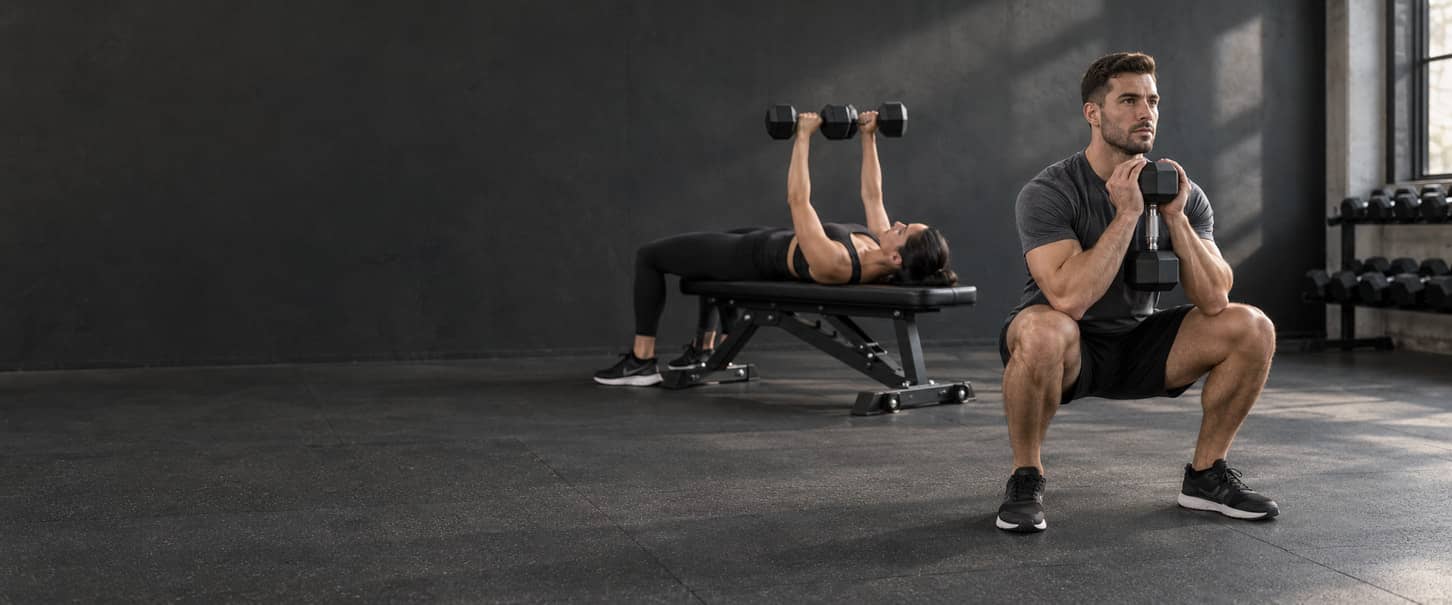
5-Day Dumbbell Workout Plan: Who It Suits
This is a dumbbell-based Upper/Lower/Push/Pull/Legs week: Monday is Upper Body, Tuesday is Lower Body, Wednesday is recovery, Thursday is Push, Friday is Pull, Saturday is Legs and Core, and Sunday is recovery. It is intended for someone who already handles basic resistance exercises and can reliably sustain five training sessions. Five days is an organizational choice, not proof that this schedule is better than a suitable plan using fewer days. The baseline requires suitable dumbbells, a locked adjustable exercise bench, clear floor space, and enough room to enter, perform, and finish each movement under control. An explicit no-bench branch replaces every bench-dependent exercise, and deliberate bodyweight work remains part of both paths. One fixed dumbbell pair may be appropriate for one exercise and unsuitable for another, so the plan does not assume that any single pair covers the whole week. Three actions are non-negotiable. First, select the bench or no-bench equipment branch before starting. Second, read the execution rules for warm-ups, effort, rest, tempo, side-specific work, and stopping standards. Third, follow the day tables in order and log the work actually completed, including the exercise version, load or bodyweight setup, repetitions or time, rest, and effort. Starting resistance comes from controlled repetitions at the prescribed standard, not a generic weight chart. Use this plan when five focused sessions and the available equipment fit the week. When a lower-frequency structure is more realistic, the Full Body Workout Plan is an established alternative with its own equipment, schedule, and prescriptions; it is not presented here as a dumbbell-only version of this routine.
Dumbbells, Bench Options, and Equipment Limits
The only required external resistance is a suitable set of dumbbells. Adjustable dumbbells or multiple fixed pairs must cover both lighter work such as lateral raises and reverse flyes and heavier work such as squats, hinges, rows, and presses. Before training, inspect selectors, collars, locking mechanisms, handles, and plate retention, and use each dumbbell only in orientations permitted by its manufacturer. A pair that fits one exercise can be too heavy or too light for another. The baseline plan also uses a rated adjustable exercise bench that locks securely in flat, modest-incline, and near-upright positions. Clear nonslip floor space, overhead clearance, controlled pickup and set-down room, and a clear walking lane are part of the setup. Push-ups, hamstring walkouts, dead bugs, and side planks are deliberate bodyweight exercises within the plan; bodyweight does not mean that the exercise is optional or resistance-free.
| Equipment or space | What is required | Important limitation or check |
|---|---|---|
| Dumbbells | Adjustable dumbbells or multiple fixed pairs spanning light raises and heavier lower-body, rowing, and pressing work. | Check locking and plate retention before use, follow permitted orientations, and do not assume one pair can load every exercise appropriately. |
| Adjustable bench | A rated exercise bench that locks flat, at a modest incline, and near upright without shifting during entry, work, or exit. | Do not improvise with unstable furniture. Bench angle and external chest or back support are not recreated by the no-bench substitutions. |
| Floor and overhead space | A clear nonslip floor, enough overhead clearance for pressing, and room to place, lift, and settle dumbbells under control. | Push-ups, walkouts, dead bugs, and side planks need usable floor space; clutter or low clearance can make the planned setup unsuitable. |
| Carry lane | A clear, level walking lane with enough room to turn or stop and set one dumbbell down safely. | Do not perform carries through obstacles, on a slippery route, or where a controlled set-down is unavailable. |
| No-bench path | The later replacement map uses floor pressing, standing pressing, and unsupported rowing or reverse-fly versions without adding another exercise slot. | These substitutions remove incline and external chest or back support, add new balance or trunk demands, and require fresh load and setup baselines. |
No cable station, resistance band, pull-up bar, machine, slider, foot-trapped dumbbell, or improvised household support is mandatory. The no-bench branch appears later and preserves the planned exercise slots, but it does not reproduce the original incline angle, chest support, back support, or loading history. The plan also has honest coverage limits. It contains rows but no actual vertical pull, and it contains hamstring walkouts but no progressively loaded heavy knee-flexion machine exercise. Rows can train useful back musculature without becoming pulldowns, and walkouts can challenge the hamstrings without becoming an exact leg-curl substitute. These limitations should guide equipment and plan choice rather than being hidden behind a claim of complete gym equivalence.
Five Training Days and Two Recovery Days
The numbered days identify training sessions, not five consecutive weekdays. Day 1 and Day 2 occur on Monday and Tuesday, Wednesday is a recovery opportunity, and Days 3–5 occur from Thursday through Saturday. Sunday provides another recovery opportunity before the sequence returns to Day 1.
| Calendar day | Session | Recovery note |
|---|---|---|
| Monday | Day 1: Upper Body | Mixed pressing, rowing and small arm/delt allocations |
| Tuesday | Day 2: Lower Body | Squat, hinge, unilateral legs, calves and trunk |
| Wednesday | Recovery | No missed-session double-up or additional hard circuit |
| Thursday | Day 3: Push | Pressing, lateral delts and triceps |
| Friday | Day 4: Pull | Rows, posterior delts, curls and carry |
| Saturday | Day 5: Legs and Core | Second lower-body exposure with a different lead movement |
| Sunday | Recovery | Prepare the next cycle; add recovery if needed |
The week gives lower-body work two planned exposures on Tuesday and Saturday. Upper-body work is distributed across Monday's mixed session, Thursday's push session, and Friday's pull session. That arrangement creates repeated practice while separating the largest overlapping tasks, but split names and calendar spacing do not guarantee growth or a universal 48-hour recovery result. Wednesday and Sunday are opportunities to recover, review performance, and prepare the next session. They are not default places for another hard core, cardio, shoulder, or full-body workout. Add recovery when the planned session cannot be performed with its normal setup, range, effort, and control rather than forcing the weekday label. Friday's baseline pulling rows and reverse fly are chest-supported. In the no-bench branch, the replacements require a maintained hip hinge, which can add trunk fatigue before Saturday's Romanian deadlift and other lower-body work. Take an extra recovery day when needed and continue the session order; do not rush Saturday merely to keep the week inside seven calendar days.
Confirm the schedule before starting the first cycle
- Confirm that five training sessions are genuinely available while retaining Wednesday and Sunday as recovery opportunities.
- Confirm that the available dumbbells cover both lighter and heavier exercises and that the selected bench or no-bench branch can be performed securely.
- Rehearse the planned movements and choose manageable versions that preserve the required support, range, entry, and exit.
- For the first complete cycle, use one fewer working set from every row, with a minimum of one set, while keeping every exercise and its prescribed repetition or time range. Begin dynamic work with about three technically sound repetitions in reserve, then add the omitted set only when the reduced dose is repeatable and recovered.
Experienced lifters already tolerating comparable work may enter the base week directly. The reduced first cycle is a conservative on-ramp, not a compulsory calendar progression, and it does not authorize combining this plan with another complete routine or compressing missed sessions into double workouts.
Starting Weights, Warm-Ups, Rest, and Tempo
Prepare each exercise before counting a working set. Check the dumbbells, locking or retention hardware, bench or floor support, walking lane, overhead clearance, and the route used to enter and leave the position. Select a starting weight yourself by using the lower end of the prescribed repetition range with the stated technique, effort, and safe-exit standard. Do not use a generic male or female chart, a bench-press conversion, or another exercise's load as the answer. If the first working set cannot reach the lower target without losing support, range, grip, or control, reduce the weight or use the taught regression. Setup and exit can be the limiting factor before the target muscles are exhausted.
Warm up without adding hidden working sets
Check the day's equipment, use several minutes of easy movement until you feel ready, and rehearse the squat, hinge, press, or row patterns that lead the session. For the first demanding lifts, use 1–3 progressively heavier, non-fatiguing rehearsal sets when needed. Warm-up and rehearsal work is not included in the working-set totals shown in the day tables. No exhaustive stretching circuit, forced range, maximum test, or failed repetition is required. Use controlled breathing that respects any individual restriction rather than prolonged maximal breath-holding as a default technique.
Use the first cycle as a conservative on-ramp
For the first complete cycle, perform one fewer working set from every row while keeping at least one set: a three-set row becomes two sets, and a two-set row becomes one. Keep every exercise and its listed repetition or time range. Begin dynamic exercises with about three technically sound repetitions in reserve and add the omitted set only when the reduced dose is repeatable and recovered. After acclimation, the full base week generally uses about 2–3 technically sound repetitions in reserve for dynamic exercises. Repetitions in reserve estimate how many more repetitions could be completed at the same range, support, tempo, and control, not how many could be gained through swinging, shortening the movement, or risking the exit. The reps in reserve article explains the estimate in more detail; no failure test is needed.
Use observable margins for nonstandard repetition tasks
For holds, carries, dead bugs, and hamstring walkouts, do not invent a seconds-to-failure conversion. End a side plank before sagging, rolling, shrugging, or altered breathing replaces the selected hold. End a suitcase carry before gait, trunk position, grip, turning, or the controlled set-down changes. End dead-bug repetitions before the pelvis or ribcage shifts, the limbs stop following the selected path, or alternating control is lost. End a walkout before the hips sag, the heels slip, the marked travel changes, or the return cannot be completed with the same small-step pattern.
Perform straight sets and preserve the listed recovery
Use straight sets rather than hidden supersets or circuits. The table rest applies between bilateral sets and also before moving to the next exercise after the final set. Take more recovery when needed and record the actual interval; changing exercises or sides does not prove that recovery is complete. For split squats, suitcase carries, and side planks, complete one side, rest the listed interval, perform the other side, rest again, and then begin the next round. Every side receives the stated number of sets. Dead bugs work differently: alternate the prescribed opposite arm-and-leg reaches within one set until each side reaches its target, then take the listed rest after the complete alternating set.
Read the tempo by the movement being performed
The four-part convention is controlled lowering or return – pause at the lower or starting position – lift or pull – finish pause, measured in seconds. The notation is not always chronological from the position in which the first repetition begins, and a zero never means bounce. Use each tempo as a practical execution reference, not as a uniquely growth-optimal cadence or a reason to force a stretch or joint endpoint.
| Tempo or task | Movement-specific phase meaning | Exercises or use |
|---|---|---|
| 3-1-1-0 | Lower or hinge for 3 seconds, hold the controlled lower position for 1, return in 1, and use no deliberate top pause. | Goblet squats, static split squats, and Romanian deadlifts |
| 2-1-1-0 | Lower for 2 seconds, pause for 1 at the comfortable lower position, press or extend in 1, and use no forced upper pause. | Dumbbell presses, push-ups, and floor triceps extensions |
| 2-1-1-1 | For rows, release or reach for 2, pause in the controlled reach for 1, pull in 1, and hold the comfortable finish for 1. For calf raises, lower for 2, pause with the heels grounded for 1, rise in 1, and pause at the top for 1. | Rows and standing calf raises |
| 2-0-1-1 | Lower for 2 seconds, use no deliberate bottom pause, lift or open in 1, and hold the controllable finish for 1. | Lateral raises, reverse flyes, standing curls, and hammer curls |
| Dead bug 2-1-2-0 | Reach the selected opposite limbs out for 2 seconds, hold the controlled reach for 1, return in 2, and use no deliberate pause after returning. This limb-motion definition overrides generic eccentric and concentric labels. | Alternating dead-bug repetitions |
| Noncyclic steps, walking, and holds | Use about 1 second per small heel step in a hamstring walkout, with a marked out-and-back path and a pelvic reset between cycles; one full out-and-back is one repetition. Carries use steady walking for the listed seconds, and side planks use a steady-breathing hold. | Hamstring walkouts, suitcase carries, and side planks; no four-number tempo is assigned |
Label loads and stop when the standard changes
For exercises using a pair, record the load per dumbbell. For goblet squats and suitcase carries, record the mass of the one dumbbell being used. Keep the chosen unit (lb or kg) consistent and do not convert automatically between exercises or equipment. Bodyweight movements record the exact version and completed repetitions or seconds rather than a zero load. Stop and settle the resistance safely when support, grip, retention hardware, range, or control fails. Stop for sharp, radiating, or worsening pain, numbness, unexpected weakness, dizziness, or another concerning symptom and obtain appropriate assessment rather than forcing a harder set. No maximum attempt, failed free-weight repetition, or unsafe exit needs to be demonstrated.
Day 1: Upper Body
Monday combines horizontal pressing, a chest-supported row, supported overhead pressing, lateral-delt work, and small elbow-flexor and triceps allocations. Review the starting-weight, effort, rest, and tempo rules before the first working set. Follow the baseline table when a locked adjustable bench is available, or use only the mapped replacements in the no-bench branch; do not append both versions.
Day 1 workout table
| Exercise | Sets & Reps | Rest | Tempo | Target Muscles | Notes |
|---|---|---|---|---|---|
| Flat Dumbbell Bench Press | 3 sets of 6–10 reps | 120–180 seconds | 2-1-1-0 | Chest, anterior deltoids, triceps | Keep a repeatable lower endpoint and a controlled entry and exit. |
| Chest-Supported Dumbbell Row | 3 sets of 8–12 reps | 120–180 seconds | 2-1-1-1 | Lats, upper back, elbow flexors | Keep the chest supported and upper arms nearer the torso. |
| Seated Dumbbell Shoulder Press | 2 sets of 8–12 reps | 120–180 seconds | 2-1-1-0 | Deltoids, triceps | Maintain back support; no growing arch or leg drive. |
| Dumbbell Lateral Raise | 2 sets of 12–20 reps | 60–90 seconds | 2-0-1-1 | Lateral deltoids, scapular muscles | Use a consistent elbow bend and comfortable arm arc. |
| Standing Dumbbell Curl | 2 sets of 10–15 reps | 60–90 seconds | 2-0-1-1 | Biceps, brachialis | Curl both arms together without torso swing. |
| Lying Dumbbell Triceps Extension on the Floor | 2 sets of 10–15 reps | 60–90 seconds | 2-1-1-0 | Triceps | Lower beside the head with a secure grip; no failure attempt. |
The session contains 3 + 3 + 2 + 2 + 2 + 2 = 14 written working-set allocations. Every row uses a bilateral implementation, so side expansion does not add separate turns: the session also contains 14 actual work bouts. These are exercise-set and bout counts, not 14 equal direct sets for every muscle named in the table. Keep the longer recovery for the three compound movements instead of rushing into the next exercise. The bench press and shoulder press require a controlled entry and exit, while the row must retain chest support; end the set when setup, support, range, or control changes rather than forcing the final repetition. The lateral raise and arm work remain straight sets with their listed recovery. Log the exercise version, load per dumbbell and unit, completed repetitions, actual rest, estimated effort, and any setup or range change. Then follow the scheduled recovery and next-session rules rather than adding another upper-body block after Monday's work.
Day 2: Lower Body
Tuesday combines a knee-dominant squat, a hip hinge, per-side split squats, bodyweight hamstring work, bilateral calf raises, and alternating trunk control. Review the starting-weight, effort, rest, and tempo rules before the first working set. The baseline Day 2 session does not depend on a bench, but the no-bench branch remains the authoritative map for any substitutions elsewhere in the week.
Day 2 workout table
| Exercise | Sets & Reps | Rest | Tempo | Target Muscles | Notes |
|---|---|---|---|---|---|
| Goblet Squat | 3 sets of 8–12 reps | 120–180 seconds | 3-1-1-0 | Quadriceps, glutes, adductors | One dumbbell at chest; stop before the hold or balance fails. |
| Dumbbell Romanian Deadlift | 3 sets of 8–12 reps | 120–180 seconds | 3-1-1-0 | Hamstrings, glutes, spinal erectors | Hinge with soft knees; depth is not a floor-touch target. |
| Dumbbell Static Split Squat | 2 sets of 8–12 reps per side | 60–90 seconds after each side | 3-1-1-0 | Quadriceps, glutes, adductors | Both feet on floor; rest 60–90 seconds after EACH leg. |
| Hamstring Walkout | 2 sets of 4–8 out-and-back reps | 60–90 seconds | Controlled steps | Hamstrings, glutes, trunk | One full small-step out-and-back cycle is one rep; reset hips between cycles. |
| Standing Dumbbell Calf Raise | 3 sets of 10–20 reps | 60–90 seconds | 2-1-1-1 | Gastrocnemius, soleus | Bilateral on level floor; no loose step or bouncing. |
| Dead Bug | 2 sets of 6–10 reps per side | 60–90 seconds after the complete alternating set | 2-1-2-0 | Abdominals, trunk stabilizers | Alternate opposite arm/leg reaches; target is per side; rest after the full set. |
The session contains 3 + 3 + 2 + 2 + 3 + 2 = 15 written working-set allocations. Split squats expand the two prescribed sets into four leg-specific work bouts because each lead leg completes two sets. The two dead-bug sets remain two bouts, with left and right repetitions alternating inside each complete set. The session therefore contains 3 + 3 + 4 + 2 + 3 + 2 = 17 actual work bouts after side expansion. These are bookkeeping units, not equal direct-set credit for every muscle named in the table. For split squats, complete the target repetitions with one leg leading, rest 60–90 seconds, repeat with the other leg leading, rest again, and then begin the next round. For dead bugs, alternate opposite arm-and-leg reaches until each side reaches the target, then take the listed rest after the complete set; do not split the prescription into separate left and right sets. One hamstring-walkout repetition is the full cycle: begin in the raised-hip start, take small alternating heel steps outward along a repeatable marked path, stop before the hips sag or the heels slip, walk the heels back to the same start, and briefly reset the pelvis before the next cycle. The outward trip alone is not one repetition, and extra travel does not qualify when hip position or the return changes. Log the actual exercise version, one-dumbbell goblet load or per-dumbbell pair load with units, lead-leg order, completed repetitions or walkout cycles, actual rest, estimated effort, and any balance, grip, hinge, or trunk-control limit. Then follow the scheduled recovery rules rather than adding unplanned leg or core work after Tuesday's session.
Day 3: Push
Thursday returns to pressing after Wednesday's recovery opportunity, using an incline chest press, a recorded push-up version, the same supported shoulder-press implementation used on Day 1, direct lateral-delt work, and floor-based triceps extensions. Review the starting-weight, effort, rest, and tempo rules before the first working set. Follow the baseline rows when the adjustable bench is available, or use only the corresponding replacements in the no-bench branch; do not perform both versions of a replaced slot.
Day 3 workout table
| Exercise | Sets & Reps | Rest | Tempo | Target Muscles | Notes |
|---|---|---|---|---|---|
| Incline Dumbbell Bench Press | 3 sets of 8–12 reps | 120–180 seconds | 2-1-1-0 | Chest, anterior deltoids, triceps | Use one locked modest incline and a new load baseline. |
| Push-Up | 2 sets of 8–15 reps | 90–120 seconds | 2-1-1-0 | Chest, triceps, anterior deltoids, trunk | Toes or recorded knees-down version; no loose weight on the back. |
| Seated Dumbbell Shoulder Press | 2 sets of 8–12 reps | 120–180 seconds | 2-1-1-0 | Deltoids, triceps | Keep the same supported implementation used on Day 1. |
| Dumbbell Lateral Raise | 3 sets of 12–20 reps | 60–90 seconds | 2-0-1-1 | Lateral deltoids, scapular muscles | Keep the selected path; progression is not heavier swinging. |
| Lying Dumbbell Triceps Extension on the Floor | 2 sets of 10–15 reps | 60–90 seconds | 2-1-1-0 | Triceps | Preserve upper-arm position and face clearance. |
The session contains 3 + 2 + 2 + 3 + 2 = 12 written working-set allocations. Every listed implementation is bilateral or performed as one complete bodyweight set, so side expansion adds no separate turns and the session also contains 12 actual work bouts. These are exercise-set and bout counts, not 12 equal direct sets for every muscle named in the table. Keep the incline setting fixed across its working sets and establish a new incline-press load baseline rather than copying the flat-press number from Day 1. Record the push-up support as toes or knees down and keep that lever consistent within the set. The seated shoulder press should retain the same supported setup used on Monday so performance can be compared without silently changing the exercise. Use the full listed recovery between straight sets and before changing exercises. End a set when the bench setup, push-up body line, shoulder-press support, lateral-raise path, triceps-extension face clearance, or safe exit no longer meets the selected standard rather than forcing another repetition. Log the exercise version, bench setting where applicable, load per dumbbell and unit, push-up support, completed repetitions, actual rest, estimated effort, and any range or setup change. Then follow the scheduled recovery and Friday Pull rules rather than appending another chest, shoulder, or triceps session.
Day 4: Pull
Friday combines two chest-supported row roles, a supported reverse fly, two distinct curl contexts, and a per-side suitcase carry. Review the starting-weight, effort, rest, and tempo rules before the first working set. Follow the chest-supported baseline when the adjustable bench is available, or use only the mapped replacements in the no-bench branch; do not append the unsupported versions to the same slots.
Day 4 workout table
| Exercise | Sets & Reps | Rest | Tempo | Target Muscles | Notes |
|---|---|---|---|---|---|
| Chest-Supported Dumbbell Row | 3 sets of 8–12 reps | 120–180 seconds | 2-1-1-1 | Lats, upper back, elbow flexors | Main row with nearer-torso arm path; chest stays supported. |
| Chest-Supported Upper-Back Dumbbell Row | 2 sets of 10–15 reps | 90–120 seconds | 2-1-1-1 | Upper back, posterior deltoids, elbow flexors | Secondary more-open arm path; not a reverse fly or vertical pull. |
| Chest-Supported Dumbbell Reverse Fly | 3 sets of 12–20 reps | 60–90 seconds | 2-0-1-1 | Posterior deltoids, scapular muscles | Use light weights and a stable elbow bend. |
| Standing Dumbbell Curl | 2 sets of 8–12 reps | 60–90 seconds | 2-0-1-1 | Biceps, brachialis | Record separately from the Day 1 rep-range context. |
| Dumbbell Hammer Curl | 2 sets of 10–15 reps | 60–90 seconds | 2-0-1-1 | Brachialis, brachioradialis, biceps | Keep palms inward and avoid hip drive. |
| Suitcase Carry | 2 sets of 20–40 seconds per side | 60–90 seconds after each side | Steady walking | Trunk stabilizers, grip | One dumbbell; rest after EACH side; clear lane and controlled set-down. |
The session contains 3 + 2 + 3 + 2 + 2 + 2 = 14 written working-set allocations. The five bilateral exercise rows account for 12 work bouts. The suitcase carry's two sets per side expand into four side-specific walking bouts, producing 12 + 4 = 16 actual work bouts after side expansion. These are exercise-allocation and bout counts, not equal direct-set credit for every muscle named in the table. The two row slots use different selected upper-arm paths. The first keeps the upper arms nearer the torso, while the second uses a more-open path and its own load and performance record. Both remain horizontal rowing tasks with elbow flexion; neither provides the vertical-pulling role that is absent from this plan. The reverse fly keeps a comparatively stable elbow bend and should not be converted into a third row. The suitcase carry remains a time-based task. Walk for the listed seconds on one side, set the dumbbell down under control, rest 60–90 seconds, complete the other side, rest again, and then begin the next round. Record the one dumbbell's mass rather than doubling it, and do not convert seconds into repetitions. Log the exercise version, bench setting, arm path, load per dumbbell or the single carry load with units, completed repetitions or seconds, side order, actual rest, estimated effort, and any loss of chest support, hinge control, grip, gait, or set-down quality. Then follow the scheduled recovery rules before Saturday's legs-and-core session rather than adding another pulling or arm block.
Day 5: Legs and Core
Saturday provides the second lower-body exposure, leading with per-side split squats before a moderate Romanian-deadlift slot, higher-repetition goblet squats, repeated hamstring walkouts, bilateral calf work, and per-side side planks. Review the starting-weight, effort, rest, and tempo rules before the first working set. Day 5 itself does not require a bench, but the no-bench branch remains authoritative for substitutions elsewhere in the week and for the added trunk demands they may create before this session.
Day 5 workout table
| Exercise | Sets & Reps | Rest | Tempo | Target Muscles | Notes |
|---|---|---|---|---|---|
| Dumbbell Static Split Squat | 3 sets of 10–15 reps per side | 60–90 seconds after each side | 3-1-1-0 | Quadriceps, glutes, adductors | Both feet on floor; record each lead leg and rest after EACH leg. |
| Dumbbell Romanian Deadlift | 2 sets of 10–15 reps | 120–180 seconds | 3-1-1-0 | Hamstrings, glutes, spinal erectors | Moderate second hinge exposure; delay when trunk or grip has not recovered. |
| Goblet Squat | 2 sets of 12–20 reps | 120–180 seconds | 3-1-1-0 | Quadriceps, glutes, adductors | Use a controlled squat; do not stack or combine unsecured dumbbells. |
| Hamstring Walkout | 2 sets of 4–8 out-and-back reps | 60–90 seconds | Controlled steps | Hamstrings, glutes, trunk | Same marked out-and-back path as Day 2; not a machine-leg-curl equivalent. |
| Standing Dumbbell Calf Raise | 3 sets of 12–20 reps | 60–90 seconds | 2-1-1-1 | Gastrocnemius, soleus | Bilateral calf raise on level floor; keep heel range repeatable. |
| Side Plank | 2 sets of 15–35 seconds per side | 45–60 seconds after each side | Steady hold | Obliques, lateral trunk stabilizers | Record knee/foot lever; rest after EACH side; stop before sagging. |
The session contains 3 + 2 + 2 + 2 + 3 + 2 = 14 written working-set allocations. The split squat expands three prescribed sets into six lead-leg work bouts, while the side plank expands two prescribed sets into four side-specific holds. The four bilateral rows contribute nine more bouts, giving 6 + 2 + 2 + 2 + 3 + 4 = 19 actual work bouts after side expansion. These are exercise-allocation and bout counts, not equal direct-set credit for every muscle named in the table. Complete one split-squat side, rest 60–90 seconds, complete the other side, rest again, and then begin the next round. Apply the same side-separated structure to the side plank with its 45–60-second recovery. Record the lead-leg order and the selected knee- or foot-supported plank lever so both sides are interpreted under the same stated version. Friday's rows, curls, carry, and any unsupported no-bench pulling may leave residual grip or trunk fatigue. Do not force Saturday's Romanian deadlift through a changing hinge, failing grip, or unstable setup merely to preserve the calendar. Add recovery and continue the session order when the normal hinge standard is not available. The Day 5 walkout uses the same marked complete out-and-back cycle as Day 2, and it remains distinct from a loaded machine leg curl. Log the exercise version, load per dumbbell or one-dumbbell goblet load with units, lead-leg and plank-side order, completed repetitions, walkout cycles or hold seconds, actual rest, estimated effort, and any balance, grip, hinge, gait, or trunk-control limit. Then use Sunday's scheduled recovery opportunity rather than adding another leg, core, or conditioning block.
Dumbbell Presses, Push-Ups, and Triceps Technique
These five entries teach the pressing and elbow-extension exercises used in the day tables. Keep each setup, range, load record, and exit method specific to that exercise rather than transferring numbers or assuming that a bench angle, bodyweight lever, or overhead position is interchangeable.
Flat Dumbbell Bench Press
Use the flat dumbbell bench press as the plan's main horizontal dumbbell press, with the chest working alongside the anterior deltoids and triceps. It requires matched dumbbells, a locked rated flat bench, and enough clear floor space for controlled entry, pressing, and set-down.
- Inspect the bench, dumbbell load retention, and the set-down area. Choose weights you can bring into position and return safely; use competent assistance or the taught floor-press alternative when setup would otherwise be uncontrolled.
- Sit, bring the dumbbells into a controlled shoulder-level position while settling onto the bench, and plant the feet. Keep the head, upper back, and pelvis supported without forcing one universal back shape.
- Use a full grip and a comfortable elbow path, with the wrists supported over the forearms. Press both dumbbells without striking them together or lifting the hips from the bench.
- Lower through a comfortable, repeatable range without bouncing or chasing maximum depth. End the set while a controlled exit remains available.
- Return to supported sitting with the dumbbells controlled or use trained assistance. Do not fling the weights to the floor or twist out from beneath a failing load.
Regress by reducing the load or using the separately taught floor press when bench entry or exit cannot be controlled. Progress by adding technically consistent repetitions before a small per-dumbbell increase. Record the load per dumbbell, grip, bench setup, lower endpoint, completed repetitions, actual rest, estimated effort, and whether entry and exit remained controlled.
Incline Dumbbell Bench Press
Use the incline dumbbell bench press for an inclined pressing slot involving the chest, anterior deltoids, and triceps. The exercise requires matched dumbbells and a stable adjustable bench locked at one modest incline that fits the selected pressing path.
- Lock the bench at a modest incline that permits a comfortable press; do not assume one angle maximizes chest growth for everyone. Prepare the same secure entry and exit used for the flat press.
- Plant the feet and maintain pelvis, upper-back, and head support. Hold the dumbbells securely near the upper chest with comfortable wrist and elbow alignment.
- Press through a controlled path above the upper chest without colliding the weights or creating the finish through a large back arch.
- Lower to the same comfortable endpoint and keep the bench setting unchanged throughout the set.
- End before a failed repetition threatens the exit. The no-bench floor press preserves a pressing slot, not the incline angle or identical loading.
Regress by reducing the load or using the floor-press branch. Do not improvise an incline with cushions, furniture, or another unstable support. Progress through repetitions and then manageable per-dumbbell loading; changing the bench inclination starts a separate baseline. Record the bench setting, load per hand, grip, lower and upper endpoints, completed repetitions, actual rest, and estimated effort.
Seated Dumbbell Shoulder Press
Use the seated dumbbell shoulder press for supported overhead pressing by the deltoids and triceps. The selected version uses two manageable dumbbells and a locked near-upright bench that permits a comfortable overhead path and controlled set-down.
- Lock the bench near upright at a stable setting that fits the overhead path, then clear the floor, overhead area, and set-down space.
- Sit with the feet planted and bring the dumbbells to the shoulder-level start through a controlled entry. Maintain seat and back support.
- Press with a comfortable full grip and arm path. Allow coordinated shoulder-blade motion rather than pinning the shoulder blades permanently down.
- Lower under control and stop before leg drive, increasing trunk extension, or uncontrolled dumbbell drift changes the repetition.
- Exit while the dumbbells can still be lowered and set down securely. Standing is a different supported-demand choice, not a compulsory next level.
Regress by reducing the load. Use the separately taught standing version only when that setup is appropriate and controllable. Progress through repetitions before increasing each dumbbell by a manageable increment. Record the backrest setting, load per dumbbell, grip, lower and upper range, completed repetitions, actual rest, and estimated effort.
Push-Up
Use the push-up as the plan's horizontal bodyweight press for the chest, triceps, anterior deltoids, and trunk. It requires a clear nonslip floor and enough hand and foot space to maintain one documented toes-supported or knees-down version.
- Place the hands on the floor at a comfortable spacing and establish a controlled body line. This is a bodyweight exercise within a dumbbell-based plan; do not balance the hands on round dumbbells.
- Lower the chest and trunk together through a manageable range with a comfortable elbow path. Keep the head and neck unloaded.
- Press through the hands and allow natural shoulder-blade movement as the body returns. Do not gain repetitions by sagging the hips or shortening the selected range.
- Use a knees-down floor version when needed and record it. Change the lever only after all sets meet the same execution standard.
- Finish by bringing the knees to the floor under control. Do not place a loose dumbbell on the back to make the exercise harder.
Regress to a knees-down floor push-up or a shallower documented range while developing control. Progress through repetitions, then move from knees to toes when appropriate. Do not use unstable furniture or unsecured external loading. Record toe or knee support, hand placement, depth, completed repetitions, body mass when tracked, actual rest, and estimated effort.
Lying Dumbbell Triceps Extension on the Floor
Use the lying dumbbell triceps extension as a floor-based elbow-extension exercise for the triceps. The selected version requires two manageable dumbbells, a stable mat, secure load retention, and enough space beside the head for the weights to move without contact.
- Lie on the floor with the knees bent, feet planted, and two light dumbbells controlled above the shoulders. Use a secure full grip, especially with adjustable dumbbells.
- Keep the upper arms at a comfortable, reproducible angle. Bend the elbows so the dumbbells travel toward the space beside the head rather than toward the face.
- Stop the lowering phase within a controllable range that clears both the head and the floor. Do not force an extreme elbow bend.
- Extend the elbows without turning the movement into a press, flaring unpredictably, or shifting the shoulders to finish the repetition.
- Lower the dumbbells to a controlled rest and sit up without twisting under load. Avoid failure and do not use a weight-retention design that is unsuitable for this position.
Regress by using lighter dumbbells and a comfortable shorter elbow range. Persistent symptoms are a reason to stop rather than force another extension variation. Progress through repetitions before small load increases, independently of chest-press strength. Record the load per dumbbell, upper-arm angle, elbow range, completed repetitions, actual rest, and estimated effort.
Dumbbell Rows, Raises, and Curls
This section teaches the two row paths, lateral raise, reverse fly, and two curl variations used in the weekly tables. Repeated appearances in the plan refer back to these same instructions; they do not create a second technique version. Keep each exercise’s support, arm path, grip, load, and progression record distinct.
Chest-Supported Dumbbell Row
Use this chest-supported row when the plan calls for a nearer-torso upper-arm path involving the lats, upper back, and elbow flexors. It requires two manageable dumbbells and a locked inclined exercise bench that supports the chest while leaving clear pickup, rowing, and set-down space.
- Lock the bench at an incline that supports the chest and leaves a clear path beneath and beside it. Arrange the dumbbells so they can be picked up and set down without twisting or reaching blindly.
- Rest the chest on the pad with both feet planted and enough room to breathe. Hold the dumbbells with a comfortable neutral or slightly rotated grip.
- Bend the elbows and move the upper arms back near the sides without forcing them tightly against the torso. Let the shoulder blades coordinate naturally with the pull.
- Lower the dumbbells to the same controlled reach without heaving, abruptly shrugging, rotating the trunk, or lifting the chest from the bench.
- Settle the weights before leaving the support. A materially different arm path or the unsupported no-bench version starts a separate performance record.
Regress by reducing the load. Use the explicitly taught no-bench row only when maintaining its hinge is suitable. Progress through technically consistent repetitions before increasing each dumbbell while chest support and the nearer-torso path remain unchanged. Record the bench setting, load per hand and unit, grip, upper-arm path, lower and upper endpoints, completed repetitions, actual rest, estimated effort, and any loss of chest contact.
Chest-Supported Upper-Back Dumbbell Row
Use this distinct secondary row for a more-open upper-arm path that emphasizes the upper back and posterior shoulder while retaining elbow-flexor involvement. It uses the same type of locked inclined bench and two dumbbells, but it needs its own load and movement record.
- Use the same secure chest-supported bench arrangement, selecting a lighter pair when the more-open upper-arm path requires it.
- Choose a comfortable more-open elbow path without forcing a right angle or an extreme flare. Let the grip rotate only as needed to support that path.
- Row through controlled elbow flexion and upper-arm motion while keeping the chest and feet in contact with their supports.
- Finish before the shoulders, neck, or torso must heave, then return steadily without forcing a maximal shoulder-blade squeeze.
- Keep this as a separate secondary-row record. It is not a pure reverse fly and does not supply the vertical-pulling role missing from the plan.
Regress by using lighter dumbbells or a more modest open path. Keep the movement comfortable rather than forcing flare. Progress through repetitions and then manageable per-hand load increases, independently of the nearer-torso row. Record the arm path, grip, bench setting, load per hand and unit, completed repetitions, actual rest, estimated effort, and any support or torso change.
Dumbbell Lateral Raise
Use the dumbbell lateral raise for controlled arm elevation involving the lateral deltoids and scapular muscles. The selected version uses two light dumbbells, stable standing space, a reproducible elbow bend, and a comfortable arm path rather than a mandatory exact angle.
- Stand securely in clear space with light dumbbells at the sides and a small, reproducible elbow bend.
- Raise the upper arms through a comfortable arc, often slightly forward of directly sideways, while keeping the chosen elbow bend similar.
- Use approximately shoulder level only as a practical reference, not a required endpoint or universal safety ceiling. Allow natural shoulder-blade movement.
- Lower steadily and avoid hip swing, a sudden shoulder hike, or a forced thumbs-down rotation.
- Stop when the selected path or lever changes, then set the dumbbells down under control.
Regress with a lighter pair or a shorter controlled lever or range, recording the modification. Progress by adding clean repetitions before load; do not turn a large dumbbell jump into a swinging raise. Record the load per hand and unit, stance, elbow bend, arm plane, lower and upper endpoints, completed repetitions, actual rest, estimated effort, and any swing or lever change.
Chest-Supported Dumbbell Reverse Fly
Use the chest-supported reverse fly for posterior-shoulder upper-arm opening with rear-deltoid and scapular-muscle involvement. It requires two light dumbbells and a locked inclined bench that supports the chest, permits normal breathing, and leaves the arms and weights clear.
- Arrange and lock the bench so the chest is supported, breathing remains comfortable, and both dumbbells can travel without striking the bench.
- Let the arms hang with a comfortable slight elbow bend and keep the head aligned naturally with the trunk.
- Open the upper arms outward while keeping the elbow angle approximately consistent. Allow coordinated shoulder-blade movement.
- Stop before the chest lifts or the elbows repeatedly bend into a row, then lower along the same controlled arc.
- Set the dumbbells down before leaving the support, using a load light enough that pickup and exit remain controlled.
Regress with lighter dumbbells or a shorter controllable arc. The no-bench version adds a maintained-hip-hinge demand and is not the same supported record. Progress through repetitions and then small per-hand increases without converting the fly into a row. Record the bench setting, load per hand and unit, grip, elbow bend, arm arc and endpoints, completed repetitions, actual rest, estimated effort, and any chest lift or rowing change.
Standing Dumbbell Curl
Use the standing dumbbell curl for bilateral supinated or smoothly rotating elbow flexion involving the biceps and other elbow flexors. It requires two manageable dumbbells and clear standing space, with the selected forearm position established before the working set.
- Stand securely with both dumbbells controlled and the palms comfortably forward or rotating toward that position according to the chosen version.
- Flex both elbows together while keeping the trunk steady and upper-arm movement small and repeatable.
- Finish where elbow flexion remains controlled rather than throwing the elbows forward to lift the weights higher.
- Lower steadily through the same comfortable range without snapping the elbows straight.
- Stop before hip drive or backward lean changes the lift, then return the dumbbells safely.
Regress with a lighter pair and avoid forcing forearm rotation. Progress through repetitions and then load within this curl’s own range, keeping its history separate from the hammer curl. Record the supinated or rotating variant, load per hand and unit, elbow range, completed repetitions, actual rest, estimated effort, and any upper-arm or trunk change.
Dumbbell Hammer Curl
Use the dumbbell hammer curl for bilateral neutral-grip elbow flexion involving the brachialis, brachioradialis, and biceps. It uses two manageable dumbbells and stable standing space, with the palms remaining inward throughout the selected version.
- Stand with the palms facing each other and the wrists held in a comfortable neutral position.
- Curl both dumbbells together without changing the neutral grip or driving the movement through the hips.
- Keep the upper arms and torso steady, finishing at a comfortable elbow-flexion endpoint.
- Lower under control and stop when swing or an altered grip replaces the planned motion.
- Treat this as the plan’s small secondary curl allocation, not permission to append another full arm workout.
Regress by reducing the load when wrist, upper-arm, or torso control is lost. Progress through repetitions within its own prescribed range before increasing the dumbbells. Record the load per hand and unit, neutral grip, elbow range, completed repetitions, actual rest, estimated effort, and any swing or grip change.
Keep rows, raises, reverse flyes, and curls distinct
The nearer-torso row and more-open upper-back row are both horizontal pulling tasks with elbow flexion, but their selected upper-arm paths and load records differ. The reverse fly keeps a comparatively stable elbow angle as the upper arms open, while the lateral raise elevates the arms away from the torso. The two curls differ primarily through their chosen forearm orientation and remain separate progression records. These entries do not supply an actual vertical pull or a complete back-exercise library. Use the back exercise selection guide for the wider rowing and vertical-pulling decision. None of these exercises promises complete muscle isolation, and repeated appearances in the weekly tables do not require repeating the tutorials.
Squats, Hinges, Hamstrings, and Calves
These five entries teach the lower-body exercises used across Days 2 and 5. Keep each exercise’s loading method, stance, range, side accounting, and progression record distinct. The static split squat keeps both feet on the floor, the hamstring walkout counts a complete small-step journey out and back as one repetition, and the calf raise begins bilaterally on level floor.
Goblet Squat
Use the goblet squat as the plan’s knee-dominant bilateral squat for the quadriceps, glutes, and adductors. It requires one suitable dumbbell held securely at the chest and a clear nonslip floor; the dumbbell’s shape and retention system must permit the chosen grip.
- Check that the dumbbell can be held securely in the selected goblet grip. Adjustable dumbbells must be approved for that orientation and must not depend on unsecured plates or loose components.
- Hold the dumbbell close to the chest, choose a comfortable stance width, and establish balance and trunk control before descending.
- Bend the hips and knees together while keeping whole-foot pressure and the weight close. Let the knees travel naturally with the feet rather than forcing them behind the toes.
- Descend only to the deepest range you can repeat without pain, loss of balance, or a major uncontrolled trunk or pelvic change, then stand without bouncing.
- End the set when the hold, grip, or available dumbbell becomes the limiting factor before the legs. Record that constraint instead of assuming the exercise provides unlimited loading.
Regress to a bodyweight squat, a lighter goblet load, or a shorter controlled range. Progress through repetitions before a safe one-dumbbell increase. When the hold or available weight limits further progress, use the plan’s split-squat strategy rather than stacking or combining unsecured dumbbells. Record the one-dumbbell total load and unit, stance, depth marker, completed repetitions, actual rest, estimated effort, and the factor that ended the set.
Dumbbell Romanian Deadlift
Use the dumbbell Romanian deadlift as the plan’s hip hinge for the hamstrings and glutes, with additional spinal-erector and grip demands. It requires two manageable dumbbells, clear nonslip floor space, and a controlled pickup and set-down route.
- Pick up the dumbbells with a controlled squat or hinge that fits their starting position, then stand with one weight beside each thigh.
- Soften the knees and move the hips backward while keeping the dumbbells close to the legs and the chosen trunk relationship controlled.
- Lower only until further travel would require unwanted spinal movement or the hips can no longer move backward. Touching the floor is not the target.
- Return by extending the hips to stand without leaning backward, shrugging the dumbbells, or manufacturing a larger finish at the top.
- End before grip or trunk control is lost, then set the dumbbells down through a controlled route. This is not a straight-knee stretch or a conventional deadlift restarted from the floor on every repetition.
Regress with a lighter pair, a shorter controllable hinge, or a bodyweight rehearsal. Progress through repetitions and then per-dumbbell load while preserving the same knee bend, trunk relationship, and lower endpoint; never gain depth by rounding. Record the load per dumbbell and unit, knee bend, lower endpoint, completed repetitions, actual rest, estimated effort, and any grip or trunk limitation.
Dumbbell Static Split Squat
Use the dumbbell static split squat as a stationary unilateral-biased squat for the quadriceps, glutes, and adductors. The selected version uses two dumbbells and a stable staggered stance on level nonslip floor, with both feet remaining on the ground.
- Establish a stable staggered stance with both feet on the floor and hold one dumbbell in each hand. The rear foot is not elevated.
- Keep the stance fixed as both knees bend, maintaining front-foot pressure and a comfortable balanced descent.
- Lower within the range that preserves control, then rise without bouncing, stepping, or changing the torso lean to finish.
- Complete the prescribed repetitions with one leg leading, set the dumbbells down safely when needed, rest for the listed interval, and repeat with the other leg leading.
- Stop before balance deteriorates. Begin without dumbbells when appropriate; a Bulgarian split squat is a different exercise version, not an automatic upgrade.
Regress to a bodyweight static split squat with a shallower controlled range. Light contact with a secure wall can be used only as a separately recorded support option. Progress by adding repetitions on both legs before matched per-hand load, with no extra sets assigned to the easier side. Record the lead leg, load per hand and unit, stance, range, completed repetitions, and the actual rest taken after each leg.
Hamstring Walkout
Use the hamstring walkout for bodyweight knee-angle-changing hamstring work while the hips resist dropping. It requires a mat or comfortable level nonslip floor. It is not an experimentally tested machine-leg-curl-equivalent hypertrophy protocol.
- Lie on the back with the knees bent, heels planted, and the arms providing light support. Raise the pelvis into a modest bridge without arching the lower back.
- Take small alternating heel steps away from the pelvis while keeping the hips as level as possible and retaining some bend in the knees.
- Stop the outward travel before hip sagging, cramping, slipping, or increasing back extension replaces control. Fully straight legs are not required.
- Walk the heels back under control to the marked starting position, then lower the pelvis briefly to reset. The complete out-and-back cycle is one repetition.
- Begin with only a few small steps, mark the same travel, and use approximately one second per step. Do not trap a dumbbell between the feet, use a furniture anchor, or rely on a sliding surface.
Regress by shortening the full out-and-back path. A bridge hold can be a temporary regression, but it does not reproduce the changing knee angle. Progress through more controlled cycles within the prescribed range, then use modestly longer marked travel with a new baseline. A longer walkout does not establish machine-curl-equivalent growth. Record the outward reach marker, heel-step count in each direction, completed out-and-back repetitions, actual rest, estimated effort, and whether hip position remained controlled.
Standing Dumbbell Calf Raise
Use the standing dumbbell calf raise for bilateral plantar flexion involving the gastrocnemius and soleus. The baseline version uses two manageable dumbbells and starts with both feet on a level nonslip floor rather than a loose step or improvised platform.
- Stand with one dumbbell at each side, the feet stable, and the knees comfortably near straight without rigid locking.
- Rise onto the balls of both feet as far as balance and ankle control allow without rolling toward the outer edges.
- Pause briefly at the top, then lower both heels to the floor under control.
- Keep the knees, trunk, heel range, and pace repeatable. Do not bounce or balance on a loose plate or household step.
- End when balance or grip fails. A securely wall-supported single-leg version with one dumbbell is an optional new variation when bilateral loading becomes too easy.
Regress to the bodyweight bilateral version. Stable fingertip wall contact is acceptable only when the support and load arrangement are recorded. Progress through repetitions and then per-hand load; a wall-supported unilateral version changes the accounting and requires separate side records. Record the load per hand and unit, bilateral or single-leg mode, heel range, completed repetitions, actual rest, estimated effort, and any support used.
Dead Bugs, Carries, and Side Planks
These three trunk entries use different work units and side structures. Dead bugs alternate left and right repetitions inside one complete set, while suitcase carries and side planks complete one named side, take the listed rest, and then repeat on the other side. Repetitions and seconds remain separate records. Use only the allocations in the day tables rather than appending another ab block.
Dead Bug
Use the dead bug as a bodyweight contralateral anti-extension exercise on a stable mat. The aim is to reach an opposite arm-and-leg pair while maintaining a repeatable ribcage and pelvis relationship, then alternate within the same complete set.
- Lie on the back with the hips and knees comfortably bent and the arms above the torso. Establish a ribcage and pelvis position that you can maintain while continuing to breathe.
- Reach one arm and the opposite leg away only as far as trunk control remains unchanged.
- Return the pair under control, then alternate to the opposite arm and leg. One complete reach-and-return of a pair counts as one repetition on that side.
- For this plan, continue alternating until each side reaches its prescribed target, then take the listed rest. Do not split the set into two separate held sets or insert an unrecorded break between sides.
- Shorten the reach when needed. Do not force one universal lower-back contact rule or stop breathing to manufacture the appearance of control.
Regress to a short contralateral reach. A single-arm or single-leg rehearsal can prepare the pattern, but it is not a hidden replacement for the prescribed working version. Progress the controlled reach first and then the completed repetitions, ending the set before fatigue alters the trunk position or limb path. Record the reach, knee lever, left-side repetitions, right-side repetitions, actual rest, and any ribcage, pelvis, or breathing change.
Suitcase Carry
Use the suitcase carry as an offset walking task for lateral trunk control and grip. It requires one securely held dumbbell and a clear, level walking lane with room for a controlled pickup, turn, and set-down.
- Prepare a clear lane and establish a safe pickup and set-down area before holding one dumbbell at the side.
- Walk with a repeatable gait while resisting excessive side bending, twisting, or dragging the dumbbell.
- Count seconds of walking while the weight is held in the named hand. Turn only where the clear lane allows a controlled change of direction.
- Stop at the time target or sooner when grip, gait, or trunk control changes, then set the dumbbell down before resting or changing hands.
- Complete the other side after the stated rest. A stationary suitcase hold can be used when space prevents walking, but label it as a different version rather than recording it as walking time.
Regress with a lighter dumbbell or a shorter duration. Use a clearly labeled stationary suitcase hold only when the available space prevents safe walking. Progress time within the prescribed range before increasing the one-dumbbell load; do not extend the carry indefinitely. Record the holding hand, one-dumbbell load and unit, walking time, route and turns, actual rest, and the grip, gait, trunk, or space limit that ended the bout.
Side Plank
Use the side plank as a bodyweight lateral-trunk-control hold on a nonslip mat. Choose one reproducible knee- or foot-supported lever and keep the forearm support, trunk position, breathing, and hold duration explicit for each side.
- Lie on one side with the forearm supported and the elbow near the shoulder in a comfortable position.
- Choose a bent-knee or straight-leg lever and lift into a controlled line through the trunk and pelvis.
- Breathe throughout the hold and stop before sagging, rolling, or shoulder discomfort changes the task.
- Lower onto the mat, rest for the listed period, and then reproduce the same lever on the other side.
- Record the exact version. No external dumbbell is required on the torso.
Regress to a bent-knee lever or a shorter controlled hold. Progress the hold only to the prescribed cap, then change the lever when appropriate; additional external load is not mandatory. Record the side, knee- or foot-supported lever, hold seconds, actual rest, and the reason the hold ended.
Keep the plan's trunk allocations distinct
Dead-bug targets are repetitions per side completed by alternating within one set. Carries and side planks are timed bouts completed separately on each side with the listed recovery after each side. Do not add repetitions and seconds together, convert holds into rep counts, or treat changing hands as automatic recovery. These are the complete plan allocations, not permission to append a second trunk workout. Use the ab exercise guide for broader exercise selection when building a different plan, not for adding its optional blocks to this five-day schedule.
How to Follow the Plan Without a Bench
| Original row | No-bench replacement | Affected slots | Important difference |
|---|---|---|---|
| Flat Dumbbell Bench Press | Dumbbell Floor Press | Day 1, exercise 1 | Floor limits lower arm travel; preserve the slot, not identical range. |
| Incline Dumbbell Bench Press | Dumbbell Floor Press | Day 3, exercise 1 | No incline is recreated. Day 3 already has push-ups separately, not a second duplicate floor-press row. |
| Seated Dumbbell Shoulder Press | Standing Dumbbell Shoulder Press | Day 1, exercise 3; Day 3, exercise 3 | More trunk and balance demand; controlled entry may require a lighter pair. |
| Chest-Supported Dumbbell Row | Bent-Over Dumbbell Row, nearer-torso path | Day 1, exercise 2; Day 4, exercise 1 | Unsupported hinge; trunk fatigue may limit work before the back. |
| Chest-Supported Upper-Back Dumbbell Row | Bent-Over Dumbbell Row, more-open arm path | Day 4, exercise 2 | Separate path and load record; still a row, not a fly. |
| Chest-Supported Dumbbell Reverse Fly | Bent-Over Dumbbell Reverse Fly | Day 4, exercise 3 | Maintained hinge and clear floor; use light weights. |
Keep the same session order, exercise count, working-set allocation, and target range unless an explicitly recorded regression is needed. Select new loads for every changed implementation; flat, incline, seated, chest-supported, standing, floor, and bent-over records are not one shared load history. All exercises not listed in the replacement map remain unchanged. The no-bench branch requires no furniture, machine, resistance band, hidden anchor, foot-trapped dumbbell, or improvised support. Day 3 replaces its one incline-press slot with one floor-press slot while retaining the separately prescribed push-up row; it does not add a duplicate floor-press exercise.
Dumbbell Floor Press
Use the dumbbell floor press as the no-bench replacement for the flat- and incline-press slots. It requires two manageable dumbbells and a nonslip mat, and its floor-limited lower range does not reproduce the full bench-press range or an incline angle.
- Sit on the floor with manageable dumbbells, bring them into a controlled close-to-body position, and roll back deliberately, or use trained assistance. Do not attempt a heavy, awkward floor pickup.
- Bend the knees and plant the feet. Hold the dumbbells above the chest with comfortable full grips and the forearms supported beneath the loads.
- Lower until the upper arms lightly contact the floor or reach another comfortable, repeatable endpoint. Do not slam the elbows into the floor.
- Press without using a hip bridge or colliding the dumbbells, and repeat the same floor-limited range.
- Set the weights down under control and return to sitting deliberately. This replacement does not recreate an incline or the full lower range of a bench press.
Regress by using lighter dumbbells. Use the taught push-up version when the floor-press entry or exit cannot be performed safely. Progress through repetitions and then load within this exercise’s own baseline rather than copying the flat- or incline-press history. Record the load per hand and unit, floor endpoint, grip, completed repetitions, actual rest, estimated effort, and whether entry and exit remained controlled.
Standing Dumbbell Shoulder Press
Use the standing dumbbell shoulder press as the no-bench overhead-press replacement. It requires two manageable dumbbells plus clear standing and overhead space. Removing the backrest changes the balance and trunk-control demands; both versions still require active control.
- Pick up a pair you can bring to shoulder level without a heavy ballistic clean or an uncontrolled twist. Use full grips and a stable stance.
- Establish the shoulder-level start and a controlled ribcage and pelvis relationship before pressing.
- Press overhead through a comfortable arm path while the knees and hips remain steady. Allow natural shoulder-blade movement.
- Lower to the same starting position and stop before a growing back arch or leg drive replaces the press.
- Bring the dumbbells down securely while a controlled exit remains available. Standing is not claimed to be superior to a supported press.
Regress with a lighter pair or another controllable pressing task. Do not force overhead pressing through concerning symptoms. Progress through repetitions and then manageable per-dumbbell loading, keeping this record separate from the seated press. Record the load per hand and unit, stance, lower and upper range, completed repetitions, actual rest, estimated effort, and the trunk or entry limit.
Bent-Over Dumbbell Row
Use the bent-over dumbbell row for both no-bench row slots, with two distinct records: a nearer-torso path for the main row and a more-open path for the upper-back row. Both require two dumbbells, nonslip floor space, and a maintained hip hinge that replaces the original external chest support.
- Pick up both dumbbells under control and establish a comfortable soft-knee hip hinge.
- Hold the torso at a reproducible angle and let the arms reach down without collapsing the spine.
- For the main row, move the upper arms nearer the torso as the elbows bend. For the upper-back slot, use a comfortable more-open path with its own separately selected, often lighter load.
- Lower along the same chosen path while the hinge remains unchanged. Stop when trunk endurance rather than pulling becomes the limiting factor.
- Stand and set the weights down deliberately. Before the Legs and Core session, reduce the load or move the next session when remaining trunk fatigue would impair the planned hinge; never label this exercise chest-supported.
Regress with a lighter pair or a shorter controllable rowing range. Unsuitable hinge endurance is a genuine no-bench limitation, not a reason to invent furniture support. Progress through repetitions and then load within the defined path without making the torso progressively more upright. Record the nearer-torso or more-open variant, load per hand and unit, hinge angle, range, completed repetitions, actual rest, estimated effort, and the trunk limit.
Bent-Over Dumbbell Reverse Fly
Use the bent-over dumbbell reverse fly as the no-bench posterior-shoulder replacement. It requires two light dumbbells and stable floor space, and the unsupported hip hinge adds a trunk-endurance demand that was not present in the chest-supported version.
- Establish a manageable maintained hip hinge with the feet stable and the dumbbells hanging below the shoulders.
- Keep a slight, consistent elbow bend and open the upper arms outward without rising from the hinge.
- Finish before neck reach, torso heave, or repeated elbow bending turns the movement into a row.
- Lower slowly to the same start and stop when holding the hinge changes the exercise.
- Choose lighter dumbbells than for a row and set them down under control. No support or safety superiority is inferred.
Regress with a lighter pair or a shorter controllable arc. Omit the slot only through a documented plan adjustment when the required position is unsuitable. Progress through repetitions and then very small load increases without swinging. Record the hinge position, elbow bend, load per hand and unit, arm arc, completed repetitions, actual rest, estimated effort, and the reason the set ended.
Account for the extra no-bench hinge demand
The two bent-over row records and the bent-over reverse fly add sustained hinge work on Friday. That can increase trunk fatigue before Saturday’s Romanian deadlift even though the set counts and target ranges are preserved. The branch is not assumed to create identical fatigue or support. Use extra recovery when the planned Saturday hinge cannot be performed with its normal trunk position, grip, range, and controlled exit. Continue the session sequence after recovering rather than forcing Day 5 to remain on the original calendar day.
Progress When Dumbbell Weights Are Limited
Keep the selected exercise version, load, range, typical rest, and execution standard comparable while adding acceptable repetitions within the prescribed range. After every working set reaches the upper bound with the intended effort and a controlled exit on two comparable exposures, try the smallest safe available load increase and expect repetitions to return toward the lower bound. Two qualifying exposures are this plan’s conservative decision rule, not a universal research threshold and not a promise of weekly progress. If the heavier pair prevents the lower target, safe setup, or controlled exit, return to the prior load. Different day-table ranges remain separate contexts even when the exercise name repeats. Do not derive dumbbell loads from a one-repetition maximum, wedge loose objects onto weights, or treat inadequate resistance as a guarantee of unlimited progress.
Use a fixed-weight progression decision tree
- Check equipment, security, and symptoms first. Stop and resolve a retention, support, control, or concerning-pain problem before making any progression decision.
- Ask whether the lower target can be completed to the required standard. If not, use a lighter available pair or the taught regression.
- Ask whether every prescribed set has reached the upper target with the intended effort margin. If not, retain the load and build technically acceptable repetitions.
- When a small safe increment is available, use the normal two-comparable-exposure rule, increase by that increment, and return toward the lower end of the range. Do not attach improvised weights.
- When no suitable increment exists, choose one documented adjustment: extend the working repetition range, restore a previously restricted controlled range, add a modest pause, or use a taught harder bodyweight or leg lever. Do not change several variables at once.
- For a documented range extension, a 6–10, 8–12, or 10–15 exercise may move to an individually manageable 12–20 range; work already prescribed at 12–20 may move to 15–25. These are optional coaching ranges, not new base-table prescriptions or universal optimal limits.
- When a goblet hold limits the legs, a lighter loaded or bodyweight static split squat may replace the bilateral slot and concentrate work per leg. Recalculate time and side-specific bouts, review the full leg allocation, and do not append new split-squat sets to both existing split-squat rows. A wall-supported single-leg calf raise with one manageable dumbbell is another new variation that requires explicit sets, rest for both sides, and a fresh baseline.
- For carries and side planks, progress within the stated time interval first; at the cap, use a manageable carry-load increase or a more demanding documented plank lever when appropriate. Do not convert seconds into repetitions or extend every hold indefinitely. Progress hamstring walkouts through control and completed cycles, then a modest new marked reach with its own baseline.
- When available resistance remains inadequate after suitable documented options, maintain what is still useful and change equipment access or choose another complete plan. Five increasingly easy training days do not guarantee continued growth.
The original day tables remain the base prescription. A documented extension, added pause, longer controlled range, different lever, unilateral replacement, or changed implement can alter the exercise’s difficulty and performance meaning. Name the change and begin a separate record instead of silently treating it as unchanged repetition or load progress.
Read the fictional exposure example correctly
The log below is a constructed example for the Day 1 Chest-Supported Dumbbell Row, prescribed for 3 sets of 8–12 reps, using the same per-dumbbell load, setup, range, typical rest, and effort standard. It did not happen to a tested person and does not predict consecutive visits or weekly gains. The example illustrates the plan’s two-comparable-exposure rule and a successful return to the lower bound after a manageable increase.
| Exposure | Set 1 | Set 2 | Set 3 | Decision |
|---|---|---|---|---|
| A | 10 | 9 | 8 | Keep the load; add acceptable reps. |
| B | 12 | 12 | 11 | Keep it; the third set is short. |
| C | 12 | 12 | 12 | First qualifying exposure, assuming intended effort and control. |
| D | 12 | 12 | 12 | Second qualifying exposure; try the smallest safe increment next time. |
| E | 8 | 8 | 8 | Illustrative successful heavier-pair result, not guaranteed. |
Exposure C qualifies once; exposure D supplies the second comparable upper-bound result. Exposure E shows one possible heavier-pair outcome at the lower bound, not a required or predicted result. If the increase produced fewer than the lower target, unsafe setup, or changed technique, return to the prior pair instead of forcing the heavier weight.
Use limited-load changes without hiding new accounting
A goblet squat can become limited by the hold before the legs. Replacing that bilateral slot with a static split-squat version changes the work into per-leg bouts and usually changes the time requirement. Count the replacement honestly, preserve the plan’s other split-squat rows, and reassess the complete lower-body allocation rather than appending more unilateral sets. A bilateral calf raise may move to a securely wall-supported single-leg version with one manageable dumbbell when appropriate. Define the left and right sets, recovery, support, range, and load under a new baseline; do not use an unstable balance trick merely to make a light weight feel harder. Carries and side planks progress only within their stated time caps before load or lever changes. Hamstring walkouts progress through repeatable cycles and then a modestly longer marked out-and-back reach. Seconds, repetitions, per-side bouts, and marked travel remain separate records, and none is converted into an RDL, curl, or universal workload score.
Adjust recovery and time before adding more work
Review repeated performance, sleep, soreness that changes technique, joint comfort, and normal readiness. One poor session is not automatically a plateau. First check setup and rest, remove unplanned additions, and take an extra recovery day when needed. A temporary lower-volume cycle can use one fewer working set per row with a minimum of one, approximately 3–4 technically sound repetitions in reserve on dynamic work, and easier hold or range versions. The resulting 3→2 and 2→1 reductions do not halve every row and are not a compulsory calendar deload. Persistent concerning symptoms need appropriate assessment rather than repeated deload attempts. Restore work when it is manageable, not automatically after seven days. Session duration depends on repetition speed, actual rest, per-side turns, and equipment changes. Do not shorten the prescribed rests or rush repetitions to force the full session into 30 minutes. Use the explicit reduced-set cycle or select a plan that fits the available schedule rather than deleting every second leg session or converting the week into rushed circuits.
Weekly Workload, Recovery, and Deloads
The workload ledger below partitions the base week into twelve non-overlapping bookkeeping categories. Its values add to the plan’s 69 written set allocations, but the units are mixed: bilateral sets, per-side prescriptions, timed tasks, alternating repetitions, and overlapping muscle involvement do not become one physiological dose. Use the guide to counting workout sets when you need the wider distinction between raw exercise sets, direct work, overlap, and user-defined assumptions.
| Bookkeeping category | Base-week allocations | Interpretation |
|---|---|---|
| Horizontal pressing (bench/incline + push-ups) | 8 | Chest/triceps/anterior deltoids overlap; not 8 isolated sets for every muscle. |
| Rows (both arm-path roles) | 8 | Includes the secondary upper-back row; no vertical pull implied. |
| Overhead pressing | 4 | Adds to chest-pressing exposure; front raises not compulsory. |
| Lateral raises | 5 | Direct lateral-raise slots, with normal scapular contribution. |
| Reverse flyes | 3 | Additional posterior-shoulder allocation; rows also contribute. |
| Curls (supinated + hammer) | 6 | Elbow-flexor work in addition to rows; not a biceps-only dose. |
| Triceps extensions | 4 | Direct extension plus substantial pressing overlap. |
| Knee-dominant squats and split squats | 10 | Five goblet sets plus five sets per leg of split squats; mixed allocation units. |
| Hip hinges | 5 | RDL allocations; do not relabel as knee-flexion sets. |
| Hamstring walkouts | 4 | Out-and-back tasks; not leg-curl-equivalent credit. |
| Calf raises | 6 | Baseline bilateral sets on level floor. |
| Direct trunk/carry tasks | 6 | Two dead-bug sets, two carries per side and two side planks per side; distinct units. |
The category total is 8 + 8 + 4 + 5 + 3 + 6 + 4 + 10 + 5 + 4 + 6 + 6 = 69 written allocations. The categories partition the week, so no row is added again under another category to create a larger total. They do not state the weekly dose received by every listed muscle, and no direct/indirect multiplier or fixed optimal weekly target is implied. Pressing overlap is qualitative: horizontal presses involve the chest, anterior deltoids, and triceps; overhead presses add deltoid and triceps work; direct triceps extensions remain their own category. Rows involve the upper back, lats, posterior shoulder, and elbow flexors according to the selected arm path, while reverse flyes and curls retain distinct tasks. Do not count every press as an isolated front-delt set, every row as a full rear-delt set, or every curl and row as duplicate biceps-only work.
Separate exercise slots, written allocations, and work bouts
The five day tables contain 29 exercise slots. Their written allocations count each prescribed row-set unit once, while side-expanded work bouts count separated split-squat legs, suitcase-carry sides, and side-plank sides individually. Alternating dead bugs remain one bout per set because both sides are completed inside the same set.
| Session | Exercise slots | Base allocations | Base work bouts | Reduced allocations | Reduced work bouts |
|---|---|---|---|---|---|
| Day 1: Upper Body | 6 | 14 | 14 | 8 | 8 |
| Day 2: Lower Body | 6 | 15 | 17 | 9 | 10 |
| Day 3: Push | 5 | 12 | 12 | 7 | 7 |
| Day 4: Pull | 6 | 14 | 16 | 8 | 9 |
| Day 5: Legs and Core | 6 | 14 | 19 | 8 | 11 |
| Weekly total | 29 | 69 | 78 | 40 | 45 |
The base totals are 6 + 6 + 5 + 6 + 6 = 29 exercise slots, 14 + 15 + 12 + 14 + 14 = 69 written allocations, and 14 + 17 + 12 + 16 + 19 = 78 side-expanded work bouts. The reduced first or deload cycle keeps all 29 exercise slots but removes one working set from each row, with a minimum of one set. A three-set row becomes two sets and a two-set row becomes one: 3→2 and 2→1. Across 29 rows, 69 − 29 = 40 allocations. Expanding the remaining per-side work produces 45 bouts, distributed as 8/10/7/9/11. These are count checks, not proof that fatigue, stimulus, or recovery demand has been reduced by exactly one-half.
Count per-side work without doubling the set prescription
For a constructed split-squat example prescribed as 2 sets of 10 repetitions per side, the left leg completes 2 × 10 = 20 repetitions and the right leg completes 2 × 10 = 20 repetitions. Two rounds create 2 + 2 = 4 leg-specific work bouts and 20 + 20 = 40 one-leg repetitions. Each leg receives 2 sets, not 4 sets. Rest after each leg as prescribed, keep both dumbbell loads labeled per hand, and do not compare the 40 one-leg repetitions with bilateral repetitions or timed tasks as though they were interchangeable units.
Use recovery and deload decisions from repeated performance
Judge recoverability from repeated performance, sleep, soreness that changes technique, joint comfort, normal readiness, and whether the selected setup remains controllable. One poor session does not establish a plateau. Check actual rest, equipment, technique, and unplanned additions first, and use an extra recovery day when needed rather than forcing the weekday label. A temporary reduced-volume cycle is appropriate when the base workload is no longer repeatable or recoverable. Use the stated one-set reduction with a floor of one, approximately 3–4 technically sound repetitions in reserve on dynamic work, and easier hold or range versions where needed. Reintroduce work only when it is manageable; do not restore it automatically after one calendar week. There is no fixed optimal weekly set target supplied here. Do not respond to stalled recovery by automatically adding a specialization plan, another shoulder day, routine front raises, or extra arm and trunk blocks. Preserve the plan’s allocations, reduce or redistribute work when needed, and choose a different complete schedule when five sessions are not recoverable.
Missed Workouts and Changes to Your Schedule
Keep the five training sessions in their planned order even when their weekday labels drift. A missed day does not require doubling up, placing two missed sessions back-to-back, or permanently deleting a later session to force the cycle back into Monday through Sunday. Recovery and readiness control when the next session occurs.
Resume the next session in sequence
For the exact missed-Thursday example, assume Monday Upper Body and Tuesday Lower Body were completed, Wednesday remained a recovery day, and Thursday Push was missed. Resume Day 3 Push on Friday. Perform Day 4 Pull on Saturday only when ready, rest on Sunday, then perform Day 5 Legs and Core on Monday. Reassess recovery before beginning the next Day 1 Upper Body session. The cycle therefore extends beyond seven calendar days, and the session names no longer match their usual weekday labels. Do not skip Legs and Core permanently, perform Push and Pull together, or place Pull and Legs back-to-back merely to restore the printed calendar. When Saturday Pull is not appropriate, add recovery and continue the same session order later.
Keep completed work in a partial-session record
If a session ends early, log every completed exercise and working set. When an appropriate opportunity remains, prioritize the unfinished main work that can still be performed with its normal setup, range, effort, rest, and safe exit. Do not restart completed sets, repeat the full session automatically, or append all unfinished isolation work to the next day without reviewing overlap and recovery. A partial session is not erased because its final rows were missed. Record the stopping reason, actual work, and what remains, then decide whether the remaining work still belongs in that session or whether the cycle should continue. The missed-workout guide covers the broader decision without changing this plan's five-session order.
Return conservatively after illness, symptoms, or a longer break
Illness, sharp or worsening pain, numbness, unexpected weakness, dizziness, or another concerning symptom is a reason to recover and obtain appropriate assessment when needed, not a reason to preserve the calendar. After a long break, rehearse the movements, use manageable loads and effort, and apply the reduced-cycle structure when appropriate. Do not assign one automatic load-reduction percentage to every exercise or person. Repeated availability for only three or four training days indicates that this five-session plan does not fit the current schedule. Choose a suitable complete existing plan built for that availability rather than cutting off Day 5, merging sessions, or renaming the first four days as a complete four-day routine. No new fallback program is created inside this section.
Nutrition and Cardio Alongside the Plan
Support five training sessions with enough total food and protein for your current goal, regular meals that fit your schedule, and consistent hydration. The plan does not require one universal calorie surplus, macro split, body-fat target, supplement stack, or meal timing pattern. Use the Nutrition Guide for detailed calorie, protein, and sustainable body-composition decisions rather than rebuilding those calculations here. Muscle growth is not guaranteed by completing the workouts or eating one particular way. Training a body part does not selectively remove fat from that area, so pressing, rows, squats, carries, and trunk exercises should not be treated as local fat-loss methods. Judge nutrition by the wider goal, performance, recovery, and longer-term body-weight or measurement trends rather than a short-term pump or one workout.
Use meals, hydration, and sleep to support repeatable sessions
Choose meals you can repeat around work, family, and training, and include protein-containing foods across the day. Arrive at sessions adequately hydrated and replace fluids according to normal thirst, conditions, and individual needs. Sleep and a workable routine matter because five sessions are difficult to sustain when recovery habits are inconsistent. Supplements are optional products, not prerequisites for this plan. No powder, stimulant, fat burner, recovery drink, or other stack is required, and this section does not recommend products or prescribe a universal intake target.
Add cardio only when it fits recovery
Easy optional walking or another manageable cardio activity can be used on Wednesday, Sunday, or another suitable time when it does not reduce readiness for the next session. Keep the effort and duration low enough that normal leg function, grip, sleep, and planned lifting performance remain available. Hard intervals, long hill sessions, or demanding leg conditioning can add fatigue before Lower Body, Pull carries, or Legs and Core. They are not automatic additions to the program. Reduce, move, or omit cardio when it changes lifting technique, prevents completion of the prescribed work, or extends soreness and fatigue into the next session. No universal cardio-minute target or calorie-burn estimate is assigned.
Track the Five-Day Dumbbell Workout
Keep a separate record for each week or extended training cycle so the planned session order, missed-day changes, reduced-cycle adjustments, and actual performance remain visible. Use real calendar dates rather than assuming Day 1 always occurs on Monday, and identify whether each bench-dependent slot used the baseline or no-bench implementation. The existing Workout Trackers page can support custom logging and local storage. This plan does not supply a formula that automatically selects weights or provides clinical clearance.
Record each completed session consistently
- Start a distinct weekly or cycle record and enter the real date beside each completed session. Keep the session identity even when weekday labels drift after extra recovery or a missed workout.
- Record the exact exercise version and setup: bench or no-bench branch, bench setting where used, support, arm path, stance, bodyweight lever, walking route, or marked walkout reach.
- Enter resistance using the correct unit. Pair exercises use load per dumbbell; goblet squats and suitcase carries use the mass of the one dumbbell. Keep lb or kg explicit and do not combine the two dumbbells into an unlabeled total.
- Record every actual work result in its proper unit. Use repetitions for dynamic exercises, seconds for carries and side planks, and complete out-and-back cycles for hamstring walkouts. For alternating dead bugs, enter the completed left-side and right-side repetitions within each set.
- Enter the actual rest taken, estimated effort, and the stopping reason or technique limit. Note shortened range, changed support, grip loss, balance changes, symptoms, interrupted sets, or an exercise substitution rather than presenting them as unchanged performance.
- Leave an actual-result field blank only when the result was not recorded. A blank cell does not mean zero repetitions, zero seconds, zero cycles, or confirmed completion. Preserve completed work during a partial session and record only what was actually performed.
Compare progress only across records with a genuinely comparable exercise version, setup, range, rest, and execution standard. A new dumbbell pair, bench angle, no-bench substitution, longer walkout path, different plank lever, or changed carry route may require a fresh baseline rather than a direct load or repetition comparison. Use the log to inform the next progression or recovery decision; it does not prescribe that decision automatically.
5-Day Dumbbell Workout FAQs
Can I build muscle with dumbbells only?
Dumbbells can support productive muscle-building training when the available weights suit the exercises, working sets reach the intended effort without losing technique, and the records show a repeatable way to progress. This plan also uses deliberate bodyweight exercises. Results are not guaranteed, and dumbbell availability can eventually limit heavier leg work or other movements even when the weekly structure remains useful.
Is a five-day dumbbell split better than three or four days?
No fixed training frequency is automatically better. Five days can distribute work into shorter, more focused sessions, but it also requires five reliable training opportunities and adequate recovery. A three- or four-day structure may be more appropriate when it fits the schedule and equipment better. Choose among complete workout plans rather than compressing this plan or deleting its final day.
Can beginners follow this plan?
This plan is intended for someone who already handles basic resistance exercises and can sustain five sessions. A complete beginner may be better served by a lower-frequency plan while learning setup, range, effort, and safe entry and exit. Someone otherwise ready for the structure can use the first-cycle on-ramp: keep every exercise and target range, but change three-set rows to two sets and two-set rows to one while starting dynamic work with about three technically sound repetitions in reserve.
Can I do the workouts without a bench?
Yes, by using the explicit no-bench branch rather than improvising furniture or appending replacement exercises. The floor press replaces the flat- and incline-press slots, the standing press replaces the seated press, and bent-over rows and reverse flyes replace the chest-supported versions. Preserve the assigned sets and ranges, select new loads, and record each changed implementation separately because the no-bench versions add trunk and balance demands and do not recreate incline or external support.
What dumbbell weights should I start with?
Choose each load by the exercise, not from a generic chart. Rehearse the setup, then select a weight that allows the lower end of the prescribed range with the required support, tempo, range, safe exit, and effort margin. After acclimation, dynamic work generally finishes with about two to three technically sound repetitions in reserve. Record load per dumbbell for pair exercises and the one-dumbbell mass for goblet squats and carries, with lb or kg stated explicitly.
What should I do when my dumbbells are too light?
First build controlled repetitions within the prescribed range. After all sets reach the upper bound at the intended effort on two comparable exposures, use the smallest safe available increase and expect repetitions to return toward the lower bound. When no suitable increment exists, change one documented variable at a time, such as an approved repetition-range extension, controlled range, pause, bodyweight lever, or per-leg variation. Do not attach loose objects to dumbbells, silently rewrite the base tables, or assume inadequate resistance can produce unlimited progress.
Do I need a pull-up bar or leg-curl machine?
No pull-up bar, cable station, band, machine, or slider is required. The limitation is that the plan contains no actual vertical pull and no progressively loaded heavy knee-flexion machine exercise. Rows remain horizontal pulling tasks, and hamstring walkouts provide useful knee-angle-changing bodyweight work without becoming an exact leg-curl substitute. Keep those limits visible when deciding whether the available equipment still matches the goal.
How do I count split squats, dead bugs, and carries?
A split-squat prescription applies to each lead leg: two sets per side means two sets for the left leg and two for the right, creating four side-specific work bouts, not four sets for each leg. Dead bugs alternate opposite arm-and-leg reaches inside one complete set until both sides reach the target, then the listed rest begins. Suitcase carries are timed separately on each side with rest after each side. Repetitions, seconds, cycles, allocations, and work bouts remain distinct records.
What happens if I miss a workout?
Resume the next session in sequence rather than doubling up or permanently skipping a later day. After Monday Upper and Tuesday Lower, a missed Thursday Push can move to Friday; Pull can follow Saturday if readiness permits, Sunday can remain recovery, and Legs and Core can move to Monday before reassessing the next Upper session. Log completed work during a partial session and do not restart finished sets. Illness, concerning symptoms, or a longer break requires recovery and a conservative return rather than a fixed automatic load reduction.
How long should I follow the plan?
There is no guaranteed eight- or twelve-week result and no artificial expiration date. Keep using the plan while five sessions fit, the exercise versions and equipment remain suitable, technique and recovery are manageable, and comparable records show productive work or a clear progression path. Review several comparable cycles rather than one isolated workout, and change the structure for a real limitation such as schedule, recovery, equipment, persistent stalled progress, or unsuitable movement demands. Next action: choose the bench or no-bench equipment branch, rehearse each setup and select manageable loads, complete the next scheduled session in order, log the actual work, then make the recovery or progression decision from comparable records.