
Choose Chest Exercises That Fit Your Goal
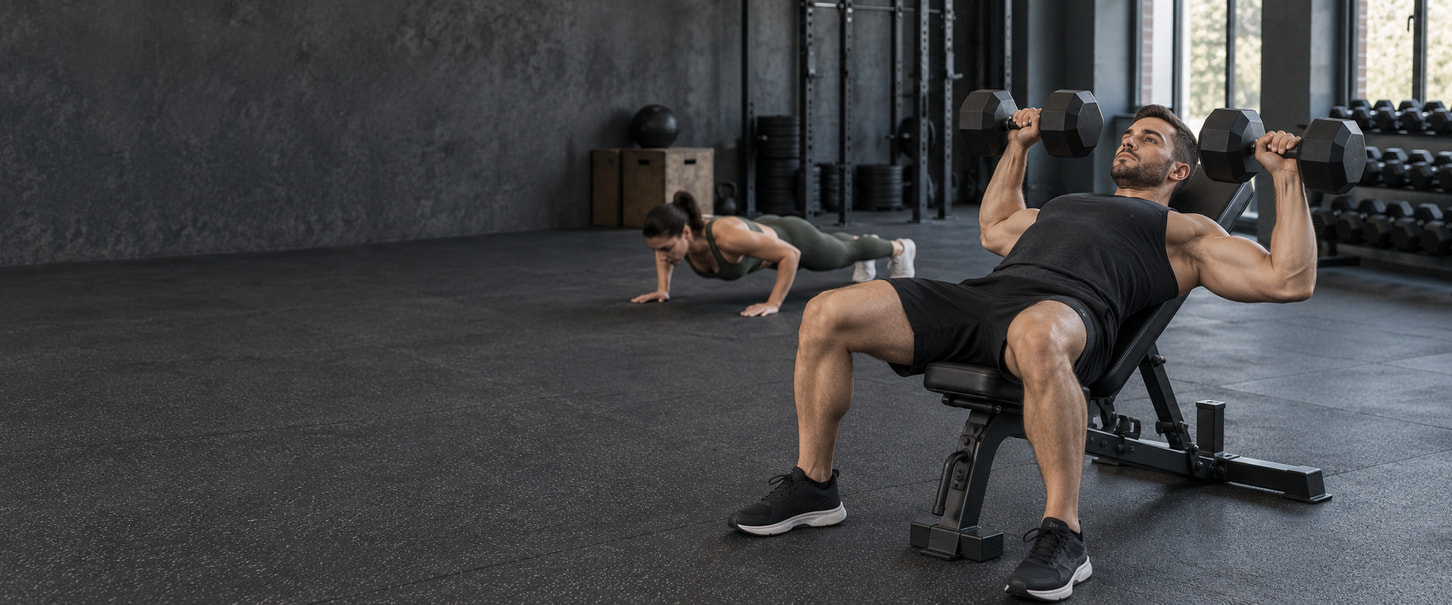
Choose one controllable press that matches the role in your plan: a flat barbell or dumbbell bench press, a fitted machine chest press, or an incline dumbbell press when a different pressing emphasis is useful. With limited equipment, use a push-up or dumbbell floor press. Add a standing cable fly or fitted pec deck only when the complete plan needs adduction-focused work, meaning the upper arms move toward the front of the torso without repeated elbow extension as the main action. The ten detailed entries are a menu, not a ten-exercise workout or a universal best-to-worst ranking. Pressing trains the pectoralis major alongside the anterior deltoids and triceps. A fly keeps the elbow bend more stable and reduces repeated elbow extension, but it does not isolate the chest from every assisting or stabilizing muscle. Choose by the equipment that actually fits, the support and entry or exit you can use, a comfortable repeatable range, and a progression method you can record. This guide provides the comparison, individual technique, and two optional partial blocks. Complete weekly schedules and total training doses remain on the existing workout-plan pages. One well-chosen movement may be enough for an allocated chest slot, and you do not need every press angle, fly type, dip, or push-up variation. Start with the comparison below, then read the entry for the option you intend to use.
Compare Chest Exercises by Equipment and Purpose
Use this matrix to compare the pressing or fly role, required equipment, body support, main execution check, and practical progression method. The ten exercises are selectable options, not a ranked ten-exercise workout. A guided path is useful only when the station fits, while free weights and bodyweight options still require secure setup, a repeatable range, and a controlled exit.
| Exercise | Main use | Equipment and support | Useful when | Main check | Progression |
|---|---|---|---|---|---|
| Flat Barbell Bench Press | Flat shared-bar pressing for the chest, with anterior-deltoid and triceps assistance. | Flat bench in a compatible rack, bar, plates, collars, safety supports, and stable foot and torso support. | Barbell-specific strength or repeatable shared-bar pressing matters and safe rack access is available. | Keep grip, support, and the lower endpoint repeatable; do not bounce or compromise the rerack. | Build reps in the plan range, then use a manageable total-bar increment with the same setup. |
| Flat Dumbbell Bench Press | Flat pressing with independent hand paths for the chest, anterior deltoids, and triceps. | Two dumbbells, a rated flat bench, stable floor, and clear controlled entry and set-down space. | Independent grips and paths are useful and both dumbbells can be positioned and returned safely. | Retain bench and foot support, a repeatable elbow path, and a controllable lower endpoint. | Add clean reps before the smallest useful per-dumbbell increase; keep range and support unchanged. |
| Incline Dumbbell Press | Inclined pressing that changes regional emphasis while still training the wider chest, anterior deltoids, and triceps. | Matched dumbbells and a stable adjustable bench with its backrest locked at one repeatable incline. | A distinct inclined pressing exposure serves the plan without merely duplicating more pressing. | Keep bench setting, support, and hand path fixed; stop before an increasing arch changes the lift. | Progress reps, then per-hand load; treat a meaningful incline change as a new baseline. |
| Machine Chest Press | Guided chest pressing with triceps and anterior-deltoid assistance. | A chest-press machine whose seat, backrest, handles, start range, and permitted assistance can be fitted. | Simpler load handling or a guided path is useful and the particular machine actually fits. | Reach the start without losing back support; do not force the path, lift from the pad, or crash the stops. | Add reps, then the station's smallest suitable increment; record the exact machine and settings. |
| Push-Up | Bodyweight horizontal pressing for the chest and triceps with active shoulder-blade and trunk control. | Nonslip floor, or a secure fixed wall or raised support for the selected regression. | Equipment is limited and body geometry can make the repetition appropriately challenging. | Lower and raise the body together without lumbar sag, neck reach, or collapsing shoulder support. | Increase repeatable reps, then change hand elevation or body lever while recording the geometry. |
| Dumbbell Floor Press | Floor-supported horizontal pressing with a floor-limited lower arm position. | Two manageable dumbbells, a nonslip floor or mat, and a controlled entry and set-down area. | No bench is available and the dumbbells can be positioned and returned safely on the floor. | Do not strike the elbows or bridge the hips; repeat the same floor endpoint and controlled exit. | Progress reps and per-hand load within its own floor-defined range and load history. |
| Standing Cable Fly | Bilateral shoulder horizontal adduction with a relatively stable elbow bend. | Two fitted pulleys, compatible handles, controllable resistance, clear cable travel, and a stable stance. | Adduction-focused chest work is wanted without repeated elbow extension as the main action. | Keep elbow bend, torso position, and open endpoint repeatable; do not turn the fly into a press. | Add reps, then the smallest station increment; preserve pulley height, stance, and body distance. |
| Pec Deck Chest Fly | Supported guided forward fly in which the upper arms close toward the front of the torso. | A fitted chest-fly machine with permitted seat, handle or forearm-pad, and start-range settings. | A supported adduction movement is useful and the station's forward-fly path fits. | Maintain support and intended pad or handle contact; do not use reverse mode or force the open range. | Progress reps, then the smallest station increment while preserving mode and settings. |
| Flat Dumbbell Fly | Optional long-lever free-weight fly with less elbow movement than a press. | Two light securely retained dumbbells, a stable flat bench, and controlled entry and exit. | A free-weight fly is deliberately selected and its opening range can be managed. | Keep a soft near-fixed elbow bend and stop before a forced shoulder stretch or uncontrolled lever change. | Add controlled reps before small per-hand increases without changing elbow angle or depth. |
| Parallel-Bar Dip | Optional bodyweight pressing with chest and triceps contribution and substantial shoulder-extension demand. | Secure purpose-built parallel bars with safe access, or a compatible assisted station when needed. | The user can enter, support, lower, and return through a tolerable controllable range. | Control the descent and safe return; do not force a universal depth, kick, bounce, or improvised setup. | Improve controlled reps and range, then reduce assistance gradually when appropriate; added load is optional. |
A reverse pec deck opens the upper arms backward for a posterior-shoulder task, while the chest-fly pec deck closes them forward. A pike push-up shifts bodyweight pressing toward a raised-hip shoulder-focused geometry. Neither is an unchanged substitute for the chest choices above merely because the equipment or exercise name looks related.
- Define the missing chest role or the equipment, support, or setup constraint that needs solving.
- Remove options whose rack, bench, machine fit, cable path, floor setup, or access cannot be used securely.
- Select one candidate that preserves the intended press or fly role without adding redundant work.
- Read its full instructions and confirm the required entry, support, range, and exit.
- Rehearse a manageable version before counting working sets.
- Fit the exercise into the work already allocated by the complete plan rather than appending another chest session.
Keep the chosen setup and progression record consistent long enough to judge it. Change the exercise for a real fit, equipment, support, or progression limitation, not because the matrix supplies ten names.
Upper, Middle, and Lower Chest: What Exercise Angles Change
The pectoralis major is one broad muscle on each side of the chest with a clavicular region near the collarbone and a larger sternocostal region arising across the breastbone and nearby rib cartilage. Their fibers have different orientations but overlapping roles in moving the upper arm, including bringing it forward and across the torso. The deeper pectoralis minor is a separate muscle that acts on the shoulder blade rather than serving as a lower-chest pressing region. Pressing also uses the anterior deltoids and triceps, while the rotator cuff and muscles controlling the shoulder blade contribute according to the exercise. In a push-up, for example, the serratus anterior helps the shoulder blades move around the rib cage. “Middle,” “lower,” and “inner” chest are useful descriptive labels for exercise discussion, not separate muscles that each require a unique isolation movement.
What incline and horizontal pressing change
A modest incline can be selected when greater clavicular-region emphasis fits the plan. Flat pressing remains useful for the wider pectoralis major, and neither position excludes the other region. Inclination changes the upper-arm path, available support, anterior-deltoid contribution, comfortable range, and load that can be controlled, so use one stable setting that fits rather than chasing the steepest possible bench position. Research performed under specific pressing conditions supports only a cautious regional inference. It does not establish one universally best dumbbell angle, prove that everyone needs both flat and incline pressing, or turn acute muscle-activation readings into a long-term growth chart. Grip, implement path, bench support, and the lifter’s build can also change how the exercise is performed and tolerated.
What lower- and inner-chest labels do not mean
The broader sternocostal region includes fibers people often describe as the middle or lower chest, but those labels do not identify independently isolated muscles. A decline press or a high-to-low cable path can change the direction of resistance and upper-arm movement, yet it still trains overlapping chest regions with assistance from other muscles. The “inner chest” is not a separate structure that switches on when the hands cross or when a hard squeeze is added at the top. Those choices may change range, cable direction, leverage, or the sensation near the breastbone, but they do not move the muscle’s anatomical attachments. Exercise selection cannot promise to close a chest gap, remove fat from one chest area, or diagnose an appearance difference.
Chest movement is not shoulder-blade immobility
During a bench press, the bench supports the torso and shoulder blades, so a comfortable repeatable supported position can help define the press. That does not require forcing the shoulder blades into maximal retraction or permanent downward pressure. The grip, lower endpoint, and support should permit the upper arms to move without losing the chosen bench position. Push-ups use a different support relationship: the hands stay fixed while the shoulder blades normally move around the rib cage as the body lowers and presses away. Serratus and other scapular muscles contribute to that coordinated movement. Normal scapular motion is not the same as a sudden shoulder hike, collapsing support, or body heave that replaces the intended chest press.
Flat Barbell and Dumbbell Bench Presses
Flat barbell and dumbbell bench presses both train the pectoralis major with anterior-deltoid and triceps assistance, but they solve different training tasks. The barbell uses one shared implement and a rack-based setup; dumbbells allow independent hand paths but require separate control of both weights during entry, pressing, and exit. Their loads are not interchangeable, and bench support does not remove the need for bracing, shoulder control, or a safe finish.
Flat Barbell Bench Press
Use the flat barbell bench press for horizontal pressing and specific shared-bar strength practice. It requires a stable flat bench inside a compatible rack, a suitable bar with plates and collars, correctly positioned safety supports, and clear access for a controlled unrack and rerack.
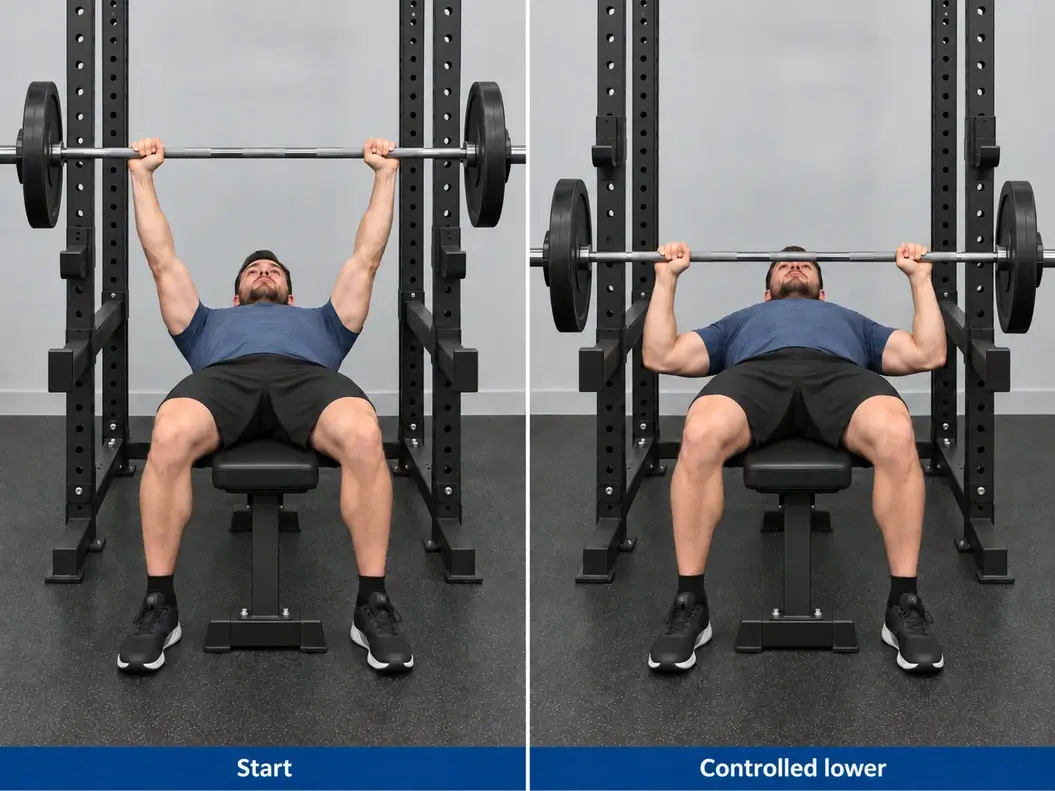
- Set the flat bench securely in the rack. With an unloaded or light bar, verify the rack-out height and position compatible safety supports so they permit the planned range while catching a lowered bar clear of the chest and neck. Obtain qualified setup help when uncertain and use a competent spotter when needed; do not rely on plate dumping, a roll-of-shame escape, or solo failure testing.
- Lie with the head, upper back, and pelvis supported and the feet stable. Set the shoulder blades comfortably against the bench and brace without forcing a maximal arch or permanent downward pinning. Take a full grip with the thumbs around the bar and choose a width that lets the wrists and elbows support the bar at the intended lower position.
- Unrack under control, using assistance when appropriate, and settle the bar above the shoulder region with the elbows extended under control. Do not begin lowering while the bar is still moving across the rack hooks.
- Lower toward a repeatable point on the chest or a separately recorded comfortable endpoint. Let the grip and elbow path fit the lifter rather than forcing one exact angle or extreme flare. Do not bounce the bar or allow the pelvis to leave the bench.
- Press back to a balanced top position without losing the chosen support. End with enough capacity to guide the bar into both hooks, confirm that both ends are supported, and only then release the grip. Stop for concerning pain or loss of control rather than attempting a failed-repetition escape.
Regress by reducing the total load or using a light training bar. Choose a fitted machine or another taught press when the rack setup, safety supports, or competent spotting are unavailable; that substitution begins a separate exercise and load history. Progress by building repetitions within the actual plan range before using a manageable total-bar increase with the same grip, support, and range. Record the total bar-plus-plate mass and unit, grip, bench and rack position, lower endpoint, completed repetitions, actual rest, and estimated effort. This is general training guidance, not competition-technique certification, a maximal-testing instruction, or a universally injury-proof grip.
Flat Dumbbell Bench Press
Use the flat dumbbell bench press for horizontal pressing with independent hand paths. It requires two suitable dumbbells, a rated flat exercise bench, stable floor support, and enough clear space to bring both weights into position and return them safely.
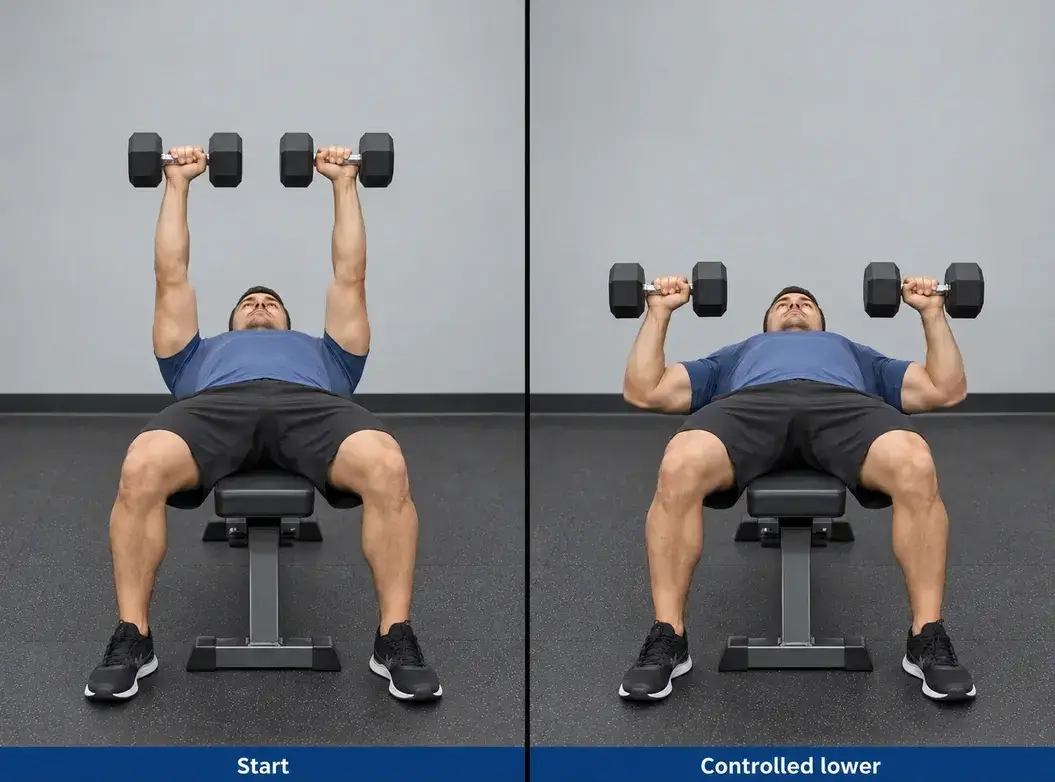
- Check the bench for stability and inspect the dumbbells or adjustable-weight retention hardware. Choose a pair that can be brought into and out of position under control, arranging trained assistance when needed rather than selecting the weights only by pressing strength.
- Sit with the dumbbells organized close to the body and settle onto the flat bench through a controlled entry. Plant the feet and keep the head, upper back, and pelvis supported. Rehearse the entry and exit with light weights before beginning working sets.
- Hold both dumbbells with full grips and support the wrists over the forearms. Lower with an elbow path that feels comfortable and repeatable rather than forcing a maximal flare, one universal grip, or a prescribed lower endpoint.
- Press both weights through controllable independent paths. Do not crash the dumbbells together, lift the hips, or twist the torso to finish one side. Use only the depth that can be reversed without losing the chosen support or control.
- Finish while a controlled return to sitting or assisted set-down remains available. Do not throw the dumbbells, twist out from beneath them, or continue into a failed repetition that cannot be exited safely.
Regress by using a lighter pair or the taught dumbbell floor press when appropriate; the floor changes the available lower range and is not an identical bench press. Progress by increasing technically acceptable repetitions before the smallest useful load increase per dumbbell. Do not convert a barbell maximum or calculator estimate into a dumbbell prescription. Record the mass per dumbbell and unit, grip, bench setup, lower and upper range, completed repetitions, actual rest, estimated effort, and entry or exit changes. Independent implements do not automatically provide greater growth or safety, and bench support does not eliminate normal shoulder motion or the need to brace.
Choose the press that matches the training task
Select between these presses by specificity, equipment fit, setup and exit control, and the progression method the complete plan can support. A barbell is useful for shared-bar practice and small total-load changes when the rack is configured correctly; dumbbells offer independent paths but make positioning and per-hand increments part of the exercise. The Bench Press Calculator is limited to estimates derived from flat barbell-bench performance. It does not prescribe a dumbbell, machine, or incline load, and using it does not require a one-repetition-maximum test. Neither press is a universal growth winner.
Incline Dumbbell Press and Machine Chest Press
These presses offer different forms of support and resistance. The incline dumbbell press uses independent hand paths and an adjustable bench, while the machine chest press follows the geometry of one fitted station. Choose by the role needed in the complete plan, the setup you can enter and exit safely, and the version you can repeat and progress.
Incline Dumbbell Press
Use the incline dumbbell press when an inclined pressing exposure fits the plan without simply adding more redundant pressing. It trains the wider pectoralis major with anterior-deltoid and triceps assistance and requires two matched dumbbells plus a stable adjustable exercise bench with its backrest locked.
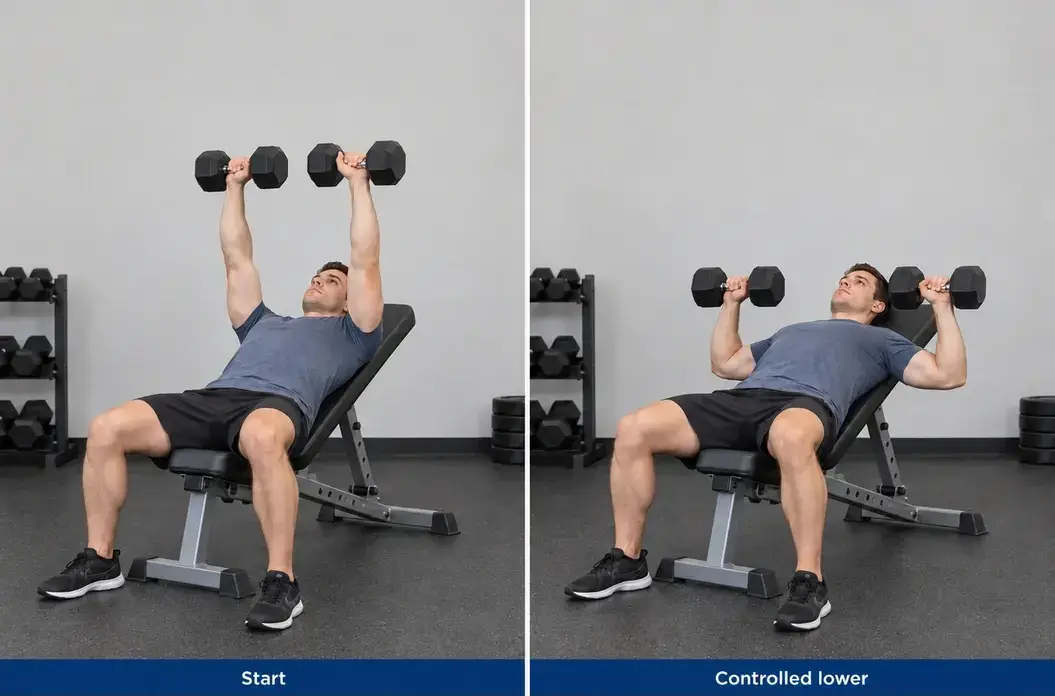
- Lock the bench at a modest incline before handling the working weights. Around 15–30 degrees above horizontal can be a practical starting range to explore when suitable, not a mandatory setting or a scientifically optimal angle. Confirm that the bench is stable and that the dumbbells can be brought into and out of position safely.
- Sit with the dumbbells close to the body, plant the feet, and settle onto the bench through a controlled entry. Maintain head, upper-back, and pelvic support while positioning the weights near the selected lower pressing point.
- Use full comfortable grips with the wrists supported over the forearms. Press above the upper-chest and shoulder region through reproducible independent paths without colliding the dumbbells or manufacturing the finish through increasing lower-back extension.
- Lower both weights to the same comfortable endpoint while keeping the bench setting, body support, and elbow path consistent. Do not raise the backrest during the set or force a depth that cannot be reversed under control.
- End while both dumbbells can still be returned and set down safely. Record the incline version independently because flat-press loads do not transfer automatically.
Regress by reducing the dumbbell load or using a lower suitable inclination. A floor press can preserve a no-bench pressing opportunity, but its floor-limited range does not recreate an incline; do not prop a bench or the body on loose furniture. Progress through technically consistent repetitions before increasing the load per hand. Treat a meaningful angle change as a new setup and performance baseline. Record the bench setting or measured inclination, mass per dumbbell and unit, grip, lower and upper endpoints, completed repetitions, actual rest, estimated effort, and any entry, support, or exit change. No exact best incline or isolated upper-chest switch is claimed.
Machine Chest Press
Use the machine chest press for guided chest pressing with anterior-deltoid and triceps assistance when the particular station fits. A supported machine can simplify weight handling, but its seat, backrest, handles, starting range, assisted-entry controls, and lever path remain specific to that design.
- Read the station instructions and adjust the resistance only while the load is resting. Use the permitted seat, start-position, and handle adjustments so the pressing start is reachable around chest level without forcing the upper arms far behind the torso.
- Use an assisted-entry control only when the station provides one and only as its manufacturer intends. Ask facility staff about unfamiliar controls rather than assuming a generic release pedal or lever procedure.
- Sit with stable foot, pelvic, and back contact and take a full comfortable grip. Press along the station-specific path with controlled elbow extension without lifting from the pad, pushing repeatedly through the legs, or changing the grip to finish.
- Stop at a controllable forward endpoint rather than forcing the handles to touch or slamming a mechanical stop. Return steadily to the fitted lower position without letting the resistance pull the shoulders into an uncontrolled reach or allowing the stack to crash.
- Settle the resistance and use the station’s intended exit procedure before changing any setting or leaving. Select another machine or press when the permitted adjustments still do not provide a reachable, comfortable path.
Regress by reducing the displayed resistance or using a permitted shorter starting range. A fitted machine may simplify entry and stabilization demands, but it does not remove all trunk activity, guarantee safety, or make every station suitable. Progress through repeatable repetitions before using the smallest permitted increment on that exact machine. Record the machine identity, seat, start and handle settings, displayed resistance and unit, grip, range, completed repetitions, actual rest, estimated effort, and any support or path change.
Compare adjustable incline support with a station-specific path
The dumbbell press lets each hand follow its own path while the locked bench angle defines the support. The machine provides a guided path and may make handling simpler, but its geometry and displayed number belong to that station. Read why gym machine weights differ for the broader equipment explanation, and select the working resistance on the actual machine rather than converting another stack, a dumbbell pair, or an incline-press record. Neither option is a universal safety or growth winner. Choose the press that fits the allocated role, permits a controlled start and finish, and offers increments you can track without changing the setup to complete the repetition.
Push-Ups and Dumbbell Floor Presses
Push-ups and dumbbell floor presses provide horizontal pressing options when a bench or full gym setup is unavailable. A push-up changes resistance through body geometry and requires the trunk and shoulder blades to coordinate with the press. A floor press uses external load and floor support but shortens the lower arm travel. Neither option is automatically equivalent to a flat or incline bench press.
Push-Up
Use the push-up as a bodyweight horizontal press for the chest and triceps, with active trunk and shoulder-blade control. The regular floor version uses the hands and feet; a knees-down floor version, secure wall push-up, or hands-elevated push-up on a fixed rated support can reduce the demand without pretending that every version represents the same resistance.
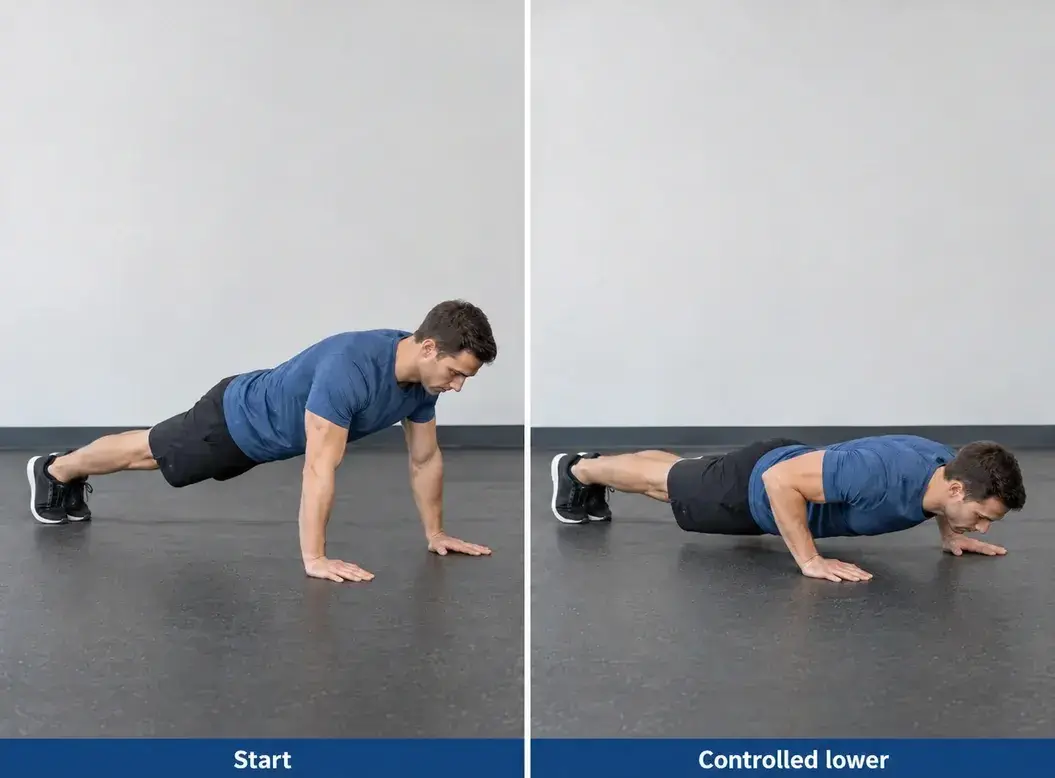
- Select a floor, knees-down, wall, or hands-elevated version whose support will not move. A higher fixed hand support can make the exercise easier; do not use a loose chair, sofa edge, unstable furniture, or a pair of rolling dumbbell handles.
- Place the hands at a comfortable spacing and establish a stable line through the supported body. For a floor push-up, organize the trunk, pelvis, and legs so the body can lower and rise as one unit. For knees-down work, keep the trunk and hips connected rather than folding only at the hips.
- Lower the chest and trunk together through a repeatable range while the elbows follow a comfortable path. Keep the head and neck unloaded, and stop before lumbar sag, a collapsing shoulder position, or a shortened range changes the repetition.
- Press the body away and allow the shoulder blades to move normally around the rib cage instead of forcing a bench-press pinning cue. Return to the same body line without gaining repetitions through hip sag, neck reach, or a changing hand position.
- Finish by returning to a supported rest under control. Change only one lever or support-height variable when progressing, and do not place a loose dumbbell on the back to make the exercise harder.
Regress to a secure wall, higher fixed support, or knees-down version that permits useful whole-body control. These are alternatives, not compulsory stages or exact percentages of body weight. Progress by adding repeatable repetitions, then lowering the hand support or changing the lever when appropriate. If the selected geometry becomes too easy, choose another safely loaded press rather than rushing endless repetitions. Record the hand or support height, foot or knee support, hand spacing, depth, completed repetitions, actual rest, estimated effort, and any body-line change. A pike push-up uses a raised-hip, shoulder-focused position and is a different exercise from the regular push-up taught here.
Dumbbell Floor Press
Use the dumbbell floor press as a floor-supported horizontal press when no bench is available and two manageable dumbbells can be positioned and returned safely. The floor limits the lower position of the upper arms, so this is its own exercise with its own load and range record rather than a substitute that recreates a full flat-bench or incline press.
- Sit on a nonslip floor or mat with manageable dumbbells arranged close to the body. Settle back deliberately with the weights controlled, or use competent assistance. Do not attempt an awkward heavy pickup while already lying on the floor.
- Bend the knees, plant the feet, and hold the dumbbells above the chest with full comfortable grips. Keep the wrists aligned over the forearms and the hips resting on the floor.
- Lower until the upper arms lightly contact the floor or reach an earlier comfortable endpoint. Do not slam the elbows down, bounce from the floor, or force a lower position that the surface prevents.
- Press both dumbbells through controllable independent paths without bridging the hips, changing the grip unpredictably, twisting to finish one side, or striking the weights together. Repeat the same floor-defined range.
- End while the weights can still be lowered and set down through a controlled route, then return to sitting deliberately. Use a lighter pair or a suitable push-up version when entry or exit cannot be managed safely.
Regress with lighter dumbbells or an appropriate push-up version. Floor support does not make every load suitable, and the upper-arm floor contact is part of this variation rather than a cue to force impact. Progress repetitions first, then use the smallest practical increase per dumbbell while the entry, hip position, range, and exit remain consistent. Record the mass per dumbbell and unit, grip, floor-contact or earlier lower endpoint, completed repetitions, actual rest, estimated effort, and entry or set-down changes. Do not transfer a bench-press number, invent an incline with furniture, or treat the floor press as having the same lower range as a bench press.
Choose the option that solves the actual setup constraint
Use a push-up when secure bodyweight geometry supplies an appropriate challenge and the body can move as one unit. Use the floor press when manageable dumbbells provide a clearer loading path and the floor entry and exit are controllable. Progress within the selected version long enough to compare like with like, and fit it into an existing chest allocation rather than turning these two exercises into a new home routine.
Cable Flyes, Pec Deck, and Dumbbell Flyes
Flyes emphasize shoulder horizontal adduction: the upper arms move toward the front of the torso while the elbows retain a relatively stable soft bend. That reduces repeated elbow extension compared with a press, but it does not isolate the chest from every assisting or stabilizing muscle. Cable, machine, and dumbbell versions apply resistance and support differently, so select one that fits the available equipment, controllable range, and progression method rather than performing all three.
Standing Cable Fly
Use the standing cable fly as a bilateral adduction-focused chest exercise when two fitted pulleys, compatible handles, controllable resistance, and a clear standing and cable path are available. This teaching version uses both pulleys around mid-chest height, a stable stance, and a repeatable open range with a relatively fixed elbow bend.
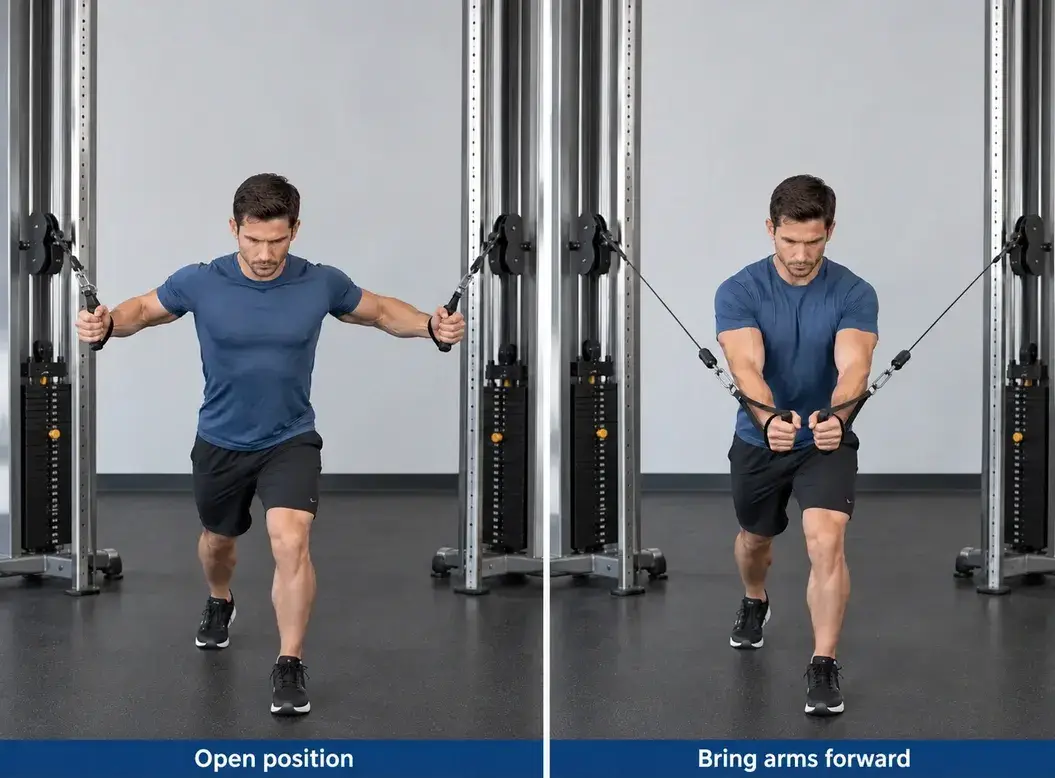
- Set both pulleys around mid-chest height as the selected teaching setup, not as an ideal position for every station or person. Attach compatible handles while both stacks rest, inspect the cable routes, and clear the cables from the body and surrounding equipment.
- Take the handles and enter a stable staggered stance without allowing the resistance to pull you backward. Begin with the arms open through a modest controllable range, the elbows softly bent, and the wrists comfortable.
- Bring the upper arms toward the front through a hugging arc while keeping approximately the same elbow bend and torso position. Let the hands approach each other without requiring them to cross.
- Return along the same arc only as far as shoulder comfort and control allow. Do not chase a deep stretch, launch the resistance with a body lean, or repeatedly bend and extend the elbows as though performing a press.
- Step back toward the station and settle both stacks under control before releasing the handles. Do not walk out of a loaded cable position in a way that drags an arm behind the body.
Regress by reducing the displayed resistance or using a smaller repeatable open range. Choose a fitted pec deck or an appropriate press when the two-cable setup cannot be entered, performed, and released securely. Progress through controlled repetitions before the smallest permitted station increase; changing pulley height or body distance creates a different setup record. Record the station, both pulley heights or settings, displayed resistance per side and unit, stance, body distance, elbow bend, hand path, open and closed endpoints, completed repetitions, actual rest, and estimated effort. Cable tension, joint torque, and muscle force are not the same quantity and are not constant by definition. Mid-, high-, and low-cable paths do not create an inner-, upper-, or lower-chest isolation switch. This entry uses both arms together; unilateral work would require an explicit side and recovery prescription.
Pec Deck Chest Fly
Use the pec deck chest fly as a supported bilateral adduction exercise when the station can be fitted in its forward chest-fly configuration. The upper arms close toward the front of the torso while the back remains supported; this is distinct from the rear-delt reverse-pec-deck mode, in which the arms open backward.
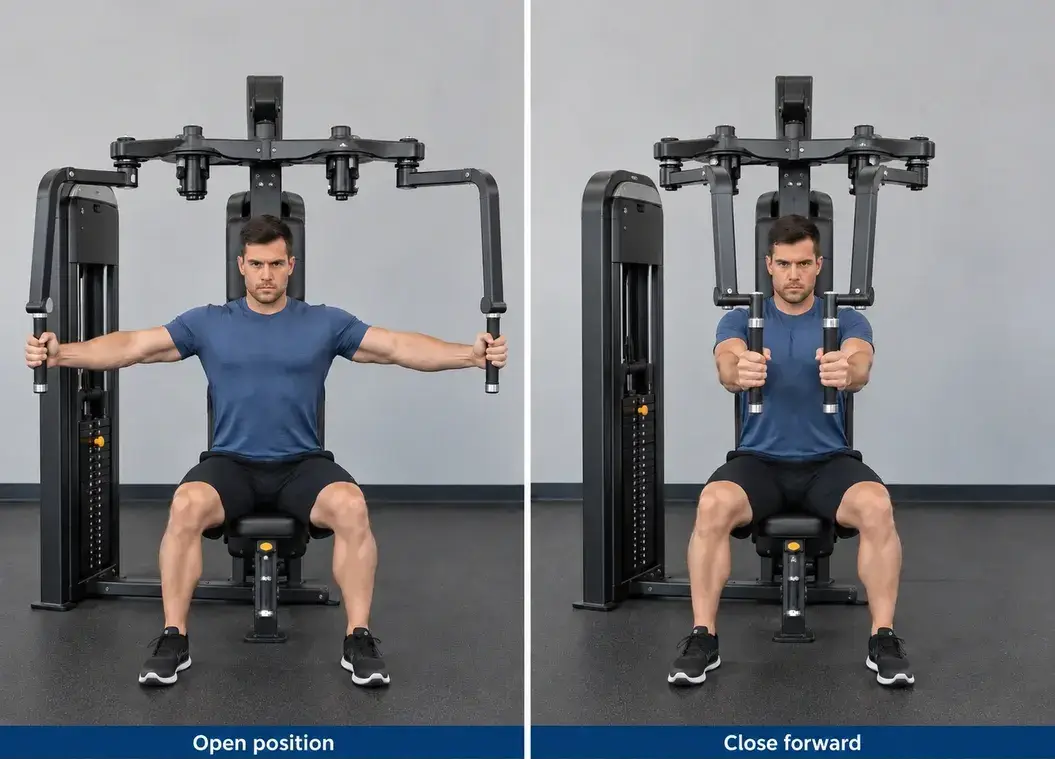
- Set the machine to its chest-fly mode rather than the rear-delt reverse configuration. With the resistance at rest, adjust the seat and permitted starting range and confirm whether the design uses handles or forearm pads.
- Sit with the feet and back supported. Reach the handles or pads without leaving the backrest or allowing the station to pull the shoulders into an excessive open position.
- Bring the upper arms forward along the designed fly arc. Keep the selected elbow arrangement and intended handle or forearm-pad contact consistent instead of changing the movement into a chest press.
- Return steadily to the permitted open endpoint without crashing the stack or allowing the machine to force the shoulders backward. The handles or pads do not need to collide at the front.
- Bring the resistance fully to rest using the station's intended procedure before leaving or changing any setting. Select another option when the available adjustments still do not provide a comfortable, reachable path.
Regress by reducing the resistance or using a smaller permitted opening. A standing cable fly changes the support, path, and load scale; its number is not a machine conversion. Progress repetitions first, then use the smallest suitable increment while preserving the chest-fly mode, seat, start position, and contact arrangement. Record the machine identity, seat and start settings, handle or forearm-pad design, displayed resistance and unit, elbow arrangement, open and closed endpoints, completed repetitions, actual rest, and estimated effort. Handle and forearm-pad machines are different implementations, and a reverse pec deck teaches the opposite upper-arm direction rather than an interchangeable chest fly.
Flat Dumbbell Fly
Use the flat dumbbell fly only when a free-weight fly is deliberately selected and its longer arm lever can be controlled. It requires two light securely retained dumbbells, a stable flat exercise bench, supported entry and exit, and an opening range that does not depend on chasing a deep stretch.
- Choose dumbbells that are substantially easier to control than a press load, inspect their retention hardware, and settle onto a stable flat bench with the head, upper back, pelvis, and feet supported.
- Begin with the dumbbells above the chest, full grips, comfortable wrists, and a soft elbow bend that can remain nearly unchanged through the repetition.
- Open the arms in a broad controlled arc while preserving the selected elbow bend. Stop at a reproducible shoulder-tolerated point; lowering the weights beneath bench level is not a target.
- Bring the upper arms back toward the front through the same arc without converting each repetition into a press, sharply changing the elbow angle, or striking the dumbbells together.
- Finish well before control or a safe exit is threatened and return the weights securely. Do not stretch a fatigued shoulder farther to manufacture another repetition.
Regress with lighter dumbbells and a shorter controllable opening, or choose a fitted cable fly, pec deck, or press when that setup is more appropriate. Progress through controlled repetitions before a small increase per dumbbell; elbow bend and opening depth must remain comparable rather than changing silently to move more weight. Record the mass per dumbbell and unit, bench setup, grip, elbow bend, open and closed endpoints, completed repetitions, actual rest, estimated effort, and entry or exit changes. Gravity's leverage changes through the arc, and squeezing at the top does not isolate an inner-chest muscle. The dumbbell fly is optional, not a compulsory stretch exercise or a universally superior alternative to pressing.
Choose one fly that fits the equipment and progression
A cable fly provides an adjustable cable direction and station-specific increments while requiring two secure cable routes and a stable stance. A fitted pec deck supplies external back support and a guided path whose seat, contact points, and load scale must match the user. A dumbbell fly allows independent free-weight paths but uses a long lever and usually smaller manageable loads. Keep each station, bench, load, range, elbow arrangement, and progression history separate. Choose the version that permits a useful repeatable adduction task within the complete plan; do not perform all three, rank one as universally safest or most hypertrophic, or use hand crossing and top squeezing as an inner-chest isolation method.
Chest Dips and Other Optional Variations
Parallel-bar dips, decline presses, changed cable paths, and squeeze presses are optional choices rather than missing categories every chest plan must include. Use them only when their equipment, setup, range, and progression solve a real goal or constraint. None isolates a separate lower- or inner-chest muscle.
Parallel-Bar Dip
Use the parallel-bar dip as an optional bodyweight press with chest and triceps contribution and substantial shoulder-extension demand. It requires secure purpose-built parallel bars with controlled access, or a compatible assisted station when bodyweight support is not yet manageable.
- Inspect the rated station and its access steps before starting. Use a compatible assisted-dip machine when bodyweight cannot be controlled, and learn its moving support and exit procedure from the station instructions. Do not improvise between chairs or add an unreviewed loose band.
- Take full grips and establish a stable top support with the arms extended under control. A modest forward inclination may suit a chest-oriented version, but do not dive the head forward or force the shoulders downward.
- Bend the elbows and lower only through a range that can be reversed without sharp discomfort, lost support, or excessive shoulder travel behind the body. No universal elbow angle or maximum depth is required.
- Press back to the selected top position without kicking, bouncing, or changing the torso angle to manufacture the finish. End the set while a controlled return to the access support remains available.
- Return deliberately to the steps or to the assisted station’s resting position before releasing the grips. Use a taught machine press or push-up when the support or lower position remains unsuitable.
Regress with properly configured machine assistance or a more easily adjusted press. A chair or bench dip is a different exercise and is not the default regression. Progress by improving controlled repetitions and the usable range, then reducing assistance gradually when appropriate; added external loading is not required or taught here. Record body mass when tracked, the exact station or assistance setting, torso position, lower endpoint, completed repetitions, actual rest, estimated effort, and the reason the set ended. This entry does not prescribe a deep dip, promise lower-chest isolation, require an unassisted milestone, or claim general injury prevention.
Decline pressing and cable-path variations
A decline press changes the torso-to-arm relationship and usually requires a purpose-built decline bench or fitted machine with secure entry, support, and exit. It can be a useful pressing variation when that setup and angle fit, but this brief description is not a complete barbell, dumbbell, or machine-decline tutorial. Do not improvise the angle with household furniture or assume a steeper decline is automatically better. A high-to-low cable fly changes the line of pull, pulley setup, and upper-arm path compared with the bilateral mid-height cable fly already taught. A squeeze press is another pressing choice that keeps the dumbbells close together, not an inner-chest requirement or a method that moves the muscle’s attachments. Use the detailed taught press or fly entries when a fully specified alternative is needed, and begin a new setup and load record after a material change.
Do you need another chest exercise?
Add a variation only when it answers a defined need such as equipment access, a specific pressing skill, a tolerable range, or a progression problem. Dips, decline pressing, and high-to-low cable paths can change the task, but none isolates a separate lower-chest muscle or makes the existing flat, incline, machine, push-up, floor-press, or fly options incomplete. Keep a familiar productive exercise while it fits the plan and progresses. Do not turn these short variation descriptions into an unreviewed program or append them all to existing chest work. Stop and settle the resistance for lost support or control; stop for sharp, radiating, worsening, or persistent concerning symptoms and seek appropriate assessment instead of testing progressively deeper alternatives.
Chest Exercises at Home and Without a Bench
Choose from the secure equipment and usable resistance you actually have, not from the word “home” or “gym.” Floor space can support push-ups and floor presses, a rated adjustable bench adds supported flat and incline choices, and fitted stations add guided pressing or fly options. Equipment location alone does not guarantee that the load, support, range, or technique will fit.
| Available setup | Practical choices | Important limitation |
|---|---|---|
| Floor or secure wall only | A suitable push-up version | No improvised chest fly, chair dip, or unstable handle setup; change the lever when needed. |
| Dumbbells without a bench | Dumbbell Floor Press; Push-Up | Floor limits lower arm travel and does not recreate incline pressing. |
| Dumbbells and a rated adjustable bench | Flat Dumbbell Bench Press or Incline Dumbbell Press; optional light Flat Dumbbell Fly | Choose the needed role; all three are not compulsory. |
| Cable, press, or fly station | Machine Chest Press, Standing Cable Fly, or fitted Pec Deck Chest Fly | A gym location does not guarantee fit; exact apparatus and settings matter. |
Choose one movement for the allocated role
Start with the role already assigned by the complete plan. Use a press when pressing is needed, or an adduction-focused fly when that separate role is deliberately allocated. Remove options that lack secure support, manageable resistance, or a repeatable entry and exit, then select one taught movement and progress that version instead of treating the table as four stages or adding every available exercise. A no-bench floor press does not reproduce an incline or the full lower range of a bench press. Ordinary push-ups need stable floor, wall, or fixed-support geometry; they do not require makeshift furniture or a cable attachment. Record the chosen push-up lever, floor-press range, bench setting, or machine configuration so a material change starts a new comparison.
Match the resistance to the exercise
A very light dumbbell pair may work for a fly yet become too easy for pressing, while an overly heavy pair is not appropriate merely because an article lists dumbbell exercises. Use only loads that permit the taught setup, range, and safe exit. The dumbbell floor press taught here uses two weights. With only one dumbbell, use a suitable push-up version or follow a separate plan that explains single-arm pressing and its sets and repetitions for each side. Readers seeking a complete five-session dumbbell schedule can use the 5-Day Dumbbell Workout Plan. It is a separate full program with its own exercise order, recovery, bench and no-bench branches, and progression rules, not a chest block to append to another routine.
Build a Chest Workout Without Redundant Sets
These are two alternative partial chest blocks for a slot inside an otherwise complete plan. They are not complete Push, upper-body, or full-body sessions; automatic weekly prescriptions; add-ons to an existing chest day; or claims that different set totals produce equal results. Choose the block whose equipment and role fit, then let the complete plan control placement, other exercises, and recovery. The ranges, tempos, initial effort, and progression rule below are original coaching choices for these examples. They do not replace the real Push A source extract in the next section or import the separate progression rule used by the 5-Day Dumbbell Workout Plan.
Block A: Fitted machine press plus cable fly
Use this partial block when the complete plan deliberately allocates one supported chest press and one adduction-focused fly, and both stations can be fitted and exited under control. It combines pressing and fly work without becoming a full upper-body session.
| Exercise | Sets & Reps | Rest | Tempo | Target Muscles | Notes |
|---|---|---|---|---|---|
| Machine Chest Press | 3 sets of 8–12 reps | 120–180 seconds | 2-1-1-0 | Chest, anterior deltoids, triceps | Use one fitted station and leave about 2–3 technically sound reps in reserve. |
| Standing Cable Fly | 2 sets of 12–15 reps | 60–120 seconds | 2-1-1-1 | Pectoralis major; shoulder stabilizers assist | Use both arms together; keep the elbow bend and open endpoint repeatable. |
The block contains 3 + 2 = 5 bilateral working sets. Both arms act within each set, so there is no side expansion. It develops one chest-pressing and one fly allocation; it does not supply the rest of an upper-body or Push session.
Block B: Minimal bodyweight option
Use this smaller partial block when one secure push-up geometry provides a controllable chest-pressing challenge. Select a wall, fixed hands-elevated, knees-down, or floor version for the block; do not perform all four as separate exercises or treat them as compulsory stages.
| Exercise | Sets & Reps | Rest | Tempo | Target Muscles | Notes |
|---|---|---|---|---|---|
| Push-Up | 3 sets of 8–15 reps | 90–150 seconds | 2-1-1-0 | Chest, triceps, anterior deltoids; trunk and scapular muscles assist | Choose a wall, fixed hands-elevated, knees-down or floor version that leaves about 2–3 good reps in reserve. |
This is 3 bilateral working sets, not 6 sets because two arms press together. The intentionally smaller block is not claimed to equal the five-set gym block, meet every lifter's weekly chest requirement, or become three exercises merely because several push-up geometries are available.
Use either block with repeatable execution
- Check the fit and security of the selected equipment or support, rehearse the movement, and perform progressively heavier non-fatiguing warm-up sets when needed. Warm-up and rehearsal work does not count toward the listed working-set totals.
- Choose resistance or body geometry that permits the lower repetition target with about 2–3 technically sound repetitions in reserve and a controlled exit. An unfamiliar setup may justify an easier introductory exposure and fewer working sets. Do not use a generic starting-weight chart or a failure test.
- Perform straight sets. Take the listed rest after every working set and before moving from the final set of one exercise to the next exercise. Take more recovery when needed for repeatable performance; do not silently turn the block into a superset or circuit.
- For a press or push-up, 2-1-1-0 means lower for two seconds, pause for one second at the comfortable lower position, press in about one second, and use no deliberately prolonged top pause. For the cable fly, 2-1-1-1 means open for two seconds, pause for one second at the comfortable open position, close forward in one second, and hold the controllable closed position for one second. A zero does not mean bounce, and no forced stretch or joint endpoint is used to satisfy a pause.
- Use double progression within the displayed range: build acceptable repetitions while setup, range, rest, and intended effort remain comparable. When every prescribed set reaches the upper target, try the smallest safe increase or an appropriate harder push-up geometry. If the lower target cannot be met to standard, retain or reduce the demand instead of grinding.
- Review the complete plan before using a block. Retain, replace, reduce, or omit existing chest work rather than adding this block automatically. Account for other pressing, shoulder and triceps work, and recovery; do not infer a universal weekly frequency or dose from these examples.
Chest presses also train the anterior deltoids and triceps, so use the shoulder exercise selection guide when the wider plan's shoulder allocation needs review. Overlap does not mean a chest block should replace every shoulder exercise, and it is a reason to replace or reduce redundant work rather than append more sets automatically. Strength-specific barbell practice belongs in an appropriate complete plan with its own exercise order, rest, effort, and progression. The next section provides the relevant real source extract. Neither constructed block promises a session duration, requires failure, or supplies a generic starting load.
Fit Chest Exercises Into Your Existing Workout Plan
The Push Pull Legs Workout Plan provides a real example of how chest exercises fit beside shoulder and triceps work. The four rows below are a selected extract from one occurrence of Push A: Chest-Emphasis Workout. They are not all six original rows, the complete Push session, the whole workout plan, or a weekly volume total. The extract shows the source prescription without claiming that it is optimal for every reader.
Push A: selected source rows
| Exercise | Sets & Reps | Rest | Tempo | Target Muscles | Notes |
|---|---|---|---|---|---|
| Barbell Bench Press or Machine Chest Press | 3 sets of 5–8 reps | 2–4 minutes | 2-1-X-0 | Chest, triceps, anterior delts | Use safeties or a competent spotter; keep the same touch point and range. |
| Incline Dumbbell Press | 3 sets of 8–12 reps | 2–3 minutes | 3-1-1-0 | Upper chest, triceps, anterior delts | Use a bench angle and depth that remain comfortable and repeatable. |
| Seated Dumbbell or Machine Shoulder Press | 2 sets of 8–12 reps | 2–3 minutes | 2-1-X-0 | Deltoids, triceps | A stable seated variation limits unnecessary lower-back fatigue. |
| Cable Fly or Pec Deck | 2 sets of 12–15 reps | 60–120 seconds | 3-1-1-1 | Chest | Control the stretched position without forcing the shoulder beyond a tolerable range. |
For one occurrence of this extract, the selected chest work is the first press for 3 sets, the incline press for 3 sets, and one fly choice for 2 sets: 3 + 3 + 2 = 8 chest-focused exercise sets. The seated shoulder press adds 2 separate overhead-press sets, so the extract contains 8 + 2 = 10 selected exercise sets. Those 10 are not 10 isolated chest sets. Warm-ups, the two omitted Push A rows, other training days, and any other sessions are outside this count. “Barbell Bench Press or Machine Chest Press” means one three-set choice, not both. “Cable Fly or Pec Deck” means one two-set choice, not both. The source supports different scheduling modes, so this extract does not assume Push A always occurs on Monday and does not convert one occurrence into a weekly total.
Preserve the source tempo and effort context
The source generally uses approximately one to three technically sound repetitions in reserve for this type of work, with its own preparation, recovery, and progression rules. Its four-part tempo is lowering or return, starting-position pause, lift or pull, and finish pause. In the two press rows, X means controlled acceleration intent rather than a bounce, leg drive, forced repetition, or guaranteed bar speed. The source fly tempo is 3-1-1-1: open or release for 3 seconds, pause for 1 second at the comfortable open position, close for 1 second, and hold the controllable finish for 1 second. That differs legitimately from the separate constructed block's 2-second opening. Do not replace the source tempo, effort context, or progression with the examples from another section.
Replace the fly choice without adding extra sets
The source already permits Cable Fly or Pec Deck in the same two-set row. When a fitted pec deck is selected instead of the cable fly, retain the source row's 2 sets of 12–15 repetitions, 60–120 seconds of rest, and 3-1-1-1 tempo. Choose a new manageable resistance on that station rather than converting the cable-stack number.
| Situation | Fly-choice sets | Chest-focused sets in this Push A occurrence |
|---|---|---|
| Original: cable fly chosen | 2 | 3 + 3 + 2 = 8 |
| Replacement: pec deck chosen instead | 2 | 3 + 3 + 2 = 8 |
| Unintended addition: both choices performed | 2 + 2 = 4 | 3 + 3 + 2 + 2 = 10; this adds work rather than substituting |
Selecting the pec deck instead leaves the chest-focused count at 8. Performing both fly choices raises the fly allocation from 2 to 4 sets and the chest-focused count from 8 to 10, so it is an addition rather than a substitution. Equal raw set counts do not prove that cable and pec-deck sets create identical force, fatigue, muscle involvement, or long-term results. Presses involve the chest, anterior deltoids, and triceps to different degrees, but that overlap does not award identical isolated set credit to every named muscle. Use the guide to counting workout sets when making broader accounting assumptions. Keep the complete PPL plan's schedule and exercise allocations unchanged when applying this one-for-one substitution.
Progress Chest Training With Repeatable Technique
Progress the exact exercise version assigned by the plan rather than comparing unrelated equipment. Keep fit, support, range of motion, typical rest, and the intended effort standard repeatable while adding technically acceptable repetitions inside that exercise's prescribed range. The reps in reserve estimate is the number of additional repetitions you believe you could complete with the same setup and technique, not repetitions gained by shortening the range, changing support, or forcing a failed repetition. Record resistance in the unit that belongs to the exercise: mass per dumbbell for a dumbbell pair, total bar-plus-plate mass for a barbell, and the displayed resistance plus exact settings for a machine or cable station. Bodyweight exercises require their support height or body geometry. Those records make progression interpretable without pretending that different implements share one load scale.
Use a repeatable chest-progression sequence
- Review the previous records before changing anything. Confirm the exercise version, equipment identity, bench or seat settings, grip, support, range, rest, completed repetitions, and estimated effort. A new machine, bench angle, elbow lever, or push-up support height may require a new baseline rather than a direct comparison.
- Rebuild an appropriate starting demand when the setup is new or performance has been interrupted. Rehearse the entry, movement, return, and exit, then choose a resistance or push-up geometry that permits the lower end of the plan's range with the intended repetitions in reserve.
- Keep the version comparable and add controlled repetitions within the plan's range. A set qualifies only when the intended support, range, technique, rest, and effort remain available; repetitions produced by bouncing, body heave, shortened travel, or an unsafe exit do not qualify.
- When every prescribed set reaches the upper target at the intended standard, use the smallest useful load increase or an appropriate harder push-up lever. If the available increment is too large, retain the current demand or choose one documented alternative with its own baseline. Do not attach loose or improvised weight to manufacture a smaller increase.
- When repeated performance or recovery declines, first remove unplanned additions and review the complete plan. Temporarily reduce sets, resistance, range, or exercise demand when appropriate instead of adding every press and fly variation to solve a recovery problem.
A changed setup can still be productive, but name it accurately. Moving to a different machine, changing the bench inclination, altering a fly's elbow lever, or lowering a push-up support changes the resistance conditions and may start a new performance record. Keep the previous history rather than rewriting the change as uninterrupted load or repetition progress.
Read the constructed machine-press example correctly
This example uses Block A's Machine Chest Press for 3 sets of 8–12 repetitions on the same fitted station, with the same settings, range, tempo, typical rest, and intended effort. It is a constructed teaching record, not a tested client's log. The exposures are not promised to occur in consecutive weeks and are not a generic progression table for every chest press.
| Exposure | Set 1 | Set 2 | Set 3 | Decision |
|---|---|---|---|---|
| A | 10 | 9 | 8 | Keep the same resistance and add controlled repetitions. |
| B | 12 | 12 | 11 | Keep it; the third set has not reached 12. |
| C | 12 | 12 | 12 | All three sets qualify only if effort, fit and range are retained. |
| D | 8 | 8 | 8 | One illustrative outcome after the smallest suitable increase; not a promised result. |
Exposure A remains within the range but has room for additional controlled repetitions. Exposure B is not ready because the third set remains below 12. Exposure C qualifies only when the same fit, support, technique, range, rest, and intended effort are retained. Exposure D illustrates one possible result after the smallest suitable machine increase; it does not guarantee an immediate 8/8/8 result or prescribe a starting resistance. This Chest hub illustration uses one qualifying exposure to demonstrate its decision. It does not revise the 5-Day Dumbbell Workout Plan's separate two-comparable-exposure rule or the progression rules of any released workout plan.
Reduce unproductive work before adding more variations
When chest performance, setup quality, or recovery deteriorates across comparable exposures, review the complete week's pressing, fly, shoulder, and triceps work. A temporary reduction in direct sets or exercise demand is often more useful than appending another angle, machine, or isolation exercise. There is no compulsory deload calendar, universal growth deadline, or formula that converts every indirect press contribution into identical chest-set credit. Stop and settle the resistance when support, equipment, or control fails. Sharp, radiating, worsening, or persistent concerning symptoms require appropriate assessment rather than another exercise trial or a succession of deeper ranges. Use your training record to judge progress across comparable sessions; repetitions do not have to increase every session.
Common Chest-Training Mistakes and Corrections
Use these corrections when the selected chest exercise, setup, or progression standard changes in an observable way. They help preserve the intended pressing or fly role without turning soreness, sensation, appearance, or one photograph into a diagnosis.
| Mistake | Practical correction |
|---|---|
| Treating the comparison as a ten-exercise workout | Choose only the movements the complete plan allocates. |
| Adding presses without reviewing shoulder and triceps work | Count actual pressing exposures and adjust within the full plan, not by muscle-name arithmetic. |
| Forcing one grip, bench angle or bottom depth | Use a repeatable fitting setup; change equipment when allowed adjustments cannot make it workable. |
| Turning a fly into a press as fatigue rises | Reduce load or stop when the elbow bend no longer stays reasonably consistent. |
| Using a machine stack as a dumbbell conversion | Start a separate station/implement record and select effort directly. |
| Chasing chest contact or an extreme stretch | Use the intended controllable endpoint; no bounce, forced dip depth or deep fly requirement. |
| Applying a rigid bench cue to push-ups | Allow the shoulder blades to move with the bodyweight press. |
| Logging more reps after changing range or support | Name the new variation or reestablish the old standard before comparing results. |
Normal muscular effort can include local fatigue, warmth, or a temporary pump while technique remains repeatable. Sharp, radiating, worsening, or persistent concerning pain, numbness, unexpected weakness, or loss of normal control is not a cue to test another harder repetition; stop and seek appropriate assessment when needed. End the set when the equipment, body support, grip, range, or exit can no longer be controlled. Do not use soreness, a photograph, a chest gap, or one side feeling different to diagnose impingement, a pec tear, postural disease, asymmetry, or an “inactive” chest. Keep the familiar productive exercise when it still fits, and apply the smallest relevant correction rather than adding a new movement or rewriting the plan.
Chest Exercise and Workout FAQs
What are the best chest exercises for muscle growth?
The best choices are movements you can fit, control, recover from, and progress within the complete plan. Practical options include a flat barbell, dumbbell, or fitted machine press; an incline dumbbell press when a different regional emphasis is useful; a push-up or floor press when equipment is limited; and one cable or machine fly when adduction-focused work is allocated. There is no universal winner or reason to perform the full ten-exercise menu.
Is the bench press necessary to build my chest?
No. Dumbbell presses, fitted machine presses, suitably difficult push-ups, floor presses, and fly variations can all contribute to chest training when their setup, effort, range, and progression are appropriate. Barbell bench pressing becomes necessary when the goal specifically includes improving barbell-bench skill or strength, because that goal requires relevant practice rather than a claim that the exercise is compulsory for hypertrophy.
How many chest exercises should I do in a workout?
Use the number already allocated by the complete workout plan. One controllable press may be enough for a chest slot; a second press or one fly can be useful when the plan deliberately assigns a different role. Do not turn the comparison table into a ten-exercise workout or append a full partial block to chest work that is already prescribed.
How often should I train my chest?
Frequency depends on the complete week's direct chest work, overlapping shoulder and triceps pressing, effort, progression, and recovery. A schedule that performs well and recovers is more useful than a fixed session count copied without context. Use complete workout plans for the weekly structure rather than treating this exercise guide or its partial blocks as a full schedule.
Can push-ups build chest muscle?
They can support muscle growth when the selected wall, elevated, knees-down, or floor geometry is difficult enough, repetitions remain controlled, and the version can be progressed. Record the support height, body lever, range, and actual reps. A push-up is bodyweight resistance, but every variation does not equal every barbell, dumbbell, or machine prescription.
What are the best chest exercises with dumbbells and no bench?
Use the dumbbell floor press when two manageable dumbbells can be positioned and returned safely, and use a suitable push-up version for an additional bodyweight option when the plan needs it. The floor press has a floor-limited lower range and does not recreate an incline or the full range of a bench press. The floor press described here uses two dumbbells; single-arm pressing needs its own setup and a separate set-and-repetition prescription for each side.
Does incline pressing isolate the upper chest?
No. A modest incline can place greater emphasis on the clavicular region while the wider pectoralis major, anterior deltoids, and triceps still contribute. Choose a comfortable repeatable setting rather than chasing the steepest angle. A meaningful angle change changes the exercise conditions and should begin a new setup and load record.
Can I isolate my inner chest or close a chest gap?
The inner chest is not a separate muscle that switches on when the hands cross or when you squeeze harder at the top. Those choices can change leverage, range, or sensation, but they do not move the pectoralis major's anatomical attachments. Exercise cannot guarantee closure of a chest gap or redesign inherited attachment shape.
Are cable flyes, pec deck, and dumbbell flyes interchangeable?
No. A cable fly depends on pulley height, stance, body distance, and the station's resistance; a pec deck supplies back support and a guided machine path; and a dumbbell fly uses gravity with a longer free-weight lever. Keep each load, range, elbow position, and equipment record separate. Select one version that fits the allocated role rather than transferring one load number or performing all three.
What should I change if I feel a press mainly in my shoulders or triceps?
Anterior-deltoid and triceps involvement is normal and does not prove the chest is inactive. Check whether the load permits the intended range, whether the grip and elbow path are comfortable, whether bench or machine support is retained, and whether fatigue is changing the movement. Reduce the demand or choose another taught press when the setup cannot be made repeatable. Stop for sharp, radiating, worsening, or persistent concerning pain and seek appropriate assessment rather than chasing a stronger chest sensation. Next action: choose one useful exercise, rehearse its setup, fit it into the work already allocated, record comparable performance, and adjust from the results and recovery.