
Face Pulls: What They Train and When to Use Them
A face pull combines a pull towards the upper face with elbow bending and a comfortable outward rotation of the upper arms. Use a suitable cable station and rope, keep the torso steady, and return the hands forwards under control. The rear shoulders and upper back contribute; this is not isolated shoulder external rotation. Start with manageable resistance and an attachment that leaves space beside the face. More load, a larger backward lean, or forcing the hands behind the head does not make the repetition better. A band is an option only when its actual equipment and anchoring instructions permit the setup. Use face pulls when that combined movement fits the work already assigned by your workout plan. The guide below teaches the cable movement first, explains equipment and alternatives, and works through one existing two-set prescription. It does not add a compulsory daily drill or promise to correct posture or treat pain.
How to Do Cable Face Pulls
Standing Cable Face Pull
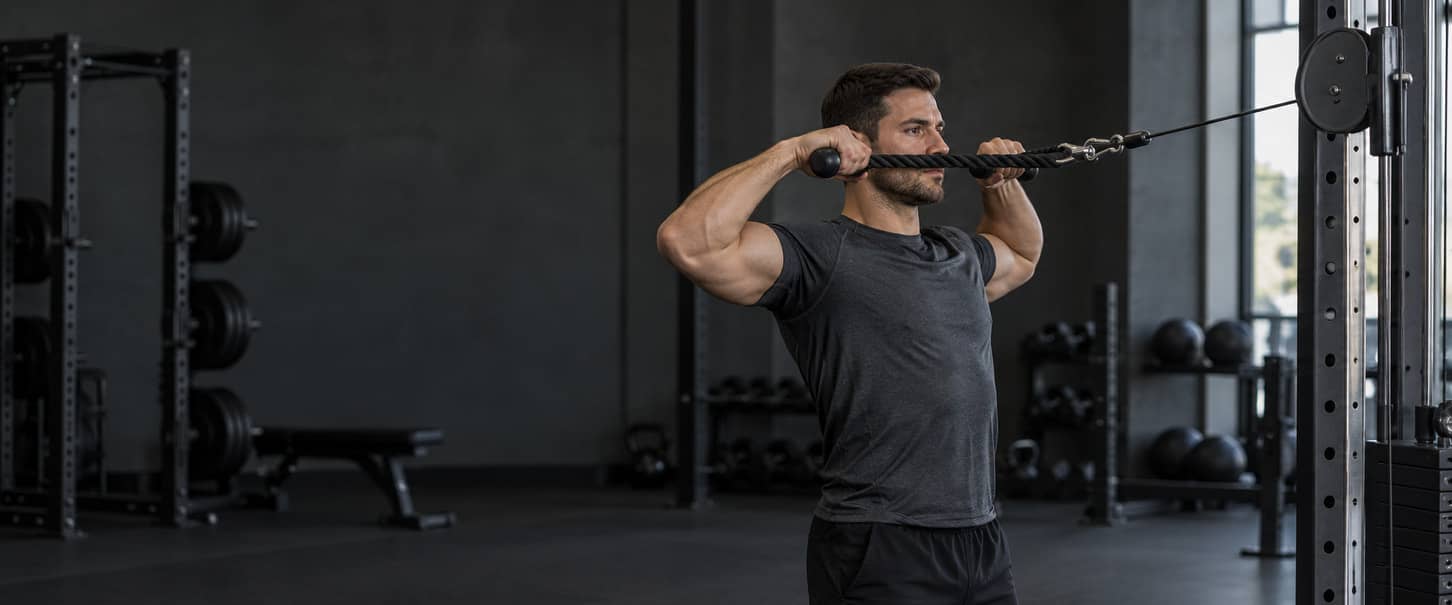
This bilateral version faces one adjustable cable outlet and uses a compatible two-ended rope. Pull towards the upper face while the upper arms open and the elbows bend, allowing a comfortable external-rotation contribution. Both arms work together, the torso remains steady, and the rope and connector stay clear of the face.
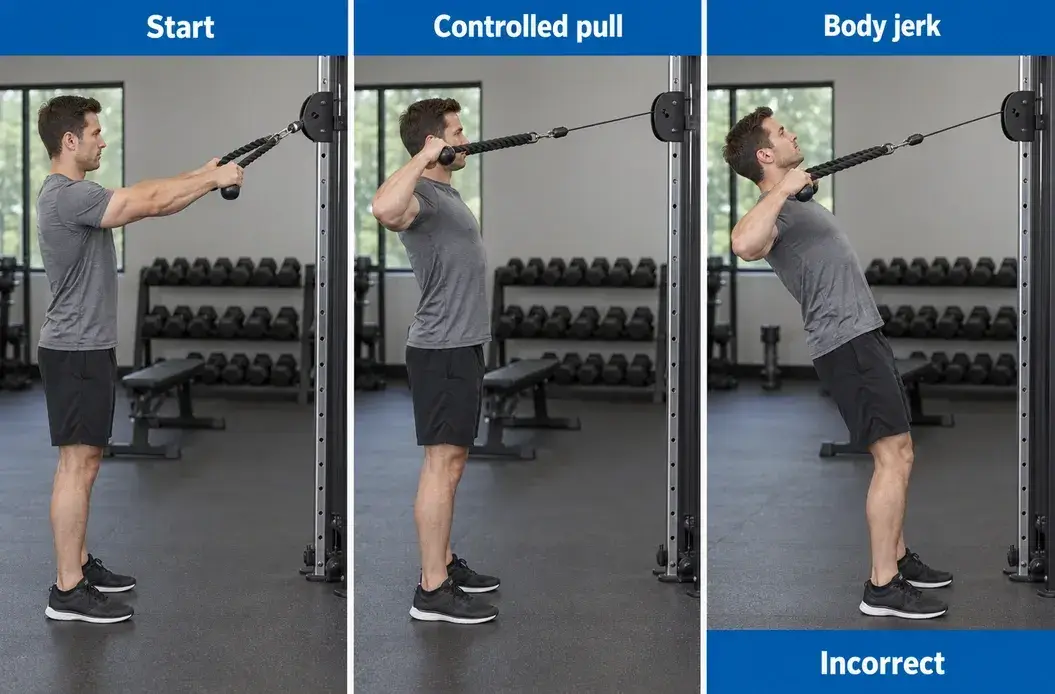
- With the stack resting, inspect the station, cable, selector, clip, and rope. Fit a compatible rope that permits hand separation without the central connector reaching the face. Choose a light rehearsal setting and clear the working and return space.
- Begin with the outlet around eye level and adjust it for the actual station, body position, and comfortable upper-face path. A setting from around upper-chest to eye level can fit, and a nearby higher setting may also work. Recheck the path rather than treating one numbered notch as universal.
- Take one rope end in each hand with full, comfortable overhand-to-neutral grips and aligned wrists. Face the station, establish stable feet and softly bent knees, and step back under control until a forward reach is available without exhausting cable travel. A fixed slight body inclination may fit, but do not use the cable to support a backward lean.
- Settle the head over the torso and keep the rib cage and pelvis controlled. Begin with the arms reaching forwards and the elbows comfortably extended, not forced straight. Let the shoulder blades move naturally with the reach instead of pinning them together before every repetition.
- Pull the rope towards the upper face as the elbows bend and the upper arms travel outwards and backwards. As the hands separate beside the face, allow a comfortable outward rotation of the upper arms. Do not create that rotation by twisting the wrists, thrusting the hips, or jerking the torso backwards.
- Finish where the hand separation, upper-arm path, rotation, and face clearance remain controlled. The rope does not have to touch the nose, the hands do not have to travel behind the head, and the forearms do not have to become vertical. Keep the chin and torso from moving to manufacture extra range.
- Return the hands forwards steadily while the elbows extend and the shoulder blades follow the arms. Use the same controlled reach without being pulled off balance or letting the stack crash. One coordinated pull and return by both arms is one repetition.
- End before grip, clearance, or the return route becomes unreliable. Maintain both grips and move towards the station under control as needed to settle the stack fully before releasing the rope or changing settings. A failed repetition is not the planned exit.
Use less resistance or a shorter comfortable endpoint while retaining the same face clearance. Choose a suitable reverse-fly or rowing option when the available rope or station cannot provide the intended task; do not improvise a connector or force the endpoint. Elbow bending, upper-arm rotation, wrist orientation, and shoulder-blade movement are separate parts of the repetition. A small natural adjustment can remain compatible with the selected movement, but a growing backward jerk or changing setup is not the same repetition. Record the station, displayed load and unit, outlet height, attachment, body distance, stance, torso position, grip, and repeatable hand and elbow endpoints. An ordinary load increase under the same setup remains progression of that exercise; a deliberate change in geometry needs an identified comparison.
Cable Height, Rope Length, Grip, and Stance
Fit the cable outlet to your height and chosen face-pull path rather than copying a numbered notch from another machine. Begin around eye level, then check whether the cable travels towards the upper face without forcing an extreme upward or downward pull. The parent guide's upper-chest-to-eye-level range is a useful starting range, and a nearby higher setting can also fit. Check both endpoints before adding working resistance. At the forward reach, keep usable cable travel without relying on the stack to support a backward lean. At the finish, the rope ends should separate beside the face while the rope and central connector remain clear of the face, neck, and body. Adjust outlet height, body distance, or rope choice if either endpoint fails.
| Setup variable | Practical starting choice | Adjustment or limit |
|---|---|---|
| Pulley outlet | Begin around eye level, then check the actual line toward the upper face. | The parent guide permits an upper-chest-to-eye-level starting range; a nearby higher setting can fit. Avoid an extreme upward or downward pull that changes the selected task. |
| Rope and connector | Use a compatible two-ended rope long enough for the hands to separate beside the face. | The clasp and rope stay clear of the face. Use only station-approved accessories; no improvised extensions or connected ropes. |
| Grip and wrists | Hold both rope ends with closed, comfortable overhand-to-neutral grips and supported wrists. | Forearm rotation is not shoulder external rotation. Do not force an underhand grip, wrist twist, or fixed thumb direction. |
| Distance from station | Stand far enough away for a controlled forward reach and usable cable travel. | Check the finish as well as the start. More distance is not automatically better or a universal load conversion. |
| Stance and torso | Use stable feet, softly bent knees, and a repeatable near-upright torso. | A small fixed inclination can fit; a growing backward lean, hip drive, or neck reach changes the repetition. |
| Seated or kneeling position | Treat a deliberate support change as a separately recorded variation. | Refit the pulley relative to the new head height and verify access and exit. Sitting or kneeling does not remove trunk control. |
Changing body height by sitting or kneeling changes the cable's angle relative to the head, torso, and arms. Treat either choice as a named adaptation with suitable support, a refitted outlet, and a controlled way to enter and leave the station. Neither position is a compulsory regression, and external support does not remove the need to control the trunk. Keep forearm rotation, wrist position, and upper-arm rotation separate. Turning the hands or choosing another grip does not by itself create the intended shoulder rotation, and no single grip earns a universal safety ranking. Use a comfortable full grip that keeps the wrists supported while the upper arms follow the selected path. A heavier station reading cannot compensate for rope ends that cannot separate beside the face, poor connector clearance, or a changing torso position. Cable tension also does not mean constant elbow or shoulder torque through the repetition. Record the exact station, outlet, attachment, distance, stance, and displayed load, and use why gym machine weights differ for the broader explanation rather than applying a pulley-ratio or cross-machine conversion.
Face Pull Muscles Worked and Evidence Limits
A face pull combines several actions rather than isolating one muscle. The posterior deltoids help move the upper arms outwards and backwards relative to the torso. Infraspinatus and teres minor are rotator-cuff muscles that can contribute to the outward-rotation component and shoulder control; they are not another name for the posterior deltoids. Shoulder external rotation means the upper arm rotates at the shoulder. It is separate from bending the elbow, turning the palm, or bending the wrist. The shoulder blades also move as the arms pull and return, with the trapezius and rhomboids contributing to that movement and control. Normal upper-trapezius involvement is not automatically an error, and the shoulder blades do not need to remain permanently pinched together.
| Muscle group | Contribution to the selected movement | Interpretation limit |
|---|---|---|
| Posterior deltoids | Help move the upper arms outward and backward relative to the torso. | This involvement does not establish complete rear-delt isolation or superiority over every fly or row. |
| Trapezius and rhomboids | Contribute to shoulder-blade movement and control as the arms pull and return. | Do not try to switch the upper traps off or hold the shoulder blades permanently pinched together. |
| Infraspinatus and teres minor | Can contribute to the controlled shoulder external-rotation component and joint control. | A face pull combines several actions; it is not the same task as separately prescribed cable external rotation. |
| Elbow flexors, grip, and trunk muscles | Bend the elbows, retain the rope, and stabilise the chosen body position. | Assistance does not create additional exercise sets or mean the rear delts are inactive. |
What the Evidence Can and Cannot Show
Muscle involvement explains why an exercise can serve a selected training role. It does not by itself prove a universal growth result, posture correction, pain treatment, or injury-prevention effect. Zhu and colleagues used motion-capture data and OpenSim to estimate posterior-deltoid force during three exercises. Their face-pull and bent-over-raise estimates did not differ significantly, while the tested row estimate was lower. These were model-dependent estimates, not a measured-EMG result, not directly measured muscle force, not a hypertrophy comparison, and not a treatment trial. A non-significant difference also does not prove that two exercises produce equal results. Acute surface EMG, model estimates, a felt contraction or soreness, and longitudinal changes in muscle size or strength are different outcomes. Vigotsky and colleagues' methodological review supports caution when using an acute signal to predict later adaptation; it does not mean that EMG has no descriptive value. The reviewed evidence supports describing the face pull as a combined upper-arm pull, elbow-flexion and controlled external-rotation movement, while keeping outcome claims narrow. It does not establish a pulley-height optimum, a universal exercise ranking, or a rehabilitation result. This is a targeted discussion of the cited evidence, not a systematic review of all face-pull research.
Common Face Pull Mistakes and Comfort Checks
Compare each repetition with the stance, torso position, grip, upper-face path, hand separation, and return selected for the exercise. A small repeatable inclination can remain part of the setup; a growing backward body jerk changes the movement. Normal shoulder-blade contribution is also different from a shrug that replaces the chosen arm path, and comfortable upper-arm rotation is different from forcing a larger endpoint.
| Observed problem | Focused correction |
|---|---|
| A backward body jerk starts or finishes the pull | Reduce resistance and repeat the chosen stance and torso position; let the arms move without a hip thrust. |
| The lower-back arch or chin lift grows as the rope approaches | Refit rope length, distance, and endpoint; keep the head and rib cage controlled instead of making room through a new body position. |
| The pull becomes a low row toward the chest | Recheck the intended upper-face path, upper-arm opening, and usable rotation; lower the load rather than forcing the elbows higher. |
| The hands are forced behind the head or into vertical forearms | End within the comfortable controlled rotation available. A landmark beyond that range is not compulsory. |
| The clasp, rope, or hands risk striking the face | Return the resistance to rest and correct the attachment or clearance before another repetition. |
| A shrug or wrist bend replaces the selected arm path | Use a manageable load and comfortable grip; allow normal shoulder-blade movement without a forced downward pin. |
| The return becomes abrupt or the stack crashes | Control the forward reach and elbow extension through the same range; reduce resistance when control cannot be retained. |
| A band, anchor, grip, or joint symptom makes control uncertain | Stop and unload securely. Do not repeat a questionable setup or use another exercise as a diagnostic test. |
When technique changes, settle the resistance first. Check the rope or band condition, approved attachment or anchor, clasp position, face clearance, cable travel, grip, stance, and route back to rest before another repetition. Reduce the resistance, adjust the setup, or keep a shorter comfortable endpoint rather than forcing rotation or continuing with uncertain clearance. A sensation in the arms, rear shoulders, upper back, or neck does not by itself prove correct technique, an inactive muscle, or an injury. Compare the observable movement with the selected standard instead. Pain is not a cue to pull farther, rotate harder, or repeat the exercise as a test. When repetitions repeatedly fall across otherwise comparable sessions, review the actual rest taken, earlier pressing or posterior-shoulder work, changes in load or setup, sleep, nutrition, and wider recovery before adding more sets or daily face pulls. The guide to why reps drop between sets covers those performance and recovery checks; it is not a pain diagnosis or treatment. Stop and unload when grip, face clearance, anchoring, attachment security, or equipment control fails. Persistent or concerning pain, radiating symptoms, numbness, or unexpected weakness needs appropriate assessment rather than forced repetitions or repeated exercise changes. Keep suitable work that remains controlled instead of treating fatigue as a reason to add more of the same exercise to the workout plan.
Band Face Pulls and Home-Equipment Limits
Anchored Band Face Pull
Use this alternative only with an intact two-hand elastic exercise system and a fixed anchor whose manufacturer permits the chosen attachment and face-level pulling direction. The instructions must also permit the hand separation and working stretch. A generic band name, a strong-looking post, or eye protection alone does not establish that the setup is suitable.
- Read the actual band, handle, and anchor instructions before use. Confirm that this direction of pull and the intended two-hand arrangement are permitted; follow every stated stretch, inspection, eye-protection, and replacement requirement. Do not perform this version with a product that prohibits pulling towards the face.
- Inspect the complete elastic length, end connections, handles or permitted handholds, and anchor. Reject damaged or uncertain parts. Use a purpose-designed fixed anchoring system fitted according to its instructions, not a door handle, loose furniture, a sharp edge, another person, or a guessed knot.
- While the system is unloaded, fit the permitted anchor around the intended face-height line and secure the two-hand arrangement exactly as directed. Check the anchor under light tension from a position outside the likely recoil path, and confirm that it cannot slip, detach, or pull its support towards you. A light check does not certify an unsuitable anchor or eliminate recoil risk.
- Take a secure permitted handhold in each hand, face the anchor, and use a stable stance. Move back only far enough for a controlled forward reach and suitable starting tension while remaining inside the permitted stretch at the finish. Do not support your body weight on the elastic.
- Pull the hands towards the sides of the upper face as the elbows bend and the upper arms open, allowing only the comfortable rotation the setup permits. Keep every band segment, handle, and connector clear of the eyes, face, and neck. Do not stretch a taut segment across the face or increase the range by leaning back.
- Pause only within the controlled endpoint assigned by the workout plan. If the elastic becomes too demanding near the finish, select a lighter suitable system or reduce the permitted starting stretch rather than shortening every late repetition or forcing greater rotation.
- Guide the hands forwards through the same range without letting the elastic snap back. Retain secure handholds and balance. One simultaneous two-arm pull and return counts as one repetition, not two.
- After the set, keep both handholds secure and move towards the anchor deliberately until tension is removed before releasing either hand or disconnecting the equipment. Stop using the arrangement immediately if the band, anchor, grip, or clearance changes.
An elastic system can break or slip even when it looks usable. Follow its instructions and required protective equipment, including eye protection where specified; do not override a prohibited pulling direction because a generic tutorial shows it. When suitability cannot be confirmed, choose another properly taught exercise rather than testing an uncertain face-level pull. Record the exact band and resistance designation, attachment, resting length or permitted reference length, working distance, stance, range, repetitions, and actual rest. Colour alone is not a universal resistance unit, and a cable display is not a band-load conversion. More stretch changes both the resistance and how it develops through the repetition. A harder finish can limit the selected range without making late partial repetitions the intended standard. Without a suitable anchor, do not invent one. Use the already taught alternative-selection guidance to choose another allocated task. With dumbbells and a rated bench, a supported reverse fly is a different gravity-loaded posterior-shoulder exercise. Pulling dumbbells horizontally towards the face while standing does not reproduce a cable face pull because gravity still acts downwards. An unloaded rehearsal is not the same loaded exercise.
Face Pull vs. Reverse Fly, Rear-Delt Row, and External Rotation
Choose by the movement role, available support, equipment fit, and secure loading. Reverse flyes, rear-delt-biased rows, and cable external rotation change the movement being trained. Use the instructions for your selected exercise rather than treating the options below as identical substitutes or a list to perform in full.
| Option | Main movement distinction | When it can fit | What is not preserved automatically |
|---|---|---|---|
| Standing Cable Face Pull | Upper-arm pulling and elbow flexion with a controlled external-rotation contribution. | The combined task fits and a suitable station and rope are available. | No automatic rear-delt isolation, pure external-rotation dose, or universal stack value. |
| Anchored Band Face Pull | A similar coordinated pull against an elastic system that permits this direction. | A suitable band, handles, fixed anchor, and all required precautions are available. | Cable load, resistance profile, stretch limits, attachment security, and progression are not interchangeable. |
| Reverse fly or reverse pec deck | The upper arms open with a comparatively stable elbow bend. | A supported posterior-shoulder opening task fits better than a rope pull. | The face pull's repeated elbow bending and selected rotation are not reproduced automatically. |
| Rear-delt-biased row | The elbows bend during a row with a deliberately chosen upper-arm path. | The plan calls for a row and its support and loading fit. | A row is not automatically a face pull or a separate external-rotation drill. |
| Cable external rotation | The intended task is rotation of the upper arm with separately specified support and elbow position. | That specific rotation task is deliberately selected and correctly taught. | Sharing a source-plan OR slot does not make it mechanically equivalent to the face pull. |
Elbow action helps separate these choices. A rear-delt-biased row repeatedly bends the elbows while the upper arms follow a selected rowing path. A reverse fly keeps the elbow angle comparatively stable as the upper arms open. Cable external rotation centres on rotation of the upper arm at the shoulder, with its support and elbow position specified separately. Sharing muscles or appearing as alternatives in a workout plan does not establish an identical task, equivalent load, or equal growth. Use the shoulder exercise selection guide for the existing reverse-fly and reverse-pec-deck tutorials and wider deltoid selection. Use the back exercise selection guide for compound rowing and vertical-pull choices. Select the option that matches the intended role, actual support, available equipment, and a load that can be entered and returned securely. Retain a suitable existing choice instead of automatically performing every option or adding another allocation for novelty.
Face Pull Sets, Reps, Weight, and Progression
The Bro Split Workout Plan places Face Pull or Cable External Rotation as the fifth and final exercise row in one Wednesday shoulder session. It is one OR choice within that complete workout, not a new session and not proof that the two exercises are mechanically identical. The source does not specify the face-pull attachment, pulley height, or hand-count convention. Using the bilateral rope setup taught in this guide is a practical implementation of the Face Pull option, not a quotation of geometry that the source did not state.
| Exercise | Sets & Reps | Rest | Tempo | Target Muscles | Notes |
|---|---|---|---|---|---|
| Face Pull or Cable External Rotation | 2 sets of 12–20 reps | 60 sec | 2-1-1-1 | Rear Delts, Rotator Cuff, Scapular Muscles | Use light controlled resistance; do not force end range |
Use non-fatiguing rehearsal or ramp-up sets before the prescribed work; they are separate from the two working sets. Select manageable resistance that lets both working sets reach at least 12 repetitions with the intended upper-face path, hand separation, torso position, controlled return, and secure exit. The plan permits very low reps in reserve selectively for some final stable isolation work, but that is not a command to take a face pull to failure. This final row is not assigned a new fixed RIR number here, and the plan's opening-heavy-set guidance is not imported as its exact target. Grip, face clearance, attachment control, and the return route end the set before an effort estimate does when necessary. Preserve the quoted 60 sec between the two working sets. The wider plan allows more recovery when performance requires it, so take and record the actual rest used. A comparison made after materially changing rest is a new comparison, not an identical exposure. This final row ends the Wednesday session; there is no hidden superset, daily schedule, or extra finishing exercise. The 2-1-1-1 tempo means returning the hands forwards for two seconds, pausing for one second at the controlled reach, pulling for one second, and pausing for one second at the controlled finish. A repetition may begin with the pull even though the notation names the return phase first. Neither pause means hanging passively from the cable or bringing the rope into the face.
Progress the Source Face-Pull Choice
The hypothetical log below applies only to the Face Pull option in that Bro Split row: two sets of 12–20 repetitions using the taught bilateral cable setup. Exposures A through C use the same station, displayed load, rope, outlet height, stance, body distance, grip, range, planned effort, and comparable rest. Exposure D is one possible result after a manageable increase, not a source timetable or an actual customer record.
| Exposure | Set 1 | Set 2 | Decision |
|---|---|---|---|
| A | 16 | 14 | Retain the load and add controlled repetitions under comparable conditions. |
| B | 20 | 18 | Retain the load; the second set has not reached the upper boundary. |
| C | 20 | 20 | Consider a small permitted increase only when technique, planned effort, rest, and safe handling also qualify. |
| D | 14 | 12 | One possible result after a manageable increase, not a promised outcome. |
Keep the load unchanged while adding technically acceptable repetitions. The numerical upper boundary is reached only when both sets achieve 20, so 20/18 does not qualify. Consider the smallest permitted increase only when 20/20 also retains the selected path, range, planned effort, rest, face clearance, and controlled return. If an increase makes either set fall below 12 or makes the exit unreliable, use a smaller permitted station increment or return to the previous manageable load. A hypothetical 14/11 result misses the second-set lower target. Do not count assisted, shortened, or body-jerked repetitions as successful working repetitions merely to keep the larger displayed number. Record the station, displayed load and unit, rope, outlet height, stance, distance, grip, hand and elbow endpoints, repetitions, actual rest, effort estimate, and limiting factor. Ordinary load increases with that setup unchanged remain in the same exercise history. A different station, attachment, outlet, stance, distance, grip, or movement geometry needs an identified comparison. Do not improvise selector-pin loading or convert a setting from another machine.
Fit Face Pulls Into Your Workout Plan
The final Bro Split Wednesday slot is one two-set choice: Face Pull or Cable External Rotation. The two source-listed options involve different actions and need their own setup and load. Selecting either one keeps the slot at two working exercise sets. Performing both for their full allocations creates four working sets and adds two; using one set of each would be an explicit modification rather than the unchanged source choice. Do not replace a separately prescribed external-rotation or rehabilitation exercise with a face pull merely because this source presents an OR choice. The source choice describes one place in one workout plan, not mechanical equivalence between the exercises.
| Decision for the final slot | Working exercise sets | Meaning |
|---|---|---|
| Face Pull selected | 2 sets of 12–20 reps | One source-listed choice, performed with the selected face-pull setup. |
| Cable External Rotation selected instead | 2 sets of 12–20 reps | The other source-listed choice; its different movement needs its own instructions and load. |
| Both source choices performed for their full allocations | 2 + 2 = 4 working sets | Two sets have been added; the original two-set choice has not been preserved. |
| Band face pull explicitly chosen to replace the face-pull task | 2 sets of 12–20 reps in this adaptation | An authored equipment adaptation, not a band option quoted from the source; verify suitability and keep its own resistance record. |
The band row is a newly authored equipment adaptation of the face-pull choice. It is not an option named in the quoted source. In this worked adaptation, retain 2 sets of 12–20 reps, 60 sec rest, and 2-1-1-1 with a separate band baseline. Do not append another two sets, convert cable load to band resistance, or assume equal stimulus. If the intended role is separately prescribed external rotation, a band face pull is not automatically an appropriate replacement. Both taught face-pull versions use both arms together, so one bilateral set counts as one exercise set rather than two. No unilateral dose follows from the source exercise name. The preceding Wednesday rear-delt row or reverse-fly choice has three working sets; combined with the selected two-set final slot, that creates five selected exercise-set entries. It does not prove five isolated rear-delt or rotator-cuff sets. Use the guide to counting workout sets for the wider distinction between exercise-set bookkeeping and shared muscle involvement. Keep the other four Wednesday rows, Thursday rest, all other training days, and the plan's actual frequency, recovery, and progression rules intact. Optional low-fatigue rehearsals prepare the selected exercise but are separate from the assigned working sets. A different exercise order changes the workout; it is not a free addition. Do not answer fatigue by adding compulsory daily face pulls or imposing an arbitrary push-to-pull ratio.
Face Pull FAQs
What muscles do face pulls work?
Face pulls involve the posterior deltoids and muscles that move and control the shoulder blades. Infraspinatus and teres minor can contribute to the controlled external-rotation component, while the elbow flexors, grip, and trunk assist. The exact demand changes with the setup, so this is not an isolation percentage or a claim that every version trains each muscle identically.
Are face pulls a shoulder exercise or a back exercise?
They involve both the rear shoulder and upper-back region. Place them according to the role and work already assigned by the workout plan rather than the label alone. The source used in this guide places the choice in its Wednesday shoulder session, which does not create a duplicate back-day allocation.
What height should the cable be for face pulls?
Begin around face or eye level, then check the actual line towards the upper face, rope and connector clearance, body distance, and cable travel at both endpoints. An upper-chest-to-eye-level starting range or a nearby higher setting can fit. No numbered notch is universal, and changing the outlet does not simply switch individual muscles on or off.
Should I use an overhand or underhand grip?
Use a secure, comfortable full grip that keeps the wrists supported. The taught rope setup permits an overhand-to-neutral orientation as the hands separate. Forearm rotation is different from rotation of the upper arm at the shoulder, so an underhand grip is neither compulsory nor proven universally superior.
How far back should my hands and elbows travel?
Finish where the upper arms can open, the hands can separate, and comfortable rotation and face clearance remain repeatable. Stop before a neck reach, growing backward jerk, or forced range changes the movement. The hands do not need to pass behind the head, and the forearms do not need to become vertical.
How much weight and how many sets and reps should I use?
Choose resistance that permits the full pull and controlled return without losing grip, face clearance, torso position, or the planned exit. The exact source example is 2 sets of 12–20 reps with 60 sec rest and a 2-1-1-1 tempo. That is one source prescription, not a universal dose or a reason to import another guide's sets and repetitions.
Should I do face pulls every day or before bench pressing?
Not automatically. A light, non-fatiguing rehearsal can prepare the movement, but it is separate from challenging working sets and is not a compulsory extra training dose. Keep the source working sets in their assigned slot unless the complete plan deliberately changes the order. Use established workout plans for the full schedule, exercise order, and recovery context.
Can I do face pulls with a resistance band at home?
Only when the actual elastic system and fixed anchor permit the face-level pulling direction, two-hand arrangement, working stretch, and required precautions. Use the product's inspection, replacement, anchoring, and protective-equipment instructions. When suitability cannot be confirmed, choose another taught task. Band resistance and cable-stack values are not interchangeable.
Can dumbbells, reverse flyes, or rows replace face pulls?
They can fill a related posterior-shoulder role after deliberate selection, but they change the joint actions, support, resistance direction, and loading record. A reverse fly keeps the elbow angle comparatively stable, while a row repeatedly bends the elbows. Moving dumbbells towards the face while standing does not recreate a horizontal cable force because gravity still acts downwards. Pure external rotation is also a separate task.
Do face pulls fix rounded shoulders or shoulder pain?
No guaranteed postural correction, pain treatment, rehabilitation result, or injury-prevention effect is established by this guide. Train the selected movement rather than diagnosing a condition from posture or sensation. Stop and unload for failed control or concerning symptoms; persistent or worsening pain, radiating symptoms, numbness, or unexpected weakness needs appropriate assessment.