
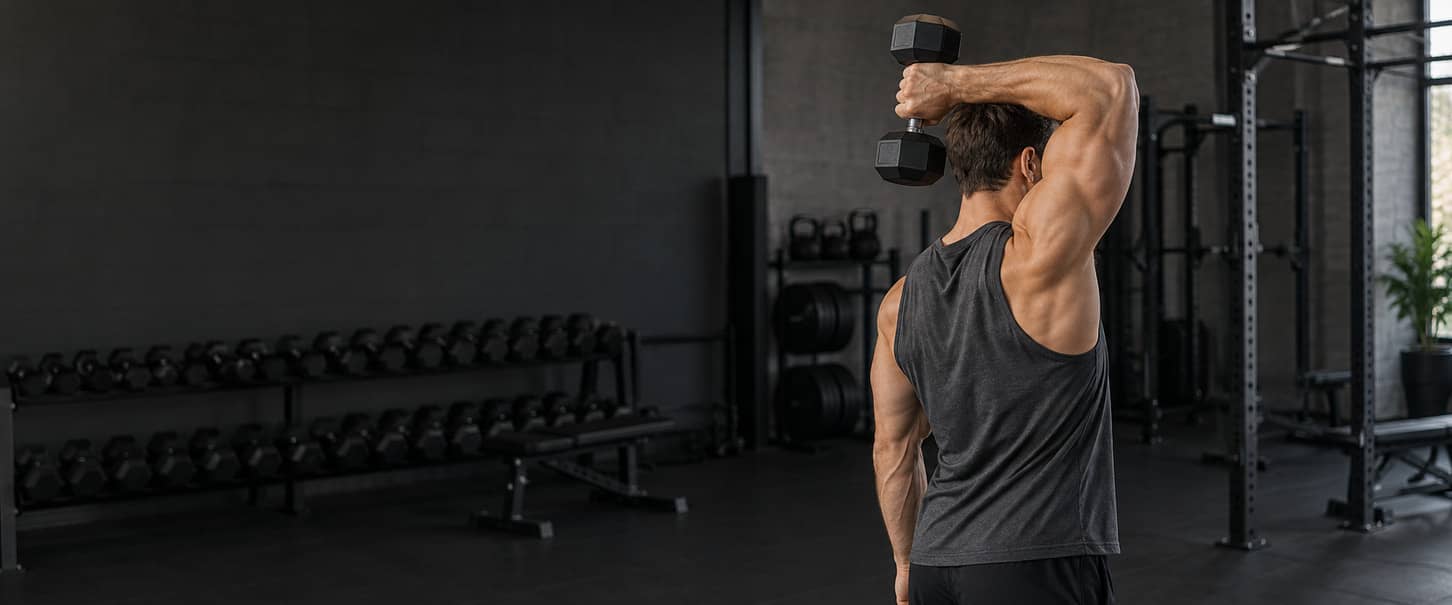
Choose Long-Head Triceps Exercises That Fit Your Plan
An overhead triceps extension is a useful option to consider for long-head-focused training when you can hold the raised-arm position, manage the resistance, and return it securely. A low-pulley rope extension provides one practical setup. A single-arm dumbbell version is another equipment choice, not an identical load or movement record. Lying extensions and pressdowns remain useful alternatives when their support or arm position fits better. All three triceps heads contribute to elbow extension, so long-head emphasis does not mean complete isolation or a requirement to perform every variation. Start with the comparison below, choose an option that fits the triceps work already in your workout plan, and read its complete instructions. This guide explains shoulder-position choices and progression, not another compulsory arm day or a promise of a particular growth rate.
Compare Overhead, Lying, and Arm-at-Side Triceps Exercises
Use the table to compare four fully taught direct-extension implementations and the compound pressing already present in many workout plans. It is not a list of five isolated long-head exercises and not a five-exercise routine. Choose by shoulder-position tolerance, controllable elbow range, cable or free-weight path, grip, support, entry and exit, and the load increments you can reproduce.
| Option | Upper-arm position and role | Equipment and handling | Selection check |
|---|---|---|---|
| Overhead Rope Cable Triceps Extension | Elevated upper arms; direct elbow extension. | One low pulley, two-ended rope, stable stance, clear entry and return. | Consider when a manageable overhead option fits; do not force the deepest stretch. |
| Standing Single-Arm Dumbbell Overhead Extension | One raised upper arm; direct extension tracked per arm. | One securely retained light dumbbell and a controlled overhead transfer. | Useful without a cable; each arm needs its own work and rest. |
| Lying Dumbbell Triceps Extension on the Floor | Raised upper arms relative to the lying torso; supported elbow extension. | Two light dumbbells, floor support, and clear space beside the head. | Useful without a bench; it does not replicate the upright overhead geometry. |
| Rope Triceps Pressdown | Upper arms near the torso; direct elbow extension. | One high pulley and a compatible rope with a secure return. | Retain when the arm-at-side position, access, or progression fits better. |
| Existing compound pressing | Elbow extension combined with shoulder movement and other muscle work. | The actual bench-press, machine-press, or push-up setup already assigned. | Account for triceps involvement without calling every press an isolated long-head set. |
A fitting overhead extension can be a useful first candidate when the raised-arm position, cable or dumbbell path, and handling are manageable. A productive pressdown or lying extension does not need to be replaced simply for novelty. Keep the first option that fits the allocated role and can be progressed with repeatable technique. These rows describe practical differences in shoulder position, support, resistance path, and load recording. They do not assign measured percentages of regional loading or prove that one implementation isolates the long head. This focused guide covers triceps shoulder-position choices. Use the arm exercise selection guide for broader curl, grip, and compound-press selection.
Long-Head Triceps Anatomy and Shoulder Position
The triceps has long, lateral, and medial heads, and all three contribute to straightening the elbow. The long head begins on the scapula and crosses both the shoulder and elbow. The lateral and medial heads begin on the upper-arm bone and cross the elbow without the same two-joint arrangement. Separate the two joint actions when comparing exercises. Raising the upper arm relative to the torso changes shoulder position, while bending and straightening the elbow changes elbow position. Shoulder flexion or elevation describes the upper arm moving forward and upward relative to the torso. Shoulder extension describes the upper arm moving behind the torso. The height of the hands in the room does not define either position by itself. Because the long head crosses the shoulder, its scapular attachment makes upper-arm position relevant to its length context. The lateral and medial heads still contribute during an overhead extension, so the raised-arm position changes the task without creating one-head isolation.
| Position | Practical example | What the position does not establish |
|---|---|---|
| Upper arms elevated overhead | The taught upright overhead cable or dumbbell extension. | A compulsory maximum shoulder angle, one-head isolation, or identical resistance across equipment. |
| Upper arms raised in front of a lying torso | The taught floor extension with space beside the head. | The same shoulder position as upright overhead work merely because the weights point toward the ceiling. |
| Upper arms near the sides or deliberately behind the torso | Pressdowns use the near-side position; a kickback is a separate behind-body task. | The largest long-head stretch, a mandatory additional exercise, or a universal growth ranking. |
Lying on the floor with the upper arms aimed toward the ceiling is not automatically the same shoulder position as standing with the upper arms overhead. In the lying setup, the upper arms are raised in front of the torso even though the dumbbells may be high in the room. Compare the upper arm with the torso, not the weight with the ceiling. Moving the upper arm behind the torso changes the shoulder-length context, but a hand traveling behind the head does not prove that the shoulder is extended. The elbow may bend while the upper arm remains elevated or in front of the torso. Forearm rotation, hand orientation, and wrist bending are also separate from shoulder angle. External turning demand at the elbow depends on the load direction and the perpendicular distance between that line of force and the elbow. As the forearm and equipment move, that distance can change. A cable can maintain tension while elbow torque still varies, and neither cable tension nor external elbow torque states the force produced by an individual triceps head. A longer muscle position can be useful to compare, but it does not prove the largest active force, the best growth response, or that the deepest available stretch is best. Use the shoulder-position table to understand the geometry, then judge each implementation by fit, controllable range, handling, and repeatable progression within the workout plan.
Are Overhead Extensions Better for Long-Head Growth?
In the strongest direct comparison available here, overhead cable extensions produced greater measured triceps growth than arm-at-side cable extensions. That makes a tolerable overhead extension a useful first candidate for an allocated direct-extension role, but it does not establish one universally superior exercise. Maeo et al. (2023, published online in 2022) studied 21 young adults who had not performed systematic resistance training during the preceding year. For 12 weeks, each participant trained one arm with a unilateral overhead cable extension and the other with an arm-at-side cable extension through the prescribed 90–0-degree elbow range. MRI-measured long-head volume increased by 28.5% in the overhead condition and 19.6% in the arm-at-side condition. Whole-triceps volume increased by 19.9% and 13.9%, respectively, and the combined lateral and medial measure also favored overhead. Both conditions produced growth, even though the absolute loads were lower overhead. An earlier, smaller trial did not show the same clear between-condition result. Stasinaki et al. (2018) studied nine novice young women for six weeks, comparing a unilateral cable pushdown with a contralateral overhead extension. Ultrasound-derived size measures improved, with similar changes reported between conditions. That study was shorter, included fewer participants, and used different exercise ranges and measurements. A nonsignificant difference does not prove that the two positions are equivalent, just as the later trial does not prove that every overhead implementation will outperform every pressdown. These longitudinal studies measured changes in muscle size. They are different from acute activation research, modeled force-length curves, and explanations of a possible mechanism. Villalba et al. (2024) found higher long-head surface EMG and fewer repetitions with a supinated-handle pushdown condition than with a pronated-handle condition in an acute comparison. That result describes electrical activity and performance during the tested sets, not long-term hypertrophy or a universal grip advantage. An anatomical explanation that an overhead position lengthens the long head at the shoulder is useful context, but it does not by itself prove why a growth difference occurred. A modeled curve can describe assumptions about muscle length or force without measuring future muscle growth. The percentages above describe changes in measured muscle volume, not equal changes in arm circumference and not a guaranteed growth timetable. The main trial used a supinated, single-arm cable protocol, so its result should not be copied directly to every rope, dumbbell, machine, bilateral setup, training load, set count, elbow limit, or grip. Equipment fit, secure entry and exit, tolerable shoulder position, controllable elbow range, and practical load increments still determine whether an overhead option is usable. Consider a tolerable overhead extension for the direct triceps work already assigned in your workout plan. Use a suitable lying or arm-at-side setup when the overhead position, resistance path, or handling does not fit. The evidence supports making the shoulder-position choice deliberately, not forcing one implementation or repeating a research protocol as your training prescription.
How to Do Overhead Rope Cable Triceps Extensions
Overhead Rope Cable Triceps Extension
Use one low pulley and a compatible two-ended rope for a bilateral extension while facing away from the station. The upper arms stay comfortably elevated and the hands travel from behind the head toward controlled elbow extension. Both arms move together; the cable must remain clear of the body through the working range and the return.
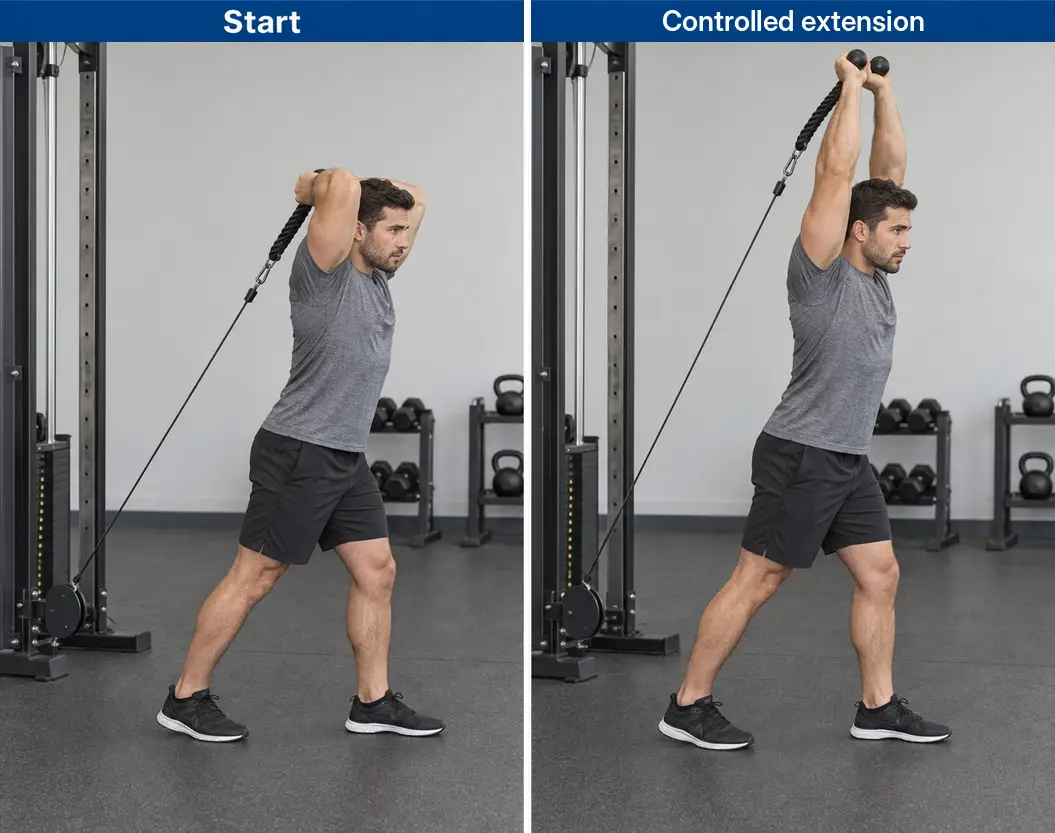
- With the stack fully resting, inspect the cable, selector, clip, rope, and available travel. Choose a light rehearsal load and a rope long enough for the selected overhead path. Clear the area behind and above the body.
- Rehearse the station-specific route for bringing the rope overhead and returning it to rest. Use a competent demonstrated handoff when needed. Do not start with a heavy blind turn under tension or assume that a way to begin guarantees a way to finish.
- Face away from the low pulley in a stable staggered stance. Hold one rope end in each hand with full grips and aligned wrists. Use only the modest forward inclination needed to keep the cable and rope clear of the head, neck, back, and elbows.
- Raise the upper arms to a comfortable repeatable position and bend the elbows so the hands are behind the crown. Let the shoulder blades position naturally; do not pin them downward, force the upper arms against the ears, or obtain height through rib flare and a larger back arch.
- Extend both elbows to move the hands upward along a clear arc while the torso, feet, and selected upper-arm position remain controlled. Do not lunge forward, turn the movement into a pullover, or chase the heaviest stack setting.
- Finish at comfortable active elbow extension without forcing the joints or changing shoulder position to move the hands higher. Retain secure grips and the same cable clearance.
- Bend the elbows under control to return to the same behind-head endpoint. Stop the return before clearance, shoulder position, grip, or trunk control changes. Do not force additional depth or let the cable pull the arms abruptly backward.
- End while the rehearsed exit is still manageable. Return the resistance fully to rest and lower the rope through that route or with the agreed assistance before releasing it or turning toward the station. Setup and removal are handling, not extra repetitions.
Use less station resistance or a shorter comfortable elbow range while preserving the same cable clearance. Choose the taught pressdown or a suitable lying extension when overhead access or handling does not fit. More shoulder elevation is not a compulsory progression. Rope length, body distance, attachment shape, and the station's permitted connection determine whether the path clears the body. Let the shoulder blades move naturally and keep a comfortably elevated upper-arm position that can be repeated. A small natural adjustment is not automatically a failed repetition, but a material change in torso position, upper-arm elevation, cable clearance, or elbow range means the repetition no longer matches the selected standard. Stable positioning matters more than forcing the elbows against the ears. Record the exact station, low outlet, rope or permitted attachment, body distance, stance, displayed load and unit, upper-arm position, elbow range, and entry and exit route. Ordinary load increases remain in this setup history. A high-pulley forward extension, kneeling variation, different attachment, or single-arm version is a separately identified setup. The station number is specific to that apparatus; see why gym machine weights differ rather than applying a universal cable-height or displayed-load conversion.
How to Do Single-Arm Dumbbell Overhead Extensions
Standing Single-Arm Dumbbell Overhead Extension
This standing version uses one light dumbbell in one working hand, with no bench required and the upper arm raised comfortably. The free hand is available for controlled positioning and removal but does not assist the working repetitions. The dumbbell lowers behind the head as the elbow bends; it is not held by both hands as a shared two-arm exercise.
- Inspect the dumbbell and confirm that its plates or selector remain securely retained in every intended orientation. Use a genuinely manageable load, clear overhead and behind-head space, and a nonslip standing area with a planned set-down.
- Rehearse the raised-arm position without resistance. For right-arm work, take a full right-hand grip around the handle and use the left hand as needed to help position the light weight from a controlled shoulder-height hold. Use a competent handoff if the transfer cannot otherwise be made manageable.
- Establish a stable stance and comfortable raised upper-arm position with the weight controlled above the shoulder region. Keep the right wrist supported in line with the forearm. The left hand may rest lightly against the upper arm as a position cue, without pushing it or forcing the elbow inward.
- Bend the right elbow to lower the dumbbell behind the head through clear space. Keep the upper arm broadly in the same position, the ribs and pelvis controlled, and the weight clear of the skull, neck, and back. Do not lean sideways or deepen the range beyond control.
- Extend the right elbow to return to the same controlled overhead position. Keep the grip closed and avoid using the free hand, leg drive, or a shoulder thrust to finish. Do not require a forcibly straight joint or an elbow pressed against the ear.
- Continue through the same repeatable elbow range, allowing natural shoulder-blade positioning rather than pinning the shoulder down. Breathe through manageable repetitions and stop before grip or load-removal control becomes uncertain.
- Use the free hand or an agreed helper to guide the dumbbell back to a secure shoulder-height hold, then lower it to the side and set it down through the rehearsed route. Do not release it behind the head, make a blind heavy transfer, or twist beneath a suspended weight.
- Rest as prescribed and mirror the entire arrangement for the left arm. Entry and exit assistance is not a counted working repetition, and the free hand does not make a failed working repetition successful.
Reduce the one-dumbbell load or use a shorter comfortable elbow range while retaining secure handling. A stable back-supported version is a different named setup, not permission to use loose furniture. When overhead positioning does not fit, choose an available non-overhead option with its own complete instructions. The floor extension uses two dumbbells and is not silently converted into a one-weight extension. Record the working arm, the mass and unit of the one dumbbell, stance or a deliberate support change, upper-arm position, elbow endpoints, actual repetitions, and rest after each arm. Do not derive the load by halving a two-arm cable display or a two-handed shared-dumbbell record. Ordinary load increases with the same setup remain in this exercise history.
Count the Dumbbell Version by Working Arm
This original standalone illustration uses 2 sets of 10–15 reps per arm, 90–120 seconds after EACH arm, a 2-1-1-1 tempo, and approximately 2–3 technically sound reps in reserve where useful. Free-hand assistance is for entry and exit only, not counted lifting. It does not convert the bilateral overhead cable example or replace the source's two-set cable choice. At ten repetitions per set, two sets provide 20 repetitions for the right arm and 20 for the left arm. That creates four arm-specific work bouts and 40 total arm repetitions, not four sets per arm. Work one arm, guide the dumbbell to a secure hold, settle it, and rest 90–120 seconds. Switch the complete setup, work the other arm, settle the dumbbell, and rest again. Repeat until both arms have completed two sets. The same rest follows the final arm before another exercise. The 2-1-1-1 tempo means lowering through elbow flexion for two seconds, pausing for one second at the controlled bent-elbow endpoint, extending for one second, and holding comfortable elbow extension for one second. Because the tutorial starts with the dumbbell controlled overhead, the first working action is the lowering phase. Positioning and removing the dumbbell are handling, not additional repetitions. One controlled lowering and return by the working arm is one repetition.
Lying Triceps Extensions and Skull-Crusher Alternatives
Lying Dumbbell Triceps Extension on the Floor
Use two light dumbbells with the head, upper back, and pelvis supported on the floor. Each hand retains a neutral full grip, and both weights lower beside the head rather than toward the face. This lying extension is a practical alternative within the skull-crusher family of exercises, not a direction to touch the skull or an identical overhead cable exercise.
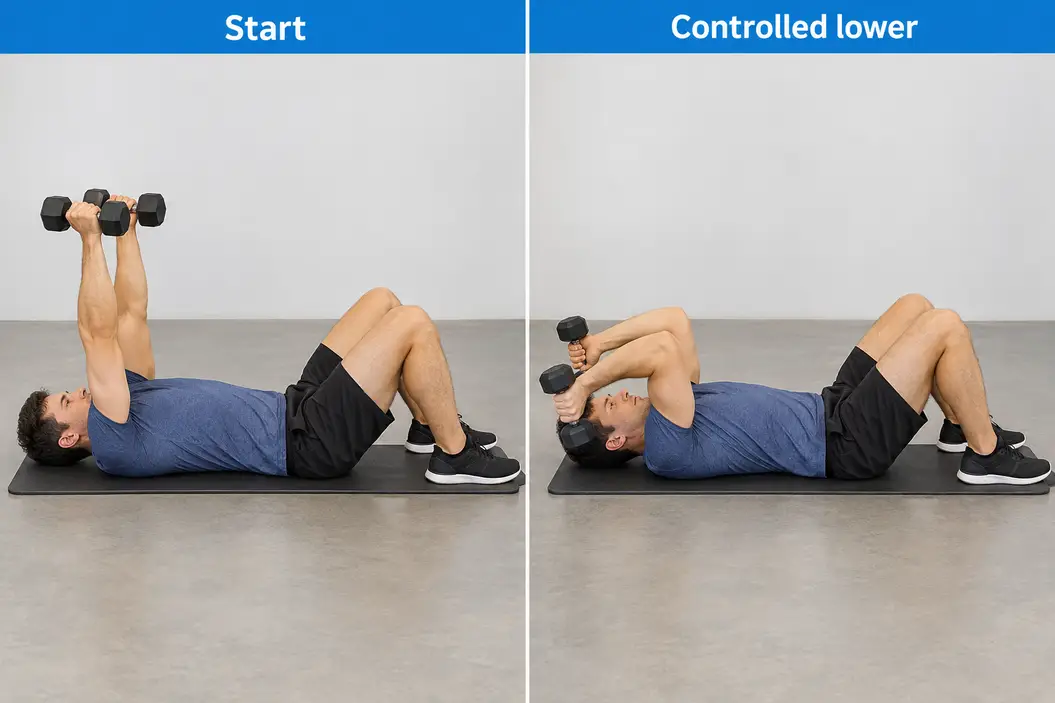
- Inspect both weights and their retention mechanisms for the intended orientation. Clear the space beside the head and shoulders and rehearse the path with very light dumbbells.
- Sit with the weights controlled near the thighs, then use a deliberate two-weight entry or competent assistance to lie back. Keep the head, upper back, and pelvis supported, the knees bent, and the feet planted. Establish both weights under control above the shoulder region.
- Keep inward-facing palms and full grips. Choose an upper-arm angle that leaves each dumbbell room to travel beside the head without pointing it toward the face, forcing a shoulder stretch, or changing torso support.
- Bend both elbows while the upper arms stay broadly in the selected position. Keep the weights clear of the head, floor, and one another; reverse before contact or a range that cannot be controlled.
- Extend both elbows to return to the same controlled top position. Do not turn the repetition into a floor press or pullover, roll the shoulders forward, or strike the dumbbells together.
- Lower and extend at the pace assigned by the workout plan while maintaining the same head clearance and support. One coordinated repetition by both arms counts as one, not two.
- End well before handling fails. Bring the weights to a controlled position beside the torso through the rehearsed exit, settle them securely with assistance if needed, and only then sit up. Do not drop the weights beside the head or twist beneath suspended loads.
Use lighter weights or a shorter repeatable elbow range without contact. The floor provides support, not automatic safety at any load. When two-weight handling does not fit, a compound push-up is a different training task rather than an isolated-extension equivalent. Skull crusher describes a family of lying elbow-extension exercises, not one compulsory implement or contact point. An EZ-bar version on a bench changes the implement, grip, clearance, torso support, entry, and exit. A two-handed single-dumbbell extension also differs from this two-weight exercise and needs its own secure handling method. Describe shoulder position relative to the torso. Upper arms aimed toward the ceiling while lying are raised in front of the torso, so this setup does not recreate the upright overhead position or inherit its load, range, or evidence. Keep the selected upper-arm angle broadly stable so repeated elbow flexion and extension remain the main task. A large upper-arm swing can turn the movement into a pullover or press. Record the mass per dumbbell and unit, floor support, neutral grip, upper-arm angle, elbow range, head and floor clearance, and entry and exit route. A shorter controlled range is a separately recorded practical choice, not permission to strike the head or floor. Bench-based EZ-bar extensions, two-handed single-dumbbell extensions, and pullovers each require their own records and instructions.
Pressdowns, Pressing, and Behind-the-Body Positions
Rope Triceps Pressdown
Face one high pulley and hold a compatible rope with both hands. Keep the upper arms near the torso while elbow extension moves the hands downward. This is an arm-at-side extension and a useful alternative when that position fits better, not an exercise that switches off the long head.
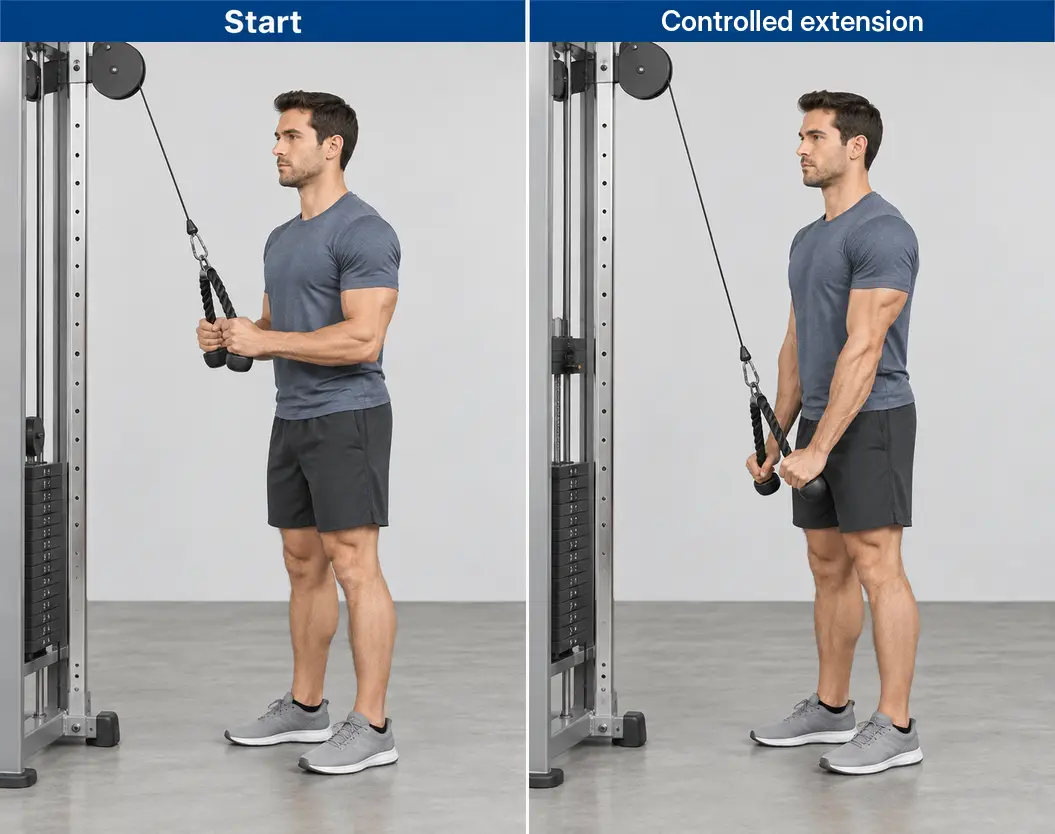
- With the stack resting, inspect the cable, clip, selector, and rope. Set the outlet high enough for a clear downward path and choose a light rehearsal load. Stand facing the station with room for the movement and the return.
- Take one rope end in each hand using full grips and aligned wrists. Set stable feet and use a modest forward inclination only if needed. Start with bent elbows and the upper arms comfortably near the torso, without the stack pulling the shoulders upward.
- Extend both elbows while the upper arms remain broadly in place. Bring the hands toward the thighs without dropping the body, driving the hips, or pulling mainly through shoulder motion.
- Finish at comfortable active elbow extension. Allow the rope ends to separate only as the natural hand path requires. Do not force an outward wrist twist, push the elbows behind the torso, or use a backward shoulder swing to gain travel.
- Control the elbow-bending return to the same start without stack impact or a rising elbow position. Keep the stance, upper arms, and range repeatable.
- Return the resistance fully to rest through the planned route before releasing the rope or changing the selector. Finish while that return is secure; a dropped attachment does not complete the set.
Reduce the load or select a compatible straight or angled attachment when that option fits better, and record the change. A productive pressdown does not need to be discarded solely because another exercise permits greater shoulder elevation. Record the exact station, high-pulley setting, attachment, displayed load and unit, stance, upper-arm position, elbow range, completed repetitions, and actual rest. Do not use a pressdown display as an overhead starting-load conversion. Ordinary load increases with the same station and setup remain in this exercise history. Keep the finish as an arm-at-side elbow extension rather than turning it into a behind-body kickback. This tutorial uses a bilateral rope, one stack, and a mainly elbow-driven path. A reverse-grip pressdown is a separately identified setup, not a method for mechanically isolating one triceps head.
Where Pressing and Behind-Body Work Fit
Bench presses and push-ups involve the triceps while also using shoulder movement, the chest, and other supporting muscles. Account for that involvement in the complete workout plan without counting every press again as an isolated long-head set. The Arm Exercises parent provides the specific close-grip bench-press and push-up instructions; use the chest exercise selection guide when broader pressing selection is the main question. Another close-grip press is not automatically required. Kickbacks and dips are different movement and shoulder-position tasks. Moving the upper arm behind the torso creates a different shoulder-length context from elevating the upper arm overhead. A strong behind-body squeeze is a sensation, not proof that the exercise produces superior long-head growth. Do not treat an untaught kickback, bench dip, or improvised apparatus as the default fallback. Forearm orientation and shoulder position are separate variables. A reverse forearm grip does not mechanically switch the other triceps heads off. Acute electrical activity can describe a tested repetition under specific conditions, but it does not establish long-term growth, complete isolation, or a universal reverse-grip advantage. Choose a grip and setup that can be entered, repeated, and returned securely.
Elbow Comfort, Shoulder Fit, and Common Mistakes
Compare each repetition with the grip, support, upper-arm position, range, and resistance path selected for that exercise. Small natural movement is not automatically cheating. A material change that replaces elbow extension, reduces clearance, or alters the recorded range means the repetition is no longer directly comparable. Elbow, wrist, shoulder, or muscle sensation does not by itself diagnose tendinopathy, a nerve problem, an inactive muscle, or an injury. A photograph also cannot establish those diagnoses.
| Observed problem | Focused correction |
|---|---|
| The overhead position requires rib flare or a growing back arch | Reduce load, elevation, or range; use a non-overhead option when a controlled position does not fit. |
| The cable or dumbbell approaches the head, neck, or body | Settle the resistance and refit the path and clearance before continuing. |
| Upper-arm travel or a body lunge replaces elbow extension | Use a manageable load and repeat the selected upper-arm position without demanding perfect immobility. |
| The wrists fold or a handle starts to slip | End securely, then choose a compatible full grip and manageable resistance. |
| The return becomes shorter or faster as the record claims unchanged progress | Restore the selected range and pace or identify the changed execution separately. |
| A new grip or shoulder angle is added as another full exercise automatically | Replace the intended slot, or reassess the complete plan before deliberately adding work. |
| Pain, clearance, or equipment control becomes uncertain | Stop and settle the load; seek appropriate assessment for persistent or concerning symptoms. |
First settle the resistance. Review dumbbell or attachment retention, access and exit, cable and head clearance, and the support used. Rehearse a compatible full grip, a controllable upper-arm position, a repeatable range, and a manageable load before resuming. Choose a suitable non-overhead option when that shoulder position or handling fits the allocated role better. When control or performance repeatedly declines across comparable sessions, review the pressing and extension work performed earlier, the actual rest taken, setup consistency, load changes, sleep and nutrition availability, and other recovery demands before adding more sets to the workout plan. The guide to why reps drop between sets provides the wider performance and recovery checks; it is not a pain diagnosis or treatment. Stop and settle the load when grip, support, clearance, retention hardware, cable travel, or movement control fails. Sharp, worsening, radiating, or persistent pain, numbness, or unexpected weakness needs appropriate assessment rather than forced repetitions, a maximal stretch, or repeated exercise changes used as a test.
Sets, Reps, and Progression for Long-Head Triceps Training
This original example uses the bilateral Overhead Rope Cable Triceps Extension for one direct-extension slot already allocated by a complete workout plan. It is one three-set exercise illustration, not a complete session, a required specialization routine, an extra weekly arm day, or a reason to add every triceps angle.
| Exercise | Sets & Reps | Rest | Tempo | Target Muscles | Notes |
|---|---|---|---|---|---|
| Overhead Rope Cable Triceps Extension | 3 sets of 10–15 reps | 90–120 seconds | 2-1-1-1 | Triceps, including the long head; shoulder and trunk muscles assist | Use one low pulley and both arms together; retain the same overhead position, clear path, and controlled exit. |
Use a light, non-fatiguing rehearsal and any needed ramp-up work before the working sets. Those preparation sets stay outside the three-set total. Fewer working sets or less resistance can be appropriate while learning the entry, overhead position, cable clearance, and return route. Select a resistance that permits the lower target with approximately 2–3 technically sound reps in reserve. Handling control takes priority over the effort estimate. End the set when grip, cable clearance, upper-arm position, or the secure return route becomes doubtful, even when more elbow extensions might otherwise be possible. Perform straight sets and take the full 90–120 seconds after every working set, including after the third set before another exercise. Take more recovery when needed and record the actual interval. A transition to another movement is not proof that enough recovery has occurred. The 2-1-1-1 tempo means returning the hands behind the head through elbow flexion for two seconds, pausing for one second at the selected bent-elbow endpoint, extending the elbows for one second, and holding comfortable elbow extension for one second. One bilateral extension and controlled return is one repetition. Bringing the rope into position and returning the stack to rest are handling, not extra working repetitions.
Progress the Three-Set Overhead Cable Example
The progression log below belongs only to this original three-set bilateral overhead cable example. Exposures A through C use the same station resistance, low outlet, rope, stance, body distance, upper-arm position, elbow range, planned rest, intended effort, and secure exit. Exposure D is one possible result after a suitable increase, not a promised weekly outcome.
| Exposure | Set 1 | Set 2 | Set 3 | Decision |
|---|---|---|---|---|
| A | 12 | 11 | 10 | Keep the load and build repetitions with the same setup and range. |
| B | 15 | 15 | 14 | Keep the load; the third set has not reached 15. |
| C | 15 | 15 | 15 | Consider a small increase only when technique, rest, intended effort, and exit control also qualify. |
| D | 12 | 11 | 10 | One possible result after a suitable increase, not a guaranteed outcome. |
Build repetitions within 10–15 while preserving the same range, setup, rest, intended effort, and controlled exit. Consider a manageable station increase only after all three sets reach 15 and those execution standards also qualify. One qualifying exposure is the teaching rule for this original example, not a universal progression rule for every workout plan or source prescription. If the next available increment prevents any of the three working sets from reaching 10 controlled repetitions or makes the return and exit insecure, use a smaller permitted step or return to the previous manageable resistance. Do not shorten the range, change the shoulder position, bounce the return, or use assistance during working repetitions merely to preserve a larger displayed number. Keep one concise record of the station, outlet, rope, displayed load and unit, stance and body distance, upper-arm position, elbow range, completed repetitions, actual rest, estimated effort, and limiting factor. Ordinary load increases with those features unchanged remain in the same exercise history. A new attachment, outlet, body position, shoulder position, or unilateral implementation needs a clearly identified comparison. Frequency belongs to the complete workout plan, the pressing and direct triceps work already assigned, and recovery. A deliberately allocated overhead and pressdown combination can fit some plans, but different angles do not automatically require additional sets. Do not count assisting triceps heads as separate extra sets or stack this three-set example with the separate per-arm dumbbell illustration, the Arm guide's two-set pressdown log, or the actual Upper B two-set source choice.
Fit Your Triceps Choice Into an Existing Workout Plan
The Upper Lower Workout Plan supplies the exact source application. In one occurrence of Day 3: Upper B: Hypertrophy-Biased Upper Body, the triceps choice is the seventh and final exercise row, after the incline press, vertical pull, row, shoulder press, rear-delt choice, and curl. This is one session occurrence, not a weekly total.
| Exercise | Sets & Reps | Rest | Tempo | Target Muscles | Notes |
|---|---|---|---|---|---|
| Overhead Cable Extension or Rope Pressdown | 2 sets of 10–15 reps | 60–120 sec | 3-1-1-0 | Triceps | Choose one angle and progress it under the same setup. |
The source lists an Overhead Cable Extension or Rope Pressdown as one choice. It names a rope for the pressdown but does not specify the overhead attachment, outlet height, hand count, or body position. Choosing this guide's bilateral low-pulley rope overhead extension is therefore an application of the source slot, not a quotation of an equipment setup the source did not state. Keep the source prescription at two sets of 10–15 reps, 60–120 sec rest, and 3-1-1-0. The tempo means a controlled three-second elbow-bending return, one second at the selected bent-elbow endpoint, a one-second extension, and no deliberately prolonged extended hold. Zero does not mean bouncing, snapping the elbow, or dropping the attachment. Preserve the source's warm-up, planned-effort, rest, double-progression, recovery, and schedule guidance. Add acceptable repetitions across comparable sessions with consistent setup, range, tempo, and rest. When both source sets reach 15, the numerical top is 15/15 and the smallest practical increase may be considered. Do not import the separate original example's three sets, 90–120-second rest, 2-1-1-1 tempo, or three-set progression log. The source's first and fourth rows provide three and two pressing sets. Those five pressing sets involve the triceps, but they are not five additional isolated long-head sets and do not convert this two-set direct-extension choice into seven direct sets.
| Choice for the triceps slot | Direct extension sets | Interpretation |
|---|---|---|
| Overhead Cable Extension selected | 2 sets of 10–15 reps | One source-listed option with its own attachment and load selection. |
| Rope Pressdown selected instead | 2 sets of 10–15 reps | A replacement that retains the two-set slot, not an overhead-equivalent load. |
| Both full allocations performed | 2 + 2 = 4 working sets | Two additional extension sets, not an unchanged source prescription. |
Selecting either source option keeps two direct extension sets. Performing both for the full allocation creates four working sets and adds two. Splitting the slot into one set of each is not the source row as written and requires an explicit adaptation within the complete workout plan. Select a manageable load for the actual attachment, station, and body position by rehearsal. Do not convert a pressdown display into an overhead starting load or assume that different angles use equivalent resistance. A changed curl, press, or triceps implementation does not automatically create another allocation. Keep the other six Upper B rows, all other sessions, and the plan's actual schedule intact. This source row remains separate from the guide's three-set bilateral example and its single-arm dumbbell illustration, and no weekly multiplier is inferred from this one occurrence.
Home Equipment Limits and Triceps Substitutions
Match the triceps exercise to equipment you can enter, use, and exit securely. With a suitable cable station, use the taught low-outlet setup for the facing-away overhead rope extension or the high-outlet setup for the facing-station rope pressdown. Confirm the permitted attachment, cable route, body clearance, and return to a resting stack before choosing a working load. These are separate setups with separate load records. With one manageable dumbbell, the standing single-arm overhead extension is available only when the raised-arm position and the transfer to and from shoulder height remain controllable. Complete the assigned work for one arm, guide the weight down, settle it, take the prescribed rest, and repeat the complete setup for the other arm. Record the weight and work by side. One fixed dumbbell may suit this task while remaining unsuitable for a two-weight floor extension or another movement. With two appropriate dumbbells and no bench, use the taught lying floor extension. Keep the head, upper back, and pelvis supported, retain one weight in each hand, maintain clearance beside the head, and use a planned two-weight entry and exit. Do not silently turn one dumbbell into a new floor-extension tutorial or place an uncontrolled weight behind the neck. When no external resistance or tolerable direct-extension setup is available, a suitable close-grip push-up from the Arm Exercises parent can fill a compound pressing role. It is not a load-equivalent overhead extension and does not reproduce the same shoulder position or direct elbow-extension task. Do not add loose weights to the back, improvise household anchors, prop the body on unstable furniture, or treat an unsupported band as required equipment. Specialist triceps machines require the actual station's fitting, restraint, start position, path, and return controls. A machine name alone does not establish its shoulder position or make it a universal overhead substitute. Choose another allocated task or different equipment when the available setup forces range, removes clearance, makes the body unstable, or cannot be progressed with manageable resistance. Longer pauses and additional repetitions can extend a useful progression range, but they do not create unlimited loading. The 5-Day Dumbbell Workout Plan provides a complete equipment-specific schedule and its own no-bench branch. Use it as a separate workout plan when that full structure fits, not as another block to append to the examples here. Follow the selected workout plan's own exercise order, sets, repetitions, rest, and progression.
Long-Head Triceps Exercise FAQs
What is the best exercise for the long head of the triceps?
A manageable overhead extension is a useful first option because the raised upper-arm position changes the long head's length context. The best practical choice still depends on equipment fit, shoulder position, grip, resistance path, and a secure entry and exit. A productive lying extension or pressdown remains useful when it fits better, and the other triceps heads continue contributing.
Can I isolate the long head completely?
No. The long head crosses both the shoulder and elbow, so changing upper-arm position can alter its emphasis, but all three triceps heads contribute to elbow extension. Emphasis is not complete isolation, an exact percentage of work, or a guarantee of a particular upper-arm shape.
Are overhead extensions better than pressdowns?
The best direct comparison in this guide supports considering an overhead cable extension for growth, while an earlier smaller study did not show the same clear difference. That evidence makes a tolerable overhead option worth considering, not mandatory. A pressdown can remain the better choice when the overhead position, cable path, grip, or handling does not fit.
Are cables better than dumbbells for long-head training?
No universal equipment winner has been established. Cables provide a station-dependent line of pull and often smaller load increments, while dumbbells use gravity and require a controlled overhead transfer or floor entry. Grip, support, clearance, and joint demand also differ. Select and record the actual setup rather than converting cable displays into dumbbell loads or assuming equal resistance.
Do skull crushers and floor extensions train the long head?
Yes. They are elbow-extension choices in which the long head contributes, but their upper-arm angle, support, clearance, and resistance path differ from upright overhead work. The taught floor version uses two light dumbbells that travel beside the head. Skull crusher names a family of lying extensions, not a target that requires touching the forehead or skull.
Do pressdowns, kickbacks, or reverse grips leave out the long head?
No. An arm-at-side pressdown or behind-body task changes shoulder position, but it does not switch the long head off. Forearm rotation, shoulder angle, elbow action, and resistance direction are separate variables. Acute activation findings do not create a long-term growth ranking, and an untaught kickback or reverse-grip variation is not automatically required.
How many sets, reps, and sessions per week should I use?
Follow the actual complete plan and account for pressing and direct triceps work already assigned. This guide's original bilateral overhead example uses three sets of 10–15 reps, the separate single-arm illustration uses two sets of 10–15 reps per arm, and the Upper B source choice uses two sets of 10–15 reps for either an overhead cable extension or a rope pressdown. These are separate applications, not totals to combine. Complete workout plans control frequency, exercise order, effort, recovery, and whether another triceps slot is useful.
Should I do overhead extensions before or after pressing?
Follow the priorities and order of the complete workout plan. Performing direct triceps work earlier can reduce later pressing performance, while placing it later preserves the pressing priority. It is not a free addition in either position. In the quoted Upper B example, the two-set triceps choice remains the seventh and final exercise row.
What can I do at home with one dumbbell or no bench?
One manageable dumbbell permits the taught standing single-arm overhead extension when the raised-arm position and transfer remain secure, with the prescribed work and rest completed for each arm. Two suitable dumbbells allow the taught floor extension without a bench. With no external resistance, a close-grip push-up can provide compound pressing, but it is not a load-equivalent direct extension. Do not invent household anchors, band setups, or a shared one-dumbbell floor technique.
What should I change if my elbows or shoulders hurt?
Stop and settle the resistance, then review equipment fit, grip, upper-arm position, range, cable or dumbbell path, entry and exit, and fatigue from earlier pressing or extension work. Reduce the load or range, or choose another taught setup when the current position cannot be controlled. The exercise name does not diagnose the cause. Persistent or concerning pain, radiating symptoms, numbness, or unexpected weakness needs qualified assessment rather than repeated forced tests.