
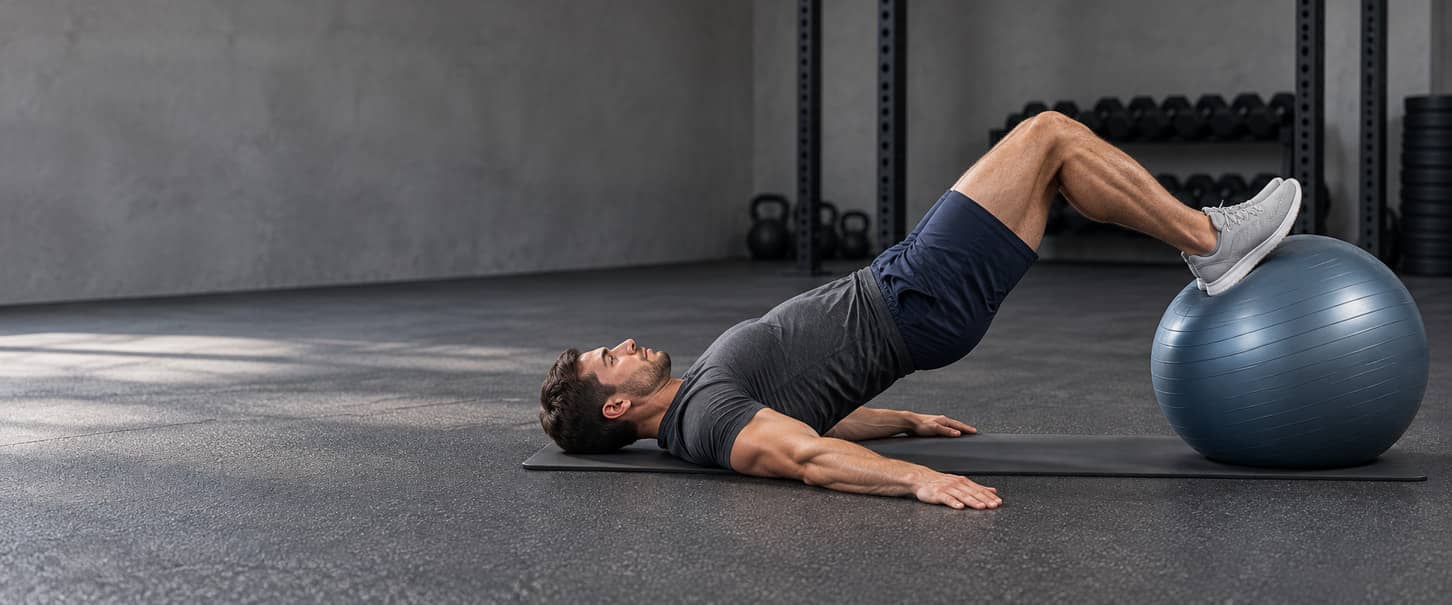
Choose a Leg Curl Alternative That Fits Your Equipment
A leg curl alternative should still train the hamstrings as the knee bends or as you resist it straightening. Another suitable curl machine is the simplest swap. Without one, consider a sliding curl, stability-ball curl or properly anchored band curl. A Nordic curl is a more demanding option, not the default starting point. Choose from the equipment you can use securely, then learn that version before changing your workout. A short hamstring walkout offers a floor-only option, but it does not reproduce a heavily loaded machine curl. Romanian deadlifts and bridges train the hamstrings differently and are not direct knee-curl replacements. The guide compares the options, teaches their setup and movement, and shows how to replace one existing leg-curl allocation. Choose one suitable option; this is not a workout containing every exercise below.
Compare Leg Curl Alternatives by Equipment
Start with the equipment and support available. Read the relevant technique entry before using an option; a familiar exercise name does not guarantee that the setup fits.
| Available setup | Option | What changes | First check |
|---|---|---|---|
| Another curl machine | Seated or lying leg curl | Hip position, support, movement path and displayed resistance | The seat or pad, knee pivot and roller must fit. |
| Exercise sliders and a compatible surface | Bilateral sliding leg curl | Your heels move while your hips stay raised | The sliders must move smoothly without the shoulders or arms slipping. |
| A suitable stability ball | Stability-ball leg curl | The ball rolls beneath both feet while you support your hips | You must be able to control the ball without it shooting away. |
| A resistance band, ankle attachment and fixed exercise anchor | Prone single-leg band curl | Each leg works separately against elastic resistance | Every connection must be intended for this setup. |
| A purpose-built Nordic station | Hand-assisted Nordic lowering | Your ankles stay fixed while your body moves around the knees | Comfortable restraint and a controlled hand-supported descent are essential. |
| Only a clear, nonslip floor | Short hamstring walkout | Small heel steps change the knee angle while the hips stay raised | Keep the steps short enough to control the pelvis. |
These options are not a best-to-worst ranking. A ball or slider curl can be demanding even without added weight, and a band is not a complete setup without its compatible attachment and anchor. Another machine may be the more practical choice when floor access or upper-body support is difficult. If no setup provides controllable knee-flexion work, record the omission and adjust the plan rather than forcing a substitute. Do not trap a dumbbell between your feet, anchor your ankles under furniture or tie a towel over a door.
Why a Hip Hinge Is Not the Same as a Leg Curl
Knee flexion means bending the knee. In an ordinary curl, the hamstrings help bring the heel towards the back of the thigh. During the return, they resist the knee straightening. In a Nordic lowering, the lower leg stays fixed and the thigh and trunk move forwards instead. Most of the hamstring muscles also cross the hip. A Romanian deadlift loads them while the hips bend and straighten, with much less change in knee angle. That is useful hamstring training, but it does not practise the same movement as a curl.
| Movement | Main action in this comparison | Substitution limit |
|---|---|---|
| Machine, sliding, ball or band curl | Repeated knee bending and controlled straightening | Support and resistance still differ between versions. |
| Nordic lowering | Resisting knee straightening as the body tips forwards | A lowering-and-reset repetition is not a full unassisted curl. |
| Romanian deadlift or hip thrust | Hip extension with a different knee movement | Useful for their own roles, not direct replacements for allocated knee curls. |
Research comparing exercises does not make every hamstring movement equivalent. One short trial found similar changes in selected muscle measurements after its tested Romanian-deadlift and Nordic protocols. That does not mean the movements, loads or all possible training outcomes are interchangeable. Use the Romanian deadlift guide when your plan needs a standing hinge, and the hip thrust guide for supported hip extension. Choose a curl variation when the missing task is knee-flexion work.
Use Another Seated or Lying Leg Curl Machine
Check whether another machine solves the problem before changing to a bodyweight exercise. Seated and lying curls both provide adjustable knee-flexion resistance, but their settings and weight-stack numbers are not interchangeable.
Seated Leg Curl
Use a seated station that supports your back and thighs. The restraint holds the thighs down while a separate roller moves behind the lower legs.
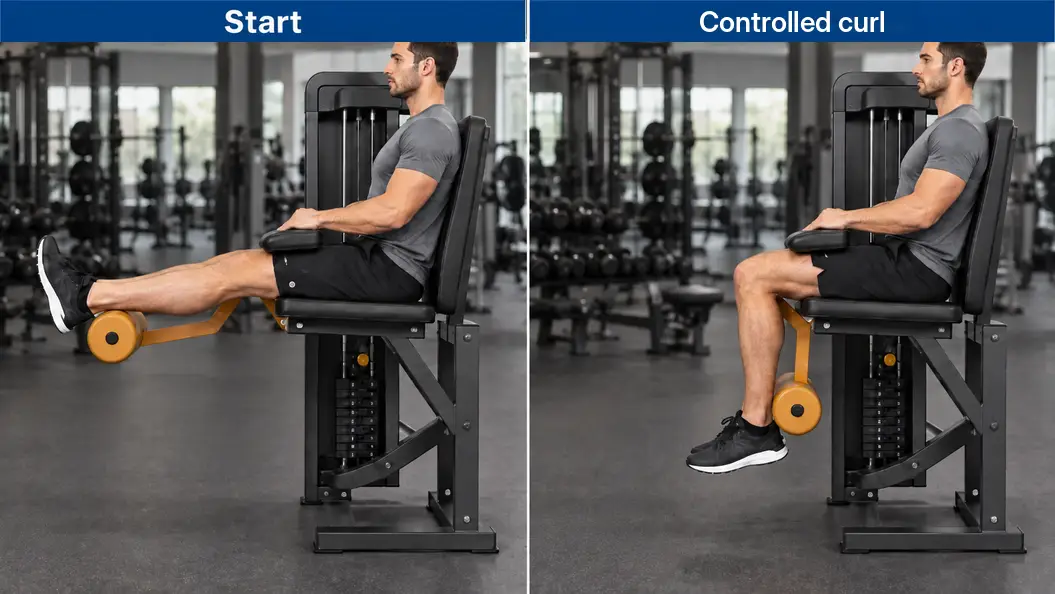
- With the resistance resting, adjust the seat and backrest so your knees line up with the machine pivot as its instructions require.
- Place the moving roller against the backs of the lower legs above the heels. Secure the thigh restraint without pressure on the kneecaps and choose a manageable start position and load.
- Take the handles and bend both knees, moving the roller down and back. Keep your pelvis on the seat and thighs beneath the restraint.
- Stop at a comfortable bent-knee position, then return slowly without letting the resistance pull the legs forwards abruptly.
- Settle the resistance and release the restraint as designed before leaving or adjusting the station.
Reduce the load or permitted range if your hips lift or the return becomes uncontrolled. A roller pressing against the fronts of the shins is not the seated-curl arrangement described here.
Lying Leg Curl
Use a purpose-designed lying-curl station with comfortable torso support and a moving roller behind the lower legs.
- With the resistance resting, set the roller and starting angle. Position your knees at the intended pivot and clear of an uncomfortable pad edge.
- Lie face down with your pelvis supported, take the handles and place the roller above the heels as the machine requires.
- Bend both knees while keeping your hips against the pad. Do not kick the roller or lift your pelvis to finish.
- Return steadily through the same comfortable range, without snapping the knees straight or dropping the stack.
- Bring the resistance fully to rest before getting off or changing settings.
Reduce the load if the hips lift. If the pad or available range does not fit, choose another station rather than forcing the position. A controlled study found greater growth in several hamstring measurements with seated than lying curls under its tested conditions; both versions produced growth. This favours considering a seated curl when both fit, not abandoning a usable lying curl or copying the study's training volume. The leg exercise guide covers their place alongside squats, hinges and calf work. Use a fresh starting load on another station rather than converting the number from the old machine; why gym machine weights differ explains that limitation.
How to Do Sliding Leg Curls
Bilateral Sliding Leg Curl
Use two exercise sliders on a surface they are designed for. Your heels slide away and back while your upper back and arms remain supported and your hips stay raised.
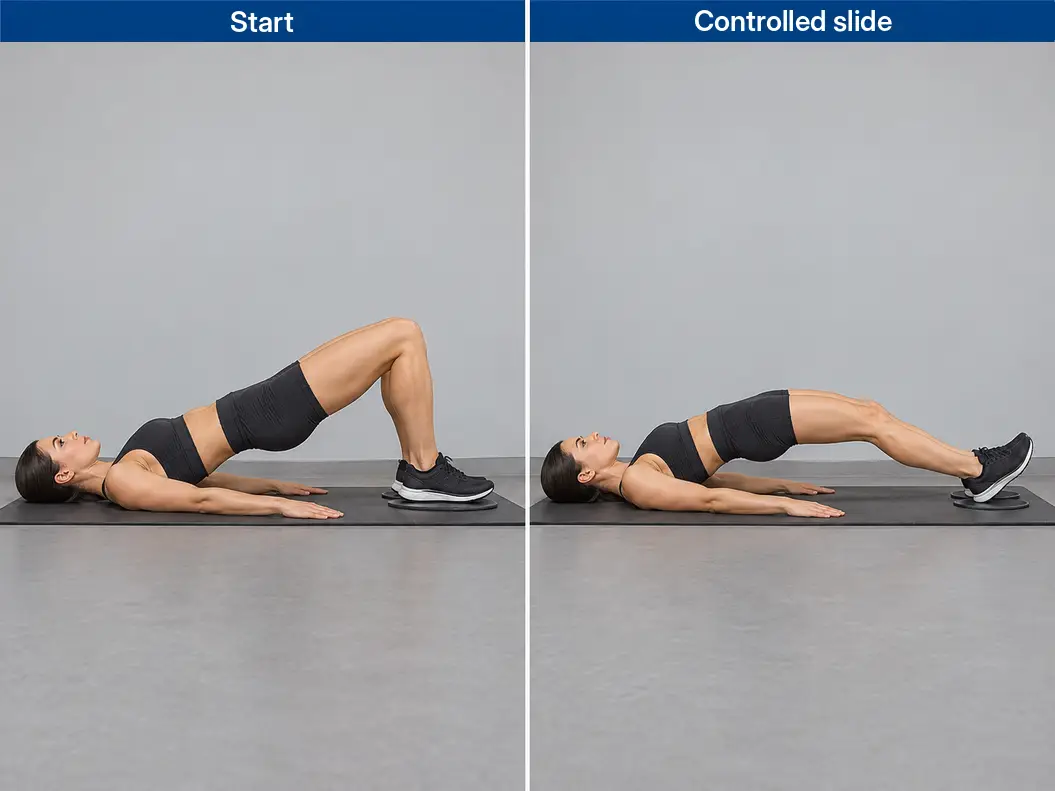
- Clear the working area. Lie on your back with bent knees, a heel on each slider and your arms resting on a surface that does not slip.
- Press through the heels and lift your hips into a comfortable bridge. Keep your ribs controlled rather than arching your lower back.
- Slowly slide both heels away, letting the knees straighten only as far as you can keep the hips raised. Straight knees are not required.
- Bend both knees to pull the heels back towards you without dropping the pelvis. The outward slide and return count as one repetition.
- After the final return, lower your hips and bring the sliders to rest before sitting up.
Make the movement manageable
Shorten the outward travel first. If the return is still too difficult, use a lowering-only version: slide out slowly, lower the hips to the floor, bring the heels back with the hips down, then lift to reset. Count one controlled outward slide and reset as one repetition of that version, not as a full curl. Do not switch to uncontrolled lowering simply to finish the target. If the floor or sliders snag, move unpredictably or pull your upper body along, stop and change the setup or exercise.
Progress the same version
Build controlled repetitions over the same distance before increasing the travel. If you began with lowering-only repetitions, first learn a short out-and-back curl. Change one feature at a time; a longer slide and a full return are separate increases in difficulty. Do not balance loose weights on your hips to make it harder.
How to Do Stability-Ball Leg Curls
Bilateral Stability-Ball Leg Curl
Use an undamaged exercise ball, inflated and sized according to its instructions. Both heels and lower legs begin on the ball; the floor supports your head, shoulders and arms.
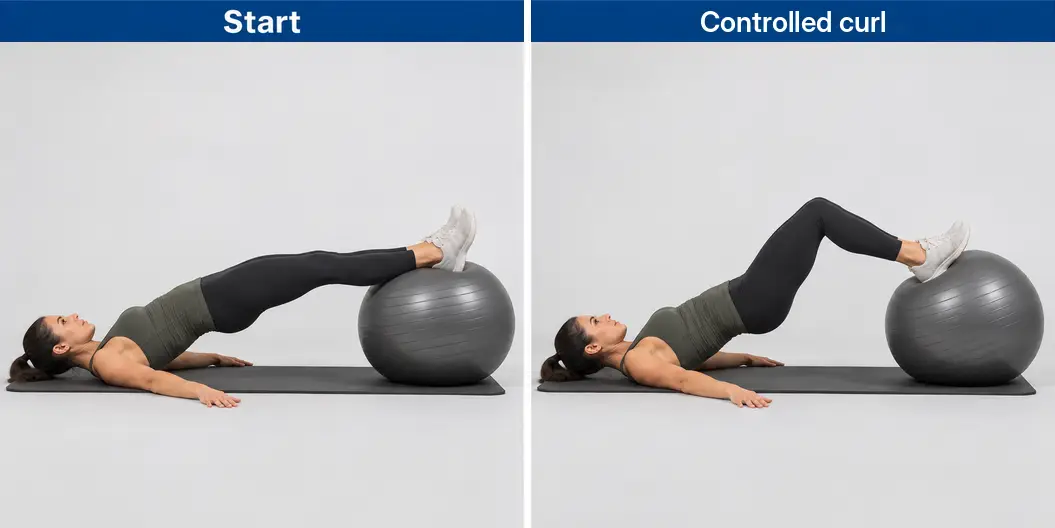
- Lie on your back with the heels and lower legs on the ball and your arms out on the floor for balance.
- Lift the hips until your trunk and thighs form a controlled line. Do not gain height by arching the lower back.
- Bend both knees to roll the ball towards you. Let foot contact change naturally as the ball moves, keeping the hips raised.
- Roll the ball away slowly to the same controlled starting range. Pulling in and returning out count as one repetition.
- Lower the hips and settle the ball before getting up.
Use less travel if the pelvis drops or the ball veers sideways. A stable bridge hold with the lower legs on the ball can help you learn the support position, but it is not a completed curl repetition. Keep both arms available for support. Build repetitions and controllable travel rather than removing hand support merely to make balancing harder. If you cannot keep the ball in place, choose another exercise.
How to Do Prone Resistance-Band Leg Curls
Prone Single-Leg Band Curl
This version uses one leg at a time. You need an intact exercise band, a compatible ankle attachment and a fixed low exercise anchor permitted by the equipment instructions. A band alone is not enough.
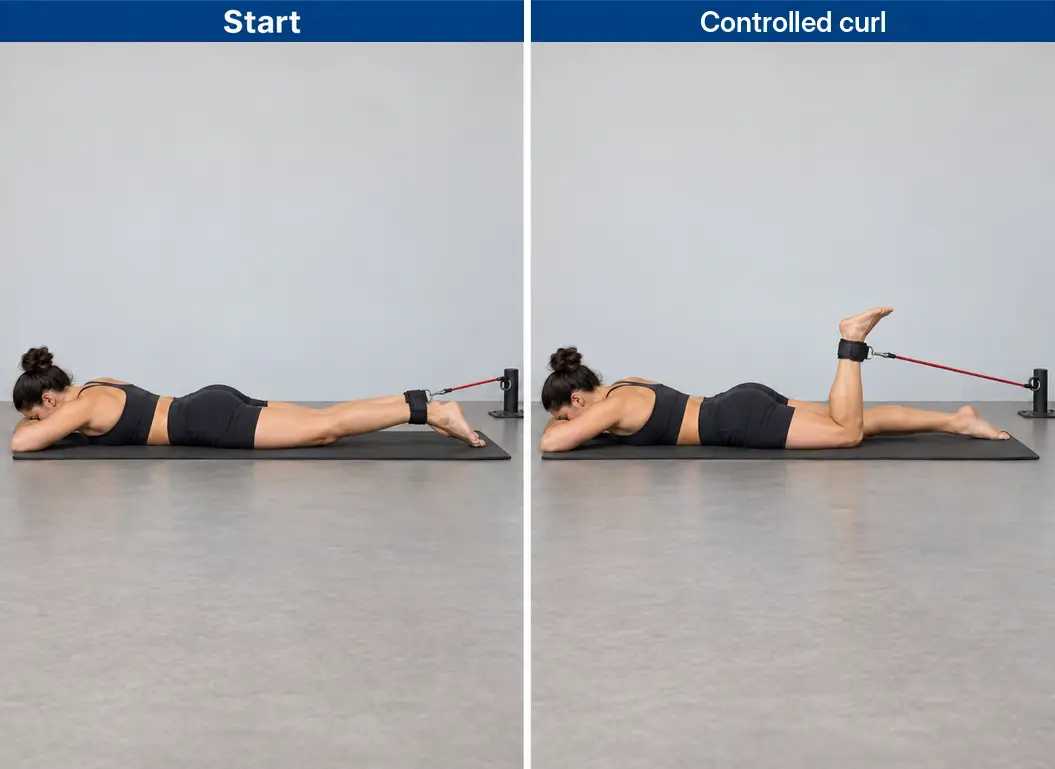
- Inspect the band and connections. Attach them without tension, with the anchor beyond your feet and away from your head. Follow the product's stretch limits and eye-protection instructions.
- Fit the ankle attachment as designed and lie face down on a nonslip mat, facing away from the anchor. Keep the band clear of the other leg.
- Start with the working knee nearly straight and the thigh supported. Choose a position that provides usable resistance without overstretching the band.
- Bend the working knee, bringing the heel towards the back of the thigh while keeping your pelvis down. Stop before the attachment shifts or the hip lifts.
- Straighten the knee slowly without letting the band pull it abruptly. Finish the set, remove tension, then change sides or detach.
A lighter band or shorter comfortable range makes the curl easier. Do not increase resistance by moving beyond the manufacturer's permitted stretch or by joining incompatible bands and clips. Keep the band identity and starting position consistent when comparing repetitions. Complete the prescribed work on both legs and rest after each side. A cable cuff is not automatically compatible with a resistance band. Without a suitable fixed anchor and attachment, use a different option rather than substituting a door handle, radiator or loose furniture.
Nordic Curls: Start With Controlled Lowering
Hand-Assisted Nordic Lowering and Reset
Use a purpose-built Nordic station with comfortable knee padding and secure lower-leg restraint. This is a demanding lowering exercise with an assisted reset, not a full unassisted Nordic curl.
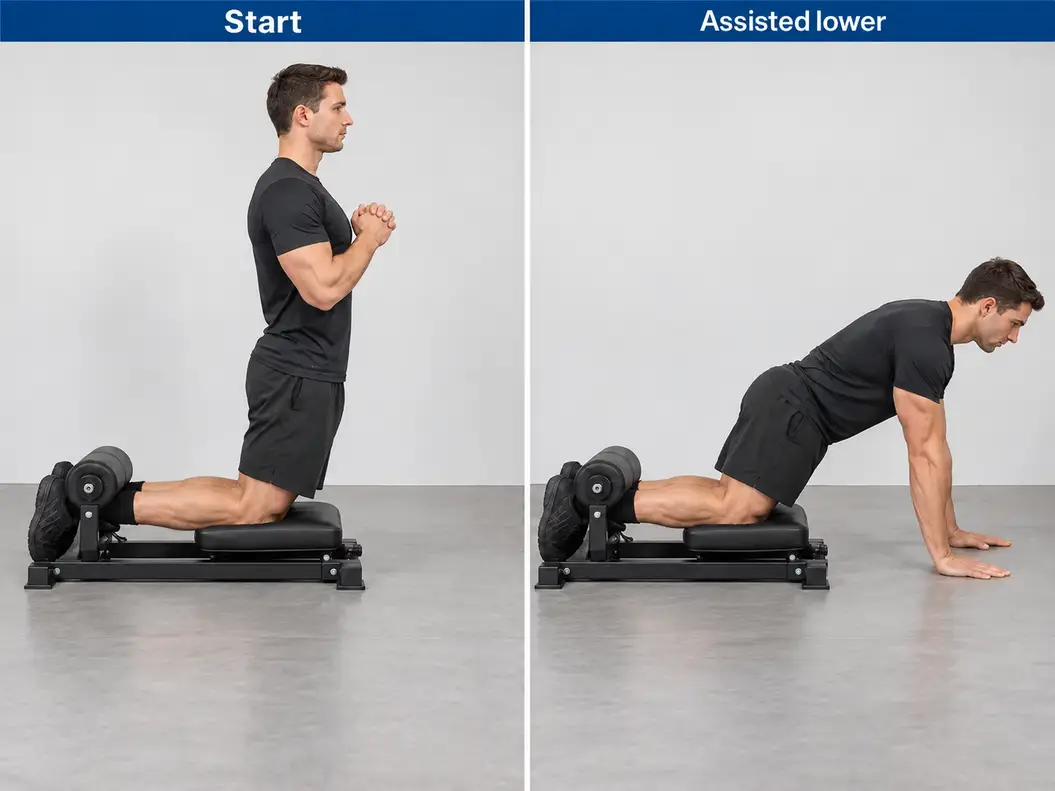
- Fit the station as instructed and establish comfortable knee and ankle support. Keep clear floor space in front for your hands. Get qualified help with an unfamiliar station.
- Kneel upright with the hips extended and trunk steady. Hold your hands ready in front of you rather than behind your back.
- Lean forwards from the knees while resisting the descent. Keep the trunk and thighs moving together; do not fold at the hips to reach farther.
- Place your hands down before control is lost and use your arms to support the rest of the descent. Do not deliberately fall or let your face approach the floor without support.
- Use your arms and bend at the hips as needed to return to kneeling, then restore the upright start. Count the controlled lowering and assisted reset as one repetition.
Reduce the unsupported part of the descent and use your hands earlier when needed. If you cannot support and reset yourself smoothly, choose a machine, band or short sliding curl instead. Do not wedge your ankles under a sofa or hold them beneath a loose loaded barbell. Progress the distance you can lower under control, not the speed of the fall. Keep the same station and similar hand assistance when comparing repetitions. Full unassisted returns and added weights are not required by this guide. A Nordic is not automatically the best choice simply because it is difficult.
Floor-Only Option: Short Hamstring Walkouts
Short Hamstring Walkout
The heels take small steps rather than sliding. Use a level, nonslip floor and keep the outward distance modest.
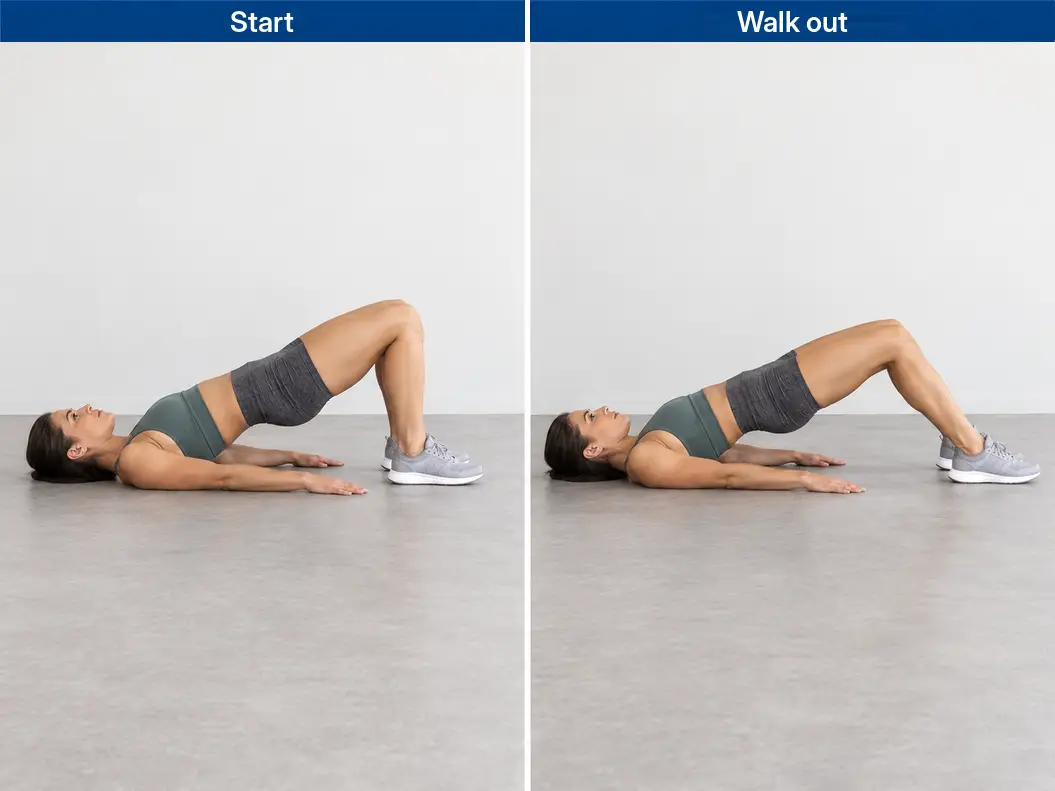
- Lie on your back with bent knees and heels planted. Raise the pelvis into a small bridge with your head, upper back and arms supported.
- Take small alternating heel steps away from your hips. Keep some knee bend and maintain the raised pelvis.
- Stop moving out before your hips sag, your lower back arches farther or your feet slip.
- Walk the heels back, then briefly lower the hips to reset. The complete outward-and-return cycle counts as one repetition.
- Repeat the same distance at a controlled pace, taking about one second per heel step.
Shorten the path if needed. A simple bridge hold can help you practise the support position, but it removes the changing-knee-angle task. If even a short walkout is unsuitable, do not force it as a curl replacement. A walkout has a loading ceiling. More heel steps do not guarantee the same training effect as a progressively loaded machine. Keep that limitation visible when deciding whether your available equipment meets your goal. For a complete floor-and-wall routine rather than a single replacement, use the No-Equipment Home Workout Plan. Its own schedule and prescriptions remain separate from the examples below.
Choose Sets, Reps and Progression for the Replacement
Keep a suitable prescription from your existing workout plan when you are using one of its listed alternatives. A new exercise may need a different repetition range, rest or starting amount; it does not inherit the old machine weight. Practise unfamiliar movements with easy resistance or short travel first. At your first session with a new non-machine option, use one controlled working set instead of immediately adopting the two-set examples below. For a single-leg band curl, that means one set on each leg. Move to the normal example at a later session only when the movement and recovery are manageable. The Nordic example already uses one set.
Starting examples for one selected exercise
These are practical starting suggestions for an existing hamstring slot, not research-tested equivalents or a complete workout. Use only the row for your chosen exercise. The Nordic row deliberately begins with one set because the movement can be demanding even with assistance.
| Exercise | Sets & Reps | Rest | Movement pace | Progression choice |
|---|---|---|---|---|
| Another suitable curl machine | Use the current plan's curl prescription | Use the plan's rest | Use the plan's tempo | Build repetitions before the smallest suitable station increase. |
| Bilateral sliding curl with a full return | 2 sets of 6–10 reps | 120 sec after each set | 3-1-1-1 | Add controlled repetitions, then slightly increase travel if appropriate. |
| Bilateral stability-ball curl | 2 sets of 6–10 reps | 120 sec after each set | 2-1-1-1 | Add controlled repetitions or restore a previously shortened range. |
| Prone single-leg band curl | 2 sets of 10–15 reps per leg | 90 sec after each leg | 2-1-1-1 | Build repetitions on both sides before a suitable band increase. |
| Hand-assisted Nordic lowering and reset | 1 set of 3–5 reps | 120 sec after the set | About 3 seconds lowering, then an unhurried assisted reset | Improve controlled travel or reduce assistance gradually. |
| Short hamstring walkout | 2 sets of 4–8 reps | 90 sec after each set | About 1 second per heel step; brief reset after the return | Add cycles before modestly increasing outward travel. |
For the slider, the four tempo numbers mean three seconds sliding out, one second at the controlled outer position, one second curling in and one second at the bent-knee position. For ball and band curls, 2-1-1-1 means two seconds returning towards straighter knees, one second there, one second curling and one second at the bent-knee position. Pauses do not require forced joint endpoints. Use your workout plan's effort target for machine curls. For the slider, ball and band examples, finish with about two or three controlled repetitions still possible. Use the reps-in-reserve guide to understand that estimate. For Nordic lowering and walkouts, stop before control or support deteriorates rather than testing how many poor repetitions remain. Pain is a reason to stop, not an effort target.
When to make it harder
For a rep-range exercise, first reach the upper number on every prescribed set with the same range and control. For the single-leg band curl, both legs must qualify. Then change one suitable feature and return towards the lower end of the range. If the new version cannot meet the minimum with control, reverse the change. A slider curl already performed over its useful range does not need endless extra travel. Once the version becomes too easy, consider a more adjustable loading option. The same applies to a ball curl or walkout: do not invent instability, extra sessions or loose weights to avoid an equipment limit. For lowering-only slider curls, use the one-set introduction and stop before control deteriorates. The table's rep range, four-part tempo and repetitions-in-reserve target apply to full curls, not this regression. Record each controlled outward slide and hips-down reset as one lowering-only repetition. Build control before trying a short full return. Nordic progression similarly depends on controlled travel and assistance, not just completing five increasingly uncontrolled falls.
Replace One Leg-Curl Slot in an Existing Workout
The Upper Lower Workout Plan gives Lower A a seated-or-lying curl in exercise position four of six. The original row is:
| Exercise | Sets & Reps | Rest | Tempo | Target Muscles | Notes |
|---|---|---|---|---|---|
| Seated or Lying Leg Curl | 2 sets of 10–15 reps | 60–120 sec | 2-1-1-1 | Hamstrings | Keep the hips stable and control both ends of the range. |
Changing between the two listed machine options retains that prescription but requires a new load suited to the station. The examples below deliberately change the exercise and, where stated, its dose. They are alternatives to the curl slot, not additions to the workout or changes to its other five exercises.
| Choice | Work for the curl slot | Interpretation |
|---|---|---|
| Use a suitable seated or lying machine | 2 sets of 10–15 reps; 60–120 sec; 2-1-1-1 | Original listed prescription; two bilateral sets. |
| After learning it, use a bilateral sliding curl instead | 2 sets of 6–10 reps; 120 sec; 3-1-1-1 | Suggested replacement; two bilateral sets, using a different exercise and rep range. |
| After learning it, use a prone single-leg band curl instead | 2 sets of 10–15 reps per leg; 90 sec after each leg; 2-1-1-1 | Suggested replacement; four separate sets because each leg works on its own. |
| Perform the original two machine sets, then add two slider sets | 4 bilateral sets | An addition, not a replacement. |
Choose the replacement before starting the curl slot. If you have already performed part of it, record that work and do not restart with a full replacement allocation. Unfamiliar Nordic lowering is not a suitable way to chase the original fifteen-repetition target late in a session.
Sliding-curl progression example
This hypothetical log uses the two-set sliding replacement above, after the movement has been learned. Keep the same sliders, surface, travel, 120-second rests and 3-1-1-1 tempo. Every recorded repetition includes the return with the hips raised.
| Session | Set 1 | Set 2 | Decision |
|---|---|---|---|
| 1 | 6 | 6 | Keep the same travel and build repetitions. |
| 2 | 8 | 7 | Keep the same travel; neither set has reached ten. |
| 3 | 10 | 9 | Keep the same travel; the second set is below ten. |
| 4 | 10 | 10 | If control and effort also qualify, consider a small increase in travel. |
| 5 | 7 | 6 | A possible result after longer travel; build within the range again. |
Repetitions alone do not qualify a harder version if the hips drop or the return changes. Ten followed by five is fifteen completed repetitions, but the second set misses this example's six-repetition minimum. Reduce the travel or return to an easier version rather than forcing another repetition.
Count both legs accurately
Two sets of ten bilateral slider curls are twenty complete curls across two sets, not four sets because both legs work. Two sets of ten band curls per leg are twenty repetitions per leg across four separate sets. Rest ninety seconds after every leg in the band example, including before repeating the first leg. Record the exercise, resistance or travel, repetitions in each set and the rest you actually took. For bands, include the working leg and band setup; for Nordics, note the assistance and controlled travel. The set-counting guide explains how to keep those units clear. Record a one-set introduction as one set, not two. Changing equipment is not evidence that you became stronger or weaker overnight. Use when to change your workout plan when the required adjustment goes beyond one exercise slot.
Common Leg-Curl Substitution Mistakes
Correct the setup or movement before adding repetitions. One difficult session does not by itself show that you need a different exercise.
| What happens | What to change |
|---|---|
| The pelvis drops during a sliding or ball curl | Shorten the travel or use the explained regression. |
| The sliders snag or the ball escapes sideways | Stop; use a compatible surface and controllable setup or choose another option. |
| The thigh lifts during a prone band or machine curl | Reduce resistance and keep the pelvis supported. |
| The band attachment slips or the anchor moves | Stop and unload it; do not continue by gripping or tying it more tightly. |
| A Nordic becomes an uncontrolled fall | Use hand support earlier or choose a more manageable exercise. |
| More hinges are added in place of every curl | Review the missing knee-flexion role instead of assuming the same muscles mean the same task. |
| A substitution doubles the planned work | Keep the completed work in the log and replace rather than append the new exercise. |
For an unexpected drop in repetitions, first check the load, range, earlier training and rest. The reps-drop guide covers those checks without assuming every poor set is a plateau.
Soreness, cramp and pain
Keep the first exposure to a new exercise conservative. Mild muscle soreness can occur, but sharp pain is not a useful training signal. Stop a cramping set and relax the leg; do not force through it or assume that salt, stretching or another exercise will solve the cause. Sudden sharp pain, swelling, bruising or unexpected weakness warrants appropriate assessment. Persistent or worsening symptoms also need individual advice. This guide selects exercises for general training; it is not a hamstring-injury rehabilitation plan.
Leg Curl Alternatives FAQs
What is the best leg curl alternative?
Another suitable curl machine is often the simplest choice. Without one, a sliding, ball or band curl may fit. Choose the version you can set up and progress; Nordic curls are not automatically better because they are harder.
What can I use instead of a seated leg curl?
A lying curl retains adjustable knee-flexion work, but changes hip position and support. Non-machine options also change the resistance and stability demands. Start with a manageable load or range rather than converting the old machine number.
Can Romanian deadlifts replace leg curls?
They can train the hamstrings, but mainly through hip movement rather than repeated knee bending. Keep a knee-flexion option when that is the role your plan needs, especially if the routine already contains a hinge.
Can I replace leg curls with squats or leg presses?
Not as a direct knee-curl replacement. Those exercises have a different main action and training role. Use them for the squat or pressing work in the plan rather than silently removing all knee-flexion work.
What can I do with no equipment?
A short hamstring walkout is the floor-only option taught here. It has limits and is not equivalent to heavy adjustable curls. Sliding curls need a suitable sliding setup; ball and band curls require their stated equipment.
Are towels the same as exercise sliders?
Not on every floor. This guide uses exercise sliders on a compatible surface, so it does not assume that a towel will move smoothly or stay under the heels. Use the equipment as intended rather than improvising an unpredictable surface.
Are Nordic curls suitable for beginners?
They can be too demanding even with assistance. Use them only with a proper station and a descent and reset you can control. Starting with a machine, manageable band or short sliding version is a valid choice.
Can I hold a dumbbell between my feet for leg curls?
This guide does not recommend that setup. Losing grip can drop the weight, and handling it into position is an additional problem. Choose a secure machine, slider, ball or compatible band setup instead.
Should I use the same sets and reps after switching exercises?
Retain the plan's prescription when using a listed suitable alternative. A new movement may need an explicit change, as in the sliding-curl example. Two sets per leg also take four separate working sets, unlike two bilateral sets.
Should I add all the alternatives to my leg workout?
No. Choose one suitable replacement for the allocated curl work. A list of alternatives is not a requirement to perform a larger workout.
What should I record when there is no weight stack?
Record completed repetitions and the setup that determines difficulty: slider travel and surface, ball setup, band resistance and position, or Nordic assistance. Keep it simple enough to repeat consistently.
What if leg curls hurt?
Stop the painful movement. Check ordinary equipment fit, but do not repeatedly test different exercises through pain. Sudden injury signs or persistent symptoms need appropriate assessment rather than advice from an alternatives list.