
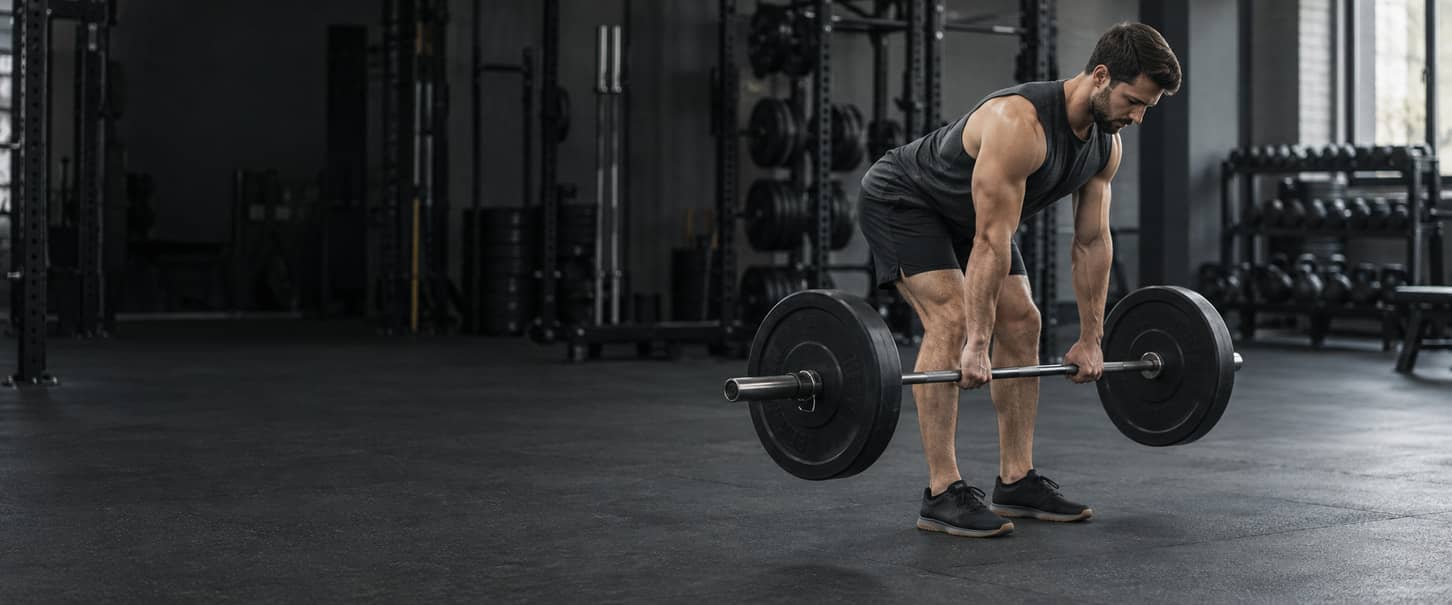
Romanian Deadlift: Form and Equipment at a Glance
A Romanian deadlift, or RDL, is a standing-start hip hinge. Lower the load close to the legs while keeping a small, broadly stable knee bend, then extend the hips to return upright. The initial pickup only brings the load to the standing start; it is separate handling rather than a counted working repetition. Choose the implementation whose equipment, pickup, return, support, and load record you can reproduce. The table routes you to the appropriate instructions without requiring you to perform every variation.
| Variation | Useful feature | Essential setup check | Load record |
|---|---|---|---|
| Barbell Romanian Deadlift | One shared bar and practical total-load increments. | Controllable pickup, close bar path, and planned return. | Total bar-plus-plate mass and unit. |
| Dumbbell Romanian Deadlift | Independent hand paths and flexible equipment access. | Two manageable weights and a clear pickup and set-down. | Mass per dumbbell and unit. |
| Smith Machine Romanian Deadlift | Guided travel when the actual station fits. | Rail direction, hooks, stops, and a usable close path. | Exact station, settings, and known resistance convention. |
| Supported Single-Leg Dumbbell Romanian Deadlift | Per-leg hinge with external hand support. | Fixed support, one loaded hand, and clear rear-leg space. | Stance leg, loaded hand, support, and one dumbbell mass. |
The four entries are choices, not a four-exercise workout or strength ranking. Start with the barbell or dumbbell tutorial when either matches your equipment, or use the Smith or supported single-leg instructions when those setups solve a specific constraint. This page explains the hinge, usable range, handling, and equipment-specific variations. Use the leg exercise selection guide when choosing among wider lower-body movement roles. Your full workout plan determines exercise order, schedule, working sets, and progression.
How to Do the Barbell Romanian Deadlift
Barbell Romanian Deadlift
Use a barbell for a bilateral hip hinge with one shared implement. Plan how the bar will reach the standing start and how it will return before adding working weight. The initial pickup is load handling; one controlled lowering phase followed by the return to upright counts as one working repetition. A separately learned floor pickup does not turn the working set into a reset-style conventional deadlift.
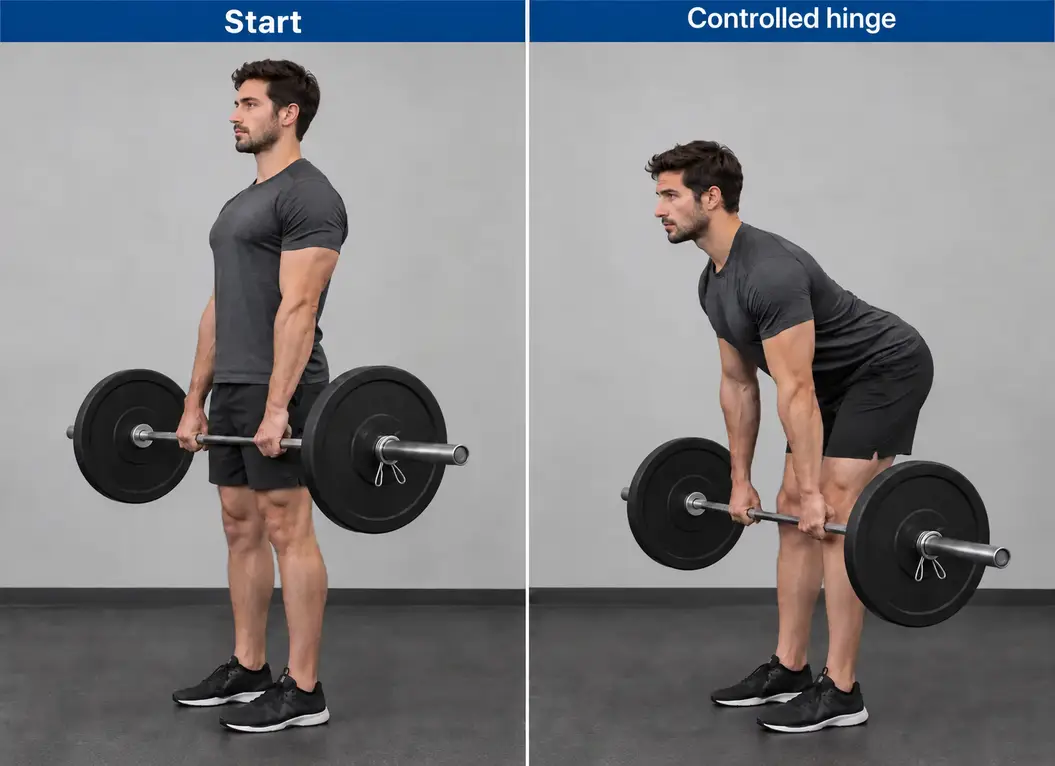
- Inspect the bar, collars, plates, floor, and working area. Use compatible rack supports at a reachable height or a separately learned controlled pickup, secure the plates and collars, and rehearse the return route with a manageable training bar. Choose lighter equipment or qualified setup help when the available bar or pickup is already unmanageable.
- Take a full, comfortable double-overhand grip just outside the thighs so the hands clear the legs. Stand with the bar close to the thighs, feet at a comfortable width, whole-foot contact, and a small knee bend. Keep the knees soft without locking them or dropping into a squat.
- Prepare the trunk and keep the arms long. Send the hips backward as the torso inclines over the hip joints. The pelvis and torso rotate at the hips as part of the hinge, while the selected trunk shape stays controlled. Do not try to freeze the pelvis or force the back into one mathematically straight line.
- Guide the bar close to the legs without dragging it forcefully against them. Keep the initial knee bend broadly stable, allowing only the small adjustments needed for a controlled hinge. Do not keep bending the knees to manufacture more depth.
- Reverse at the lowest position you can repeat before added travel requires a material change in trunk shape, uncontrolled pelvic tuck relative to the torso, forward bar drift, lost foot pressure, or extra squatting. The floor, plate diameter, and another person's shin landmark are not required endpoints.
- Extend the hips to return to the same upright start while the bar stays close and the arms remain long. Finish tall rather than leaning backward, shrugging, or pulling the bar upward with the elbows. Reset breathing and balance before the next lowering phase.
- End the set while the planned set-down or rerack remains controlled. Return the bar deliberately through the rehearsed route and confirm it is fully supported before releasing the grip. Stop before lost grip or trunk control turns into a forced final repetition.
Regress with a lighter training bar, a shorter controlled hinge, or an unloaded hinge rehearsal. A dumbbell implementation is an equipment choice rather than a compulsory beginner stage. A rack-supported pickup can solve access without changing the working repetitions into rack pulls. Progress only while the stance, grip, knee bend, close bar path, working endpoint, and return route remain comparable. Record the total bar-plus-plate mass and unit, stance, grip, endpoint, pickup and return method, and any strap or belt use. The workout plan supplies the working sets, repetitions, rest, and effort target.
How to Do Dumbbell Romanian Deadlifts
Dumbbell Romanian Deadlift
Use two dumbbells for a bilateral standing-start hinge when their grip, shape, loading increments, and pickup suit the task. Each hand controls its own weight, but both dumbbells move together as one repetition, not two. Plan the pickup and set-down before the working set so handling does not dictate the hinge.
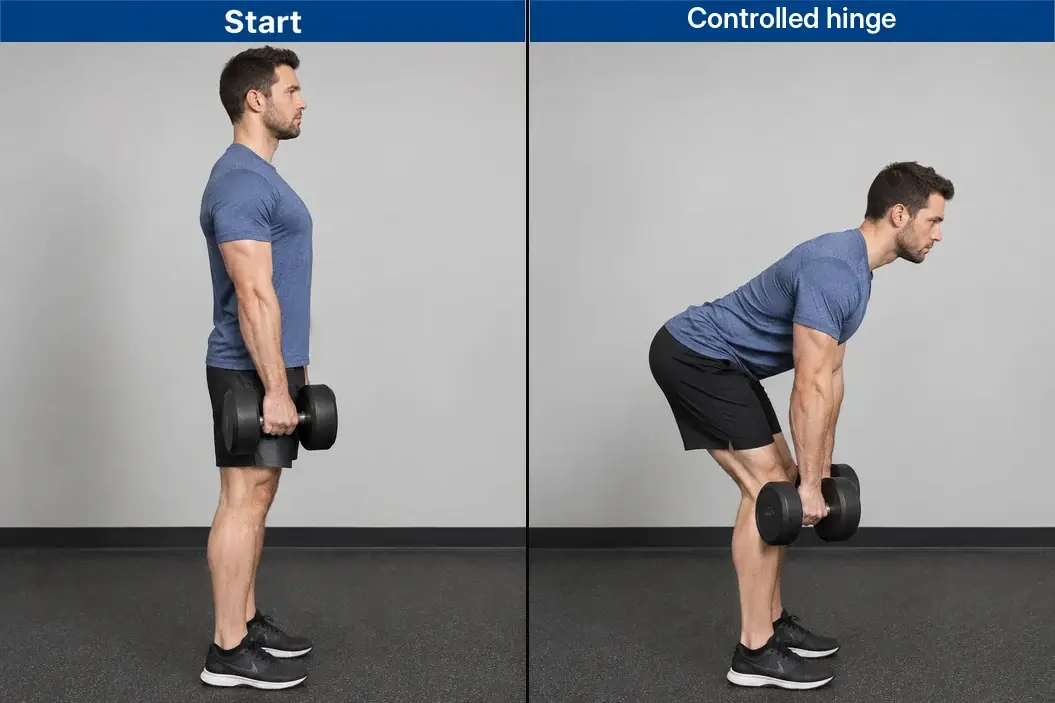
- Inspect both dumbbells and their manufacturer-approved retention mechanisms. Arrange a clear pickup and return area, use permitted stable supports or a separately learned controlled floor pickup, and rehearse with manageable weights rather than making a difficult pickup part of every repetition.
- Stand holding one dumbbell beside or slightly in front of each thigh. Establish a comfortable stance, whole-foot contact, long arms, and a small knee bend. Use full grips and hand paths that let the dumbbell heads clear the knees without swinging around them.
- Brace and send the hips backward while the torso inclines over the hip joints. Guide both weights close to the legs through independent but repeatable paths. Keep the knee bend broadly stable instead of progressively sitting down.
- Stop the descent before either dumbbell drifts forward, balance changes, or extra reach requires a material change in the intended trunk shape or additional knee bend. The weights do not need to touch the floor or reach one fixed shin landmark.
- Extend the hips to stand tall with both weights controlled. Keep the elbows long and finish without shrugging, leaning backward, or twisting one side ahead of the other. Reset balance before the next lowering phase.
- Finish before grip or handling control is lost. Set down both dumbbells through the rehearsed route without twisting, routinely dropping them, or forcing another repetition. The initial pickup and final set-down are load handling, not additional working repetitions.
Regress with a lighter pair, a shorter repeatable hinge, or an unloaded rehearsal while learning the movement. Preserve the bilateral two-dumbbell implementation rather than silently changing to a one-dumbbell or single-leg exercise. Progress repetitions before increasing the load per hand, while the stance, grip, knee bend, close paths, lower endpoint, and pickup and return method remain comparable. Record the mass of each dumbbell with lb or kg, grip orientation, endpoint, and handling arrangement. Per-hand dumbbell load is a separate record from total bar-plus-plate mass. Do not halve a barbell total to prescribe each hand. Two equal dumbbells have an arithmetic combined mass, but that does not establish an equivalent barbell training load. The workout plan supplies the working sets, repetitions, rest, and effort target.
Romanian Deadlift Muscles Worked and Benefits
Hamstrings and glutes produce the hip extension
The Romanian deadlift trains the hamstrings and glutes prominently as the hips move back and then extend to return the body upright. Most hamstring muscles cross both the hip and knee, so they can contribute to hip extension as well as knee flexion. The short head of biceps femoris crosses the knee but not the hip, so it does not share the same hip-extension role. The glutes contribute strongly to hip extension, and the adductors can assist at the hip. This does not make the RDL isolated hamstring or glute training, and it does not mean every named muscle receives the same stimulus. A seated or lying leg curl trains knee flexion more directly, so curls and RDLs are complementary rather than interchangeable.
Trunk, upper back, and grip support the movement
The spinal erectors and other trunk muscles help maintain the chosen relationship between the torso and pelvis while the hips move. Upper-back and shoulder-girdle muscles help support the arms and keep the load close without turning the repetition into a row or shrug. The hands and forearms must also hold the implement, so grip can end a set before the hip extensors do. These supporting roles are part of the exercise, not proof that the RDL trains every involved muscle equally. A useful set keeps the load path, knee bend, trunk shape, and endpoint repeatable instead of extending the range after support or grip begins to fail.
Benefits of repeatable loaded hinge practice
The practical benefit of the RDL is progressive practice of a loaded hip hinge and hip-extension strength. The controlled lowering is the eccentric phase, but it is only one part of the repetition. A complete RDL lowers from standing through the chosen hinge and then returns upright under control. Progress is better judged by comparable technique, range, repetitions, load, and effort than by a stretch sensation, pump, or next-day soreness. Those sensations can occur without proving muscle growth, and their absence does not mean the exercise failed. Immediate muscle-activity or force measurements describe the tested setup at that moment. They do not establish long-term growth, injury rates, a universal ranking over leg curls or conventional deadlifts, or a fixed result timeline. Use the RDL role and progression supplied by the complete workout plan, then evaluate whether performance improves under the same standard.
Romanian Deadlift vs. Conventional and Stiff-Leg Deadlifts
The Romanian deadlift taught in this guide uses standing-start, lowering-led working repetitions: hinge down with a modest, broadly stable knee bend, then return upright. The conventional comparison below is a reset-style pull that begins with the bar supported on the floor or prescribed blocks, then returns to that support before the next repetition. The different start, support, and knee and hip motion make these related deadlift patterns rather than interchangeable load records.
| Variation | Working repetition | Knee and hip behavior | Practical distinction |
|---|---|---|---|
| Romanian deadlift as taught here | Standing start, controlled lowering, then return to standing. | Hips travel back with a modest, broadly stable knee bend. | Use an individual controllable endpoint; no required floor contact. |
| Conventional deadlift, reset style | Bar starts supported on the floor or prescribed blocks; lift, return, and reset. | More coordinated knee and hip motion to leave the support. | The start height and floor-pull task differ; this is not an RDL load converter. |
| Stiff-leg deadlift | Definitions vary; check whether repetitions start from the floor or standing. | Usually described with less knee bend, but the name alone is insufficient. | Do not force locked knees or use the name to justify extra depth. |
Compare the defined movement, not only the label
More knee motion in a conventional floor pull does not automatically turn it into a squat, and slight knee movement during an RDL does not invalidate the hinge. This table defines one reset-style conventional comparison without claiming every conventional repetition must use the same stance, start height, or execution style. It is not a complete conventional deadlift tutorial. The terms stiff-leg deadlift and Romanian deadlift are used inconsistently. A name alone does not establish whether the repetition begins on the floor or from standing, how much knee bend is retained, or where the descent ends. Keep the knees softly bent and stop at your controlled hip-hinge endpoint rather than forcing extra reach.
Keep research findings within their tested question
An acute study comparing conventional and Romanian deadlifts measured muscle activity and movement forces under its tested loading method. Those immediate measurements can describe that particular task, but they do not establish long-term muscle growth, injury rates, a universal winner, or a percentage conversion between the lifts. Specific strength in a floor pull requires appropriate floor-pull practice within a complete workout plan. The Powerlifting Workout Plan provides that wider strength-program context. Use a separate baseline for the RDL and the chosen floor pull rather than converting one exercise's load into the other.
RDL Range of Motion: Knee Bend and How Low to Go
The useful Romanian deadlift endpoint is the deepest repeatable hip hinge you can reverse before compensation, not the floor, a universal mid-shin point, or a torso parallel to the ground. Arm length, leg and torso proportions, stance, knee bend, implement size, balance, and current control all affect where the bar or dumbbells finish. As the hips travel back, the pelvis changes position and orientation and the torso rotates over the hip joints. Keep the chosen trunk relationship controlled rather than trying to prevent all movement or force every back into one visual line.
Range and knee-bend decision procedure
A controlled hinge ends when the hips can no longer travel back under the selected standard. Gaining extra reach after that point through a marked change in trunk shape is not another controlled repetition through the same range. Natural spinal curves, different body proportions, and different valid endpoints are not errors by themselves.
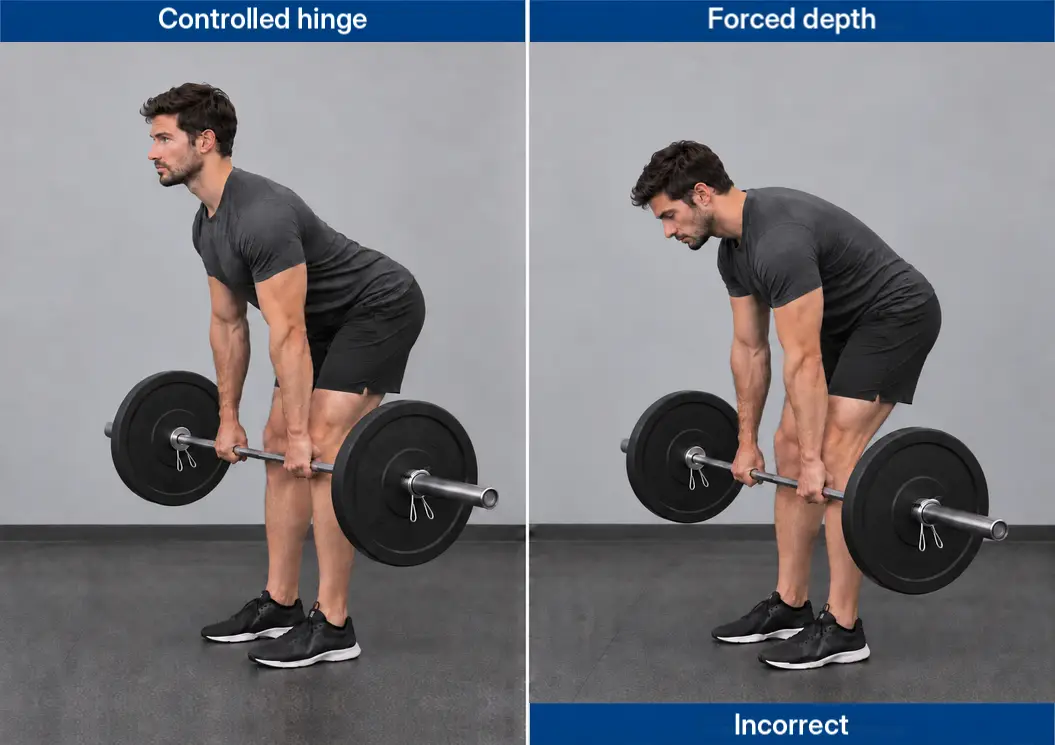
- Set a small, soft knee bend at the upright start. Keep it broadly stable instead of locking the knees or progressively squatting lower.
- Move the hips backward while maintaining whole-foot pressure. Do not shift onto the toes or let balance dictate extra reach.
- Keep the bar or dumbbells close with long arms and a controlled trunk shape. Close does not require forcefully scraping the legs.
- Reverse before additional depth comes from extra squatting, forward load drift, lost balance, or a marked uncontrolled change in the trunk and pelvic relationship.
- Repeat the same endpoint when comparing repetitions, loads, or sessions. Do not chase the floor, a maximal stretch sensation, or a parallel torso.
A side-view comparison can show when the movement standard changes, but it is not a medical test and cannot diagnose an injury, tightness, or spinal condition. To rehearse the hinge without load, stand a comfortable short distance in front of a fixed wall with your back toward it. Soften the knees, move the hips backward until they touch the wall lightly while both feet remain grounded, then return upright. Adjust the distance to the range you can control instead of using a fixed measurement. This is a movement rehearsal, not loaded growth work or an injury test. A higher pickup surface can make it easier to bring the load to the standing start or return it after the set. It does not define the working depth and does not require every repetition to land on the support. Standing on a platform to create a deficit is not an automatic progression. Add range only when the same knee bend, balance, close load path, and trunk standard remain repeatable. Side feedback from a coach or an optional video of a light rehearsal can help, but no phone or recording workflow is required. Use the endpoint you can reproduce within the work assigned by your workout plan.
Grip, Bracing, and Keeping the Weight Close
Use a grip, brace, and load path that remain secure from the standing start through the return and set-down. Grip can limit an RDL before the hip extensors do, but the solution should preserve the hinge rather than hide a loss of handling control.
Use a full grip and keep the arms long
Begin barbell work with a full, manageable double-overhand grip, or use full comfortable grips on both dumbbells. Let the arms remain long as the hips travel back. Keeping the weight close means guiding it near the legs without bending the elbows into a row, shrugging it upward, or scraping the bar or dumbbells forcefully against the body. The shoulder blades can remain organized without a compulsory maximal pinch. Keep the head in a comfortable relationship with the torso as it inclines instead of fixing the eyes on one point, craning toward a mirror, or turning to inspect the side during a loaded repetition. Check side-view feedback between sets when useful.
Use straps only for a specific grip limitation
Lifting straps are optional when the task permits them and grip repeatedly ends otherwise controlled sets before the intended hip-extension work. Learn the compatible attachment method with a manageable load, keep the set-down controlled, and practice releasing the straps only after the implement is fully supported. Straps are not a shortcut for a large load increase, a substitute for a secure pickup and exit, or a promise of injury prevention. A belt is also optional and does not replace bracing or load selection. Mixed grip and hook grip are not required for this guide. Record a change from an unassisted grip to straps, or another material implementation change, so later performances are compared fairly. A normal resistance increase with the same implement, grip method, stance, range, and handling remains part of the same exercise history.
Brace before the descent and reset upright
Take a breath and establish trunk support before the loaded descent. Maintain that support through the hinge and return, then reset at the upright position when needed. Respect any personal breathing restrictions, but do not treat one prolonged maximal breath-hold through the whole set as compulsory. End the set and settle the implement when grip, retention hardware, strap control, the close load path, or the planned set-down fails. Reduce the load or revise the permitted setup before continuing rather than forcing another repetition. Keep this execution standard consistent with the work assigned by the workout plan.
Smith Machine and Supported Single-Leg Romanian Deadlifts
Use these variations only when their equipment and support solve a real constraint. A Smith station must permit the hinge without sacrificing its catches or close load path. The supported single-leg version uses one fixed hand support and one dumbbell to create a per-side hinge with less balance demand.
Smith Machine Romanian Deadlift
A Smith Romanian deadlift guides the bar along fixed rails. Use it only when the actual station permits a standing hip hinge with a close bar path, reachable hooks, and effective safety stops. Rail direction, release action, and starting carriage resistance vary by machine.
- Read the station instructions or ask facility staff to demonstrate the hook action, rail direction, permitted standing position, safety stops, and starting resistance. Test the unloaded or counterbalanced carriage because it may still be too heavy.
- With the bar secured, set the hooks and stops for the intended working range and check the complete path with light resistance. Position the feet so the guided bar can remain close while the hips travel back. Do not move the feet or change the stops during a loaded repetition to rescue a poor fit.
- Take a full symmetric grip, establish whole-foot support and a small knee bend, and release the bar with that station's demonstrated mechanism. Settle at the upright start before lowering.
- Send the hips backward while the hands follow the rails and the arms remain long. Keep a controlled trunk shape and a broadly stable soft knee bend. Reverse before the rail path pulls the bar away or forces extra squatting, leaning, or lost balance.
- Extend the hips to return upright without leaning backward or bending the elbows. Guided travel does not remove trunk work, require maximum range, or justify overriding a safety stop.
- Re-engage both hooks as instructed and confirm that the carriage is fully supported before releasing the grip or changing an adjustment. Choose another implement when a close path, workable hooks, and usable safety stops cannot coexist.
Regress by reducing the resistance or working range while retaining effective stops. Use a taught free-weight implementation when the station cannot fit; do not remove protection or guess a facing direction or release rotation. Record the exact station, rail orientation, hook and stop settings, foot position, grip, range, and added plates or displayed resistance. Include carriage resistance only when it is actually verified. Smith resistance does not convert directly to a free-bar load; read why gym machine weights differ for the wider explanation.
Supported Single-Leg Dumbbell Romanian Deadlift
Use one fixed hand support and one dumbbell when a per-leg hinge fits the workout plan. For the left stance leg, place the left hand on the support, hold the dumbbell in the right hand, and let the right leg travel backward. Mirror every role for the other side. Support reduces the balance challenge without turning the movement into a bilateral RDL or removing all stabilization.
- Choose a secure fixed rail or rack upright that can be held without reaching, twisting, or obstructing the dumbbell. Rehearse without load and clear space behind the moving leg and around the weight. Do not use a movable chair or improvised furniture support.
- For left-leg work, stand on the left foot with a soft knee, place the left hand on the support, and hold one manageable dumbbell in the right hand. The right foot may touch down lightly only to establish the upright start.
- Shift onto the supported left stance leg, lift the right foot, and hinge over the left hip while the right leg travels backward as a counterbalance. Guide the dumbbell close to the left leg with a long right arm and keep the pelvis broadly facing the floor.
- Lower only while left-foot pressure, the soft stance knee, the chosen trunk shape, and the support arrangement remain controlled. Do not chase a horizontal torso, force the free leg higher, twist the pelvis open, or pull on the support to finish a failed repetition.
- Extend the left hip to return upright while bringing the right leg forward under control. A brief toe-touch reset at the top is permitted when it remains consistent and is recorded. A kickstand version keeps the rear toes on the floor during the hinge and is a different setup.
- Complete the planned repetitions for the left stance leg, settle the dumbbell, and rest as specified. For the right stance leg, use the right hand on the support, hold the dumbbell in the left hand, and let the left leg travel backward. Stop before balance or support control deteriorates.
Regress by shortening the range or using no weight with the same fixed support. Removing the support is optional, not a required progression, and bilateral RDLs remain a valid alternative. Progress repetitions and then the one-dumbbell load while the stance, support, toe-touch convention, and range remain comparable. Record the stance leg, support hand, loaded hand, dumbbell mass and unit, support height, toe-touch convention, and endpoint. Use one hand for the fixed support and the other for the single dumbbell.
Count the supported single-leg illustration by stance leg
This original standalone illustration uses 2 sets of 8–12 reps per stance leg, 90–120 seconds after EACH side, a 3-1-1-0 tempo, and roughly 2–3 good reps in reserve. It is not a third workout block and does not convert the source's bilateral Romanian Deadlift row into unilateral work. At 10 reps per set, two left-stance sets provide 20 repetitions for the left stance leg and two right-stance sets provide 20 for the right. That creates four side-specific work bouts and 40 total stance-leg repetitions. Complete one side, settle the dumbbell, rest 90–120 seconds, switch the entire stance-leg, support-hand, loaded-hand, and moving-leg arrangement, perform the other side, and rest again. Repeat until each stance leg has two sets. The listed rest also applies after the final side before another exercise when one follows. The support hand and moving leg still contribute, so the count does not assign all external force to the stance leg or make four bouts equal four isolated sets for every assisting muscle. No bodyweight percentage or bilateral-load conversion is implied.
Common Romanian Deadlift Mistakes and Corrections
Correct an observable change in the hinge, balance, load path, or handling instead of judging the exercise by how difficult one set feels. The smallest useful correction is usually to restore the setup and endpoint that were intended before adding load or range.
| Observed problem | Practical correction |
|---|---|
| Increasing knee bend until the RDL becomes a squat | Reduce load or range and rehearse moving the hips back with the initial soft knee bend. |
| Reaching lower after the controlled hinge ends | Reverse earlier; do not gain travel through a material change in trunk shape or uncontrolled pelvic tuck. |
| Letting the bar or dumbbells drift away | Keep long arms and guide the load close without rowing or forcing it into the legs. |
| Rocking onto the heels or lifting the toes | Retain whole-foot pressure and a repeatable balance point. |
| Leaning backward or shrugging to finish | Return to ordinary upright standing; hip extension completes the repetition. |
| Turning the head to inspect a mirror during the lift | Keep the neck in a comfortable relationship with the torso; check feedback between sets. |
| Continuing after grip, setup, or return control is lost | End and settle the load; adjust the limiting factor before another working set. |
| Changing range, support, or equipment while claiming unchanged progress | Record material changes; ordinary load increases within the same setup stay in the same exercise history. |
A hard set, a normal posterior-chain sensation, or a single poor workout does not by itself show that the exercise failed or that an injury is present. The movement standard has changed when the selected knee bend, trunk relationship, balance, close load path, endpoint, or controlled return can no longer be reproduced. A posture image can illustrate that change, but it cannot diagnose an injury. When repetitions repeatedly fall across comparable sessions, check actual rest, earlier rows, carries or squats, the setup, the load used, general recovery, and whether the selected endpoint remained consistent. The guide to why reps drop between sets explains the wider fatigue context. Restore recovery or reduce an excessive demand before adding another variation. Stop and settle the load if equipment, grip, setup, or movement control fails. Sharp, worsening, or radiating pain, numbness, or unexpected weakness warrants appropriate assessment rather than another harder attempt.
Sets, Reps, and Progression for Romanian Deadlifts
The two rows below are alternative single-exercise examples for hinge work already allocated by a complete workout plan. Choose the barbell example or the bilateral dumbbell example. Do not combine them into six RDL sets, treat either as a whole workout, or replace the separate two-set Full Body source row with these original coaching examples.
| Exercise | Sets & Reps | Rest | Tempo | Target Muscles | Notes |
|---|---|---|---|---|---|
| Barbell Romanian Deadlift | 3 sets of 6–10 reps | 120–180 seconds | 3-1-1-0 | Hamstrings, glutes; trunk and grip assist | Use one total-bar load and the same controlled endpoint. |
| Dumbbell Romanian Deadlift | 3 sets of 8–12 reps | 120–180 seconds | 3-1-1-0 | Hamstrings, glutes; trunk and grip assist | Use both dumbbells together; record the mass per hand. |
Use the examples as straight-set hinge work
Use non-fatiguing warm-up and ramp-up sets when needed, but keep them outside the working-set count. Begin with fewer working sets, lighter resistance, or a no-load rehearsal while learning instead of forcing the complete example immediately. Choose a load that permits the lower end of the selected range with about 2–3 technically sound reps in reserve, the same controlled hinge endpoint, and a secure return and exit. RIR estimates how many more repetitions could be completed at the same technique standard. End the set when grip, position, equipment handling, or the planned set-down fails, even when the target muscles might continue. Perform straight sets and rest 120–180 seconds after every working set. The same interval applies after the final set before a following exercise. Take more recovery when needed and record the actual rest rather than rushing to match a stopwatch. The 3-1-1-0 tempo means hinge or lower for about three seconds, pause for one second at the controlled hinge endpoint, return to standing in about one second, and use no deliberately prolonged pause at the top. The upright position still allows a normal balance and breathing reset. Zero does not mean bounce or rush. The initial pickup and final set-down are load handling, not additional RDL repetitions.
Progress the three-set Dumbbell Romanian Deadlift example
The constructed log below applies only to the Dumbbell Romanian Deadlift example with 3 sets of 8–12 reps. Exposures A through C use the same recorded load per dumbbell under comparable setup, endpoint, rest, and effort conditions. Exposure D shows one hypothetical result after a suitable per-dumbbell increase. These values are teaching examples, not customer data, consecutive-week promises, or guaranteed progress.
| Exposure | Set 1 | Set 2 | Set 3 | Decision |
|---|---|---|---|---|
| A | 10 | 9 | 8 | Keep the load and build technically acceptable repetitions. |
| B | 12 | 12 | 11 | Keep the load; the third set has not reached 12. |
| C | 12 | 12 | 12 | A rise is eligible only when range, control, rest, and intended effort also qualify. |
| D | 8 | 8 | 8 | One possible result after a suitable per-dumbbell increase, not a promised outcome. |
Apply double progression without changing the movement
Add technically acceptable repetitions inside the selected range while setup, intended effort, and typical rest remain comparable. When every prescribed set reaches the upper bound under that standard, try the smallest suitable increase for that implement. If the increase prevents the lower target or a controlled return, reduce to a manageable load rather than adding compensatory repetitions, shortening the hinge, or chasing a maximum. Record work that fell short without pretending the prescription was completed. Keep one shared record with the implement and unit, per-hand or total-bar convention, relevant setup and support, hinge endpoint, actual repetitions, actual rest, estimated RIR, and the factor that ended each set. Materially changed variations start a separate comparison. An ordinary resistance increase with the same implementation remains in the same exercise history. This example uses one qualifying exposure as its teaching rule. The complete workout plan being followed still controls its own frequency, exercise order, progression criteria, and recovery.
Fit Romanian Deadlifts Into Your Workout Plan
The Full Body Workout Plan provides the source application. The row below is the fourth exercise in one occurrence of Full Body Workout A: Squat, Horizontal Press, and Horizontal Pull, after the selected squat, press, and chest-supported row. It is one extracted exercise, not the complete six-exercise session.
Full Body Workout A: Squat, Horizontal Press, and Horizontal Pull
| Exercise | Sets & Reps | Rest | Tempo | Target Muscles | Notes |
|---|---|---|---|---|---|
| Romanian Deadlift | 2 sets of 8–10 reps | 2–3 min | 3-1-1-0 | Hamstrings, glutes, spinal erectors | Stop the descent when hip range ends and trunk position would change |
The source calls the exercise Romanian Deadlift without naming a barbell, dumbbells, or another implement. These two sets belong to one occurrence of one exercise slot. They are not the full-session total, a weekly RDL total, or two equal direct sets for every muscle named in the row. Warm-ups and every other exercise remain outside this extract. The source begins conservatively at about three technically sound reps in reserve on the first working set. Its double-progression instructions use approximately two to three reps in reserve on the first set, and load progression requires both prescribed sets to reach the upper end with the same setup, range, and planned rest. For this row, that qualifying top is 10 and 10, not 12 and 12 and 12. The complete plan retains its own warm-up, load-adjustment, progression, recovery, and scheduling rules. Workout B remains unchanged, including its separate Trap Bar or Conventional Deadlift and Seated or Lying Leg Curl allocations. This isolated Workout A row does not establish weekly frequency and should not be multiplied across a guessed calendar.
Changing the implement without adding another hinge slot
The source row does not state a barbell-or-dumbbell choice. The example below is an original coaching illustration for a reader who has already selected a bilateral barbell implementation for the otherwise implement-unspecified slot. Replacing it with bilateral dumbbells retains 2 sets of 8–10 reps, 2–3 min rest, and 3-1-1-0, but the new per-dumbbell load must be selected through manageable rehearsal rather than a conversion.
| Choice in the source RDL slot | RDL work in that slot | What changes |
|---|---|---|
| Barbell implementation selected | 2 sets of 8–10 reps | Keep its total-bar load and setup history. |
| Bilateral dumbbells replace that barbell implementation | 2 sets of 8–10 reps | Keep the slot, rest, and tempo; establish a per-dumbbell baseline. |
| Both implementations performed | 2 + 2 = 4 working sets | This adds two sets to that slot; it is not the one-for-one replacement. |
Two sets replace two when bilateral dumbbells take the selected barbell implementation's place. Performing both creates four RDL working sets in that slot, an addition of two sets rather than a substitution. Equal set counts do not prove equal stimulus, fatigue, total mass lifted, or joint loading. Keep total-bar and per-dumbbell load histories separate. Do not halve or otherwise convert the barbell load, and do not turn this bilateral example into a supported single-leg prescription. A unilateral version changes side accounting, support, rest, and time. Keep the rest of the Full Body workout unchanged when making this one-for-one substitution.
Romanian Deadlift Alternatives and Equipment Limits
Choose an alternative for the limitation it actually solves. A change in implement, support, limb use, or joint action starts a different exercise record, and the replacement should occupy an allocated role rather than create another hinge block.
| Need or limitation | Useful next consideration | What is not preserved |
|---|---|---|
| Barbell handling or access is the obstacle | Use the taught bilateral dumbbell RDL when the pair and pickup fit. | Implement, grip, increments, and load history change. |
| One-leg balance is the obstacle | Use the supported single-leg version or a bilateral RDL. | Support and limb-use conventions change; instability is not a required goal. |
| A hinge cannot currently be performed with a controlled setup | Use a manageable rehearsal or choose another allocated exercise with suitable guidance. | A different movement is not proof that the original symptoms were diagnosed. |
| Glute-focused hip extension is the intended role | Consider the floor bridge or the Leg guide's taught hip-thrust setup. | Support, resistance profile, and hamstring demands differ from an RDL. |
| Direct knee-flexion work is needed | Use a fitted leg curl as a separate allocated movement. | A curl is not a standing hip hinge or a load-equivalent RDL replacement. |
Use the alternative that preserves the needed role
A floor glute bridge is a supported hip-extension option. Lie on a nonslip floor with the head and shoulders supported, knees bent, and feet planted. Lift the pelvis through comfortable hip extension without increasing the lower-back arch, then lower under control. This changes the support, range, and loading from an RDL and does not replace all hamstring work. The released Leg Exercises guide contains the broader fitted-curl and loaded hip-thrust instructions. A leg curl supplies direct knee-flexion work rather than another standing hinge. A supported hip-extension movement may fit a glute-focused allocation, but it does not preserve the RDL's standing load handling, hamstring length change, or grip demands. Good mornings, kettlebell swings, cable pull-throughs, and deficit RDLs are different tasks, not automatically equivalent replacements. They need their own setup and instruction rather than being added from a name alone.
Recognize equipment ceilings without unsafe improvisation
Fixed dumbbells can eventually become too light for a useful bilateral RDL progression, while the next available pair may be too large to handle securely. More repetitions, a slower tempo, or a longer pause can change the demand, but none creates unlimited external loading. Do not combine unsecured weights, exceed manufacturer-permitted use, or force extra range to compensate for inadequate resistance. The 5-Day Dumbbell Workout Plan is an existing complete equipment-specific schedule with its own exercise order, progression, recovery, and no-bench branch. It is not a block to append to the examples on this page. When the current equipment cannot support continued repeatable progress, choose a suitable complete workout plan or a safely loadable implementation instead of multiplying alternatives.
Romanian Deadlift FAQs
What muscles do Romanian deadlifts work?
Romanian deadlifts prominently train the hamstrings and glutes through hip extension. Spinal erectors and other trunk muscles help maintain the selected torso and pelvic relationship, upper-back muscles support the load path, and the hands and forearms provide grip. That does not make the RDL isolated work for every hamstring head or a complete replacement for direct knee-flexion exercise.
What is the difference between an RDL and a conventional deadlift?
The RDL taught here uses standing-start, lowering-led working repetitions: hinge down under control and return upright. The conventional comparison is a reset-style pull that begins with the load supported on the floor or prescribed blocks and returns to that support. Their starting support, knee and hip motion, purpose, and load records differ. The initial pickup for an RDL is handling, not the start of every working repetition.
How low should I go, and should the weight touch the floor?
Stop at the deepest repeatable hip hinge you can reverse before extra squatting, load drift, balance loss, or a marked uncontrolled change in trunk shape. The bar or dumbbells do not need to touch the floor, reach a universal mid-shin point, or finish with the torso parallel to the ground. Body proportions, knee bend, implement size, and current control affect the endpoint.
How much should I bend my knees?
Begin with a modest unlocked knee bend and keep it broadly consistent while the hips travel back. Do not rigidly lock the knees, but do not keep bending them to turn the movement into a squat or manufacture more depth. No single numerical knee angle fits every person or implementation.
Should I use a barbell or dumbbells for RDLs?
Choose the implement that permits manageable pickup and set-down, a close load path, useful loading increments, and a repeatable record. A barbell uses one shared path and a total bar-plus-plate load. Dumbbells permit independent hand paths and are recorded per hand. Neither is universally better, and a barbell load is not converted into dumbbell loads by halving it.
Can I do Romanian deadlifts on a Smith machine?
Yes, when the actual station's rail path, foot position, hooks, safety stops, and starting carriage resistance permit a controlled standing hinge with the load close. Follow that station's instructions and keep its resistance history separate. There is no universal facing direction, hook rotation, or carriage mass. Choose another implement when the station cannot provide both usable range and effective protection.
Should I feel RDLs in my hamstrings or my lower back?
Hamstrings and glutes produce much of the hip-extension work, while the spinal erectors and other trunk muscles support the hinge. Some effort in both areas can be normal. Sensation alone does not diagnose technique or prove muscle growth. If lower-back effort repeatedly dominates, recheck the load, endpoint, knee bend, close path, and recovery. Sharp, worsening, or radiating pain, numbness, or unexpected weakness warrants appropriate assessment.
How many sets, reps, and weekly RDL sessions should I do?
Use the prescription and frequency from the complete plan you follow. This guide's original examples are alternatives: a barbell RDL for 3 sets of 6–10 reps or a bilateral dumbbell RDL for 3 sets of 8–12 reps. The separate Full Body source has 2 sets of 8–10 reps in one Workout A occurrence. Do not combine those examples or multiply one occurrence into a universal weekly dose. Choose suitable workout plans when you need a complete schedule.
Do I need lifting straps, a belt, or a mixed grip?
No. Start with a full manageable grip and secure handling. Properly taught straps can address a specific grip limitation when the task permits, but they require controlled set-down and release practice and are not a shortcut to a larger load. A belt is optional, and neither mixed grip nor hook grip is required by this guide. Record a material grip or support change so later performances remain comparable.
Do RDLs replace leg curls or hip thrusts?
No automatic equivalence exists. An RDL is a standing hip hinge, a leg curl trains knee flexion more directly, and a hip thrust or floor bridge uses supported hip extension with different range, loading, and support demands. Use the role allocated by the complete plan instead of appending all three merely because they involve hamstrings or glutes. Choose the intended role, rehearse a controllable setup, fit it into the existing workout plan, and record comparable work.