
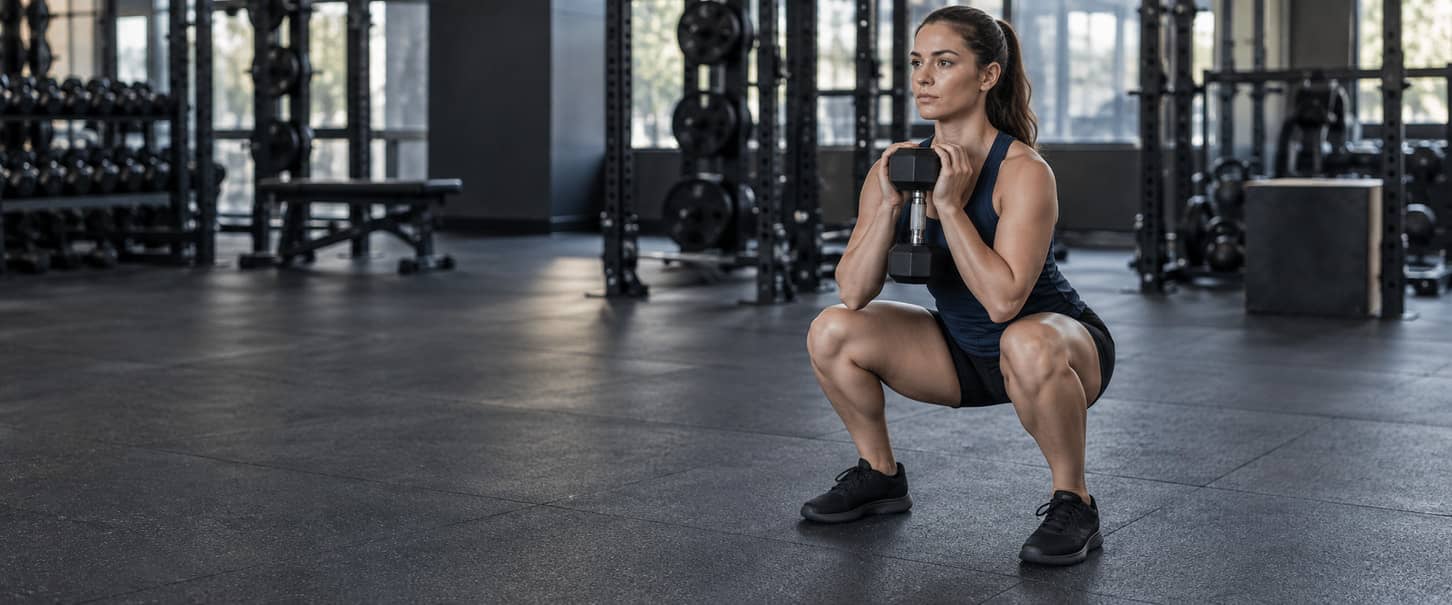
Choose Leg Exercises That Cover the Work You Need
A useful leg-training selection covers the work the complete plan needs: a knee-dominant movement, a hip hinge, a knee-flexion option, and calf work. Practical choices include a goblet squat, barbell back squat, or fitted leg press for knee-dominant work; a barbell or dumbbell Romanian deadlift for hinging; a seated or lying leg curl for knee flexion; and a standing or seated calf raise. A static split squat, reverse lunge, or hip thrust can serve a specific loading, support, balance, or glute-emphasis need, but none is a compulsory extra category. Choose by equipment fit, body support, controllable range, safe entry and exit, and a progression method you can repeat. A goblet squat may be limited by the hold, a back squat by rack and bar handling, a machine by its geometry and increments, and per-side work by balance and setup time. The thirteen detailed entries are a menu, not a prescribed thirteen-exercise session. A squat, Romanian deadlift, hip thrust, and leg curl do not give the hamstrings the same task. They differ in knee motion, hip motion, support, and loading, so later sections explain where each option fits rather than treating them as interchangeable. Start with the early comparison, remove choices that do not fit your equipment or current workout plan, and then read the exact tutorial for the exercise you select. This guide provides selection help, complete technique, two alternative partial blocks, and one bounded source-plan example. Full weekly schedules, exercise order, frequency, and recovery remain in the workout plan you follow.
Compare Leg Exercises by Muscles, Equipment, and Support
Use this matrix to compare thirteen focused choices by movement role, equipment, support, likely setup limit, and progression method. It is a selection menu, not a ranked thirteen-exercise workout.
| Exercise | Main use | Equipment and support | Useful when | Main check | Progression |
|---|---|---|---|---|---|
| Goblet Squat | Squat-pattern knee and hip extension; quadriceps, glutes, and adductors. | One securely held dumbbell; level nonslip floor; no rack required. | A front-held squat is manageable and available weight still challenges the legs. | Whole-foot balance, stable grip, and a repeatable controlled depth. | Add reps, then increase the one dumbbell; reassess when holding it limits the legs. |
| Barbell Back Squat | Shared-bar squat practice; quadriceps, glutes, adductors, and trunk. | Compatible rack, safety supports, manageable bar, secure plates/collars, and clear walkout. | Back-squat strength or a loadable free-weight squat is a specific goal. | Rack security, repeatable foot pressure, controlled depth, and a planned rerack. | Increase technically acceptable reps before small total-bar increases. |
| Leg Press | Supported knee- and hip-extension work; quadriceps, glutes, and adductors. | A fitted leg-press station with usable back support, footplate, catches, and permitted stops. | Supported leg loading is useful and the station fits the required range. | Pelvis stays supported; full foot contact; controlled knee tracking and catches. | Progress reps and the station-specific load without changing seat or depth. |
| Leg Extension | Knee extension with comparatively little hip movement; quadriceps. | Fitted seated leg-extension machine with knee-axis alignment and lower-shin pad. | Direct knee-extension work fits without adding another compound squat. | Stable thigh/back support; correctly placed pad; no kicking or stack impact. | Add reps, then the smallest permitted station increment at the same range. |
| Dumbbell Static Split Squat | Per-lead-leg knee and hip extension; quadriceps, glutes, and adductors. | Level floor and two manageable dumbbells; both feet remain on the floor. | Per-side loading is useful without rear-foot elevation or repeated stepping. | Stable stance width, front-foot pressure, and the same lead leg across the set. | Increase reps on both sides, then load per dumbbell with unchanged support. |
| Reverse Lunge | Stepping per-side knee and hip extension; quadriceps, glutes, and adductors. | Clear nonslip stepping space; bodyweight first, optional two dumbbells. | A stepping exercise fits the goal and the return step is controlled. | Stable front foot, controlled backward step, and a repeatable return. | Add reps per side, then load while step length and range remain comparable. |
| Barbell Romanian Deadlift | Hip hinge with limited knee-angle change; hamstrings and glutes with trunk/grip work. | Manageable bar and secure plates; suitable pickup/rack and clear return path. | A shared-bar hinge and its grip/trunk demands fit the plan. | Hips move back; bar stays close; lower endpoint does not depend on floor contact. | Add reps and total-bar load while knee bend and hinge endpoint remain consistent. |
| Dumbbell Romanian Deadlift | Hip hinge using independent hand paths; hamstrings, glutes, trunk, and grip. | Two manageable dumbbells and a clear nonslip pickup/set-down area. | Dumbbells suit access and grip without requiring a barbell station. | Soft knees, hips back, close hand paths, and a repeatable hinge endpoint. | Progress reps, then each dumbbell, without inventing extra depth. |
| Barbell Hip Thrust | Supported hip extension with glute emphasis and bent knees. | Purpose-built thrust station or securely fixed rated bench, padded bar, secure plates and controlled access. | Additional hip-extension work fits without treating it as a complete hamstring exercise. | Stable upper-back support and bar position; hip extension without lumbar overextension. | Add reps and total-bar load while support height, foot position, and finish remain comparable. |
| Seated Leg Curl | Knee flexion with the hip flexed; hamstrings. | Fitted seated curl station with back support, thigh restraint, lower-leg roller, and permitted range. | Direct knee-flexion work complements the existing squat and hinge allocation. | Knee/pivot fit, secured thigh support, and no pelvis lift or stack crash. | Add reps then the station increment while hip and knee settings stay comparable. |
| Lying Leg Curl | Prone knee flexion with the hips less flexed than in a seated curl; hamstrings. | Purpose-designed prone curl machine with knee clearance and lower-leg roller. | The prone machine fits better or is the available knee-flexion option. | Pelvis stays on the pad; roller remains correctly positioned; no back-arching kick. | Build reps then station load without changing hip contact or knee range. |
| Standing Calf Raise | Near-straight-knee ankle plantar flexion; gastrocnemius and soleus. | Level nonslip floor; optional dumbbells or a fitted standing machine. | Calf loading is needed with a near-straight knee and controllable balance. | Rise through forefeet without rolling, bouncing, or changing knee bend. | Increase controlled reps, then load while the heel endpoint and support stay fixed. |
| Seated Calf Raise | Bent-knee plantar flexion; soleus with reduced gastrocnemius length. | Fitted seated-calf machine with stable seat, thigh pads, footplate, and release. | A bent-knee calf task or supported loading fits the actual plan. | Pads contact thighs, heels move under control, no bouncing or lifting hips. | Progress reps and the station-specific load with the same knee angle and range. |
Use the comparison as a filter before choosing an exercise:
- Identify the movement role, performance goal, or practical limitation the current workout plan needs to address.
- Exclude equipment that is unavailable, insecure, incompatible, or impossible to enter and exit under control.
- Compare the available support and the likely grip, trunk, balance, or holding limitation that may end the set before the target movement does.
- Choose one suitable exercise rather than combining every option that shares a muscle name.
- Read its detailed instructions and rehearse a manageable setup, range, and return before working sets.
- Fit the selected movement into work already allocated by the complete plan instead of appending the comparison table as a new session.
External support changes the exercise by reducing or redirecting some balance and trunk demands, but it does not remove every stabilizer or guarantee that a station fits. Compare progress only after the support, setup, range, and limiting factor are clear.
Quads, Hamstrings, Glutes, and Calves: Match the Movement
The quadriceps straighten the knee; rectus femoris also crosses the hip, so hip position can change its role. Most hamstrings cross both the hip and knee and can assist hip extension as well as knee flexion. The short head of biceps femoris crosses the knee but not the hip, which is one reason a hip hinge and a leg curl are related but not identical hamstring tasks. The glutes contribute to hip extension and help control the hip and pelvis. The adductors draw the thigh inward and can also assist compound squat and hip-extension work. At the calf, gastrocnemius crosses both the knee and ankle, while soleus crosses the ankle without crossing the knee. Straight- and bent-knee calf work therefore change muscle length and mechanics rather than switching one calf muscle completely on and the other off.
| Movement role | Examples | Main contribution | Important distinction |
|---|---|---|---|
| Knee-dominant compound | Goblet or back squat; leg press; split squat or reverse lunge | Quadriceps with glute/adductor contribution | Not an interchangeable direct knee-curl prescription. |
| Direct knee extension | Leg extension | Quadriceps | Does not duplicate the whole squat task or require an automatic finisher. |
| Hip hinge | Barbell or dumbbell Romanian deadlift | Hamstrings and glutes; trunk and grip assist | Not a floor-touch test or a substitute for every knee-flexion task. |
| Supported hip extension | Barbell hip thrust; floor bridge as a regression | Glute emphasis with other assistance | Not the same loading curve or support as an RDL; not complete hamstring coverage. |
| Knee flexion | Seated or lying leg curl | Hamstrings | Choose one suitable curl; hip position and machine fit differ. |
| Ankle plantar flexion | Standing or seated calf raise | Gastrocnemius and soleus with knee-position-dependent mechanics | Standing does not exclude soleus; seated is not guaranteed to grow it more. |
Squats, Romanian deadlifts, and leg curls complement one another because they distribute work differently. A squat is primarily a knee- and hip-extension exercise and can train the quadriceps, glutes, and adductors, but it should not be counted as complete direct hamstring work. An RDL emphasizes a hip hinge with limited knee-angle change, while a leg curl trains knee flexion. Using one set from each category does not make the sets interchangeable or assign the same stimulus to every muscle. Squats and hip thrusts can both train the glutes, but their support, thigh involvement, grip, trunk demands, and movement-specific strength differ. A hip thrust is therefore an optional hip-extension choice, not proof that a squat is missing glute work or that either exercise covers every hamstring task. When both curl machines fit, a seated curl can be a reasonable first choice; a lying curl remains a valid knee-flexion option rather than a failed substitute. Standing calf work keeps the knee nearer straight and can place the gastrocnemius at a different working length than seated calf work. Bent-knee calf work remains useful when that task or machine fits, but knee position does not create complete soleus isolation. Choose the version that supplies the needed task with a repeatable range and progression record. Per-side work is a loading and support arrangement, not a separate muscle category that automatically requires another allocation. Both legs contribute during split squats and lunges, although the lead side receives the named emphasis. Dedicated hip-adduction or hip-abduction work can serve a specific goal, but it is not compulsory simply because adductors, abductors, and smaller pelvic stabilizers exist. External support also changes the exercise without removing every stabilizing demand. A fitted leg press or curl can reduce some balance and trunk requirements, while free-weight hinges and squats may be limited by grip, trunk control, or bar handling. Select the movement role the workout plan needs, then choose the support and practical limiter you can manage consistently rather than applying a fixed category ratio.
Goblet Squats and Barbell Back Squats
Goblet squats and high-bar back squats are separately useful knee-dominant options, not stages everyone must pass through. Choose the version whose equipment, handling, support, and progression fit the current workout plan. In both movements, the knees may travel beyond the toes while whole-foot pressure and the overall motion remain controlled.
Goblet Squat
Use a goblet squat for a knee-dominant squat with one dumbbell held close to the chest. Select a dumbbell whose shape and retention system permit a secure goblet grip, and clear enough nonslip floor space for a controlled pickup, squat, and set-down.
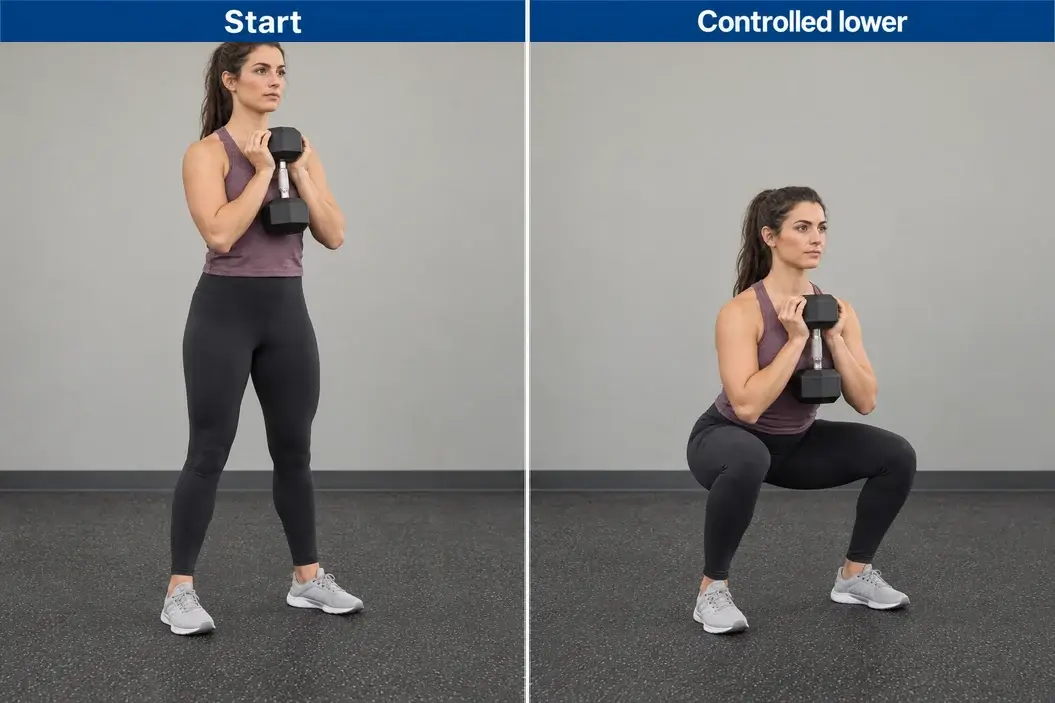
- Inspect the dumbbell and choose a load you can bring to and from chest height securely. Follow the manufacturer-permitted orientation for an adjustable dumbbell; do not grip loose plate assemblies or stack dumbbells together.
- Stand with a comfortable stance width and toe direction. Hold the weight close to the chest with a secure grip, establish whole-foot pressure, and brace while keeping breathing controlled.
- Bend the hips and knees together. Let the knees move in the direction of the feet while the heels and forefeet remain supported; knee travel beyond the toes is not automatically an error.
- Lower through the deepest range you can repeat while retaining balance and controlled trunk and pelvic motion. Reverse before a bounce, collapsing support, or forced depth replaces the squat.
- Stand by extending the hips and knees without leaning backward at the top. Repeat with the same stance, foot pressure, and lower endpoint rather than changing the movement as fatigue rises.
- End the set while the dumbbell can still be returned safely. Reduce the load or choose another squat when grip or the chest-height hold fails before the legs receive useful work.
Regress with a bodyweight squat, a lighter dumbbell, or a shorter comfortable range. For a supported rehearsal, use bodyweight and light hand contact with a secure fixed support; holding the goblet dumbbell with both hands leaves no hand free for support. Progress controlled repetitions before increasing the single dumbbell’s load. The goblet hold can become a genuine loading ceiling, so use another suitable squat rather than unsecured stacking or a balance challenge that changes the exercise. Record the one dumbbell’s mass and unit, stance, range, completed repetitions, rest, estimated effort, and whether the legs or holding capacity ended the set.
Barbell Back Squat
This entry teaches a high-bar back squat: the bar rests on the muscular upper-back shelf rather than the neck. A compatible rack, tested safety supports, secure plates and collars, a manageable walkout, and a reliable rerack are part of the exercise.
- Set both hooks at a reachable height and both safety supports at a tested position for the intended range. Rehearse the unrack, squat depth, catch, and rerack with an unloaded or light training bar. Ask qualified facility staff for setup help when the rack cannot provide both a workable range and an appropriate catch.
- Place the bar on the muscular upper-back shelf and take symmetric comfortable grips. Brace, stand to clear both hooks, and take only the small controlled steps needed to establish the stance with adequate bar-end clearance.
- Set a comfortable foot width and toe angle and establish whole-foot balance. Breathe and brace before descending without turning every repetition into a prolonged maximal breath-hold.
- Bend the hips and knees together and allow an individually appropriate torso inclination. Let the knees track with the feet; do not impose a vertical-shin rule, one mandatory torso angle, or the same stance on every lifter.
- Lower only as far as support, balance, and the chosen trunk relationship remain controllable. Rise without bouncing, an uncontrolled torso collapse, or the hips shooting up so sharply that the repetition becomes a different lift. Maximum depth is not compulsory.
- Finish while a reliable rerack remains available. Step forward deliberately until both sides meet their hooks, lower the bar into support, and confirm that both ends are secure before releasing the grip.
Regress with a lighter bar or choose the taught goblet squat or a fitted leg press when rack access, upper-body positioning, or load handling is unsuitable. Safety-bar, front, and hack squats are distinct options; this high-bar entry does not fully teach them by changing the exercise name. Progress technically acceptable repetitions before making a small increase in total bar-plus-plate load while the rack setup, bar position, stance, depth, and rerack remain consistent. Record total bar-plus-plate mass and unit, high-bar position, stance, depth, rack and safety settings, repetitions, rest, and estimated effort. Specific barbell-squat performance requires appropriate barbell practice. Readers seeking that complete strength structure can use the Powerlifting Workout Plan; general muscle-building leg work does not require everyone to progress from a goblet squat into this barbell variation.
Leg Press and Leg Extension Technique
The leg press is a supported compound movement that combines knee and hip extension, while the leg extension trains knee extension with comparatively little hip movement. They can complement the same workout plan, but they are not identical tasks or automatic substitutes for one another. Fit and record each actual machine separately.
Leg Press
Use a leg press when its seat, backrest, footplate, travel, and release controls fit your body and intended range. An angled sled is one common design, but lever and horizontal leg presses use different paths, catches, adjustments, and resistance scales.
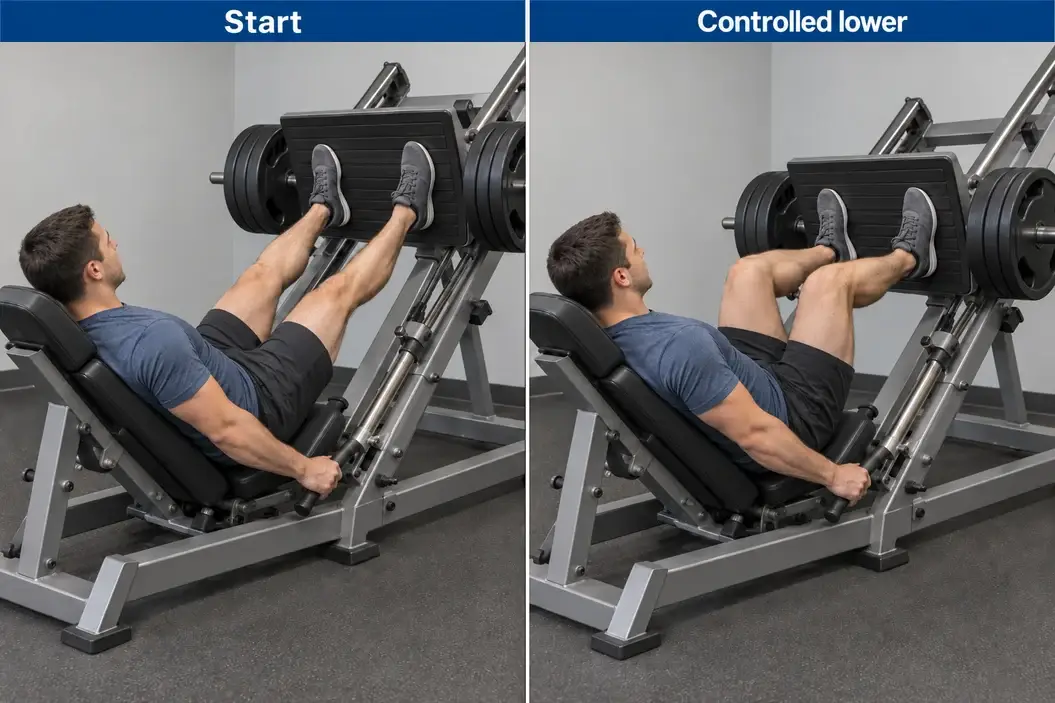
- Read the station instructions or ask facility staff to demonstrate the machine. With the resistance secured and at rest, adjust the permitted seat, backrest, and travel stops, select a manageable load, and rehearse how that model releases and re-engages its catches.
- Sit with the pelvis and back supported. Place both whole feet on the footplate at a comfortable width and angle, keeping the heels and forefeet in contact throughout the intended range.
- Take the resistance using the station’s procedure. Extend only as far as needed to clear the catches when required, without snapping the knees into forcible hyperextension.
- Lower steadily by bending the hips and knees. Stop before the pelvis rolls markedly away from the pad, the heels lift, foot contact is lost, or the selected range becomes uncomfortable. Knees-to-chest depth is not a universal target.
- Press through the feet along the machine’s path while the pelvis remains supported and the knees follow the feet. Do not push on the knees with the hands or bounce out of the lower position.
- Re-engage the catches or settle the resistance exactly as the manufacturer directs. Confirm that the load is fully supported before leaving the station or changing any setting.
Regress by reducing the resistance or using a shallower permitted range that remains repeatable. Choose another fitted station or a taught squat when the available adjustments cannot provide usable support and travel. Progress repetitions before the smallest suitable increase on that same machine, without changing the seat, foot placement, or depth to manufacture progress. Record the exact machine, seat and backrest settings, travel stops, foot placement, displayed resistance or added plates and unit, range, completed repetitions, actual rest, and estimated effort. Do not convert a sled’s plate total into a squat load or assume one catch-release direction applies to every station. Foot placement can change the movement, but it does not switch one quadriceps head on in isolation.
Leg Extension
Use the seated leg extension for direct quadriceps work when the seat, machine pivot, lower-shin pad, and permitted movement range fit. It can complement compound leg work without being a required finisher or a replacement for the full squat or leg-press task.
- With the resistance resting, adjust the seat and backrest so the thighs and trunk are supported and align the knee region with the machine pivot as the station instructs.
- Place the moving pad against the lower shins above the ankles, not on the feet or kneecaps. Select a permitted starting range and a manageable resistance before beginning.
- Take the intended handles and extend both knees smoothly through the chosen range without lifting the pelvis, kicking the pad, or using momentum to launch the resistance.
- Reach a controlled finish rather than forcibly snapping the knees straight. Return steadily to the starting bend without letting the stack or plates crash.
- Settle the resistance before changing the load, range, seat, or pad setting, and use the machine’s intended exit procedure.
Regress by reducing the resistance or using a shorter permitted range. Choose another fitted machine or a different taught knee-dominant movement when the setup remains unsuitable; tolerance of one station is not a diagnostic test. Progress repetitions before using the smallest suitable station increment while the seat, pivot alignment, pad position, and range remain comparable. Record the exact machine, seat and backrest settings, knee-to-pivot fit, lower-shin pad and range settings, displayed resistance and unit, completed repetitions, actual rest, and estimated effort. Leg extensions are not automatically damaging to healthy knees, and rotating the feet is not a reliable method for isolating one quadriceps head. Machine numbers are specific to their mechanisms and settings. Read why gym machine weights differ before comparing a leg press, leg extension, another station, or a free-weight exercise by the number displayed.
Split Squats and Reverse Lunges
Both exercises use a level floor and emphasize the leg that remains in front, while the rear leg still supplies balance and force. The static split squat keeps the stance fixed; the reverse lunge steps one foot backward and returns to standing. In the versions taught here, the front leg names the working side and stays the same throughout each side-specific set. Alternating repetitions switch the working side every repetition and must be recorded as a different convention.
Dumbbell Static Split Squat
Use a stationary split squat for per-side knee and hip extension without rear-foot elevation or repeated stepping. One foot stays forward and one stays behind on level floor. The lead leg receives the main emphasis, but the rear leg remains an active support rather than disappearing from the movement.
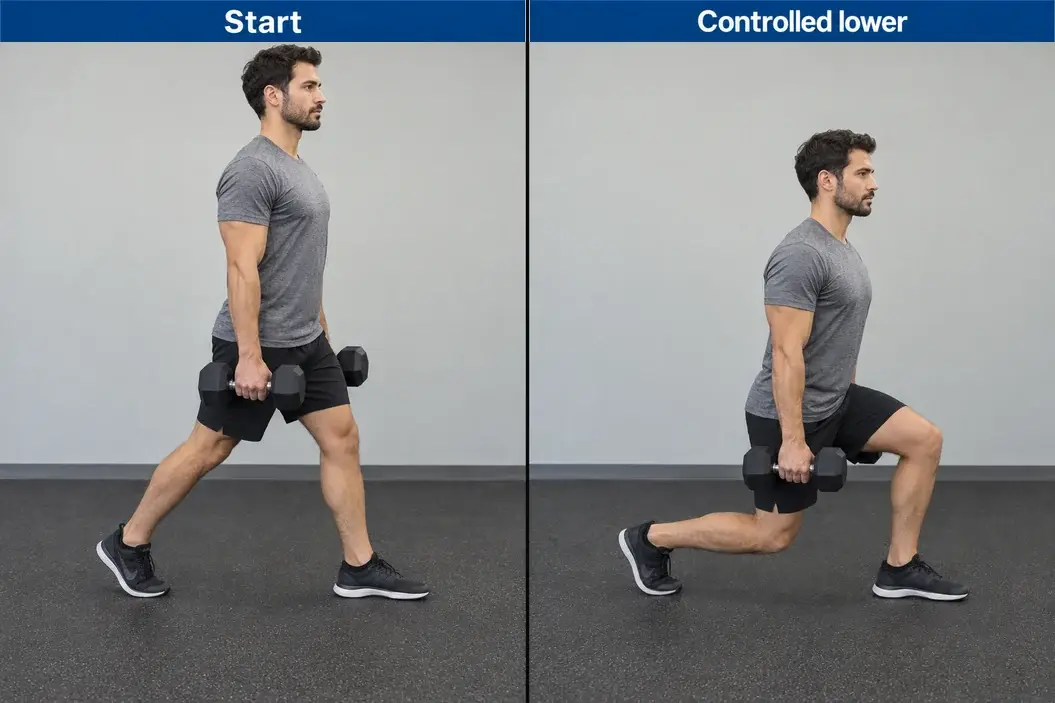
- Rehearse without weights. Set a staggered stance that is wide enough from side to side for balance, with the front whole foot supported and the rear heel raised naturally.
- For the loaded version, hold one manageable dumbbell at each side and keep the stance fixed. Use a comfortable torso inclination rather than forcing a perfectly upright position.
- Bend both knees and lower between the feet through a repeatable range. Let the front knee move naturally with the foot and stop before the rear knee strikes the floor.
- Rise through the front foot with assistance from the rear leg as needed. Do not step, bounce, or change the torso angle to finish the repetition.
- Complete the assigned repetitions with the same leg leading, return the dumbbells under control, take the per-side rest specified by the workout plan, and then switch the lead leg.
- End the set before balance or grip replaces the intended leg work. Keep the same front leg throughout every counted side-specific set.
Regress with bodyweight and a shorter controlled range. Light contact with a secure fixed support is a separate version: use no dumbbells, or hold one dumbbell while the other hand uses the support. Holding two dumbbells leaves no free support hand. Progress repetitions on both sides before increasing the load per dumbbell while the stance, support, and range stay comparable. A rear-foot-elevated Bulgarian split squat is a different exercise, not a compulsory upgrade. If balance repeatedly limits the set before the legs, reduce the demand or use an appropriate supported version rather than treating instability as the goal. Record the lead leg, stance, rear-foot contact, support arrangement, load per dumbbell and unit, range, repetitions per side, actual rest after each side, estimated effort, and whether balance, grip, or leg fatigue ended the set.
Reverse Lunge
Use a reverse lunge when a controlled backward step and return fit the current workout plan. The foot that remains in front identifies the working side for the set. That front leg receives the emphasis while the rear leg provides support during the lowered position, so this is not perfect one-leg isolation.
- Start standing on a stable nonslip surface with clear space behind you. Learn the backward step and return without load before adding dumbbells.
- Step one foot backward far enough to form a comfortable supported split stance. Keep the whole front foot grounded; the leg left in front is the named working side.
- Bend both knees and lower with the torso controlled. Let the rear knee approach the floor only as far as the selected range allows, without forcing contact.
- Push through the front foot and bring the rear foot back to the starting stance without launching, crossing the feet, or taking an uncontrolled recovery step.
- Repeat with the same front leg for the assigned repetitions, settle the load, take the plan’s per-side rest, and then switch sides. Alternating reverse lunges use a different counting method and should be named and logged separately.
- Finish before the stepping space, grip, balance, or controlled return is lost. Set any dumbbells down through a deliberate route rather than rushing into the next side.
Regress with bodyweight, a shorter comfortable step, or the taught stationary split squat when repeated stepping is the main limitation. A secure fixed support changes the setup and available loading: use no dumbbells or one dumbbell with the other hand supporting, not two dumbbells plus an unavailable support hand. Progress repetitions per side before increasing the load per dumbbell while step length, front-foot pressure, range, and return stay comparable. A longer step is not a universal glute-isolation rule, and walking lunges are a different exercise rather than the required next level. Record the working front leg, step length, support arrangement, load per hand and unit, range, repetitions per side, actual rest, estimated effort, and whether balance, grip, stepping space, or leg fatigue ended the set.
Barbell and Dumbbell Romanian Deadlifts
Romanian deadlift working repetitions begin from standing and return to standing. Keep the knees softly bent while the hips move backward, and stop the descent at the deepest repeatable hinge that preserves the selected trunk position and close load path. Do not turn the movement into a squat, lock the knees, or use the floor or one fixed shin height as the depth target.
Barbell Romanian Deadlift
Use the barbell Romanian deadlift for a shared-bar hip hinge that trains the hamstrings and glutes while the trunk and grip support the load. Arrange a secure route to standing and a controlled return before loading the bar; this is different from a conventional deadlift that begins every working repetition from the floor.
- Use a suitable rack height or a separately learned controlled floor pickup to bring the bar to standing. Secure the plates and collars, rehearse with a light bar, clear the return path, and decide how the bar will be set down before adding working load.
- Stand with a comfortable foot position, a full grip, the bar close to the thighs, and a small unlocked knee bend. Brace without forcing an exaggerated lower-back arch.
- Move the hips backward while the torso inclines and guide the bar close to the legs. Keep the selected soft knee bend broadly stable rather than progressively bending the knees and sitting into a squat.
- Reverse when further travel would require the trunk or pelvis to change position, the bar to drift away, balance to shift, or the knees to bend farther just to reach lower. Floor contact, plate height, and one fixed point on the shins are not depth requirements.
- Extend the hips to return to standing while keeping the bar close. Finish upright without leaning backward, shrugging the bar, or snapping the knees into a rigid lock.
- End the set before grip or trunk control is lost, then return the bar through the planned rack or set-down route. Keep the final handling phase controlled rather than treating it as separate from the exercise.
Regress with a lighter bar or a shorter controlled hinge, or use the dumbbell version when its handling fits better. A glute bridge or hip thrust changes the movement and does not reproduce all hip-hinge or knee-flexion work. Progress technically consistent repetitions before making a small increase in total bar-plus-plate load. Keep the stance, knee bend, grip, lower endpoint, and return route comparable. Record total bar-plus-plate mass and unit, pickup or rack setup, stance, knee bend, grip or support equipment, lower endpoint, completed repetitions, actual rest, estimated effort, and whether grip or trunk control ended the set.
Dumbbell Romanian Deadlift
Use two dumbbells for a standing-start Romanian deadlift when independent hand paths and available per-hand loading fit. The broad hinge pattern matches the barbell version, but pickup, grip, path, increments, and load records remain specific to the dumbbells.
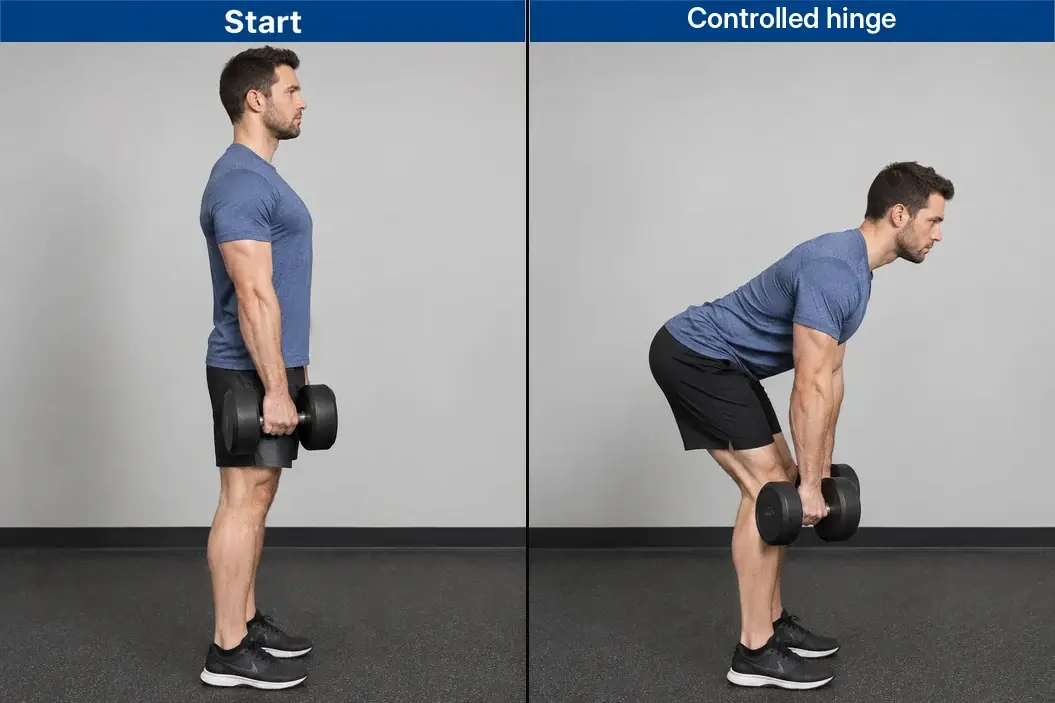
- Inspect both dumbbells and their retention mechanisms. Pick them up through a controlled route suited to their starting height, then stand with clear nonslip space for the hinge and later set-down. A difficult floor pickup is not automatically part of the working repetition range.
- Hold one dumbbell beside or just in front of each thigh with comfortable full grips, feet planted, and the knees softly bent. Establish the trunk and pelvic position you intend to maintain.
- Push the hips backward while the torso inclines, guiding both dumbbells close to the legs through independent but repeatable paths. Keep a modest knee bend instead of progressively squatting lower.
- Reverse before added depth requires a changed trunk position, lost balance, more knee bend, or either dumbbell drifting forward. A consistent controllable endpoint matters more than reaching the floor.
- Extend the hips to stand without leaning backward or shrugging the dumbbells. Retain the same hand paths, foot pressure, and knee behavior on each repetition.
- Finish before grip, trunk control, or support fails, then settle both dumbbells through the rehearsed route. Do not drop them or twist into an uncontrolled set-down.
Regress with a lighter pair, a shorter controllable hinge, or an unloaded rehearsal. A bodyweight hinge can teach the movement but may not provide enough resistance for continued progression, and one fixed dumbbell pair does not permit unlimited loading. Progress repetitions before increasing each dumbbell, without gaining depth through rounding, extra knee bend, or forward drift. Record mass per dumbbell and unit, pickup and set-down method, stance, knee bend, grip, lower endpoint, repetitions, actual rest, estimated effort, and any grip or trunk limitation. Romanian deadlifts emphasize the hamstrings' hip-extension role, while seated or lying leg curls train knee flexion. They are complementary choices rather than identical set credit, and neither guarantees equal work for every hamstring region. Use the combination and dose assigned by the complete workout plan rather than automatically adding both.
Hip Thrusts and Floor Glute Bridges
Hip thrusts provide supported hip-extension work with bent knees and a strong glute emphasis. They differ from squats, Romanian deadlifts, and leg curls in support, range, resistance profile, and joint action, so they should fill an identified role in the workout plan rather than be added automatically.
Barbell Hip Thrust
Use a barbell hip thrust when the upper-back support, padded pelvic contact, foot position, and entry and exit can all be secured. A purpose-built thrust station or a rated bench fixed against sliding or tipping must support the upper back without placing pressure on the neck.
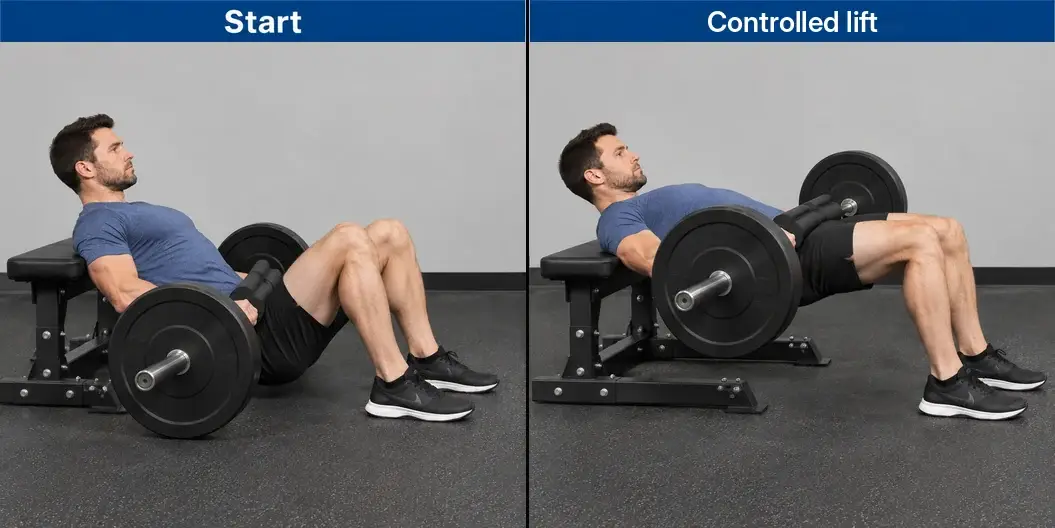
- Set a purpose-built station or securely fixed rated bench on a nonslip surface. Check that the support will not slide or tip and that its height permits firm upper-back contact around the lower shoulder-blade region without loading the neck.
- Arrange a padded, manageable bar across the hip crease with equal secured plates. Use suitable plate clearance or competent assistance to position it; do not roll a heavy bar across the abdomen or force entry when the plate size leaves insufficient clearance.
- Plant both feet and establish stable upper-back support. Hold the bar to prevent it from rolling and adjust foot distance only while the bar is resting. Approximately upright shins at the top can be a useful starting check, not a compulsory angle.
- Drive through the feet and raise the hips while keeping the bar stable. Finish at a controllable hip-extension position where the trunk and thighs align, rather than arching the lower back to lift the bar higher.
- Lower the hips through the same repeatable range while the upper back pivots on the secure support and both feet stay planted. Stop before the bench moves, the bar shifts, or trunk and pelvic control change. The bar does not have to touch the floor at the bottom of every repetition.
- End the set while the bar can still be settled and removed under control. Let the resistance come fully to rest, then use the planned clearance or assistance to exit. Reduce the load or use the floor bridge when entry or removal cannot be managed safely.
Regress to a bodyweight floor glute bridge when the supported barbell setup is not appropriate. Lie on a nonslip floor or mat with the head and shoulders supported, knees bent, and feet planted. Lift the pelvis through comfortable hip extension without arching the lower back, then lower under control. This changes the support, range, and loading capacity; it does not recreate an identical barbell hip thrust or provide a load conversion. Progress repeatable repetitions before making a manageable increase in total bar-plus-plate load. Keep the support security and height, padding, foot position, range, and finish comparable. No universal bench height is required, and loose household furniture is not a substitute for rated, secured support. Record total bar-plus-plate load and unit, padding, support type and height, support security, foot placement, range, completed repetitions, actual rest, estimated effort, and any entry or exit assistance. Squats and hip thrusts can both train the glutes, but neither universally replaces the other or wins for every muscle-building goal. An RDL emphasizes a standing hip hinge with more hamstring-lengthening demand, while a leg curl trains knee flexion. The hip thrust is useful additional hip-extension work when that role is needed; it is not the sole best glute exercise or a complete hamstring replacement.
Seated and Lying Leg Curls
Leg curls train knee flexion, while Romanian deadlifts emphasize hip extension with comparatively little change in knee angle. Those actions complement one another rather than providing identical hamstring work. The seated and lying entries below both use two legs together, but their hip position, body support, pad contact, machine path, and load records remain separate.
Seated Leg Curl
Use a seated leg curl to bend both knees against resistance while the torso and thighs remain supported. The thigh restraint stays fixed over the legs while the lower-leg roller moves with the curl. Its hip-flexed position differs from a lying curl even though both train knee flexion.
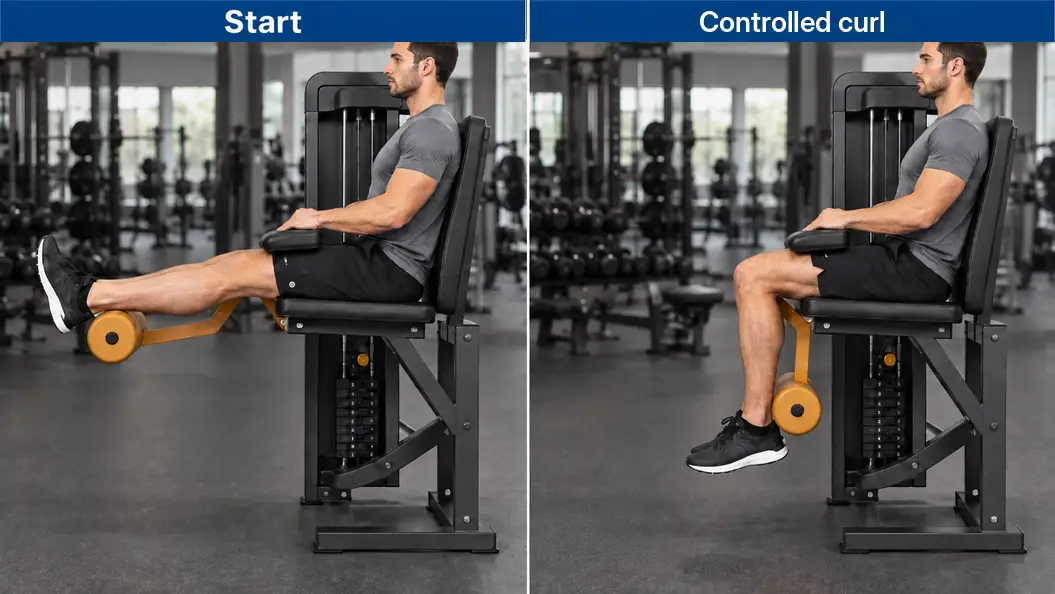
- With the resistance fully at rest, adjust the backrest and seat so the knees align with the machine pivot as intended and the back and thighs are supported.
- Position the moving roller against the backs of the lower legs just above the heels, using the machine’s intended contact area, not against the fronts of the shins. Secure the stationary thigh restraint without painful pressure on the kneecaps, then select an accessible starting knee angle and manageable resistance.
- Take the intended handles and bend both knees together, moving the lower-leg roller down and back along the station’s arc. Keep the thighs beneath the restraint and the pelvis on the seat.
- Reach a controllable knee-bent endpoint without bouncing, lifting from the seat, or forcing the furthest available setting.
- Return slowly toward the selected straighter-knee start while maintaining pad contact and control. Do not let the stack or plates jerk the lower legs forward.
- Bring the resistance fully to rest and release the thigh restraint as designed before exiting or changing any setting.
Regress by reducing the resistance or using a shorter permitted range. A fitted lying curl is a valid different implementation when the seated station does not fit; begin a separate load and setup record rather than transferring the displayed number. Progress repeatable repetitions before using the station’s smallest suitable increment while the backrest, hip position, knee-to-pivot fit, thigh restraint, roller position, and start and finish ranges remain comparable. Record the exact machine, backrest and seat settings, hip position, thigh-restraint and roller settings, displayed resistance and unit, range, completed repetitions, actual rest, and estimated effort.
Lying Leg Curl
Use a lying leg curl on a purpose-designed prone station whose torso pad, knee pivot, lower-leg roller, and available range fit. The hips are less flexed than in the seated version, and the pelvis must remain supported while both knees curl together. This is a machine exercise, not a loose dumbbell trapped between the feet.
- With the resistance resting, adjust the lower-leg roller, starting range, and load. Align the knees with the intended machine pivot and keep the kneecaps clear of an uncomfortable pad edge.
- Lie with the pelvis and torso supported and position the roller on the permitted lower-leg area above the heels. Take the station handles without aggressively lifting the chest away from the pad.
- Bend both knees smoothly while retaining pelvic contact. Do not arch the lower back, lift the hips, or kick to launch the resistance.
- Stop at a controlled knee-bent endpoint, then return along the same machine arc without snapping the knees straight or crashing the stack.
- Settle the resistance fully before leaving the station or changing the roller, range, or load setting.
Regress by reducing the resistance or range. Select a fitted seated curl when prone support is unsuitable; do not strap or trap loose weights at the feet or improvise an anchor. Progress controlled repetitions before increasing the station-specific resistance while pelvic contact, roller placement, knee range, and return remain repeatable. Record the exact machine, roller and range settings, pelvic and torso support, displayed resistance and unit, completed repetitions, actual rest, and estimated effort. When both stations fit, the seated curl is a reasonable first choice because a controlled within-person study favored it for several measured hamstring-growth outcomes under its tested protocol. Lying curls still produced growth and remain a useful option. That finding does not make the seated machine universally superior, supply an injury-prevention guarantee, justify uncomfortable positioning, or require performing both exercises. Choose the one the complete workout plan allocates unless there is a deliberate reason to add more work.
Standing and Seated Calf Raises
Standing and seated calf raises both train ankle plantar flexion, but knee position changes gastrocnemius length and the mechanics of the task. Near-straight-knee work has comparative support for greater gastrocnemius growth under the tested conditions, while the soleus contributes in both positions. A seated version can still fit a bent-knee strength goal or a need for external support; neither exercise is automatically required alongside the other.
Standing Calf Raise
Start with a bilateral standing calf raise on level floor. Both the gastrocnemius and soleus contribute. Use bodyweight or two manageable dumbbells for the baseline version; a fitted standing calf-raise machine is a separate apparatus with its own supports, footplate, catches, and load record.
- Stand on level nonslip floor with a comfortable foot position and the knees near straight but not forcefully locked. Begin with bodyweight. Light contact with a secure fixed support is a different arrangement from holding a dumbbell in each hand.
- For the two-dumbbell version, hold manageable weights at the sides and remember that both hands are occupied. Use an unloaded supported version or hold one dumbbell while the free hand uses the fixed support when balance otherwise limits the movement.
- Rise onto the balls of both feet through the available ankle range without rolling toward the outer edges, bouncing, or turning the repetition into a knee-extension movement.
- Pause at the controlled top, then lower both heels to the floor steadily. Keep the same knee bend, foot pressure, and upper and lower endpoints from repetition to repetition.
- For a fitted standing machine, first learn its shoulder-pad or body-support position, catch, and footplate settings with the resistance at rest. Use only the designed platform and a controllable heel-lowering range; below-floor heel travel is a different range from the level-floor version and must be recorded separately.
- Finish before balance, grip, or machine control is lost. Settle the dumbbells or engage the machine catches and confirm that the resistance is supported before leaving.
Regress to bodyweight with light fixed support or use a shorter controlled range. A securely supported single-leg calf raise can increase the demand, but it changes the counting and recovery: record each side and its actual rest rather than silently substituting it into a bilateral prescription. Progress controlled repetitions before increasing the per-dumbbell or machine load while knee position, support, heel range, and endpoints remain stable. A level-floor raise cannot provide below-floor heel descent. Do not balance on a loose step or plate edge, bounce through the range, or use toe rotation as an isolation switch. Record bilateral or per-side mode, support, knee position, floor or machine footplate, heel range, load per dumbbell or displayed machine resistance with units, completed repetitions, actual rest, and estimated effort.
Seated Calf Raise
Use a seated calf-raise machine when its seat, lower-thigh pads, foot support, and release mechanism can be fitted. Bending the knees changes gastrocnemius length and creates a specific bent-knee plantar-flexion task; it does not switch the gastrocnemius off or make seated work the only way to train the soleus.
- Adjust the seat and pads while the resistance rests. Place both forefeet securely on the designed footplate and position the pads on the lower thighs rather than directly on the kneecaps.
- Select a manageable load and learn the station’s release and catch. Raise the heels only as much as required to disengage the resting support using the manufacturer’s procedure.
- Lower both heels to a comfortable repeatable ankle endpoint while keeping the thighs under the pads and the pelvis supported on the seat.
- Raise both heels without bouncing, throwing the torso, lifting the hips, or changing the knee angle to move the pads. Pause at the controlled top and repeat through the same range.
- Engage the catch or return the resistance fully to rest before removing the legs, leaving the seat, or changing any setting.
Regress by reducing the resistance or range, or use a supported standing bodyweight calf raise when no fitted seated machine is available. Do not balance a heavy loose bar, plates, or stacked weights across the knees. Progress repetitions before increasing the station-specific load while the seat and pad settings, knee angle, foot position, and ankle range remain comparable. Record the exact machine, seat and pad setup, knee angle, foot position, ankle range, displayed resistance and unit, completed repetitions, actual rest, and estimated effort. Near-straight-knee training has comparative evidence for greater gastrocnemius growth under the tested protocols. The same evidence does not establish that seated work is universally superior for soleus growth, and it does not make standing work superior for every goal or apparatus. Use seated work when bent-knee specificity, balance, support, or machine fit provides a real reason; otherwise choose the version allocated by the complete workout plan rather than adding both automatically.
Leg Exercises at Home and With Limited Equipment
Choose home leg exercises from the equipment and secure support actually available, not from the location label alone. A floor, wall, dumbbells, barbell setup, and fitted gym machine each permit different movement and progression options.
| Available setup | Practical options | Important limitation |
|---|---|---|
| Level floor and secure wall only | Bodyweight squat or static split squat, floor glute bridge, bilateral calf raise | Rehearsal and bodyweight versions have a loading ceiling; no heavy knee-flexion machine equivalent. |
| Dumbbells, no bench or rack | Goblet squat, dumbbell RDL, static split squat, reverse lunge, standing calf raise | Loads must suit each movement; do not combine loose weights or trap a dumbbell between the feet. |
| Barbell with a securely fixed rated hip-thrust support and controlled access | Barbell hip thrust; floor glute bridge when the loaded setup does not fit | Bar positioning and support must be secure; a loose sofa, chair, or unanchored bench is not a substitute. |
| Fitted gym machines or a suitable rack | Select the relevant squat, leg press, curl, extension, hip thrust, or calf option | Equipment names do not guarantee fit, manageable starting resistance, or equivalent load readings. |
Match resistance to the movement
A fixed dumbbell pair may be heavy enough for one exercise but too light or too heavy for another. Goblet squats can be limited by the grip and chest-height hold before the legs, while dumbbell hinges and per-side exercises may require different loads. Do not combine unsecured weights to manufacture resistance; establish a separate record for each movement and implement. Without a secure rack, do not attempt a barbell back squat. Without a rated support that is fixed against sliding or tipping, do not improvise a loaded hip thrust from household furniture. Floor glute bridges remain the simpler regression already explained in the hip-thrust section, but their support and loading are not identical to a barbell hip thrust. Limited home equipment also may not provide heavy, progressively adjustable knee-flexion resistance comparable to a fitted seated or lying curl machine. That is an honest equipment limit rather than a reason to trap a dumbbell between the feet or assume every bodyweight option is equivalent.
Optional bodyweight hamstring walkout
From a comfortable floor bridge, take a few small alternating heel steps away while retaining hip control and some bend in the knees. Return with the same small steps, then lower the pelvis briefly to reset. One complete out-and-back is one cycle. Reduce the reach when the hips sag or the heels begin to slip. Use a level nonslip surface; do not assume frictionless sliders, improvise a furniture anchor, or trap a weight between the feet. The walkout adds a changing-knee-angle hamstring challenge, but it is not a machine-curl equivalent and does not create a new workout block. Readers who want an existing complete five-session dumbbell schedule can use the 5-Day Dumbbell Workout Plan. It is a separate full workout plan with its own no-bench branch, not a leg block to append to current training.
Build and Progress a Focused Leg-Training Block
These are two alternative partial examples for work already allocated by a complete workout plan. Neither is a complete lower-body session or weekly schedule. Each contains 3 + 2 = 5 bilateral working sets; performing both would create an unplanned 10-set combination, not a matched or automatically appropriate progression.
Block A: Knee-extension emphasis
| Exercise | Sets & Reps | Rest | Tempo | Target Muscles | Notes |
|---|---|---|---|---|---|
| Leg Press | 3 sets of 8–12 reps | 120–180 seconds | 3-1-1-0 | Quadriceps, glutes, adductors | Keep pelvis and full feet supported; use the same fitted range. |
| Leg Extension | 2 sets of 12–15 reps | 60–120 seconds | 2-1-1-1 | Quadriceps | Use both legs together on one fitted machine. |
Use Block A only when the existing plan deliberately allocates both a compound knee-dominant movement and direct knee extension. Its five working sets do not supply hip-hinge, knee-flexion, calf, or whole-week programming.
Block B: Hip hinge plus knee flexion
| Exercise | Sets & Reps | Rest | Tempo | Target Muscles | Notes |
|---|---|---|---|---|---|
| Dumbbell Romanian Deadlift | 3 sets of 8–12 reps | 120–180 seconds | 3-1-1-0 | Hamstrings, glutes; trunk and grip assist | Use the same soft knee bend and hinge endpoint. |
| Seated Leg Curl | 2 sets of 10–15 reps | 60–120 seconds | 2-1-1-1 | Hamstrings | Keep the thighs restrained and pelvis supported. |
Block B also contains 3 + 2 = 5 bilateral working sets. The hinge and curl train different hamstring-related actions, so five raw sets do not mean equal contribution to every hamstring region. This is not a complete leg day or proof that Block B and Block A provide equal stimulus.
Use the same execution standard from set to set
Inspect the selected equipment, rehearse the movement and exit, and use progressively heavier non-fatiguing warm-up sets when needed. Warm-ups remain separate from the listed working sets. Fewer initial working sets or lighter resistance can be appropriate while the setup is being learned. Choose a load that permits the lower end of the range with about 2–3 technically sound reps in reserve and a controlled finish. RIR estimates the additional repetitions available at the same range, support, and technique. End the set when grip, support, equipment handling, or the intended movement fails even if the target muscle could continue. Perform straight sets. Rest for the listed interval after each working set and after the final set before beginning the next exercise. Take additional recovery when needed and record it; do not turn the examples into hidden supersets, mandatory failure work, or a promised session duration. For the leg press and Romanian deadlift, 3-1-1-0 means lower or hinge for about three seconds, pause for one second at the controlled lower or hinged endpoint, extend the knees and hips or stand in about one second, and use no deliberately prolonged finish pause. Zero does not mean bounce. The same 2-1-1-1 digits describe different joint actions in the other rows. For the leg extension, bend the knees to lower for two seconds, pause for one second at the bent-knee start, extend in one second, and pause for one second at the controlled straighter-knee finish. For the leg curl, straighten the knees during the two-second return, pause for one second at the controlled straighter-knee start, curl in one second, and hold the knee-bent finish for one second. Do not force a joint endpoint to complete a pause. Build technically acceptable repetitions within the listed range while setup, range, typical rest, and intended effort remain comparable. When every prescribed set reaches the upper target at that standard, try the smallest suitable load increase. If the available increase prevents the lower target or a secure finish, return to the prior load or use a separately defined alternative with its own baseline. An ordinary increase in resistance with the same machine, support, range, and movement remains part of the same exercise history. A material machine, support, range, or movement change can require a new baseline. The complete workout plan still controls frequency, exercise order, other leg work, and recovery, so replace, reduce, or omit existing work rather than appending both blocks.
Standalone static-split-squat counting illustration
This separate counting example uses Dumbbell Static Split Squat for 2 sets of 8–12 reps per lead leg, with 90–120 seconds after each side, a 3-1-1-0 tempo, and about 2–3 RIR. Lower for three seconds, pause for one second at a controllable bottom, rise in one second, and use no deliberately prolonged upper pause. At 10 repetitions, 2 × 10 = 20 reps with each leg leading. Two sets for the left lead leg plus two sets for the right create 2 + 2 = 4 side-specific work bouts, and 20 + 20 = 40 total lead-leg repetitions. The rear leg still contributes, so these are not 40 isolated repetitions for every involved muscle. Complete one lead-leg set, rest 90–120 seconds, perform the other side, rest again, and repeat until each lead leg has two sets. The listed rest also applies after the final side before another exercise when one follows. Two bilateral leg-curl sets remain two working sets rather than four merely because both legs move. This illustration is not a third block to add, and it does not replace the side, rest, progression, or frequency rules in an existing source plan or the 5-Day Dumbbell Workout Plan.
Progress Block A's three-set Leg Press
The constructed log below uses Block A’s Leg Press for 3 sets of 8–12 reps on the same machine, with the same settings, stance, range, rest, and intended effort. Exposures A–C use the same displayed load. Exposure D is one hypothetical result after a suitable permitted increase; these are not client records or calendar guarantees.
| Exposure | Set 1 | Set 2 | Set 3 | Decision |
|---|---|---|---|---|
| A | 10 | 9 | 8 | Keep the load and build acceptable repetitions. |
| B | 12 | 12 | 11 | Keep it; the third set has not reached 12. |
| C | 12 | 12 | 12 | Eligible only if support, range, and intended effort also qualify. |
| D | 8 | 8 | 8 | One possible result after a suitable increase, not a promised outcome. |
One qualifying exposure illustrates this constructed decision rule. Follow your chosen workout plan’s progression and frequency rules rather than automatically applying this example’s one-exposure threshold.
Fit Leg Exercises Into Your Existing Workout Plan
The Upper Lower Workout Plan provides a real application. The table below is a non-contiguous extract from one occurrence of Day 2: Lower A: Strength-Biased Lower Body, using only original rows 1, 2, 4, and 5. The complete Lower A workout also includes Leg Press and Cable Crunch or Ab Wheel; keep those exercises when following that workout rather than treating this extract as the full session.
Lower A: four selected source rows
| Exercise | Sets & Reps | Rest | Tempo | Target Muscles | Notes |
|---|---|---|---|---|---|
| Back Squat, Safety-Bar Squat, or Hack Squat | 3 sets of 4–6 reps | 3–5 min | 3-1-X-0 | Quadriceps, Glutes, Adductors, Trunk | Use the deepest controlled range that preserves balance, bracing, and a repeatable path. |
| Romanian Deadlift | 3 sets of 6–8 reps | 2–4 min | 3-1-1-0 | Hamstrings, Glutes, Spinal Erectors | Hinge until the pelvis can no longer travel back without losing position. |
| Seated or Lying Leg Curl | 2 sets of 10–15 reps | 60–120 sec | 2-1-1-1 | Hamstrings | Keep the hips stable and control both ends of the range. |
| Standing Calf Raise | 3 sets of 8–15 reps | 60–120 sec | 2-1-1-1 | Gastrocnemius, Soleus | Pause in the stretched and shortened positions without bouncing. |
The selected count is 3 + 3 + 2 + 3 = 11 exercise sets: three sets from one squat option, three Romanian Deadlift sets, two sets from one curl option, and three calf-raise sets. “Back Squat, Safety-Bar Squat, or Hack Squat” is one three-set choice rather than nine sets, and “Seated or Lying Leg Curl” is one two-set choice rather than four. The source names “Romanian Deadlift” without assigning a barbell or dumbbell implementation. Eleven is not the complete Lower A total, a weekly total, or a direct-set total for the quadriceps, hamstrings, or any other muscle. Warm-ups, the omitted Leg Press and core rows, Lower B, and all other training days remain outside this extract. Do not multiply one selected occurrence across a week without following the actual plan schedule.
Keep the source tempo and progression context
The source tempo uses lowering or return first, followed by the controlled lower or starting pause, the lifting phase, and the finish pause. For the squat, 3-1-X-0 means descend for three seconds, pause for one second, then stand with controlled acceleration intent and no deliberately prolonged top pause. X does not mean bouncing, losing position, or guaranteeing a particular bar speed. The Romanian Deadlift keeps its source 3-1-1-0: hinge for three seconds, pause for one second at the controlled endpoint, stand in one second, and use no deliberate top pause. For the curl, 2-1-1-1 means straighten or return for two seconds, pause for one second at the controlled straighter-knee start, curl in one second, and hold the knee-bent finish for one second. For the calf raise, the same digits mean lower the heels for two seconds, pause for one second at the actual lower endpoint, raise in one second, and hold the controlled top for one second. The calf range comes from the selected setup. A level-floor raise does not acquire below-floor heel travel because the note mentions a stretched position. Keep the source plan’s preparation, effort, rest, recovery, and progression rules rather than replacing them with the constructed Block A or Block B conventions from the previous section.
Replace the curl choice instead of adding another row
The source already permits a seated or lying leg curl. Switching from a fitted seated station to a fitted lying station retains 2 sets of 10–15 reps, 60–120 sec rest, and 2-1-1-1 for this row. Select a new station-specific resistance and record its support and settings; do not convert the displayed load from the other machine.
| Choice | Curl sets | Selected exercise-set total |
|---|---|---|
| Seated curl chosen | 2 | 3 + 3 + 2 + 3 = 11 |
| Lying curl replaces seated curl | 2 | 3 + 3 + 2 + 3 = 11 |
| Both curls performed | 2 + 2 = 4 | 3 + 3 + 4 + 3 = 13; this adds work |
Replacing the seated curl with the lying curl leaves the selected extract at eleven sets. Performing both produces four curl sets and thirteen selected exercise sets, so it is an addition rather than a substitution. Equal raw counts do not prove equal muscle stimulus, joint loading, fatigue, soreness, or recovery. Use the guide to counting workout sets for broader accounting assumptions, while the actual workout plan remains responsible for exercise choice, frequency, and total workload.
Common Leg-Training Mistakes and Recovery Decisions
Correct observable changes in support, range, counting, and fatigue before replacing a useful exercise. Knees traveling beyond the toes can be normal when foot pressure and the movement remain controlled, and individual anatomy can produce different workable stances, torso positions, and depths. An ordinary load increase with the same setup is progression, not a new exercise. Soreness, a posture photograph, or a different sensation on one side does not diagnose a knee, hip, tendon, or back condition.
| Observed problem | Practical correction |
|---|---|
| Treating every listed movement as a required leg day | Use only the exercises the complete plan allocates; fill a specific role rather than collect variations. |
| Counting a squat, RDL, and curl as identical hamstring work | Distinguish compound knee/hip extension, the hip hinge, and knee flexion. |
| Forcing one stance, depth, or knees-behind-toes rule | Retain foot pressure and a controllable path suited to the lifter and equipment. |
| Lowering a leg-press sled until the pelvis leaves support | Reduce depth or adjust permitted fit before adding load. |
| Reaching the floor by turning an RDL into a squat or losing trunk control | Keep the hinge and its repeatable endpoint; use a lighter load or shorter range. |
| Using the back to finish a hip thrust or lifting the pelvis in a curl | End the set and recheck load, support, and the intended joint motion. |
| Doubling bilateral sets or forgetting per-side work/rest | Record the actual limb-use convention; use the explicit split-squat example. |
| Calling a normal load increase a different exercise | Retain the same history when setup is unchanged; distinguish real equipment or technique changes. |
| Ignoring grip, trunk, balance, sport, or running fatigue | Review the whole week and restore recovery or reduce unplanned additions before adding more work. |
Check recovery before adding another variation
A fall in later-set repetitions can reflect ordinary fatigue and the recovery available between sets; the article on why reps drop between sets explains that wider context. One difficult session does not prove that an exercise has stopped working. When performance repeatedly declines across comparable sessions, first verify that the equipment, setup, range, and execution standard are genuinely comparable. Review actual rest rather than planned rest, all scheduled and unplanned leg work, sleep and nutrition availability, demanding running or sport, and earlier grip or trunk work that may limit squats, hinges, carries, or supported positions. Restore the missing recovery input or reduce excess work before adding another variation. A temporary workload reduction can be useful when recovery is clearly inadequate, but no fixed deload date or soreness target applies to everyone.
Stop when equipment, support, or symptoms change
Stop and settle the resistance if equipment fails or support, grip, range, or control is lost. Sharp, worsening, or radiating pain, numbness, or unexpected weakness warrants appropriate assessment rather than serial harder attempts or an improvised rehabilitation test.
Leg Exercise and Workout FAQs
What are the best leg exercises for muscle growth?
Choose exercises that cover the roles your complete workout plan needs. A useful selection can include a knee-dominant movement such as a goblet squat, back squat, fitted leg press, static split squat, or reverse lunge; a barbell or dumbbell Romanian deadlift for hip hinging; a seated or lying leg curl when direct knee flexion is allocated; and an appropriate calf raise. The best choice fits your equipment, support needs, controllable range, and progression method. You do not need one supposedly perfect lift or all thirteen exercises.
Do I need squats to build my legs?
No specific barbell squat is required for leg growth. A fitted leg press, goblet squat, split squat, reverse lunge, and direct knee-extension work can train useful lower-body roles when they fit the plan. A barbell back squat remains valuable when back-squat strength or skill is the goal because that goal requires relevant practice. This is a selection decision, not a ban on squats.
Are squats enough for hamstrings, or do I need leg curls?
Squats, Romanian deadlifts, and leg curls do not give the hamstrings the same task. Squats primarily combine knee and hip extension, an RDL emphasizes hip extension with limited knee-angle change, and a leg curl directly trains knee flexion. Include a suitable curl when the complete plan calls for that action rather than counting every squat set as a full direct hamstring set.
Are seated or lying leg curls better?
When both machines fit, a seated leg curl is a reasonable first choice because comparative research favored it for several hamstring-growth outcomes under the tested protocol. Lying curls still trained the hamstrings and remain useful when their support, comfort, equipment access, or progression works better. Keep a separate setup and load history for each station rather than declaring one universally superior or safer.
Should I do standing or seated calf raises?
Standing or other near-straight-knee calf work has comparative support for greater gastrocnemius growth under the tested conditions. A seated raise provides a bent-knee task and external support that may fit a different goal or setup. The soleus contributes in both positions, so seated work is not a proven exclusive or universally superior soleus exercise. Choose the version the plan needs rather than automatically performing both.
What leg exercises can I do at home without machines?
Depending on the equipment actually available, practical choices include bodyweight or goblet squats, static split squats, controlled reverse lunges, dumbbell Romanian deadlifts, floor glute bridges, hamstring walkouts, and level-floor calf raises. Bodyweight and fixed dumbbells can eventually limit loading, and a walkout is not an exact replacement for heavy progressively adjustable leg curls. Do not create resistance with unstable furniture, unsecured stacked weights, frictionless-slider assumptions, or a dumbbell trapped between the feet.
How many leg exercises, sets, and sessions do I need?
Use the allocation, frequency, recovery, and progression rules of the complete plan you follow. The two five-set blocks in this guide are alternative partial examples, not a combined ten-set routine, a complete leg session, or a weekly target. The Lower A source extract is also only a bounded illustration. Choose suitable workout plans for the complete schedule instead of building a week by appending every example.
Can my knees move past my toes, and how deep should I squat?
Yes. Knee travel beyond the toes can be normal when whole-foot pressure, balance, and the selected movement path remain controlled. Use a stance and depth you can repeat with the available equipment and your individual proportions. Do not force a vertical shin, one universal torso angle, or maximum depth after support or control changes. New or concerning symptoms need appropriate assessment rather than a generic depth rule.
How do I count split squats or lunges on each side?
Name the working side by the lead leg and record the prescribed sets and repetitions for each lead leg. In the guide's example, 2 sets of 10 repetitions per lead leg produce 20 repetitions with the left leg leading and 20 with the right, for four side-specific work bouts and 40 total lead-leg repetitions. Rest after each side as specified. The rear leg still assists, and two bilateral curl sets remain two sets rather than doubling because both legs move.
What should I change when my back, balance, or grip gives out before my legs?
First reduce the load or range and recheck the setup, support, and movement standard. Then consider a fitted or supported alternative that preserves the intended role, such as replacing an unsupported free-weight task with an appropriate machine when available. Review earlier hinge, trunk, grip, running, sport, and recovery demands before adding another variation. An ordinary load increase with unchanged setup remains progression within the same exercise history; a material equipment or support change starts a new comparison. Sharp, worsening, or radiating pain, numbness, or unexpected weakness warrants appropriate assessment rather than a harder test. Choose the relevant movement, rehearse it with manageable resistance, fit it into existing work, and record comparable performance.