
Full Body or Upper/Lower? Start Here
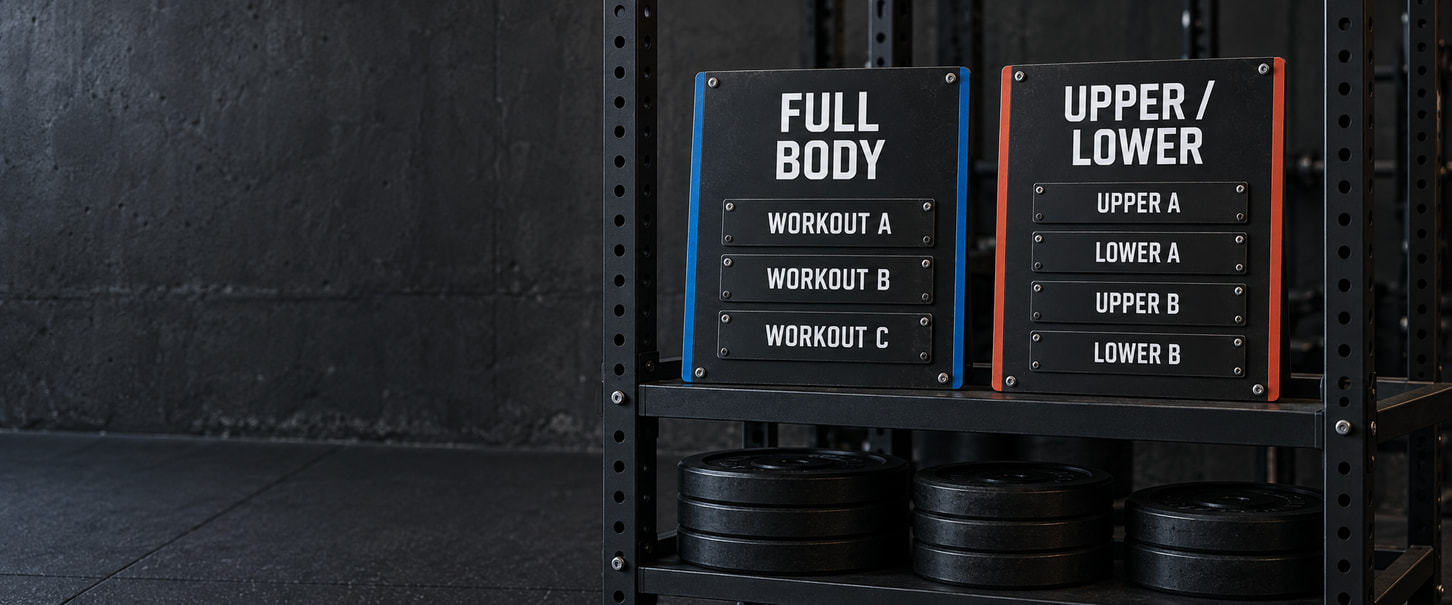
With three reliable, non-consecutive training days, Elevated Muscle's Full Body Workout Plan is a direct schedule fit: complete A, B, and C in order. With four days available in two upper/lower pairs separated by a break, the standard Upper/Lower Split Workout Plan fits that arrangement: Upper A, Lower A, Upper B, and Lower B. In either case, check that the complete sessions suit your current capacity and fit the time you have. Three suitably spaced days also allow the Upper/Lower guide's documented rolling option. Its four workouts continue in sequence across weeks instead of deleting one. That preserves the workout order, not the amount of work scheduled in a standard four-day week. Full-body sessions combine upper- and lower-body work in one visit; upper/lower sessions emphasize one of those broad regions. Neither label means every individual lift repeats each visit or every muscle receives direct work every time. Nor is the other region necessarily unloaded: lower-body sessions can still involve the trunk, back, and grip. This comparison uses these specific site routines and the documented rotation, not every workout plan with a similar name. When both structures fit, compare exercise priorities, prescribed workload and effort, recovery alongside other activity, session time, and which organization you prefer. More gym visits do not automatically mean better progress. A spare fourth day is not an obligation, and a productive current workout plan does not need replacing just to adopt a different split name. The calendar and set comparisons below show what each option actually asks you to train. These routines are not identical work distributed across different days. A similar total set count can hide different work for each body region; it does not establish matched training or equal results. Use this general adult comparison to choose an appropriate version of an existing plan, not as personal medical clearance.
Compare the Standard Three- and Four-Day Schedules
The Full Body Workout Plan schedules A, B, and C across three non-consecutive visits. The Upper/Lower Split Workout Plan uses four visits in the order Upper A, Lower A, Upper B, Lower B. This example week compares their standard calendars; the complete guides supply the exercise choices, preparation, effort, and progression instructions.
| Day | Standard three-day Full Body | Standard four-day Upper/Lower |
|---|---|---|
| Monday | Full Body A | Upper A |
| Tuesday | No scheduled lift from this plan | Lower A |
| Wednesday | Full Body B | No scheduled lift from this plan |
| Thursday | No scheduled lift from this plan | Upper B |
| Friday | Full Body C | Lower B |
| Saturday | No scheduled lift from this plan | No scheduled lift from this plan |
| Sunday | No scheduled lift from this plan | No scheduled lift from this plan |
"No scheduled lift" means no lifting session from that workout plan, not enforced inactivity. The Full Body guide keeps its midweek non-lifting days easy and cautions against hard lower-body cardio after Workout A. Upper/Lower allows easy activity midweek and rest, easy cardio, or sport on Saturday according to recovery. Neither calendar makes other training irrelevant to readiness for the next session.
What each workout puts first
Full Body A opens with a back squat or hack squat, followed by a barbell bench press or machine chest press and a chest-supported row. B starts with a trap-bar or conventional deadlift, then an overhead press and a pull-up or lat pulldown. C begins with a front squat, hack squat, or leg press, followed by an incline dumbbell press and a one-arm row, before the remaining glute and accessory work. Each visit combines upper- and lower-body work, but the opening priority changes. In Upper/Lower, Upper A opens with a barbell bench press or machine chest press; Lower A starts with its squat variation. Upper B begins with an incline dumbbell or machine press, and Lower B starts with a trap-bar or conventional deadlift. The A sessions are strength-biased and the B sessions hypertrophy-biased, but those labels describe emphasis, not exclusive adaptations. Lower B still opens with lower-repetition deadlift work.
Separate gym visits from individual lift practice
Three full-body visits do not mean three sessions of the same barbell bench press. In the listed base routine, that option appears in A; B uses overhead pressing and C uses incline pressing. Those other presses can involve related muscles without becoming identical bench practice. Likewise, four Upper/Lower visits comprise two dedicated upper sessions and two dedicated lower sessions, not four upper-body workouts. The regional labels do not isolate every demand. Lower A includes Romanian deadlifts, while Lower B starts with a deadlift: trunk support, back involvement, and grip can overlap with upper-day work. When checking whether the days fit, consider what the exercises ask of you, not just whether the next heading says "Upper" or "Lower." A calendar gap alone does not guarantee recovery.
Move the weekdays without losing the sequence
The Full Body guide also gives Tuesday, Thursday, and Saturday for A, B, and C. Upper/Lower offers Monday, Tuesday, Friday, and Saturday for Upper A, Lower A, Upper B, and Lower B. These alternatives preserve the workout order and the source spacing pattern. Check the return into the following week too; changing weekdays is not permission to compress the three standard full-body sessions into consecutive days. The three-day Upper/Lower option changes the calendar by carrying all four workouts forward across weeks. That is the rolling variant considered next, not the standard four-day week with Lower B removed.
What Changes With Three-Day Upper/Lower?
Three-day Upper/Lower keeps Upper A, Lower A, Upper B, and Lower B in that order while using three non-consecutive slots each week. After Friday's Upper B in Week 1, Monday begins with Lower B, not another Upper A. The source guide prints Weeks 1–3 and says to continue the sequence. Week 4 below follows that instruction; it is not a separately printed source week. For this illustration, assume ordinary scheduled weeks with every session completed and the base prescriptions unchanged, without missed visits, extra workouts, or deload changes. Four weeks is a comparison window, not a compulsory block or a reason to ignore fatigue, illness, or the need for a lighter phase.
| Week | Monday | Wednesday | Friday |
|---|---|---|---|
| 1 | Upper A | Lower A | Upper B |
| 2 | Lower B | Upper A | Lower A |
| 3 | Upper B | Lower B | Upper A |
| 4 | Lower A | Upper B | Lower B |
Count the whole rotation
Three visits each week give 3 × 4 = 12 visits across four weeks. That completes three four-workout cycles, with Upper A, Lower A, Upper B, and Lower B each appearing three times. The total is six dedicated upper sessions and six dedicated lower sessions. Weeks 1 and 3 contain two upper sessions and one lower session; Weeks 2 and 4 reverse that balance. For each region, six sessions divided by four weeks gives 6 / 4 = 1.5 dedicated sessions per seven days on average, not two in every week. These broad-region counts are not exact frequencies for every muscle or individual exercise, and they do not measure training stimulus.
Compare the same four weeks
Across the same four weeks, standard Full Body schedules twelve visits, with A, B, and C each appearing four times. Standard four-day Upper/Lower schedules sixteen visits, with each of its four workouts appearing four times. The rolling option retains every workout type but repeats each fewer times than the four-day schedule. Keeping the sequence does not preserve the original calendar-week workload or frequency. Carry the next workout forward rather than resetting every Monday. Do not repeatedly omit Lower B, combine complete sessions, or add catch-up work just to recover four-day totals. This is an intentionally chosen recurring schedule, not a return-from-illness or injury plan. For three suitably spaced slots and a preference for regional focus, this rotation can fit when its complete sessions are appropriate for you. Put that actual sequence into your workout plan and evaluate the completed work and recovery, rather than treating it as the standard four-day week squeezed into three visits.
Compare the Work, Not Just the Workout Count
For this comparison, count the listed working sets from every base exercise row, including calves and trunk work. Choose one permitted alternative per row, not every option. Warm-up and ramp-up sets and optional additions are excluded. A unilateral set completed on both sides counts as one listed round, not two; both sides still need performing and take time. These are planned counts, not recorded training results. They become completed-work counts only if all the listed work is performed. The four-week window keeps the base prescriptions unchanged, without missed sessions, beginner reductions, deloads, or extra work. It is a counting example, not a compulsory block. These base rows have fixed set counts: their rep ranges are not permission to choose a different number of sets. Any modification needs its own count.
Compare the same four weeks
Full Body A contains 15 working sets, B contains 16, and C contains 18: 15 + 16 + 18 = 49 in a standard week. Upper A contains 17, Lower A 15, Upper B 17, and Lower B 17: 17 + 15 + 17 + 17 = 66 in the standard four-day week.
| Workout schedule | Visits in four weeks | Raw working sets in four weeks | Average raw sets per seven days |
|---|---|---|---|
| Three-day Full Body | 12 | 196 | 49 |
| Four-day Upper/Lower | 16 | 264 | 66 |
| Three-day rotating Upper/Lower | 12 | 198 | 49.5 |
Repeating the standard weeks gives 4 × 49 = 196 sets for Full Body and 4 × 66 = 264 for four-day Upper/Lower. The three-day rotation completes each Upper/Lower workout three times, giving 3 × 66 = 198 sets. Its actual weekly totals are 49, 49, 51, and 49. The average is 198 / 4 = 49.5, not a prescription for a fractional set in every week. The two three-day options differ by just 198 − 196 = 2 raw sets across four weeks. That near match does not establish matched work for each muscle, loading, effort, fatigue, or results. Do not add or delete exercises just to make the totals identical. The four-day option's 264 sets represent more listed work here, not an automatic advantage.
See which exercises receive those sets
For this narrower comparison, the chosen presses are the barbell bench press in Full Body A and Upper A, and the incline dumbbell press in Full Body C and Upper B. Each selected row has three working sets. Full Body and standard four-day Upper/Lower each give 4 × (3 + 3) = 24 selected flat/incline press sets across four weeks. The three-day rotation gives 3 × (3 + 3) = 18. The selected curls are the cable curl in Full Body C, the EZ-bar curl in Upper A, and the incline dumbbell curl in Upper B. Each is a two-set row. Full Body gives 4 × 2 = 8 curl sets; standard Upper/Lower gives 4 × (2 + 2) = 16; the rotation gives 3 × (2 + 2) = 12. These extracts show different exercise allocations, not complete chest or biceps stimulus totals. Overhead pressing and the elbow-flexor work involved in pulling have not been assigned credit in these selected counts. They still have related muscle roles. Nor does counting flat and incline press sets together make the exercises equivalent.
Three bench sets can be different work
The barbell bench press in Full Body A is second, after the selected squat: 3 sets of 6–10 reps, with 2–4 minutes of rest and a 2-1-X-0 tempo. In Upper A it comes first: 3 sets of 4–6 reps, with 3–5 minutes of rest and the same 2-1-X-0 tempo. Both guides call for appropriate rack safeties or a competent spotter. Three sets in each routine do not erase the different prior work, rep range, rest allowance, or load-selection context. That does not tell you exactly how much the squat will affect your bench performance. Use the prescription as written rather than treating the two rows as interchangeable. With these barbell-bench choices, the standard Full Body and four-day Upper/Lower schedules each contain four occurrences across four weeks; the three-day rotation contains three. Incline and overhead pressing are different lift practice, even where muscles overlap.
A set count is not a session-time estimate
The exercise counts also overlap: Full Body has six exercises in A, six in B, and seven in C; Upper/Lower has seven in Upper A, six in Lower A, seven in Upper B, and seven in Lower B. Neither the number of exercises nor the split name gives you a session duration. Allow for preparation and equipment setup, actual between-set rests, both sides of unilateral work, transitions, and equipment waits. Include travel separately when checking the commitment in your day. Removing warm-ups from the set tally does not remove them from the workout. Check the complete session against your available time before choosing a workout plan on its visit count alone.
Choose the Version You Can Train and Recover From
Start with the dates you can reliably train and the gaps between them, then compare the actual sessions with the work you have recently completed. Check exercise priorities, equipment access, intended effort, recovery alongside other activity, and the time each visit requires. Four available slots do not establish that the four-day workload is needed, and fewer visits do not automatically make each session easier. Keep a productive current workout plan when it still fits your goal and circumstances.
Choose for the week you can actually train
- Three reliable, non-consecutive slots and a preference for broad-body sessions: choose standard Full Body A/B/C when its complete sessions are appropriate for your current capacity. Put A, B, and C on those dates in order.
- Four reliable slots in two upper/lower pairs separated by a break, with a preference for regional focus: standard Upper/Lower is a practical choice when its workload fits. Compare that commitment with what you can train and recover from, not just whether you can attend. Three-day Full Body remains an option, not an inferior fallback.
- Three suitably spaced slots and a preference for Upper/Lower: use the documented rolling order of Upper A, Lower A, Upper B, and Lower B. Accept the changed weekly exposures and workload rather than deleting Lower B, resetting every Monday, or adding catch-up work to recreate the four-day totals.
- Three slots all on consecutive days: neither displayed three-day calendar fits unchanged. Check the Full Body guide's consecutive-day modification and scheduling guidance, or another feasible arrangement. Do not paste the unchanged sessions onto those dates or combine complete workouts. This scheduling mismatch does not mean you cannot train at all.
Comparisons with matched weekly training volume have not established a clear overall strength or muscle-growth winner between split and full-body training. That does not validate these unequal site routines as interchangeable or mean frequency never matters. For a lift-specific strength goal, check the exact variation, practice opportunities, and exercise priority. That is a different question from whether a split label predicts more muscle growth.
Keep progression tied to the chosen prescription
When changing versions, retain your training history but use the destination guide's rep ranges, intended effort, rest, setup, tempo, and starting instructions. A previous 6–10-rep record does not automatically become an unchanged 4–6 prescription. Establish a suitable comparison for the changed task rather than copying old loads automatically. Both guides progress each exercise individually: build reps within its range, then increase load after every prescribed working set reaches the top with the required technique, effort, rest, and recovery. Use the guide's smallest practical increase; do not force a weekly increase or reset every lift together. Check the first new session against the work just completed and what follows. Do not double workouts or automatically import the old plan's optional work.
Record the next decision
- Name the source guide and exact variant you are choosing, and the goal it needs to serve.
- Enter feasible dates and the next workout in sequence, including the return into the following week. Account for cardio, sport, physical work, and other demands alongside lifting.
- Record the selected exercise variations, working sets, rep ranges, tempo, intended effort, and starting-load guidance. Choose one supported alternative per row rather than combining all the options.
- Allow for preparation, actual rest, both sides of unilateral work, setup, transitions, and equipment waits. Check every complete session, especially the longest, against its actual slot; allow for travel separately.
- Log actual loads, completed sets and reps, effort, technique, and relevant recovery or outside-activity changes. Note omitted or modified work. Compare like exercises under like conditions, not attendance alone or an overall raw-set score.
Use the guide's review instructions, your goal, and the actual training response to judge whether the version still fits. The four-week comparison was an accounting window, not a compulsory review deadline or a promise of measurable gains. Stop and reassess when pain, illness, or unsafe execution makes the planned work inappropriate; calendar completion is not a reason to push through. One ordinary off day does not diagnose overtraining. Specific clinical concerns need individual guidance, not clearance from a schedule table. Put the next workout and intended prescription in your log now; after training, record what was actually completed.
Full Body vs Upper/Lower FAQs
Can I keep full-body training when I have four free days?
Yes. You can keep the standard three-day A/B/C schedule when it suits your goals and recovery, even with a fourth day free. Extra availability is not a requirement to lift more or change to Upper/Lower. The Full Body guide also describes a separate four-day modification: two higher-priority sessions and two reduced-volume sessions. That changes the workload; it is not the baseline plus a fourth complete A/B/C workout. Follow the modification's guidance rather than copying a full session into the spare slot.
Is Upper/Lower only for experienced lifters?
No. You do not have to graduate from full-body training before using an upper/lower split. Both guides provide starting and scaling guidance, including reduced working sets and stable exercise choices while technique is being learned. Use a version whose sessions you can learn, complete to the intended standard, and recover from, rather than treating the full base workload as a beginner requirement. Getting more experienced does not make a split change compulsory.
Does full-body training three times a week mean benching three times?
No. In the standard Full Body routine compared here, choosing the barbell bench press in A does not put it in B and C too: B uses overhead pressing, while C uses incline dumbbell pressing. Those presses can train related muscles, but they are not the same barbell-bench practice. Check the selected exercise, not just the full-body label, when judging how often you practice that lift.
What changes when I only have two reliable days?
The three- and four-day tables no longer describe your week. The Full Body guide has a separate two-day adjustment built around A and B, with its own spacing, alternating priorities, and workload instructions. Use those instructions instead of squeezing all three original sessions into two visits or carrying over the unchanged three-day totals. Put the chosen variant on your actual calendar, keep its sequence and appropriate prescription, and use comparable completed work and recovery to evaluate the choice.