
Leg Press Alternatives: Keep the Training Goal, Change the Setup
When a leg press is unavailable, a fitted hack-squat machine, a manageable goblet squat or a hand-supported static split squat may fill the intended knee-and-hip-extension role. When only one leg-press station is unsuitable, another fitted leg press may be the simpler choice. Select for the support and equipment you need, not for the largest number on the machine. These choices are not identical. A hack squat loads a moving carriage through the shoulder pads, a goblet squat requires you to hold a weight and balance, and a split squat organises the work by lead leg. Light hand support helps balance but does not reproduce a leg press's backrest. None comes with an automatic conversion from the old load. This guide teaches those setups, shows how to replace the two-set leg-press slot in an existing workout, and explains what to do when some work is already complete. Choose one replacement rather than adding every option. Pain, unfamiliar controls and a temporarily occupied machine need different responses; there is no obligation to force a substitute when none fits.
Choose by Machine Fit, Support and Available Loading
First identify what needs replacing. An occupied station is an access problem; unreachable catches are a fit problem; a grip that fails first is a handling problem. A different exercise only helps when it addresses the actual constraint.
| Your constraint | First option to consider | What must still fit |
|---|---|---|
| One leg-press station is occupied or cannot be adjusted to fit | Another familiar fitted leg press, or wait | Its own seat, footplate, travel, controls and starting resistance. |
| Back support matters and a suitable hack-squat station is available | Back-supported hack squat | Shoulder-pad contact, reachable controls, carriage resistance and secure entry and exit. |
| You have one manageable dumbbell but no machine or rack | Goblet squat | A secure two-handed hold, balance and a repeatable range. |
| You have a secure fixed hand support and per-side work suits the plan | Hand-supported static split squat | The stance, free-hand load, lead-leg counting and recovery after each side. |
| Holding a weight or balancing ends the set before useful leg work | A suitable fitted machine rather than a harder balance exercise | The alternative must solve the limiting factor rather than reproduce it. |
| The original purpose is practice on a particular squat or leg-press setup | Retain or rearrange that specific practice when appropriate | A replacement can train overlapping muscles without reproducing the tested movement. |
| The movement causes sharp or worsening pain, numbness or unexpected weakness | Stop and obtain appropriate assessment | Do not search for a heavier or supposedly pain-free substitute to diagnose the problem. |
Back support, hand support and a guided path are different features. A hack squat still loads the body through its pads, and a hand-supported split squat still requires trunk control. Neither arrangement guarantees pain-free movement or makes an exercise suitable for every person. Choose after considering the rest of the workout. Earlier squats or hinges may already have tired the legs, trunk or grip. Waiting, using fewer suitable sets or omitting the unresolved slot can be more appropriate than learning an unfamiliar loaded movement while fatigued.
Use Another Leg Press When the Station Is the Problem
Another Fitted Leg Press
A different leg press can retain supported pressing without introducing an entirely different exercise. It still needs a new starting resistance and a check of its controls. A horizontal, lever or angled-sled design may move the seat, footplate or carriage differently; follow the station you are actually using.
- With the resistance secured and at rest, read the station instructions or ask staff to demonstrate its adjustment, release and return procedures. Check the permitted stops and a resistance you can manage; an empty sled is not automatically light.
- Adjust the seat and back support as permitted. Sit with the pelvis and back supported and place both whole feet on the intended plate at a comfortable width and angle.
- Take the resistance using the demonstrated procedure, clearing any catches only as required. Keep the hands on the intended handles, not on the knees, and do not snap the knees backwards.
- Bend the hips and knees steadily through a range that retains foot contact and pelvic support. Stop before the pelvis lifts or rolls away, the heels lose contact or control changes; do not force the knees towards the chest.
- Press along the machine's path while maintaining the same support and selected endpoints. Breathe and reset as needed rather than rushing or bouncing through the lower position.
- Finish while the return is reliable. Engage the catches or settle the resistance as instructed, then confirm it is fully supported before releasing the handles, leaving or changing settings.
Do not keep adjusting an unsuitable station under load. If it cannot provide a usable starting position, range and return, choose another option or leave the slot unfinished. Record the exact station, seat and backrest settings, foot placement, range and the resistance value with its unit. The guide to gym-machine weight differences explains why two displays do not share one load scale. Copying the old plate total onto a different machine is not a starting-load calculation, even when both machines are called leg presses.
Back-Supported Hack Squat: Check the Pads, Carriage and Catches
Back-Supported Hack Squat
This tutorial uses a conventional linear hack-squat machine: the back rests against a moving pad, the shoulders sit under its pads and both feet stay on a fixed platform. It is not a reverse-facing hack squat, a belt squat or a barbell held behind the legs. Learn the actual station's release, stops and return before using working resistance.
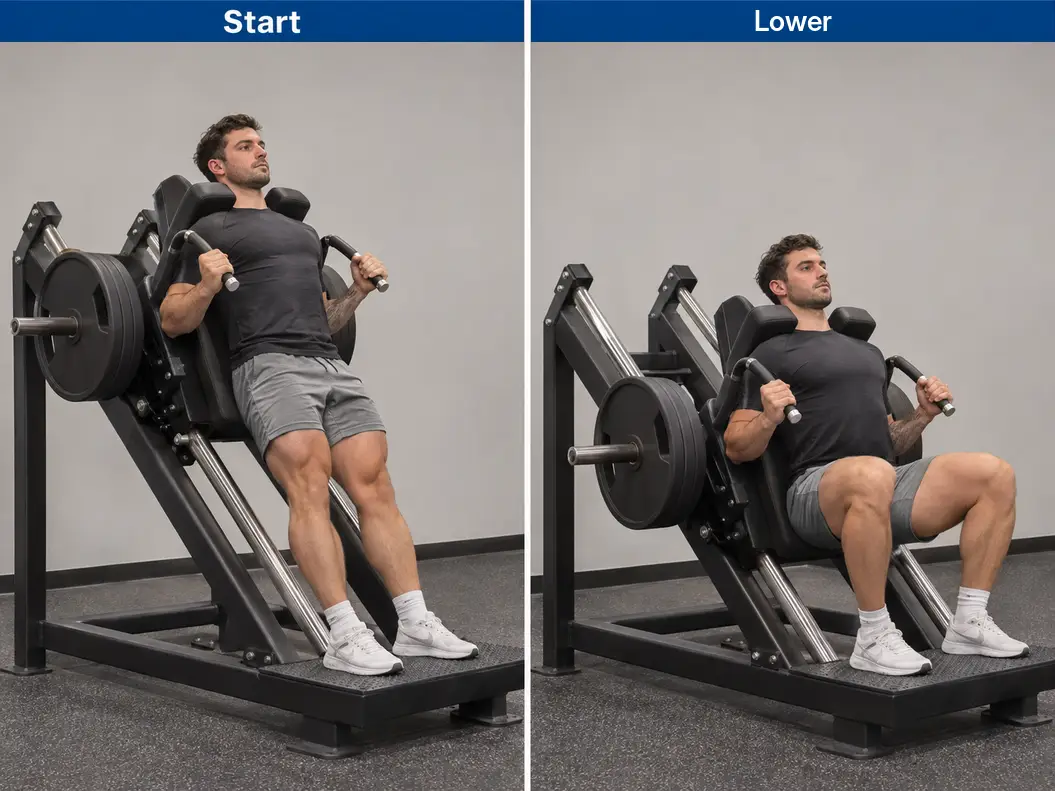
- With the carriage secured, inspect the intended platform, pads and controls. Ask staff to demonstrate the stops and return procedure. Select a manageable starting resistance and secure any plates as that model requires; do not assume the unloaded carriage is light enough.
- Adjust only the settings the station provides. Set the permitted safety stops for the intended movement and rehearse their operation with appropriate instruction. Do not remove a stop or invent a way to escape a failed repetition.
- Step onto the fixed platform and settle the back and shoulders against their intended pads, keeping pressure off the neck. Place both whole feet where the station permits a comfortable squat and take its handles securely.
- Stand only far enough to take the carriage's resistance and disengage the catches using the learnt procedure. Confirm balance and pad contact before the first descent; catch directions are not identical across machines.
- Bend the hips and knees to lower the carriage under control. Keep the feet supported and the back against the pad. Reverse before heels lift, contact is lost, the movement becomes painful or a bounce replaces control.
- Extend the hips and knees to move the carriage up its rails. Keep the shoulders and back supported without forcing the knees backwards or using the hands to push on the thighs. Reset breathing at a controlled top when needed.
- End while a controlled return to the catch position remains manageable. Re-engage the catches using the learnt procedure, settle the carriage onto them and confirm that it is supported before releasing the handles or stepping off. Use the instructed assistance procedure if normal control is lost, not an improvised exit.
Keep the platform setting, foot placement, depth and pad contact consistent. A shorter squat with more plates is not the same performance. Choose a different station or exercise when the pads, minimum resistance or catch position do not fit. Do not add improvised padding or stand on loose plates to force a fit. A hack squat can reduce the balance and holding demands of a free-weight squat, but the shoulder pads still transmit load. It is not a guarantee of pain-free knees or an unloaded back. Give it its own resistance record and learn it before adopting demanding work from another exercise.
Goblet Squat: Use One Weight Without a Rack
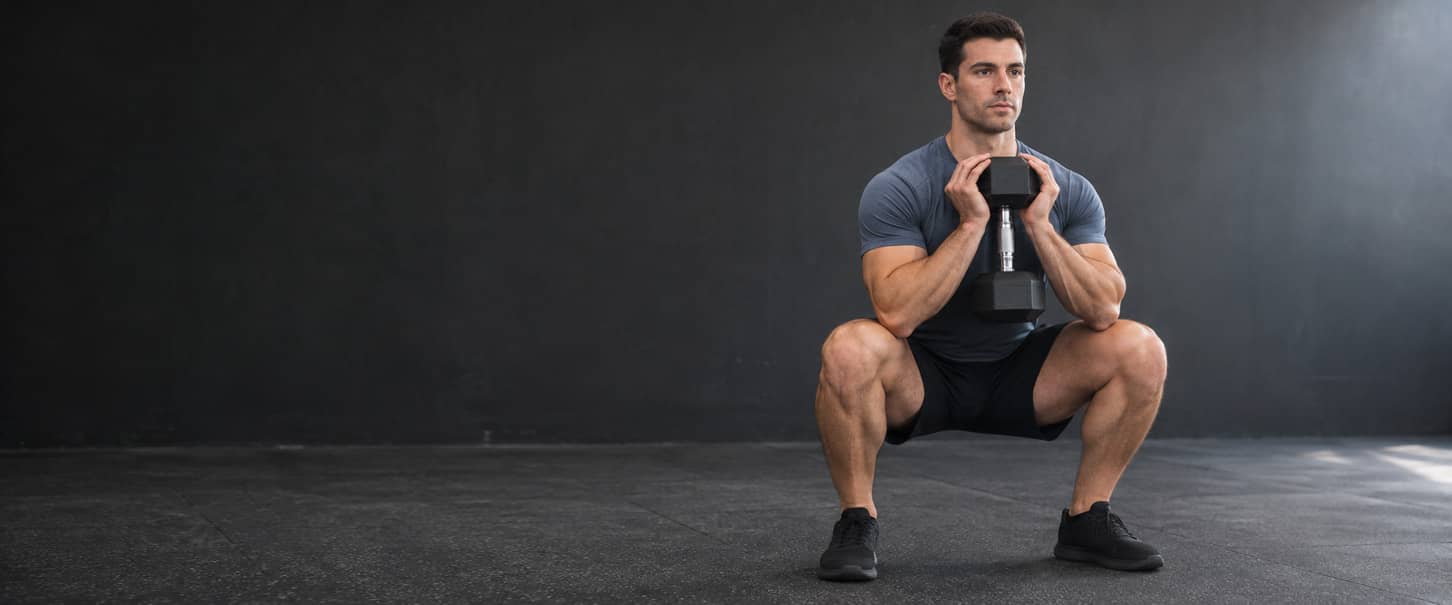
Goblet Squat
Use one dumbbell whose shape and retention system permit a secure two-handed goblet hold near the chest. You need a clear nonslip floor and a manageable pickup and set-down, not a bench or barbell rack. The hold can limit the exercise before the legs, so choose the weight for the whole sequence.
- Inspect the dumbbell and its retention system. Rehearse bringing a light weight to chest height and returning it securely, using instruction or an intended stable starting support when needed. Do not lift a weight into position that you cannot later put down under control.
- Hold it securely with both hands close to the chest. Establish comfortable foot spacing and toe direction, with heels and forefeet on the floor. Keep breathing while firming the trunk.
- Bend the hips and knees together. Let the knees follow the direction of the feet without forcing the shins vertical or the knees as far outwards as possible.
- Lower to a repeatable position that preserves balance, whole-foot contact and control of the weight. Do not force extra depth by collapsing the torso, bouncing or resting the dumbbell on the thighs.
- Extend the hips and knees to stand while the weight stays close. Finish without leaning backwards or changing the hold to force another repetition.
- Stop before grip or positioning makes the return unreliable. Bring the weight down through the route you rehearsed and set it securely on the floor or intended support before letting go.
Bodyweight practice or a lighter weight can help establish the squat. A two-handed goblet hold leaves no free hand for balance support. Use an unloaded supported rehearsal or the separately taught hand-supported split squat when hand support is needed. The Beginner Gym Workout Plan already allows a goblet squat in its leg-press slot, with that plan's current phase and progression rules. That does not make the same replacement automatically appropriate for every workout. Keep the single dumbbell's mass, hold and range clear, and change the exercise when holding capacity prevents useful leg work.
Hand-Supported Static Split Squat: Define the Lead Leg and Free Hand
Hand-Supported Static Split Squat
Use a level nonslip floor and a fixed support intended to withstand your hand pressure, such as a securely installed training rail. Both feet remain on the floor; the front leg names the side being trained, while the rear leg still helps. Begin without a weight. The loaded version uses one dumbbell in the free hand, not two dumbbells plus hand support.
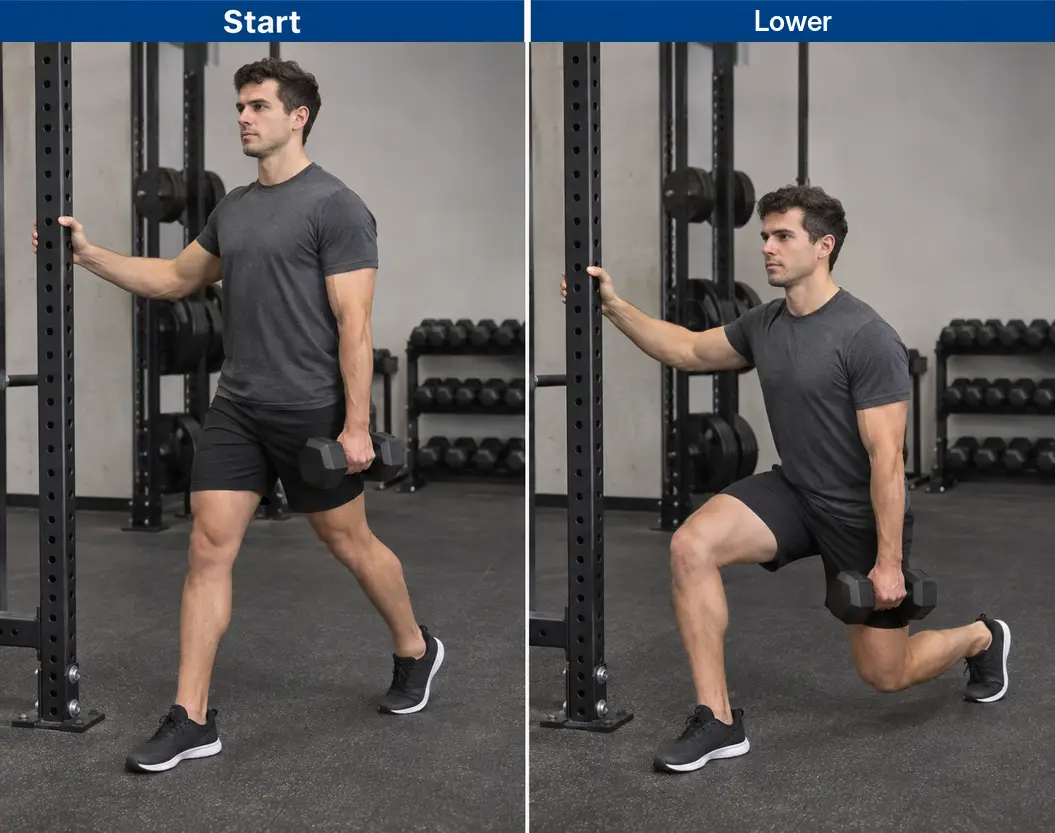
- Check the fixed support, clear floor and space for a safe return. Stand beside the support and hold it with the hand on the same side as the intended front leg. For right-leg work, the right hand uses the support and the left hand is free.
- Set a comfortable staggered stance, with the whole front foot planted and the rear heel raised naturally. Leave some side-to-side width rather than placing the feet on one narrow line. Rehearse the movement without a dumbbell.
- For the loaded version, return to stable standing after the unloaded rehearsal. Pick up one manageable dumbbell through a controlled route, then re-establish the working stance with the weight beside the free-hand hip. Use the support for steady balance, not to haul the body upwards.
- Bend both knees and lower between the feet. Keep the front foot supported and allow a comfortable torso inclination; the rear knee approaches the floor only as far as your controlled range permits, without striking it.
- Extend the legs to return to the same staggered top position. Keep the feet in place and the hand contact consistent rather than turning the repetition into a lunge, a rear-leg jump or an arm-assisted pull.
- Complete the assigned work with the same leg leading. Finish upright, retain hand support while bringing the feet into a stable standing position, then put any dumbbell down through the rehearsed route. Do not turn or swap a heavy weight while still in the split stance.
- Rest as the chosen plan specifies, then reposition so the support is beside the other hand and mirror the setup. For left-leg work, the left hand supports and the right holds any dumbbell. Stop if secure contact, balance or the controlled return is lost.
Choose bodyweight, a shorter comfortable range or a lighter dumbbell when needed. This version does not require rear-foot elevation, a moving step or a second weight. A chair, loose barbell, cable handle or unsecured piece of furniture is not the fixed support taught here. Keep the same support arrangement and amount of hand assistance when comparing sessions. Pulling harder with the arm or changing stance can alter the result without showing stronger legs. Hand support is a balance aid, not back support or proof that the rear leg does no work. Record repetitions by the leg in front.
Know What Squats, Belt Squats and Leg Extensions Change
An alternatives list can conceal a change in movement or support. The four tutorials above are complete for their stated versions. The options below are comparisons, not instructions to add more exercises or assemble unfamiliar equipment.
| Option | What changes | Decision boundary |
|---|---|---|
| Barbell back squat | Free-bar handling, rack requirements and trunk/balance demands | Use it for a suitable squat role, not as an automatic extra squat after the one already in the session. |
| Purpose-built belt-squat station | The attachment and resistance act through a belt rather than shoulder pads | Learn that specific platform, belt, release and exit; do not improvise a belt-squat station from loose equipment. |
| Step-up, reverse lunge or rear-foot-elevated split squat | Stepping, raised support or balance demands differ from the static floor version | Each needs its own instruction, side counting and recovery; the exercise name alone is not a usable tutorial. |
| Leg extension | Direct knee extension with much less hip movement | It can serve a quadriceps-specific role but is not the unchanged compound leg-press task. |
| Romanian deadlift, hip thrust or leg curl | Hip hinging, supported hip extension or knee flexion replaces a different movement role | Do not select one only because it is another leg exercise; the workout may already allocate it elsewhere. |
Use the Barbell Squat guide for the taught high-bar rack-to-rerack method. A stronger leg press does not supply the handling practice for that lift, and a higher squat number does not provide a conversion back to the machine. Strength on a specific movement still benefits from practising that movement when it fits the goal and circumstances. The leg exercise selection guide teaches the wider squat, lunge, hinge, curl and extension roles. Keeping those roles distinct is more useful than claiming every exercise on a list is an equal leg-press replacement. Do not add leg extensions or another hinge merely to make the replacement feel more complete.
Start With the Leg-Press Allocation Already in Lower A
The Upper/Lower Split Workout Plan includes the following leg-press row in Lower A. It is the third exercise in a six-exercise session, after a three-set squat choice and three Romanian deadlift sets. This row is an extract, not another workout to add.
| Exercise | Sets & Reps | Rest | Tempo | Target Muscles | Notes |
|---|---|---|---|---|---|
| Leg Press | 2 sets of 8–12 reps | 2–3 min | 3-1-1-0 | Quadriceps, Glutes, Adductors | Use a foot position and depth that remain comfortable and repeatable. |
Keep the surrounding workout in view
Lower A already begins with a choice of back squat, safety-bar squat or hack squat. Its leg-press row does not itself list a hack squat or goblet squat as an alternative. Choosing one here is a deliberate adaptation, not an instruction already contained in that row. Repeating a squat is not automatically wrong, but it needs a reason within the whole session rather than an unnoticed second allocation. If another familiar leg-press station fits, the two-set prescription can be retained when it remains suitable. Select its resistance independently and keep the remaining curl, calf and trunk work unchanged unless the complete plan is deliberately being adjusted. An unfamiliar machine may need an easier learning session rather than the printed dose.
Keep tempo, effort and progression together
For 3-1-1-0, lower for about three seconds, pause for one second at the controlled lower position, press up in about one second and use no deliberately prolonged top pause. The timing does not require bouncing, losing support or forcing a deeper endpoint. Use the source's two to three minutes between working sets, with additional recovery when needed. Allow adequate recovery before the next exercise as well. The source uses double progression: build repetitions within the range, then consider the smallest suitable increase when both sets reach twelve with the intended effort and execution. Reaching twelve in both sets does not make an unsuitable increase compulsory. A missed first-set minimum or changing technique calls for a load, setup or recovery review.
Choose One Replacement and Specify Its Sets, Sides and Rest
The following teaching example deliberately changes Lower A's exercise. It keeps the bilateral choices at two sets of eight to twelve, but gives the split squat an explicit per-lead-leg allocation and recovery arrangement. These are practical choices for the example, not additional alternatives printed in the source row or a claim of equal muscle stimulus.
| Choose one exercise | Sets & Reps | Rest | Tempo | Effort and setup |
|---|---|---|---|---|
| Back-Supported Hack Squat | 2 sets of 8–12 reps | 2–3 minutes between sets | 3-1-1-0 | About 2–3 good reps in reserve; suitable pads, stops and controllable carriage. |
| Goblet Squat | 2 sets of 8–12 reps | 2–3 minutes between sets | 3-1-1-0 | About 2–3 good reps in reserve; one securely held dumbbell and a reliable set-down. |
| Hand-Supported Static Split Squat | 2 sets of 8–12 reps per lead leg | 2–3 minutes after each side | 3-1-1-0 | About 2–3 good reps in reserve; fixed support and bodyweight or one free-hand dumbbell. |
Choose one row before starting the slot where possible. First check that it fits the earlier squat and hinge work. When the chosen exercise is new or recovery is poor, less work may be appropriate; completing the table is not an obligation. Do not perform all three rows as a circuit or use them to fill a second leg session. For the hack and goblet squat, both legs move within each repetition. For the split squat, complete one set with the left leg leading, rest two to three minutes, complete one with the right leg leading, rest again, then repeat that pair once. Keep this starting-side order for comparison. The rest also follows the final working set or side before the next exercise; take longer when control requires it.
Count the lead-leg work without doubling it again
At ten repetitions in each split-squat set, two left-leading sets give twenty left-leading repetitions and two right-leading sets give twenty right-leading repetitions. That is four separate work bouts and forty lead-leg repetitions in total, not forty repetitions with each leg leading. Both legs still contribute during a split squat; this is an allocation record, not an exact calculation of each muscle's stimulus.
Keep the effort estimate tied to the same movement
About two or three good repetitions in reserve means more repetitions with the same range, support and control, not extra ones obtained by pulling harder with the hand or shortening the squat. The number is an estimate, not a test to prove by reaching failure. The 3-1-1-0 timing also applies to these squat versions: lower for about three seconds, pause for one second at the controlled lower position, rise in about one second and use no deliberately prolonged top pause. Start each repetition from a stable position. Keep breathing and allow any needed reset rather than holding one breath across the set to meet the timing.
Keep Completed Sets When Switching Between Bilateral and Per-Side Work
A change of equipment does not erase a working set. Decide on the replacement before starting where possible; the table below handles a later change without adding a fresh full dose. Its bilateral-to-split-squat arrangement is a practical cap for this example, not a formula proving that one bilateral set equals one split-squat set on each side.
| Status of the two-set slot | Possible remaining work when suitable | How to record it |
|---|---|---|
| No working set completed | Up to 2 bilateral sets, OR up to 2 sets with each leg leading | Choose one version; the split-squat option uses up to 4 separate side bouts. |
| 1 bilateral working set completed | At most 1 bilateral set, OR 1 set with each leg leading | The side-specific option creates 1 earlier bilateral bout plus 2 later side bouts, not a new full allocation. |
| 2 bilateral working sets completed | No replacement work is needed for this slot | A newly free machine does not restart the two-set allocation. |
| 2 bilateral sets followed by 2 sets with each leg leading | Those extra side sets were an addition, not a replacement | 2 + 2 + 2 = 6 work bouts; do not label the combined work as the original two-set slot. |
| Symptoms or lost support end the work after only one lead-leg set | Stop; do not complete the other side to make the log symmetrical | Keep the partial record and address the problem; there is no immediate catch-up debt. |
After one bilateral set, both legs have already worked. If you deliberately use the split-squat option for the unperformed part and continuing is suitable, perform no more than one left-leading and one right-leading set, with the stated rest after each side. Do not add two fresh sets per lead leg. If a clear, suitable remaining allocation cannot be arranged, stop the slot rather than force a tidy total. A first working set that ends at five repetitions is still performed work. Reduce the demand for at most the remaining suitable work; do not relabel that set a warm-up and restart. Genuine light preparation remains separate. Pain, equipment failure or loss of control requires stopping rather than treating the table as permission to continue. The guide to counting workout sets explains why exercise-set records are not exact per-muscle stimulus totals. Keep each exercise and lead leg identifiable; do not combine machine, goblet and split-squat results into one load or personal-best claim.
Progress the Replacement Without Changing Its Support or Range
Keep a separate record for the chosen exercise. Record the exact machine and fit settings, one dumbbell's mass for a goblet squat, or the lead leg and free-hand load for the supported split squat. A normal resistance increase on the same setup remains part of its history. A new machine, altered hand assistance or materially different range changes what is being compared.
Example: progress the goblet squat only while the hold still works
The fictional record below uses the two-set goblet choice from the replacement example. Assume comparable stance, range, tempo and rest, with about two or three good repetitions remaining at the end of each set. The first three exposures use the same single dumbbell; the fourth illustrates a possible result after a suitable increase. No starting mass or timetable is prescribed.
| Exposure | Single-dumbbell load | Repetitions in sets 1 / 2 | Next decision |
|---|---|---|---|
| 1 | Initial manageable load | 10 / 9 | Keep the load and build repetitions without losing the hold or range. |
| 2 | Same load | 12 / 11 | Keep it; both sets have not yet reached twelve. |
| 3 | Same load | 12 / 12 | Consider a suitable increase only when effort, range, hold and set-down also qualify. |
| 4 | A suitable higher load | 8 / 8 | One possible later result; retain it and rebuild only while the full movement remains suitable. |
The repetition totals are nineteen, twenty-three, twenty-four and sixteen. A lower total after a heavier dumbbell does not by itself show regression: load and repetitions changed together. These totals describe the example, not a score of muscle growth or proof that the fourth result must follow. If a heavier dumbbell makes the hold or set-down unreliable, it is not a usable increase even when the legs could continue. Keep a suitable load, use a permitted finer increment or select a different fitting option. Do not attach loose weights, shorten the squat or change the hold to make the new number work. A working set used to discover an unsuitable increase still counts.
Check both lead-leg records
For the supported split-squat example, two sets of twelve with the left leg leading do not qualify the right-leading sets if those are twelve and ten. Keep the shared starting load while building the unfinished side in this example, without using more hand assistance to finish. Consider an increase only when both sets on both lead sides meet the chosen effort and movement standard; stop each side at its own appropriate point rather than forcing matching repetitions. This is not a two-successful-session rule. Follow the actual workout plan's progression when using a different plan. Repeated late-set losses deserve a review of rest, earlier work and recovery; the guide to reps dropping between sets covers those checks. Do not add another leg exercise simply because the next available increment is too large.
Know When to Stop and How to Revisit the Original Exercise
Secure the equipment before another decision
Stop when a foot slips, a catch cannot be operated, a weight cannot be returned securely or the intended movement loses control. Use the return or assistance procedure you have already learnt. Reduce resistance for a loading problem; do not treat damaged equipment or a moving support as a challenge to overcome with more effort. Stop for sharp or worsening pain, numbness, unexpected weakness or dizziness. Persistent or recurring symptoms need appropriate assessment rather than repeated attempts at different machines. This guide does not diagnose the problem or provide rehabilitation clearance. Seek urgent medical advice for a very painful knee, marked swelling, changed shape, locking or giving way, or a hot/red knee with fever or feeling unwell. Seek emergency assessment after an injury for severe joint pain, a joint out of place, or tingling or loss of feeling; inability to walk or bear weight also needs immediate assessment. Use the appropriate local urgent or emergency service. These examples are not an exhaustive checklist.
Return because it fits the plan, not to repay missed sets
When the reason for changing was equipment access, use the checks below. When symptoms or a health restriction caused the change, follow the advice relevant to that problem; success on a different exercise is not a test that clears you to return.
- Confirm that the original access or fit problem is resolved and that the original exercise still serves the goal. You do not have to return to a particular leg press merely because it is free again.
- Recheck its seat, footplate, permitted stops, release and return with manageable resistance. A familiar name or a previous best does not replace the current setup check.
- Choose the starting resistance from controlled preparation and the intended effort. Do not convert the goblet, split-squat or hack-squat record into a predicted leg-press load.
- Record resumed work against the same original machine and setup where comparable. Use only the work the plan now allocates; do not add a second full dose to compensate for the period spent using an alternative.
Keep the alternative when it continues to fit the goal, available equipment and complete workout. There is no universal strength threshold or deadline for returning to a leg press. A change in support or equipment is a reason to check the movement, not evidence that you failed the programme.
Leg Press Alternatives FAQs
What is the best leg press alternative?
Choose for the constraint. A fitted hack squat can provide back-supported squatting, a goblet squat needs one manageable weight, and a hand-supported static split squat can organise the work by lead leg. Another fitted leg press may be the simplest answer when only one station is unavailable. None is best for every person or goal.
Can I replace a leg press with a squat?
Often a suitable squat can fill a knee-and-hip-extension role, but support, handling and loading change. Check the workout's earlier squat work and use an appropriate prescription rather than automatically adding another full squat allocation. Barbell-specific performance still needs the relevant practice.
Is a hack squat the same as a leg press?
No. In the hack squat taught here, the body travels with a back-and-shoulder carriage while both feet remain on the fixed platform. Its contact points, catches and resistance differ from a leg press. Learn it separately and keep its own load record.
What can I use at home without a machine?
A manageable goblet squat or the taught hand-supported static split squat may fit. Bodyweight can be enough for practice or for some working sets, but it is not an unlimited substitute for adjustable heavy resistance. Do not manufacture equipment with loose furniture or unsecured weights.
What if holding the goblet weight limits me before my legs?
Treat the hold as a real limit. Use less weight or select a suitable fitted machine or separately taught alternative. Do not force the set-down, stack dumbbells or change the squat solely to keep a larger load in the log.
Is hand support the same as back support?
No. A fixed hand support can help balance, but the trunk still controls the split-squat position. Pulling with the arm also changes the work. Keep the contact consistent rather than using a stronger arm pull to finish harder repetitions.
Does one split-squat set on each side mean two sets per leg?
No. One left-leading set and one right-leading set give one set with each leg leading, across two separate bouts. The rear leg still contributes. Follow the stated per-side allocation and rest rather than doubling it again.
What if I have already done one of two leg-press sets?
Keep it in the record. When continuing is suitable, the example permits at most one remaining bilateral set or one set with each leg leading. That is a practical remaining-work limit, not proof of equal stimulus. Stop instead when symptoms or an unreliable setup make further work inappropriate.
Can leg extensions replace the whole leg press?
They can serve a deliberately chosen quadriceps-specific role, but they change the task to knee extension with much less hip movement. They are not the unchanged compound prescription, and adding them on top of a replacement requires its own reason within the plan.
Should I use the same weight on the alternative?
No automatic conversion applies. Machine displays, added carriage plates, one goblet dumbbell and a split-squat load describe different setups. Rehearse the new exercise and choose manageable resistance on that setup itself.
Do I need two successful sessions before increasing the load?
Not under the Upper/Lower example used here. All prescribed sets must meet the range, effort and execution criteria before a suitable increase is considered. Other plans can require repeated qualifying exposures; follow the rule of the plan you actually use.
Which alternative should I choose for knee or back pain?
This guide cannot diagnose the cause or prescribe a pain-free replacement. Stop the painful movement and obtain appropriate advice, urgently when symptoms warrant it. A machine, shorter range or hand support is not a treatment or clearance to continue.