
Choose a Seated Cable Row Alternative
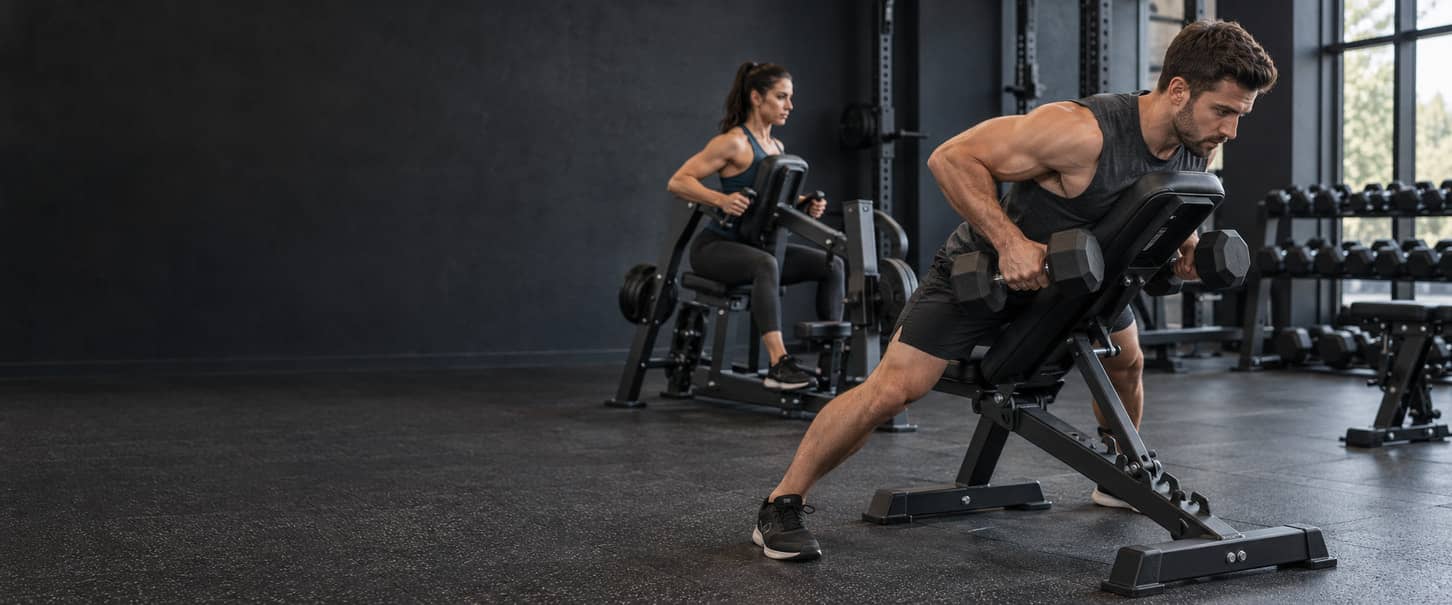
Choose a fitted chest-supported machine row or chest-supported dumbbell row when external chest support is the priority. Use a bench-supported one-arm dumbbell row when a stable bench and dumbbell suit unilateral work. Choose a bent-over barbell row only when you can maintain its hip-hinge position. Use an inverted row only with a secure, rated station, and use a resistance-band row only with an intact band and a compatible purpose-designed anchor. These are candidates for different situations, not six exercises to perform or a universal best-to-worst ranking. Before changing exercises, check whether a permitted handle, seat, foot-support, or other station adjustment solves the problem while keeping the seated cable row comfortable and repeatable. When a replacement is needed, preserve the intended rowing role: the elbows bend as the upper arms move back relative to the torso, the chosen range stays controlled, and the setup can be reproduced without relying on momentum. Select one option that fits the available equipment, support needs, and planned arm use. Replace the row already allocated in the workout plan rather than adding a second full row allocation. Because a machine, dumbbell, barbell, band, or bodyweight setup does not share one resistance scale, establish a separate baseline for the chosen exercise and record the details that make later performances comparable. The sections below compare the six options by equipment and support, provide individual setup and movement instructions, and show how one existing workout-plan row can be replaced without turning the guide into a new workout. Use those details to choose a practical, repeatable substitute rather than assuming that the hardest-looking option or the largest displayed number is automatically better.
What Should a Seated Cable Row Replacement Preserve?
The baseline in this guide is a seated low-cable row performed with the feet supported and no chest pad. The elbows bend as the upper arms travel back relative to a torso position you have chosen and can maintain. The shoulder blades move in a controlled way with the arms rather than being locked permanently together. Use a comfortable, repeatable finish; the handle does not have to touch the stomach, and the return does not need to force the shoulders forward. This baseline still requires active trunk control even though the seat and foot supports help position the body. A cable row machine that also presses the chest against a pad changes the support and therefore the recorded setup. It may be a useful row, but it is not the same no-chest-pad baseline under another name.
Compare the support, not just the exercise name
Before choosing a replacement, identify which parts of the original task matter and which part is causing the problem. Compare the support, equipment, arm use, and controllable range instead of deciding from the word row alone.
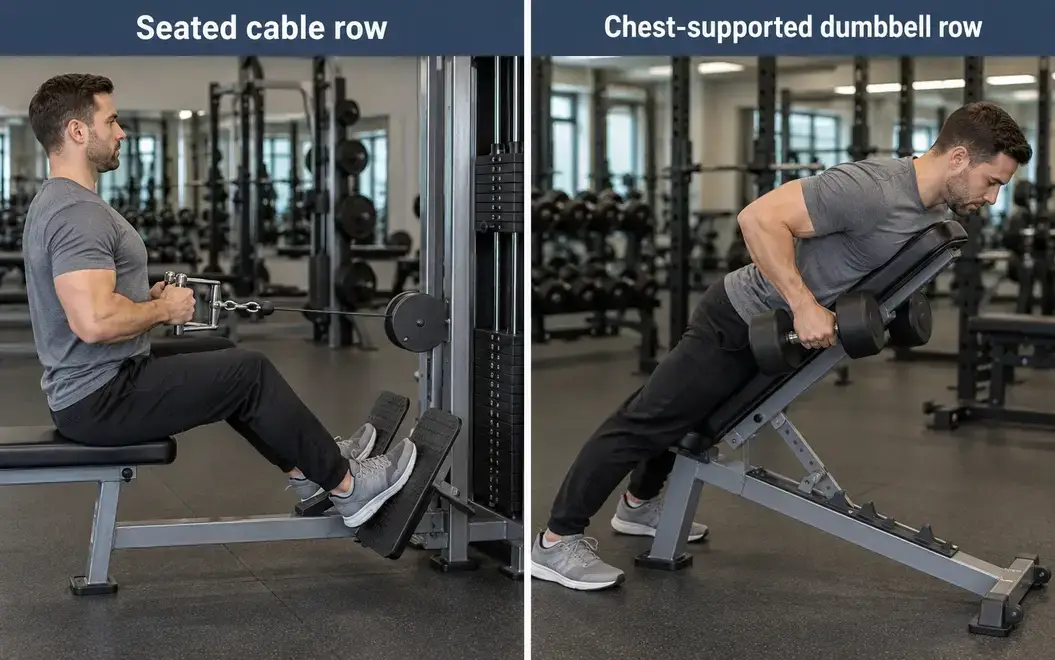
- Seated foot support is not chest support. In the baseline, the feet and seat help position you while the trunk remains responsible for holding the chosen torso position. A chest pad or inclined bench changes that support demand.
- Cable or machine resistance is not the same as free-weight gravity. A stack, lever, dumbbell, or barbell can all provide a rowing task, but their resistance paths, available increments, and displayed loads are not interchangeable.
- Bilateral and unilateral rows create different records. Two-arm work moves both sides in the same repetition, while one-arm work needs side-specific setup, repetitions, and recovery to be recorded clearly.
- A repeatable range is not the longest movement created by momentum. Keep the selected trunk and arm path stable, allow controlled shoulder-blade motion, and stop the set before rocking, twisting, or shortening the return changes the task.
A row is categorized by how the upper arms move relative to the body, not by whether the weight travels horizontally across the room. A bent-over free-weight row can still be a row because the upper arms move back relative to the maintained torso while the elbows bend. When comparing candidates, check the required equipment, the type of body support, the grip and upper-arm path, how resistance can be adjusted, and the actual reason you are leaving the cable row. The most suitable replacement is the one that preserves the needed rowing role without reproducing the limitation that prompted the change. Even if cable tension were approximately constant through the movement, that would not mean joint torque or muscle force stayed constant. Body position, joint angles, cable direction, and the machine's mechanism all influence the task, so keep comparisons qualitative unless the equipment has been specifically measured. For broader coverage of row types and other back movements, use the back exercise selection guide.
Compare Six Seated Cable Row Alternatives
Choose the alternative that addresses the actual reason the seated cable row is unavailable or unsuitable while preserving a controllable rowing task. Start with the equipment and support you genuinely have, then compare whether the option uses external chest support, hand-and-knee support, an unsupported hinge, a bodyweight setup, or an anchored elastic resistance. The matrix is a selection tool, not a growth ranking or a six-exercise workout. Each option changes the support, loading method, arm use, or record you need to keep. Discard candidates whose setup cannot be made secure and repeatable, then carry one suitable replacement forward to the detailed instructions.
| Alternative | Equipment needed | Support and arm use | What changes from the cable row | Useful when | Main check |
|---|---|---|---|---|---|
| Chest-Supported Machine Row | A row machine with an actual chest pad, supported feet, reachable handles, and seat or pad adjustments that lock securely. | External chest support with both arms rowing along the machine's designed path. | The fixed or converging path, machine mechanism, adjustments, and displayed load increments are station-specific. The chest pad replaces the baseline's unsupported trunk position. | External chest support is the main requirement and a fitted row machine is available. | Confirm breathing space, handle reach, a comfortable path, and usable increments. Record the exact machine, settings, handles, and displayed load rather than converting the cable number. |
| Chest-Supported Dumbbell Row | A stable adjustable bench, a matched pair of dumbbells, clear dumbbell travel, and a safe pickup and set-down area. | Chest on the inclined bench, feet planted, and both arms rowing with separate hand paths. | Gravity loads the dumbbells, bench angle and clearance shape the setup, and available dumbbell increments replace the cable stack and footplate. | No cable station is available but bilateral rowing with external chest support still fits the task. | Use a locked bench position that leaves room for the dumbbells and lets the chest stay supported. Record the load per dumbbell, not an unlabeled combined total. |
| Bench-Supported One-Arm Dumbbell Row | A stable exercise bench, one dumbbell, floor space for the planted foot, and a safe place to set the weight down. | The nonworking hand and knee use the bench while the other foot stays on the floor; one arm rows at a time and the trunk controls rotation. | The exercise becomes unilateral and hand-and-knee-supported rather than seated and bilateral. Each side needs its own repetitions, order, recovery, and setup record. | A bench and one dumbbell are available, unilateral work is appropriate, and the additional per-side time fits the plan. | Repeat the support arrangement without twisting or shifting to finish. Record the load, arm order, actual work, and recovery for each side. |
| Bent-Over Barbell Row | A barbell, suitable plates and collars, stable floor space, and a clear, controlled pickup and set-down route. | No external chest support; both arms row while the lifter maintains a braced hip hinge. | Free-weight gravity and the unsupported hinge add trunk, hip, and grip demands that the seated cable setup does not share. | A barbell is available and maintaining the hinge is an acceptable part of the intended work rather than the limitation being avoided. | Keep the torso reference and arm path repeatable without repeated hip drive or rising toward standing. Consider demanding hinge and grip work already placed earlier in the plan. |
| Inverted Row | A purpose-built station or securely fixed rated bar suitable for the pulling direction, plus a nonslip foot surface and safe access. | Both hands hold the fixed support while the feet contact the floor and the body moves as a controlled unit. | Body position, support height, foot placement, and leg position determine the task instead of a selected stack load. Changing the geometry changes the recorded variation. | No cable is available but a secure bodyweight-row station and a manageable body position are available. | Verify the station and choose geometry that permits a controlled range without sagging or hip thrusting. Record support height, feet, legs, and range rather than assigning a body-weight percentage. |
| Anchored Resistance-Band Row | An intact resistance band and connectors with a compatible purpose-designed anchor mounted on a support approved for the pulling direction. | A stable standing stance with both arms rowing while the trunk remains controlled; there is no chest pad or seated footplate. | Elastic force changes with stretch, and anchor height, working length, starting distance, grip, and stance all affect the task. Band color is not a cable-load unit. | Portable or limited equipment is necessary and a secure compatible anchor is genuinely available. | Inspect the band, connectors, and anchor, respect the product's stretch limit, and control the return. Record the exact band and setup instead of claiming a machine-load equivalent. |
Choose one option for the actual constraint
- Identify what the allocated row needs to preserve and the specific reason the seated cable version is being replaced.
- Discard options whose equipment, support, clearance, or secure setup is unavailable or unsuitable.
- Select one candidate that provides a comfortable, repeatable rowing task under the available conditions.
- Read that option's movement steps in the following sections and rehearse a manageable version before working sets.
- Use the replacement in the original row slot and preserve the chosen workout plan's intended allocation rather than adding the other alternatives.
Treat the chosen exercise as its own recorded task. Keep the equipment and setup identifiable so later performance is compared within the same alternative, not against an unrelated cable, machine, band, barbell, dumbbell, or bodyweight number.
Chest-Supported Machine and Dumbbell Rows
Both options preserve a bilateral rowing task while replacing the seated cable row's no-chest-pad setup with external chest support. In each version, the elbows bend as the upper arms move back relative to a supported torso, and the shoulder blades move in a controlled way with the pull and return. The machine guides the handles through its designed path, while the dumbbells move independently under gravity. Choose the version whose support, reach, clearance, and available loading fit you, then record it as its own exercise rather than treating it as the cable row under another name.
Chest-Supported Machine Row
A chest-supported machine row qualifies here only when an actual pad supports your chest through the working range. Use the station's permitted adjustments and intended path rather than assuming every seated row machine provides the same support or fit.
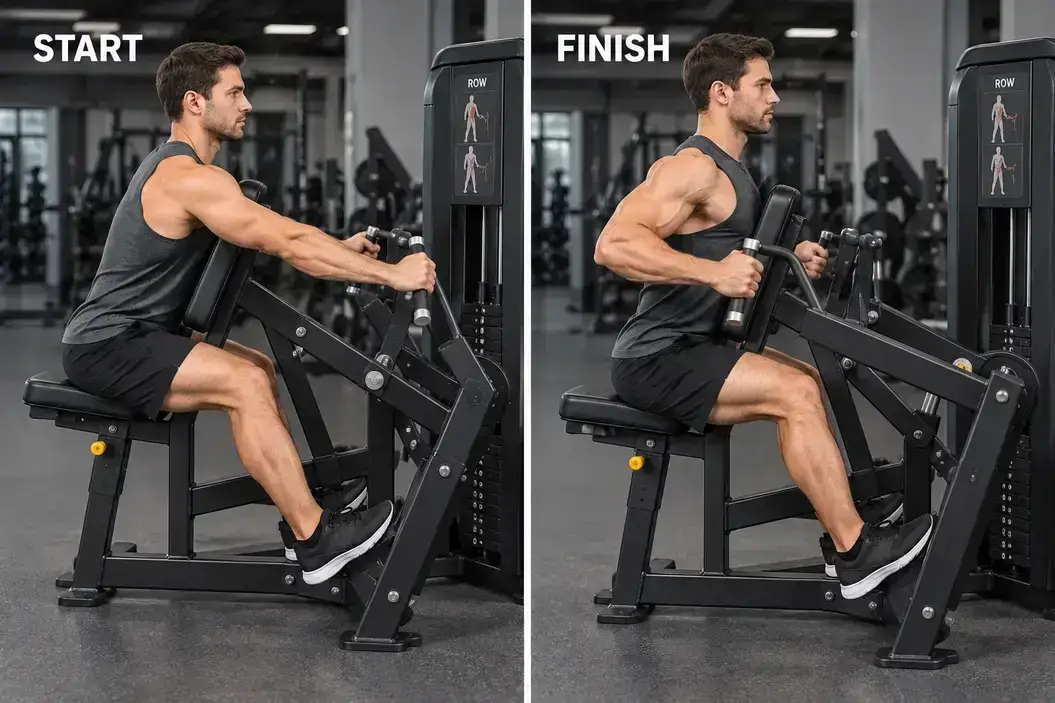
- Adjust the station with the resistance at rest. Follow its operating directions, select a manageable setting, and adjust the seat or chest pad so the handles are reachable without pulling you away from the support. Keep your feet on the floor or the station's provided supports, confirm permitted adjustments are secure, and leave enough space against the pad to breathe normally.
- Establish the supported start. Rest your chest against the pad, take a comfortable grip, and brace without pressing so hard into the support that breathing or arm movement is restricted. Check that the starting position does not force your shoulders forward or require your chest to leave the pad just to reach the handles.
- Row along the machine's intended path. Move your upper arms back as your elbows bend, allowing controlled shoulder-blade motion rather than holding the blades frozen or forcing a maximal squeeze. Keep your chest in contact and avoid leaning away from the pad to create extra travel.
- Control the return. Guide the handles forward as your elbows straighten and your shoulder blades move with the arms. Use the comfortable range the fitted machine permits without letting the resistance jerk you forward, crashing the stack, or forcing a painful reach.
- Finish with the load settled. Return the resistance to its resting position before releasing the handles, changing the setting, or leaving the station. Follow the machine's exit procedure, and ask facility staff about unfamiliar controls rather than improvising an exit.
This replacement preserves a two-arm row and external chest support, but its fixed or converging path, resistance mechanism, seat and pad adjustments, and load increments are specific to that station. A seat alone, or a backrest without a chest pad, does not meet this support criterion. If permitted adjustments still leave the handles unreachable, restrict breathing, or force an uncomfortable path, the machine does not fit the task; do not compensate by lifting away from the pad or forcing extra travel. Record the machine identity, seat and pad settings, handle choice, displayed load and units, and the range you used. Chest support can reduce the demand of holding an unsupported hinge, but it does not make spinal loading zero, guarantee injury prevention, or turn the exercise into pain rehabilitation.
Chest-Supported Dumbbell Row
This option keeps both arms rowing while an inclined bench supports the chest, but it replaces the cable's guided resistance with two independently moving dumbbells. The bench must be locked and stable, with enough breathing room and clearance for a safe pickup, controlled row and return, and safe set-down.
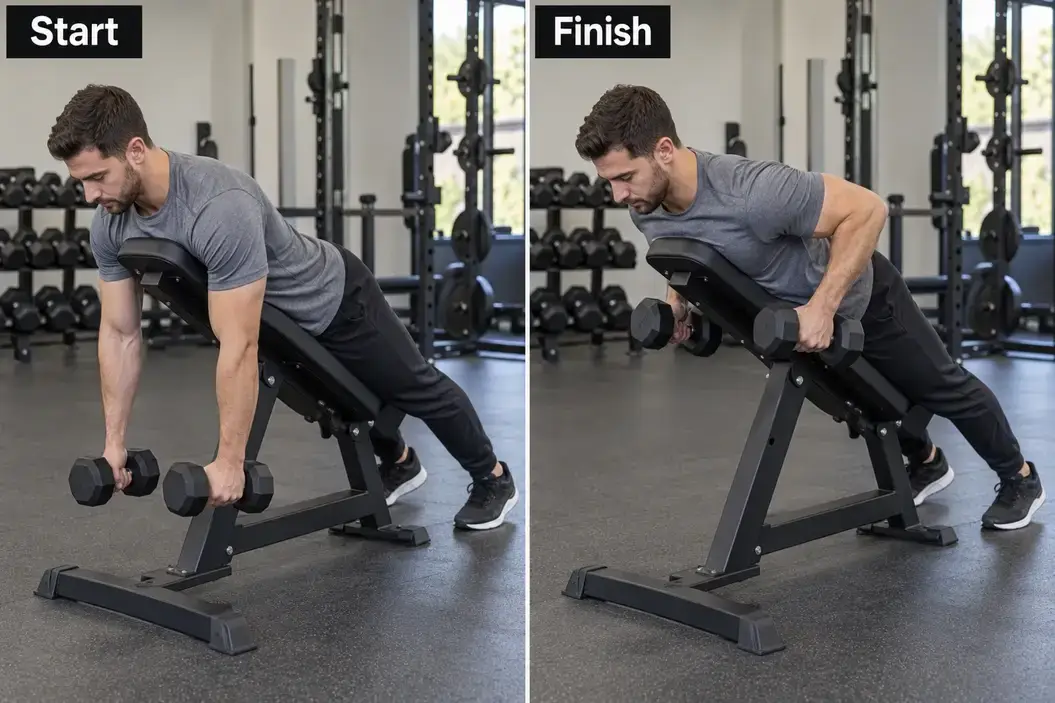
- Prepare the bench and weights. Lock a stable adjustable bench at a useful incline that supports your chest and leaves room for the dumbbells to pass beside it; no single angle is mandatory. Clear the surrounding floor and place a matched pair of manageable dumbbells where you can pick them up and return them without losing control.
- Settle onto the support. Position your chest on the pad with room to breathe, plant both feet securely, and align your head with your torso. Take the dumbbells using a controlled method and let them hang beneath your shoulders in a comfortable grip, checking that neither the bench nor floor blocks the intended reach.
- Perform the pull. Bend your elbows and bring your upper arms back toward the sides of your torso along repeatable paths. Let the shoulder blades move with the arms, keep your chest against the bench, and do not swing the dumbbells, lift the chest, or drive through the feet to finish.
- Guide the return. Lower both dumbbells steadily as the elbows straighten and the arms reach again. Maintain chest and foot contact, keep the hand paths controlled, and stop at the repeatable reach rather than dropping the weights or forcing a deeper stretch.
- Set the dumbbells down safely. Bring the weights to a stable resting position before leaving the bench. If the pickup or set-down cannot be controlled from the chosen arrangement, reduce the load or change the permitted bench and dumbbell placement before another set.
Compared with the seated cable row, resistance comes from gravity, and the bench incline, separate hand paths, dumbbell clearance, and available weight increments shape the task. Record the load per dumbbell, not an unlabeled combined total, together with the bench setting, grip, arm path, and controlled range. If your chest lifts, your feet lose position, the dumbbells strike the bench, or swinging replaces the row, end the set and reassess the load, incline, body position, and clearance. The bench provides external support, but it does not eliminate all spinal loading, prove injury prevention, or serve as treatment for pain.
One-Arm Dumbbell and Bent-Over Barbell Rows
These free-weight replacements preserve elbow flexion and upper-arm movement back relative to the torso, but they do not provide the same support. The one-arm dumbbell row uses a bench for hand-and-knee support while one side works at a time. The barbell row keeps both arms working together while you maintain an unsupported hip hinge. Choose between them by the support you actually need and can control. Neither exercise inherits the seated cable row's resistance, setup, or performance history, so each requires its own repeatable technique and record.
Bench-Supported One-Arm Dumbbell Row
Use this replacement when a stable exercise bench and dumbbell are available, unilateral rowing fits the plan, and hand-and-knee support suits the task. The bench does not support your chest; your trunk still has to resist rotation while the working arm moves freely.
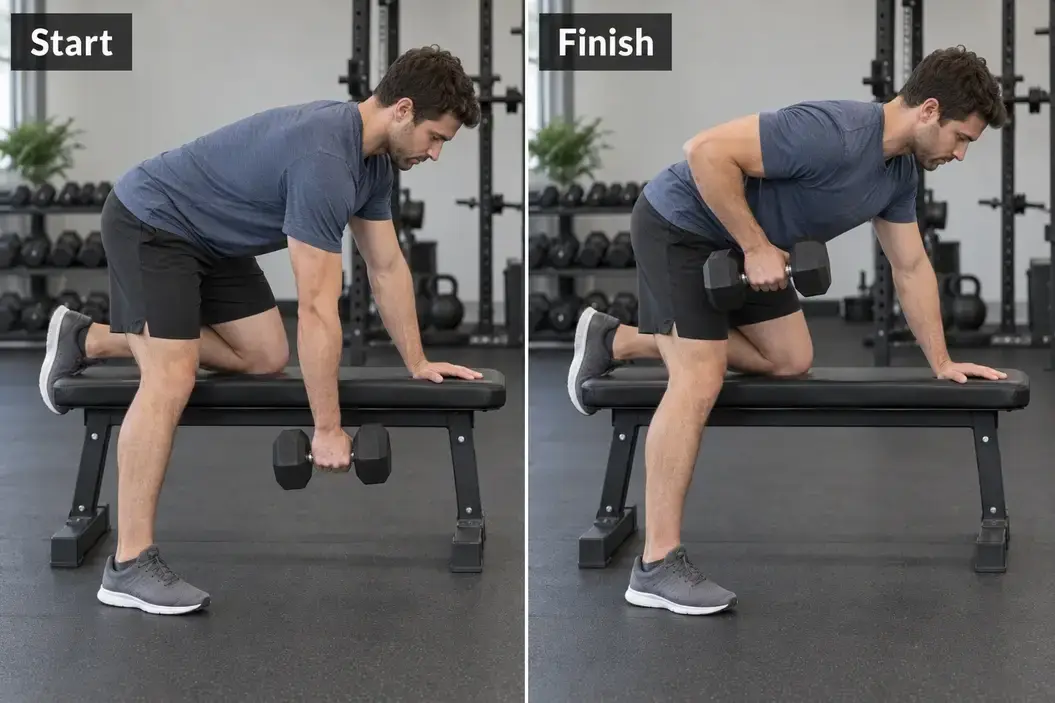
- Prepare the bench and working area. Use a stable exercise bench on a level surface, place a manageable dumbbell where it can be reached and returned safely, and leave enough clearance for the working arm and weight to move without striking the bench.
- Establish the support. Place the nonworking hand and knee on the bench and plant the working-side foot securely on the floor. Reproduce contact points that let you brace with your shoulders and hips steady, rather than twisting or shifting to make room for the dumbbell.
- Set the working-arm start. Pick up the dumbbell without abandoning the support position, let the arm reach down under control, and keep a firm comfortable grip. Maintain the chosen torso position without dropping the working shoulder or rotating toward the floor.
- Perform the row and return. Move the working upper arm back as the elbow bends, then lower the dumbbell steadily to the same controlled reach. Let the shoulder blade move with the arm while the torso stays braced. Do not rotate upward, jerk the weight, or move the supporting hand, knee, or foot to finish the pull.
- Finish one side before changing position. Set the dumbbell down safely while support is still secure, then reposition for the other arm and reproduce the setup as closely as practical. Do not carry the weight around the bench or switch sides while it is unsupported.
This is a hand-and-knee-supported unilateral row, not a chest-supported row. It changes the cable version by using one arm at a time, gravity loading, and a trunk-control task that can differ between sides. The added setup, side change, and recovery decisions can also make the exercise take longer. When a plan states sets per side, that prescription applies separately to each arm; do not silently divide the sets between sides or double the sets assigned to each arm. Record the side, arm order, dumbbell load, actual sets and reps, recovery arrangement, bench and foot positions, range, effort, and stopping reason. A difference between sides is information to record, not an automatic diagnosis or proof that this exercise will correct an imbalance.
Bent-Over Barbell Row
This bilateral free-weight row replaces the seated cable setup with gravity loading and a maintained unsupported hip hinge. Choose it only when holding that position is appropriate for the intended work and does not recreate the limitation that prompted the substitution.
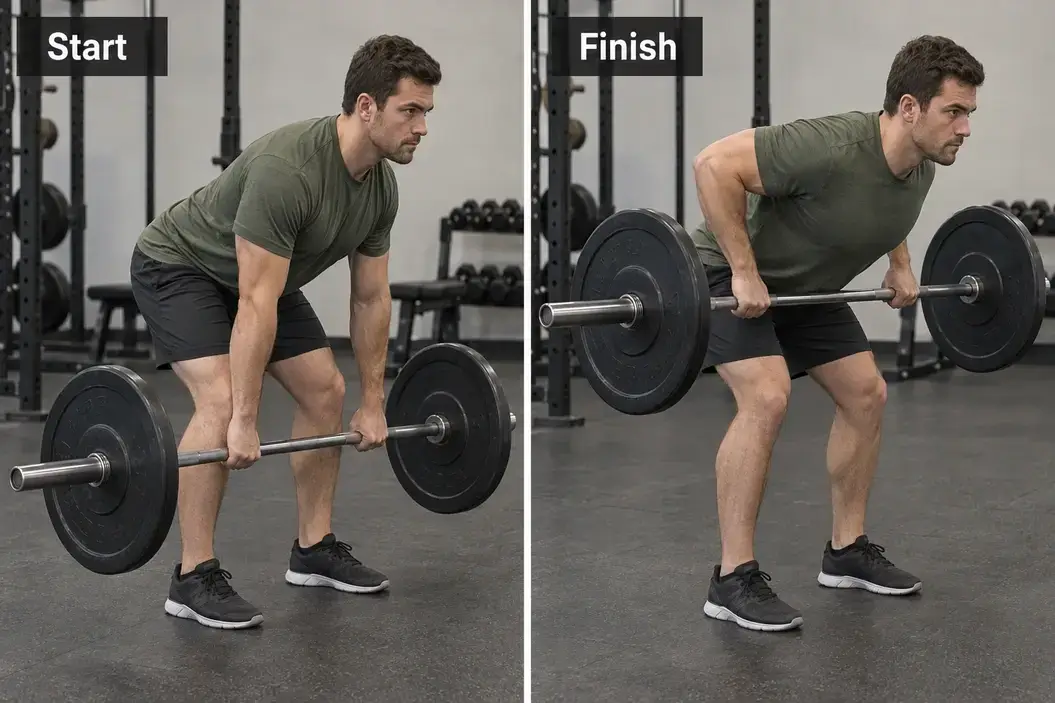
- Prepare a clear pickup and set-down area. Use a barbell setup you can reach and return safely, select a manageable load, and make sure the surrounding floor and rack area are clear. Follow the facility's equipment rules rather than improvising supports or leaving the bar where it obstructs others.
- Establish the start. Take an overhand grip, plant your feet in a stable position, and use a comfortable knee bend. Hinge at the hips and brace into a torso position you can maintain, with the bar held securely and the arms reaching down under control. No universal torso angle is required.
- Pull without changing the hinge. Move the upper arms back as the elbows bend and guide the bar toward a comfortable endpoint relative to your torso. Keep the feet planted and the trunk position repeatable; do not use repeated hip drive, rise toward standing, or force the bar to touch one universal point.
- Control the return. Lower the bar to the same intended reach as the elbows straighten, retaining the hinge and grip rather than dropping the load or letting the torso collapse. End the set when the chosen position, arm path, or controlled return is no longer available.
- Set the bar down before leaving the position. Return it to the planned support or floor under control, confirm that it is stable, and then come out of the hinge. Do not relax the brace or release the grip while the bar is still unsupported.
Compared with the seated cable row, the barbell version adds the demand of holding the torso in a hinge while both hands support one bar. If unsupported trunk fatigue was the reason for replacing the cable row, this can be the wrong candidate even when the rowing motion itself is familiar. Consider the hinges, grip-intensive work, and other demanding exercises performed earlier in the session without rewriting the complete workout plan. Record the barbell load and units, grip spacing, stance, chosen hinge and arm path, controlled range, actual repetitions and rest, estimated effort, stopping reason, and relevant preceding work. Keep that history separate from the cable row. More weight on the bar does not establish equivalent resistance or better performance than the previous exercise, and neither a fixed torso angle nor compulsory bar contact is needed to make the record valid.
Inverted Rows and Resistance-Band Rows
Inverted rows and anchored resistance-band rows can provide practical rowing options away from a cable station, but neither is equipment-free. The inverted row requires secure pulling support and suitable foot contact; the band row requires an intact band and a compatible purpose-designed anchor. Treat either as its own exercise and setup rather than converting the cable-row load into a bodyweight percentage or band color.
Inverted Row
Use an inverted row only where a purpose-built station or securely fixed bar is designed and suitable for the intended pulling direction. The exercise changes resistance through body position and support geometry, so choose a version you can control and record rather than assuming one setup represents a fixed fraction of body weight.
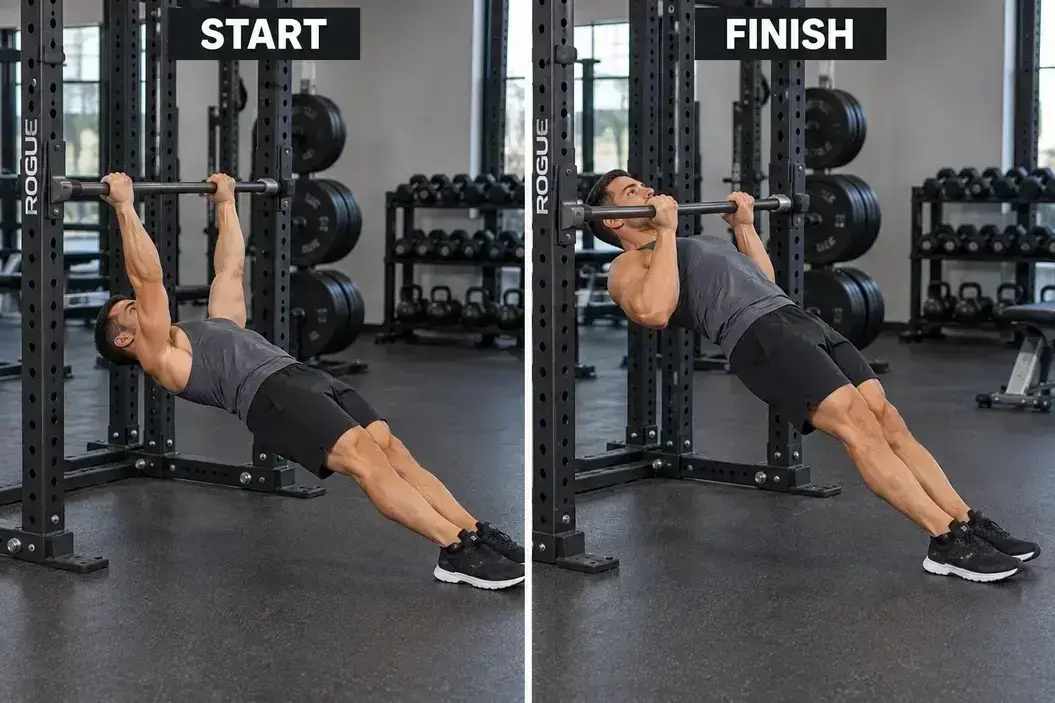
- Check the station and exit before loading it. Confirm that the bar or handles are locked or fixed as intended, that the support is rated for the pulling direction, and that there is clear space beneath and around you. Do not use a loose bar resting in supports, unstable furniture, or a setup whose locking method is uncertain.
- Set a manageable body position. Take a secure grip, place your feet on a nonslip surface, and choose a support height, foot position, and straight- or bent-leg arrangement that you can maintain. A more upright torso or a permitted bent-knee setup can reduce the demand, but it creates a different version that should be recorded.
- Establish the start. Extend your elbows under control while keeping your trunk, hips, and legs organized as one unit. Use a comfortable shoulder-blade reach without dropping suddenly into the bottom or letting the hips sag.
- Pull with the body moving together. Bring your upper arms back as your elbows bend, keeping the torso and pelvis aligned. Do not thrust the hips, reach the neck toward the bar, or force chest contact to manufacture extra travel.
- Lower and exit safely. Return steadily to the same controlled straight-arm position, then use the station's intended method to place your body in supported rest before releasing your grip. Do not drop from the bar or twist out while your body is still suspended.
Record the support or bar height, foot placement, leg position, grip, and intended range so later sets describe the same task. Changing any of those features can alter leverage and difficulty; it should remain visible in the log rather than being treated as unchanged performance. The inverted row is an equipment-dependent bodyweight row, not a cable-load conversion. Do not assign it a universal percentage of body weight or infer that a harder-looking angle automatically reproduces the original cable resistance.
Anchored Resistance-Band Row
Use a resistance-band row only with an intact band, compatible connectors, and a purpose-designed anchor installed on a support approved for the pulling direction. The band supplies elastic resistance that changes with stretch; it does not recreate the cable station's load scale or resistance profile.
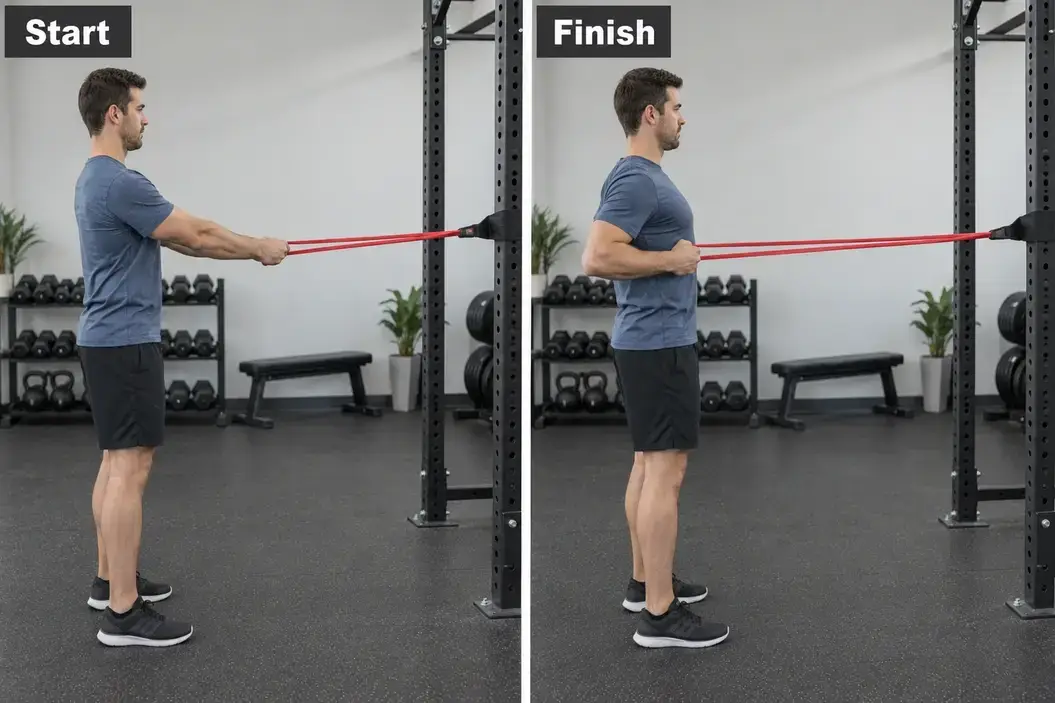
- Inspect the complete setup. Check the band, handles or connectors, anchor, and mounting point for wear, damage, looseness, or sharp edges. Install and use the anchor in the direction permitted by its manufacturer. Do not loop the band around furniture, use a towel over a door, or improvise a household anchor.
- Set the permitted working length. Position yourself so the band remains within the manufacturer's stretch limits through the intended pull and return. Keep the band clear of abrasive surfaces and make sure the anchor remains aligned with the approved pulling direction.
- Establish a stable stance and start. Face the anchor with your feet secure, knees comfortably unlocked, torso braced, and hands holding the selected grip. Begin with your elbows controlled and enough tension to keep the band organized without allowing it to pull you forward.
- Row without rocking. Move your upper arms back as your elbows bend, allowing controlled shoulder-blade motion while your stance and trunk remain steady. Do not lean backward, snap the band, or use a body swing to reach the finish.
- Control the return and release. Let your elbows straighten and upper arms move forward under control without allowing the band to recoil. After the final repetition, move toward the anchor or otherwise follow the product's approved method to ease off tension before releasing the handles.
Record the band's exact identity, working length, anchor height, starting distance, grip, stance, and intended range. Band color identifies that particular product only; it is not a universal load unit and should not be translated into a cable-stack number. Elastic force changes as the band stretches, while the joint and muscle demands also depend on body and anchor geometry. That does not establish one universal point of peak joint torque or prove that a given band setup matches the cable-row stimulus.
When a secure pulling setup is unavailable
If you do not have suitable resistance, a compatible anchor, or secure support designed for the pulling task, neither option is available as written. Leave the row out until an appropriate setup or plan-approved alternative is available rather than renaming unloaded arm movements as equivalent loaded rows or inventing an improvised exercise to fill the gap.
Match Your Arm Path, Grip, and Support
A seated cable row replacement should preserve the rowing task you intend to train, not merely use a handle with a familiar name. Palm orientation, hand spacing, upper-arm path, torso support, and resistance are separate choices. Select a combination that lets you repeat the same controlled pull and return before judging progress.
Separate grip orientation, spacing, and upper-arm path
Describe the grip accurately before comparing exercises. Overhand means the palms face down or away according to the handle position, neutral means the palms face each other, and underhand means the palms face up or toward you. Those orientations do not determine hand spacing: a neutral handle can be close or wide, and an overhand grip can use several widths. The attachment or handle influences what positions are available, but its name does not establish the complete movement. Check where your hands start, how far apart they are, whether your wrists remain comfortable, and how your upper arms travel relative to your torso.
- Palm orientation changes the forearm and grip position. It can affect comfort and elbow-flexor involvement without assigning the exercise to one back muscle.
- Hand spacing changes the available arm path and clearance. Wider is not automatically better, and closer is not automatically a lat-isolation setup.
- Upper-arm angle describes whether the elbows travel nearer the sides or follow a more open path. It is distinct from palm orientation and should be chosen deliberately rather than forced by a cue.
Keep the selected orientation, spacing, and arm path recognizable from repetition to repetition. Changing them during the set to complete harder reps changes the task and makes the result less comparable.
Choose the emphasis without inventing an exact formula
A row with the upper arms nearer the torso can place more practical emphasis on shoulder extension and the lats, while a more open upper-arm path can involve more upper-back and rear-delt work. These are qualitative differences, not exact muscle-share percentages or proof that one path is superior for growth. Do not force the elbows tightly against the body to promise lower-lat isolation, and do not flare them as far as possible to create an upper-back exercise. Use a comfortable path that the selected equipment permits while the wrists, elbows, and shoulders remain controlled. Acute muscle-activation differences can show that paths are not identical, but they do not establish a universal long-term hypertrophy ranking or one optimal angle for every person.
Allow coordinated shoulder-blade movement
The upper arms move back as the elbows bend, and the shoulder blades can move with that action. On the return, let them move forward under control rather than holding them permanently squeezed together. Stability means controlling the movement while the torso and support remain organized, not freezing the shoulder blades throughout every phase. Finish the pull where the intended upper-arm path and support can still be maintained. The longest possible elbow travel is not automatically the best endpoint; extra reach gained by lifting the chest, rotating the torso, driving the hips, or forcing the shoulders back changes the repetition. Reverse the movement before the support or arm path has to change.
Expect the arms and grip to contribute
Elbow flexors help bend the elbows, and the hands and forearms keep hold of the resistance. Feeling work in the biceps or grip does not prove the back is inactive. Check what actually ends the set: a slipping grip, loss of the intended arm path, inability to keep the support position, or ordinary effort in several contributing muscles. If grip or elbow-flexor fatigue repeatedly prevents the planned rowing task, review the load, handle fit, hand position, rest, and preceding work. Do not declare the replacement ineffective solely because it does not create a particular pump or soreness pattern.
Match the support to the reason for changing exercises
Support should solve the relevant constraint without being mislabeled. A different support arrangement creates a different exercise record even when the movement remains a row.
- For chest-supported rows, confirm that the chest pad or bench fits, leaves room to breathe, permits handle or dumbbell clearance, and allows the intended arm path without lifting away from the support.
- For the bench-supported one-arm row, reproduce the hand-and-knee support and control trunk rotation. This arrangement supports the torso differently from a chest pad and still requires active bracing.
- For a bent-over barbell row, choose it only when maintaining the unsupported hinge is appropriate. Hinge endurance, grip demands, and preceding hip-hinge work can limit the row before the intended arm movement does.
- For an inverted row, support height, foot placement, leg position, and body angle define the geometry. Change those features deliberately and record them rather than treating every bodyweight setup as the same task.
Rehearse the selected setup with a manageable resistance or body position. Use only adjustments, handles, benches, anchors, and station settings compatible with the equipment. If a fit problem cannot be solved through permitted adjustments, choose another suitable option instead of forcing the path or improvising support.
Judge the replacement by repeatable performance
Compare the setup by fit, controlled execution, effort, recovery, and progress under the same conditions. A larger machine number, stronger pump, or more soreness does not prove that the replacement is better or that it matches the old cable row. Different machines, free weights, bands, and bodyweight geometry require their own baselines. Ordinary muscular or postural fatigue can end a set without indicating an injury. Stop when the intended support, arm path, or controlled return is no longer available. Stop for sharp, radiating, or worsening pain, numbness, or unexpected weakness, and obtain appropriate assessment if symptoms persist rather than using another row variation as treatment or a diagnostic test.
Replace the Exercise Without Adding Extra Work
Use the original workout plan to control the row slot, workload, effort, and progression. A replacement changes the exercise used for that allocation; it does not automatically add another row, create a new workout, or rewrite the surrounding session.
Apply the PHUL row as written
Day 4, Upper Body Hypertrophy, in the PHUL Workout Plan already permits either a seated cable row or a chest-supported row. The row appears within the complete session, after the preceding pressing work and before a separate vertical-pull exercise. Warm-ups, the remaining exercises, and the plan's wider instructions still apply.
| Exercise | Sets & Reps | Rest | Tempo | Target Muscles | Notes |
|---|---|---|---|---|---|
| Seated Cable or Chest-Supported Row | 3 sets of 8–12 reps | 90–180 seconds | 2-1-1-1 | Lats, rhomboids, traps, rear delts, biceps | Use a repeatable torso position and full controlled reach. |
The source already allows chest support. A fitted chest-supported machine row or a suitable bilateral chest-supported dumbbell row can apply that category, but the source row does not name a particular machine, bench angle, handle, dumbbell load, or conversion from the cable stack. Keep the selected implementation repeatable and establish its own load and setup record.
Keep the source effort, tempo, and progression in context
PHUL's hypertrophy guidance generally uses approximately 1–3 technically sound reps in reserve. That means ending the set with an estimated one to three further repetitions available at the same execution standard, not forcing failure or treating the estimate as an exact measurement. This is source-plan context for this example, not a universal prescription for every row or lifter.
- First tempo position, 2 seconds: control the return as the elbows straighten and the upper arms move forward.
- Second position, 1 second: pause at the controlled starting reach without forcing a stretch or losing the selected support.
- Third position, 1 second: pull as the upper arms move back and the elbows bend while the torso position remains repeatable.
- Fourth position, 1 second: pause at a comfortable finish without forcing a maximal squeeze or extra elbow travel.
The first moving phase from the starting reach is the pull even though the notation lists the return first. Progress by adding technically acceptable repetitions while range, tempo, rest, and execution remain stable. Increase load only after every prescribed set reaches the upper end of the range to the required standard, then use the smallest practical increment. Those rules belong to the source plan and should not be converted into a universal row-progression formula.
Case A: replace the bilateral row slot
This illustrative application assumes no seated-cable-row working sets have been completed. The lifter selects one bilateral chest-supported row for the existing three-set row slot.
- Remove the 3 seated-cable-row sets and perform 3 bilateral chest-supported-row sets: 3 − 3 + 3 = 3 row sets.
- Performing the original 3 sets and then appending 3 replacement sets would produce 3 + 3 = 6 row sets. That is added work, not the stated substitution.
- The separate vertical-pull slot remains 3 sets. Across these two selected pulling slots, the raw exercise-set count is 3 + 3 = 6 sets.
The six-set figure covers only those two selected exercise slots. It is not the entire week's back workload, a direct-set total for every listed muscle, or evidence that two row variations provide identical stimulus. If a lifter changes exercises after completing some cable-row sets, those completed sets still count. Record what was actually performed and use the plan to decide what, if anything, remains; do not restart the full three-set allocation as though the earlier work did not occur.
Case B: count an explicit per-side prescription
This is a separate constructed accounting example, not a change to the PHUL source row. Assume an appropriate plan explicitly prescribes 3 sets of 10 repetitions per side for a bench-supported one-arm dumbbell row.
| Record | Sets completed | Reps per set | Repetitions for that side |
|---|---|---|---|
| Left arm | 3 | 10 | 30 |
| Right arm | 3 | 10 | 30 |
For the left arm, 3 × 10 = 30 repetitions. For the right arm, 3 × 10 = 30 repetitions. Across both sides, 3 + 3 = 6 one-arm work bouts and 30 + 30 = 60 one-arm repetitions. Each arm receives 3 sets, not 6 sets or 1.5 sets. These counts are bookkeeping, not a claim that six unilateral bouts equal six bilateral row sets or produce an equivalent dose. The actual plan must define the recovery arrangement. Keep arm order and recovery visible, allow safe setup and sufficient recovery, and do not import PHUL's 90–180-second bilateral-row rest as an invented unilateral switching rule.
Case C: start a separate equipment baseline
In this qualitative example, the cable station is occupied and the plan permits a fitted chest-supported machine row. Preserve the previous cable-row history rather than overwriting it. Record the new machine identity, seat and chest-pad settings, handles, displayed setting and unit, actual repetitions, actual rest, estimated effort, and why each set stopped. Rehearse the new setup and select a manageable load using the plan's effort and execution requirements. Do not halve, match, or otherwise convert the cable number. For the detailed reasons equipment numbers are not interchangeable, see why gym-machine weights differ. A change in band starting distance or inverted-row foot position also changes the recorded task. Note the new distance, anchor or support height, foot placement, leg position, and range rather than hiding the change under the same exercise label. A different equipment number or setup does not automatically mean strength was lost; later progress should be judged against a repeatable baseline for that specific task.
Common Row-Substitution Mistakes
A row substitution should solve a specific equipment, support, fit, or movement problem without changing the exercise role or quietly adding work. Identify the observable mistake, make the smallest relevant correction, and keep enough detail in the log to show what actually changed.
Match the substitution mistake to a practical correction
| Mistake | Practical correction | Record to keep |
|---|---|---|
| Choosing an exercise because it lists similar muscles, but replacing the row with a vertical pull, shrug, fly, or hip hinge | Confirm that the replacement still uses elbow flexion and upper-arm movement back relative to the torso. Choose one actual row that fits the intended support and equipment instead of matching only a muscle list. | Exercise name, movement role, grip, upper-arm path, support type, and the reason the original row was replaced. |
| Completing the seated cable row sets and then appending the full replacement allocation | Replace the allocated row rather than automatically adding another complete row. If some original sets were already completed, count them and use the plan to determine what remains instead of restarting the allocation. | Sets completed on each exercise, actual repetitions, stopping reason, and whether the change occurred before or during the row slot. |
| Calling any seated or hand-supported row chest-supported | Reserve chest-supported for a setup where the chest rests on a machine pad or stable bench. Label a seated row without a chest pad, or a one-arm row supported by a hand and knee, according to its actual support. | Chest pad or bench contact, seat or bench settings, hand-and-knee placement where applicable, foot support, and breathing or clearance fit. |
| Copying a cable-stack number to another machine, combining two dumbbells without labeling the total, or silently changing band or inverted-row geometry | Start a separate baseline for the changed equipment. Record dumbbell weight per hand unless a combined total is explicitly labeled, and keep changes in band distance, anchor height, support height, feet, or leg position visible. | Machine identity and displayed unit; load per dumbbell; band identity and starting distance; or inverted-row support height, foot position, leg position, and range. |
| Counting unilateral work ambiguously, ignoring the other arm, or assuming that switching sides automatically provides the required recovery | Follow the plan's explicit per-side wording. Complete and record each arm separately, preserve the intended number of sets for each side, and use the plan's actual recovery arrangement rather than inventing one from the act of switching arms. | Side, set number, repetitions, load, arm order, actual recovery between sides and sets, setup, and any side-specific stopping reason. |
| Finishing repetitions by lifting the chest, rotating the trunk, driving the hips, or shortening the intended range, then logging the work as unchanged | End the set when the selected support, torso position, arm path, or controlled return can no longer be maintained. Reassess load, rest, fit, and permitted adjustments before the next set instead of counting altered repetitions as the same standard. | Actual range, torso or support change, repetition where the standard changed, completed acceptable repetitions, actual rest, load, and stopping reason. |
| Treating pain, a moving anchor, a damaged band, or abnormal machine behavior as a problem to solve with another harder test set | Stop the set and bring the resistance safely to rest. Do not continue on damaged, unstable, or unpredictable equipment; report the equipment issue. Stop for pain or concerning symptoms and seek appropriate assessment when needed rather than using another row as treatment or diagnosis. | The symptom or equipment behavior observed, the point at which the set stopped, the equipment identity, and the action taken. Do not record an unsafe retest as a required working set. |
Keep a suitable row when it is already working
A familiar row that fits the available equipment, permits a repeatable setup, and progresses under the current workout plan does not need to be replaced merely for variety. Change it when there is a clear equipment, support, fit, scheduling, or programming reason, then preserve the old record and establish the new exercise's baseline instead of rotating rows on a fixed calendar.
Seated Cable Row Alternatives FAQs
Use the replacement that fits the row slot, available equipment, support requirement, and movement you can repeat. A different exercise needs its own setup and performance baseline even when it serves the same general rowing role.
What is the best seated cable row alternative without a cable machine?
There is no universal winner. A fitted chest-supported machine row can work when another row machine is available, while a chest-supported dumbbell row suits a stable adjustable bench and dumbbells. A bench-supported one-arm dumbbell row fits unilateral work, a bent-over barbell row fits only when maintaining the hinge is appropriate, and inverted or band rows require their own secure equipment. Choose the option that solves the actual constraint and permits a controlled, repeatable row.
Which option should I choose when holding my torso is the limiting factor?
Start with an exercise that provides actual external chest support, such as a fitted chest-supported machine row or chest-supported dumbbell row. The pad or bench must fit, leave room to breathe, and permit the intended arm path. A seated row without a chest pad and a one-arm row supported by a hand and knee use different support arrangements; they should not be labeled chest-supported or assumed to remove every trunk demand.
Can a lat pulldown replace a seated cable row?
Not as an unchanged horizontal-row substitution. A lat pulldown brings the upper arms down from overhead and can serve its own planned vertical-pull role, while a row moves the upper arms back relative to the torso. Use the movement your workout plan actually assigns. For the separate vertical-pull task, follow the lat pulldown technique guide rather than treating the two exercises as interchangeable.
Can I replace the row at home without equipment?
Not with an equivalent loaded row from this guide. An inverted row requires a purpose-built station or securely fixed bar suitable for the pulling direction, and an anchored band row requires an intact band plus a compatible purpose-designed anchor. Without suitable resistance and secure support, do not improvise with furniture or rename unloaded arm movements as a replacement for the prescribed row.
Should I use the same weight and repetitions on the replacement?
Keep the actual workout plan's appropriate sets, repetition range, rest, effort, and progression rules when the substitution is valid, but establish a new manageable load and execution baseline for the replacement. A cable-stack number does not transfer directly to another machine, two dumbbells need clearly labeled per-dumbbell loading, and band or bodyweight setups use different resistance records. Rehearse the new version and judge later progress under the same repeatable setup rather than forcing the old load or rep result.
Do three one-arm sets mean three sets for each arm?
When the plan explicitly says three sets per side, each arm performs three sets and is recorded separately. It does not mean three total bouts divided between the arms, six sets for each arm, or an unlabeled combined count. Record the side, load, repetitions, order, setup, and relevant recovery. If the plan only says three sets without clarifying whether that means per side, clarify the unit instead of guessing how to divide the work. Identify the row slot and the reason for changing it, choose one option supported by equipment you actually have, rehearse a repeatable setup with manageable resistance, and record the replacement under the chosen workout plan.