
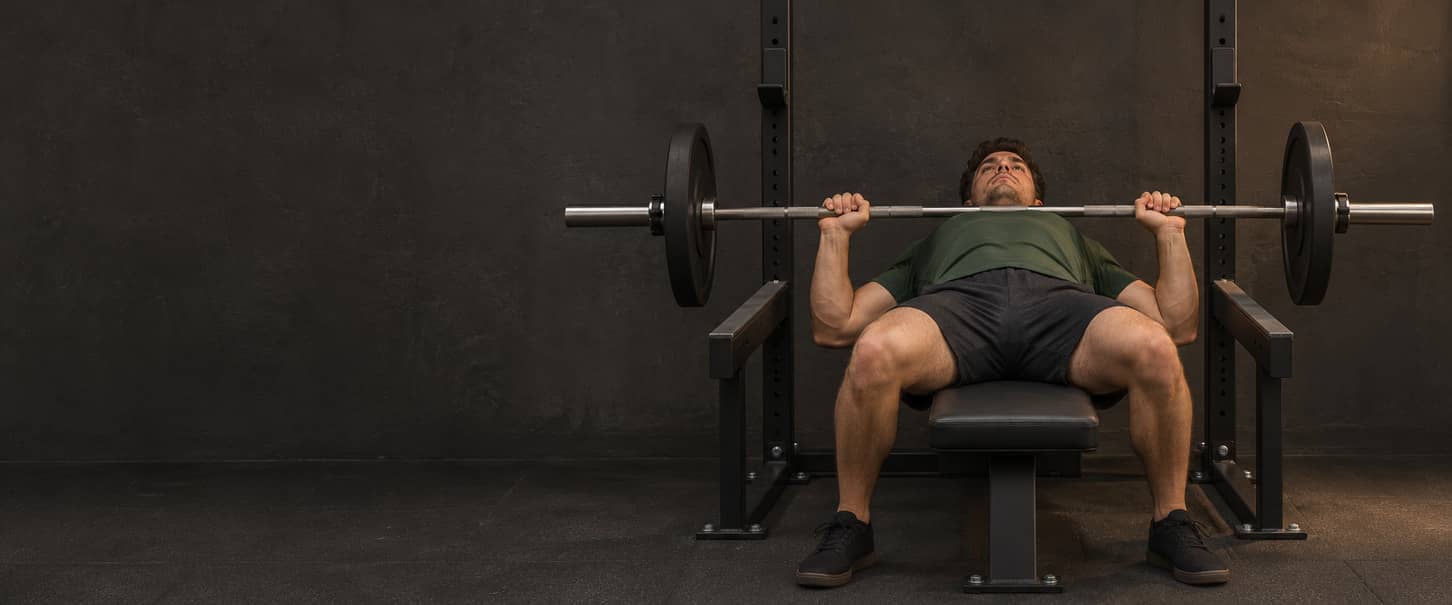
Make Flat-Bar Bench Pressing Repeatable
A useful bench-press record includes more than the weight on the bar. You need a rack and bench that fit the task, a controlled way to take the bar out and put it back, and repetitions that remain comparable from one set to the next. Choose a load that leaves good repetitions available rather than using the first work set to discover your limit. This guide teaches the flat barbell version and follows the decisions that often change a session: a larger weight increase is too demanding, a different rack changes the hand-off, or more repetitions come from a shorter range. Each example preserves the work already performed and gives a usable next choice. It does not require a maximum test or a fixed grip, arch or elbow angle. The worked allocation is the first exercise in Upper/Lower Upper A. Its exact source row and progression rule appear below. The examples are hypothetical teaching records, not client results, recommended starting weights or a clinical trial of this complete approach. The guide is general adult exercise information; individual medical needs and competition rules require their own appropriate guidance.
Check the Rack, Bench and Assistance
Use a purpose-designed flat bench and compatible barbell rack on a firm, clear floor. Follow the actual equipment instructions, load limits, anchoring requirements and gym rules. Inspect the bench, J-cups, safety supports, pins and locks before loading. A matching colour or a hole that accepts a pin does not establish attachment compatibility. For this guide, choose a rack with correctly fitted safety supports. Have a competent person help you establish their position if you cannot verify the fit yourself. Rehearse the complete unrack, intended lowering range and two-hook return with a genuinely manageable empty or training bar while fresh. A standard 20 kg bar is not automatically light enough. The supports must allow the intended repetition and provide the protection specified for that equipment and your position; do not conduct a loaded failure test to check them.
| Check | Before loading | What prevents this setup | Usable next choice |
|---|---|---|---|
| Rack and safeties | Confirm compatible attachments, required anchoring, matched J-cups and secure safety supports; check the complete intended movement with a manageable bar. | The bar strikes the supports during the intended repetition, the catches do not suit your position, or a lock, attachment or rack is uncertain. | Unload and obtain a competent equipment check or choose a different suitable station; do not improvise an escape. |
| Bench and foot support | Centre and secure the flat bench, check its rating and keep head, upper back and buttocks supported with firm foot contact. | The bench rocks or slides, the adjustment is not locked, or your feet cannot make suitable supported contact. | Use a suitable bench or a permitted purpose-designed stable foot platform; no loose plates, boxes or furniture stacks. |
| Bar, plates and collars | Identify the actual bar mass and permitted plates; load both ends evenly while nobody is underneath and fit collars as the equipment and gym require. | The bar is already too demanding, the available increase is too large, or a sleeve, plate or collar is unsuitable. | Use a suitable lighter training bar, retain the known load or use a genuinely available compatible smaller increment. |
| Competent assistance | Arrange the help required by the equipment, gym and your handling; agree any lift-off, transfer of control and rerack signals before starting. | A reliable unrack or rerack needs help that is unavailable, or the proposed spotter cannot perform the task. | Wait for competent assistance, use another suitable exercise within the plan or postpone the slot. |
Adjust the rack and supports while unloaded, then check them again with the bench in its actual position. If a safe equipment fit and your intended range cannot both be established, use a different suitable setup or exercise rather than forcing the bar below a stop or raising the bench on improvised objects. A rack does not automatically make solo lifting or a failed repetition safe. A competent spotter is not simply someone standing nearby. They must understand the task and be able to give the agreed assistance; follow the facility and equipment requirements. If you need a hand-off, establish that before unracking. A hand-off can be part of a recorded setup, but someone helping the bar through a working repetition changes that repetition. Follow the flat-bar tutorial only after the equipment and normal exit are workable. If the necessary station or assistance is unavailable, Bench Press Alternatives covers other pressing choices. A replacement is a choice within the workout allocation, not a second pressing workout to add afterwards.
Set Up, Press and Re-rack the Bar
Flat Barbell Bench Press
Use the individually fitted rack, flat bench and assistance arrangement you checked before loading. Practise the entire sequence with a manageable bar first, including the return to both hooks. Choose working loads you can control with a margin; the tutorial is not a way to escape a failed repetition. Keep the same useful contact points, grip and intended lower endpoint through each set. A gentle repeatable chest touch may suit your setup, while an earlier endpoint may be appropriate for another recorded version. Do not force the bar into the chest or neck to match a picture, and do not treat a shortened range as the same performance.
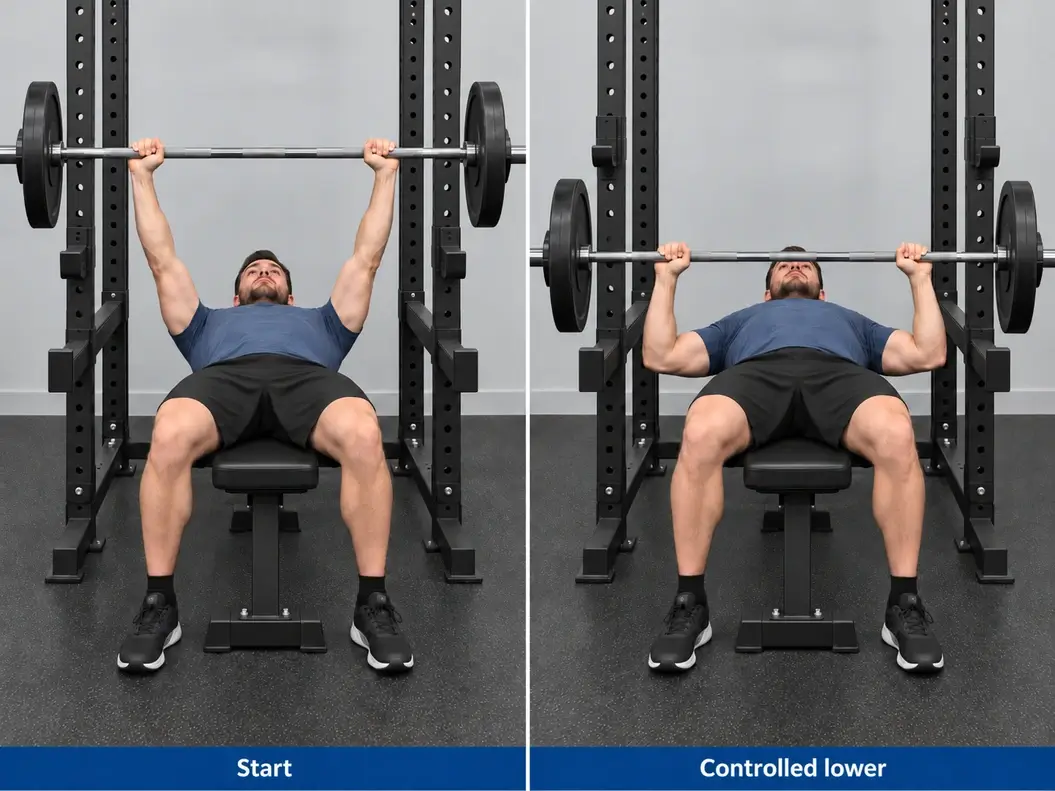
- With nobody underneath the bar, confirm the centred, stable flat bench, correctly fitted J-cups and compatible safety supports. Use the positions checked with a manageable bar. Load both ends evenly, fit the required collars and leave the floor and spotter space clear.
- Sit on the bench and lie back deliberately. Position yourself so that you can clear and return to the hooks without reaching behind your control. Keep your head, upper back and buttocks supported, and place both feet firmly on the floor or the permitted stable foot support.
- Take an even, full overhand grip with both thumbs wrapped around the bar. Let the bar sit securely in the palms rather than towards the fingertips. Choose a width that allows a controlled press with comfortable wrists and a manageable forearm position; use the bar markings to record it, not as a universal grip prescription.
- Settle your shoulder blades against the bench and make a firm, repeatable upper-back base. Keep a comfortable natural arch without lifting the buttocks or forcing a larger back bend. Keep your feet secure rather than changing their position to complete a difficult repetition.
- Confirm the agreed help and signals. If using a hand-off, make sure the competent spotter knows when to assist, when you have control and how the bar will be returned. Do not start if the required help or a reliable return is missing.
- With the full grip retained, straighten the arms enough to lift the bar clear of both hooks, then bring it to a steady starting position over the chest/shoulder region. Use the agreed hand-off if needed. The spotter releases only once you have control; do not begin lowering while the bar is still being transferred.
- Take a comfortable breath and firm your trunk while keeping the support points established. Prepare to lower under control. Breathe as needed between controlled repetitions rather than imposing a prolonged maximal breath hold; stop for light-headedness or other concerning symptoms.
- Lower the bar smoothly towards your recorded chest region or earlier endpoint. Keep both ends controlled, the wrists supported over the forearms and a comfortable elbow path. Use the prescribed pause without bouncing, sinking the bar into the chest or allowing the shoulders and hips to shift to manufacture depth.
- Press the bar back to the controlled upper position, allowing a manageable path towards the starting shoulder line rather than forcing it into a fixed vertical track. Keep the bar level and the body supported. Finish with long controlled arms without shrugging, slamming the elbows or lifting the buttocks.
- Continue only while you can repeat the intended range, tempo, control and effort margin. Reset your breath as needed while stable at the top. Finish the set before an uncertain repetition or an uncontrolled return; do not add forced repetitions to reach a number.
- After the final controlled press, retain the full grip and bring the bar back towards the hooks with the agreed assistance where needed. Guide both sides into their proper J-cups and lower until the bar is fully supported and settled on BOTH sides. Do not release because one end has reached a hook.
- Confirm the bar is stationary and secure in both hooks before opening the hands. Move out from under it, sit up and stand in a controlled way. Adjust or unload equipment only once the bar is safely supported and nobody is underneath; do not roll the bar over the body, dump plates or improvise a failed-repetition exit.
The Chest Exercises guide retains the wider chest-exercise library and its existing bench tutorial. This page uses the same basic task to interpret a complete three-set record and changes in setup. The picture shows two movement phases; it cannot establish your safety-support fit, assistance needs or a complete rack-to-rerack check.
Choose and Record Grip, Range and Contact
Choose settings you can use and reproduce, then record enough to recognise a meaningful change. Useful notes include the station or bench, J-cup and safety positions, grip relative to the bar markings, foot support, lower endpoint and any hand-off. A different rack number is not automatically an equivalent height, and a bar marking is not a measurement of shoulder anatomy.
| Setting | Useful observation | Manageable choice | What to record |
|---|---|---|---|
| Grip and wrists | The bar remains secure in both palms; the wrists and forearms support it without an uncomfortable forced position. | Choose an even full grip and practise small width changes with a manageable bar; stop for pain instead of experimenting through it. | The bar used, finger/mark relationship and any changed grip; do not infer an old unrecorded width. |
| Lower endpoint and bar path | Both ends remain controlled and reach the same intended region without bouncing or an unplanned shortening. | Use the repeatable range you can control; a gentle touch is not a licence to compress the chest or force depth. | The actual endpoint, any contact/pause and a labelled range change. |
| Bench contacts and feet | Head, upper back and buttocks remain supported; the feet stay firmly supported rather than sliding or lifting to finish. | Use a suitable bench and permitted foot support, with a manageable natural arch rather than a maximal one. | Bench identity, foot arrangement and a meaningful change in support or position. |
| Unrack, assistance and return | The bar clears both hooks, becomes steady before lowering and returns fully to both hooks before release. | Use appropriate hook settings and competent help when needed or required; postpone if reliable handling is unavailable. | Station settings, self-unrack or agreed hand-off, and any assistance during a working repetition. |
A natural arch and deliberate upper-back support can be part of a repeatable setup without chasing the largest arch or squeezing the shoulder blades as hard as possible. A single image cannot establish one correct grip or elbow angle for every person. If your contacts or range change as the load rises, record that change and reassess the load instead of counting it as an unchanged performance. This is a general training endpoint, not a statement that every repetition would satisfy a federation's competition rules. The Powerlifting guide keeps competition-oriented training in its own context. A different bench angle also changes the task; the Incline Bench Press guide covers that version rather than treating its setup and records as interchangeable with this flat press.
Check the Whole Repetition
Observe the complete movement, including what happens before the first repetition and after the last. If a competent observer or a permitted recording helps, use it to check the actual setup and control, not to diagnose a shoulder problem or force an idealised silhouette. Neither an app nor a recording is required.
- Confirm the station, support settings and assistance arrangement before unracking. A different bench or rack means checking the equipment again, not copying a number from the previous station.
- Check that the full grip stays secure, both bar ends remain controlled and the recorded body contacts stay in place. Stop a deteriorating set rather than using a new body position to rescue its total.
- Compare the actual lower endpoint, pause and return path. Shorter or bounced repetitions still happened, but they do not qualify the earlier controlled range.
- Record the load on every set and the actual rest. A mixed-load session or extra rest must remain visible; do not report all repetitions as performed at the heaviest load.
- Estimate the further GOOD repetitions you could have completed with the same range, support and control. Do not test failure to prove the estimate, and do not count a spotter-assisted repetition as independent success.
The reps-in-reserve guide explains the estimate. It is approximate, and a technically possible repetition is not useful reserve if it would require a new range, lost contacts or assistance. Pain, unusual weakness or concerning symptoms need their own stop/assessment decision rather than a technique score.
Use the Upper A Bench-Press Slot
The following is the original first row of Upper/Lower Upper A. It is first of seven exercises, after preparation rather than after another working exercise. This guide selects the flat barbell option; the machine remains a different equipment choice within the source plan.
| Exercise | Sets & Reps | Rest | Tempo | Target Muscles | Notes |
|---|---|---|---|---|---|
| Barbell Bench Press or Machine Chest Press | 3 sets of 4–6 reps | 3–5 min | 2-1-X-0 | Chest, Triceps, Anterior Delts | Use safeties or a competent spotter; retain a repeatable touch point and range. |
The source uses approximately 2–4 good repetitions in reserve for heavy compounds. This guide chooses about 3 good RIR within that range as an implementation, not new wording inside the source row. Its fitted-safety-support baseline and appropriate assistance checks likewise explain the selected barbell method without rewriting the quoted note. No starting kilogram value is prescribed. The tempo means a controlled two-second lower, a one-second pause at the recorded lower endpoint, controlled acceleration intent on the press, and no prescribed extra top pause. X does not mean a jerk, bounce or maximum strain. The final zero does not remove the need to regain control, breathe as needed or make a reliable return to the rack. Rest 3–5 minutes between working sets; if you need longer, take and record it without pretending that the conditions were unchanged. Use the source's progression: all THREE normal sets reach six with the intended effort, comparable setup, range, tempo, handling and rest before choosing the smallest practical increase. One strong first set is insufficient. A final-set-only shortfall generally means repeating the load; a first set below four or a material technique change calls for reducing or reassessing it. No second qualifying session or automatic weekly increase is added. After this slot, Upper A has three row sets, two overhead-press sets, three vertical-pull sets, two lateral-raise sets, two triceps sets and two curl sets. This is seventeen normal written sets across seven exercises. The quoted bench row is not permission to add a separate pressing workout, copy the five-set 5×5 prescription, or treat the machine option as the same barbell load and handling history.
Progress the Whole Working Allocation
This independent hypothetical person uses the same suitable flat-bench station, full grip, range, hand-off arrangement and controlled rack return. Ordinary sets use the source 2-1-X-0 tempo, four minutes between sets and about three good RIR. Every listed load is TOTAL bar-and-plate mass, not weight per end. The examples do not recommend 40 kg as a starting load. A1–A6 are appearances of Upper A, not consecutive weeks or a promised timetable. The illustration assumes a 20 kg bar with 10 kg on each end for 40 kg. Collars are fitted as required; their mass is excluded only from this stated arithmetic example. In your own record, identify the actual bar and whether collar mass is included instead of silently mixing conventions.
| Upper A appearance | Total load in set 1 / 2 / 3 | Repetitions in set 1 / 2 / 3 | Total repetitions | Interpretation and next choice |
|---|---|---|---|---|
| A1 | 40 / 40 / 40 kg | 5 / 5 / 4 | 14 | All three sets are inside the range at the stated margin; retain 40 kg and build within it. |
| A2 | 40 / 40 / 40 kg | 6 / 6 / 5 | 17 | The final five prevents all-set qualification; repeat the load rather than increase from the first two sixes. |
| A3 | 40 / 40 / 40 kg | 6 / 6 / 6 | 18 | All three reach six under the stated conditions; a suitable smallest practical increase may be considered. |
| A4 | 42.5 / 40 / 40 kg | 3 / 5 / 4 | 12 | The first three at 42.5 kg leave only about one good RIR; count that work, then use at most two suitable known-load sets or stop. |
| A5 | 40 / 40 / 40 kg | 6 / 6 / 6 | 18 | This person returns to the known setup and load; the result again meets the source rule without imposing a universal restart. |
| A6: possible later result | 41 / 41 / 41 kg | 4 / 4 / 4 | 12 | If suitable smaller plates are actually available and all conditions/effort hold, this would be a workable lower-target result; retaining 40 kg is valid. |
At A4, the already observed first work set of three remains one working bout. It is below four and closer to the limit than intended, so the example does not tell the reader to force a fourth repetition. The bar was returned under control. After four minutes, this person chooses a suitable 40 kg set of five and later a suitable set of four at the intended margin. That is three performed bouts in total. If handling, fatigue or symptoms make those remaining sets unsuitable, stopping is the appropriate alternative. The A4 sum is 3 + 5 + 4 = 12 repetitions across two loads; it is not twelve at 42.5 kg. Ordinary increases remain in the history, and mixed loads remain visible. A5 is this person's chosen return to the known load, not a new mandatory two-session rule or deletion of A3. A6 is hypothetical, not a promised response or an instruction to buy smaller plates. Adding 1.25 kg to EACH end adds 2.5 kg to the total: 40 + 2.5 = 42.5 kg, an increase of 6.25%. Adding 0.5 kg to each end adds 1 kg in total: 40 + 1 = 41 kg, an increase of 2.5%. These are changes in the stated bar-and-plate mass, not changes in joint force, safety or muscle growth. An apparently small percentage can still be too demanding for a person and task. The guide to repetitions dropping between sets covers the wider shortfall question. Here, a final-set five keeps the known load in play, while a first-set three near the limit changes the next decision. Neither result creates extra replacement sets.
When the Setup or Range Changes
A changed setting deserves an honest label. Ordinary loading progress can remain in the same history when the movement stays comparable; a different grip, range, bench support or assistance arrangement needs a clear note. Keep old records rather than deleting them, but do not turn a new condition into proof that the previous one improved. The four situations below are independent examples, not additional stages after A6.
| Observed situation | What the record establishes | Current choice | Next suitable Upper A decision |
|---|---|---|---|
| The usual rack is unavailable and the substitute cannot provide a workable hook/support fit. | No comparable work has been demonstrated at the new station; copying the old hole number does not solve the fit. | Recheck with competent help and a manageable bar, use a genuinely suitable station or alternative, or postpone the slot. | Return to the known station or record a properly fitted new setup; add no repayment sets for omitted work. |
| The usual hand-off is unavailable and a self-unrack makes the upper-back position shift before the first repetition. | Handling has changed before the work starts; the old load does not prove a reliable self-unrack. | Use a manageable rehearsal to check a suitable adjustment, obtain competent help or postpone; do not begin a heavy set from an unstable start. | Record the actual hand-off or self-unrack and compare only repeatable handling; do not hide working assistance. |
| A different grip produces 6 / 6 / 6, but the previous grip width was never recorded. | Eighteen repetitions were performed with the new recorded grip; the old grip remains unknown. | Keep the new grip label, load, range, effort and handling facts. Do not invent the old measurement or claim a precise improvement in an identical movement. | Use a manageable repeatable recorded grip for subsequent comparisons; any load increase still needs the full source conditions. |
| Three sets of six use a shorter lower range and the effort margin is unknown. | 6 + 6 + 6 = 18 performed repetitions, but the old range and intended effort have not qualified. | Keep the changed-range record without increasing on that basis; restore a manageable controlled range or label a deliberately different version. | A hypothetical 5 / 4 / 4 at a manageable load and restored range totals thirteen and is a new honest result, not proof of old eighteen-rep readiness. |
A controlled earlier endpoint can be a legitimate recorded training choice. The problem is claiming that a shorter unlabelled repetition proves progress in the original movement. Do not force a deeper touch, a wider grip or a larger arch to recover a number, especially through pain. A technical shortfall and a symptom problem require different decisions. The Bench Press Calculator estimates from a controlled, unassisted set entered with its actual weight and repetitions. It does not identify the cause of changed handling, prescribe a starting load or establish that you can repeat all three work sets. No maximum test or calculator is required to use this guide.
Count the Work Already Performed
For this selected three-set slot, count demanding work already done before deciding what remains. A short work set does not become preparation because it missed four repetitions, and a change in load or version does not restart the allocation. The remainder is a ceiling only while further work is suitable.
| Situation | Working bouts already performed | At most suitable bouts remaining | Decision |
|---|---|---|---|
| Before the first work set | 0 | 3 | Use the chosen suitable setup and normal allocation, or reduce/postpone if not ready. |
| After one work set, including a short demanding set | 1 | 2 | Retain, reduce or stop as appropriate; do not add three fresh sets. |
| After two work sets | 2 | 1 | Only one suitable bout can remain within this example; no reset after a load change. |
| After all three work sets | 3 | 0 | The slot is complete as performed work; record shortfalls without replacement sets. |
The arithmetic is 0 + 3, 1 + 2, 2 + 1 and 3 + 0. Three sets of five are fifteen repetitions in three bilateral working bouts, not six because both arms press. One original set plus three new sets is four bouts; two original plus three replacements is five; three original plus three replacements is six. These counts do not make different loads or exercises physiologically equivalent. A first working set of two or three repetitions still uses one bout and leaves at most two suitable bouts, not three replacements. If five independent controlled repetitions have already been followed by a sixth that needed the spotter's help, record six attempts, five independent qualifying repetitions and one performed set. That is an observation to record, not an instruction to force an assisted sixth or treat it as success at the intended RIR. Genuinely easy preparation remains separate from working sets; repeated demanding singles, long hard holds or forced repetitions are not free warm-up. If symptoms occur after one work set, stop rather than filling the numerical remainder. The workout-set counting guide explains the broader distinction. For a partial Upper A, three bench sets plus three row sets plus one overhead-press set are seven completed working bouts. The normal written session contains seventeen, so seventeen minus seven leaves ten unperformed. That record does not require restarting the session or adding ten sets next time. It also does not convert a bilateral exercise's sets into an automatic per-arm replacement allowance.
Schedule and Resume the Parent Plan
Keep the bench work inside the parent plan. Its standard arrangement is Upper A on Monday, Lower A on Tuesday, Upper B on Thursday and Lower B on Friday, with Wednesday and the weekend off lifting. That arrangement provides recovery between successive upper sessions and successive lower sessions, including across the week boundary. Lower-body training is still training; it is not a full non-training day merely because you are not bench pressing. Do not add a separate hard bench day or compress missed sessions into a run of work simply to keep a calendar target. Preserve the plan's recovery pattern; extra recovery can extend the cycle beyond seven days. That is a different weekly exposure, not the same four sessions somehow completed without changing the schedule. Upper A's bench history remains separate from the other upper session's different exercise prescription.
- Identify the next session in the actual Upper/Lower sequence and what was already completed. A changed calendar week does not by itself require restarting Upper A.
- Recheck the station, assistance and your readiness, especially after a break or a different gym. Use genuinely manageable preparation to decide whether to retain, reduce or postpone the work.
- Perform only the suitable allocation and record the actual load, range, handling, repetitions, effort and rest. A deliberately shorter session remains shorter; do not add demanding tests to recover the missing work.
- Use that honest record and the source progression rule at the next suitable session. Keep the recovery pattern and add no catch-up sets for omitted work.
The missed-workout guide covers the wider sequence decision. Returning after injury, significant illness or individual medical restrictions requires advice appropriate to that situation; a light bar rehearsal is not rehabilitation clearance.
When to Stop and Seek Help
Stop the exercise for pain, unstable equipment, unreliable handling or concerning symptoms. Get help rather than continuing to test grips or depth through a painful wrist or shoulder. Ordinary effort and temporary muscle tiredness do not make every sensation an emergency, but a repetition record cannot diagnose the cause of symptoms or confirm that another set is appropriate. Arrange a health assessment when joint or muscle symptoms persist, worsen, keep returning, disturb sleep or interfere with normal activities. Seek advice about unexplained chest discomfort even if it comes and goes. Individual health conditions, pregnancy, recent surgery, injury or a rehabilitation plan may need guidance beyond this general adult exercise example. Seek urgent medical advice for sudden or severe wrist or shoulder pain, inability to use the hand or move the arm, marked swelling or a change in shape, persistent pins and needles or lost sensation, or a limb that becomes unusually hot or cold. A painful joint with hot, swollen skin needs urgent assessment. Joint pain with fever, shivering or feeling generally unwell is also independently urgent; do not wait for visible swelling or a later workout review. Breathlessness beyond your usual level also warrants prompt urgent advice. Get immediate emergency help for severe pain after an injury, a joint that appears displaced, inability to bear weight on the injured joint, or injury-associated tingling or loss of feeling. Sudden chest pressure or discomfort that does not go away, pain spreading into an arm, the neck, jaw or back, or chest pain with sweating, nausea, light-headedness or breathlessness needs emergency help. Severe breathing difficulty, blue or grey colouring or sudden confusion also needs emergency help. Use your local emergency service rather than trying another set to see whether the symptoms settle. These action boundaries are not diagnoses or a promise that a particular grip, bar path, rack or spotter prevents injury. Equipment choices are for a suitable exercise task, not a treatment for an unexplained symptom or clearance to return after injury.
Bench Press FAQs
Must the bar touch my chest?
A gentle repeatable touch can suit an individual setup, while an earlier controlled endpoint can define a different recorded training version. Do not force contact or bounce the bar. A shorter unlabelled range does not qualify the previous movement, and competition requirements are a separate question.
What grip width should I use?
Use an even full overhand grip with the thumbs around the bar and a width that permits a comfortable controlled press. Record your relationship to that bar's markings. One ring position or elbow angle is not correct for every person, and pain is a reason to stop rather than keep experimenting.
Should the bar move in a perfectly straight vertical line?
Use a controlled path between your recorded lower endpoint and stable upper position. Some movement towards the shoulder line on the press can be normal. Do not force the bar into an arbitrary track or copy a path while losing your contacts and control.
Do I need a large back arch?
No maximal arch is required here. Keep a comfortable repeatable position with the head, upper back and buttocks supported and firm foot contact. Lifting the buttocks or changing the setup to complete a repetition changes the record.
Do safeties mean I never need a spotter?
No. Use compatible, correctly fitted and checked equipment, and follow the manufacturer and gym requirements. Obtain competent assistance when reliable handling needs it or the rules require it. A rack does not guarantee a safe failed repetition, and this guide does not teach a solo escape.
Is an empty 20 kg bar the required starting point?
No. It can already be too demanding. Use an appropriate manageable training bar and suitable equipment when available, or choose another suitable exercise. The 40 kg worked record is hypothetical and is not a starting-weight recommendation.
When can I increase the load in this example?
All three normal Upper A sets must reach six with the intended effort and comparable setup, range, tempo, handling and rest. Then consider the smallest practical suitable increase. The source does not add a second qualifying session or a calendar deadline.
What if the first work set has only three repetitions?
It still counts as work. In this selected slot, at most two suitable bouts remain. Reduce or reassess the load and stop when further work is unsuitable; do not perform three replacement sets or force a fourth repetition merely to reach the lower target.
Can I copy the old rack setting in another gym?
A hole number does not establish an equivalent hook or safety height on different equipment. Recheck compatibility, bench position, complete range and normal return with a manageable bar. If a workable setup or required help is unavailable, postpone or use a suitable alternative.
Does a repetition count if the spotter helps the bar?
Record the attempt and the assistance, but do not count it as an independent qualifying repetition. The working set still happened. An agreed hand-off before the first repetition is a separate handling detail and should also be recorded.
What should I do if my wrist or shoulder hurts?
Stop the exercise rather than changing grip repeatedly through pain. Persistent or recurring symptoms warrant assessment; sudden severe, functional, hot/swollen or systemic changes need urgent advice. Serious injury signs and chest or breathing emergencies require immediate help.
Do I need a calculator, app or downloadable log?
No. Ordinary notes are enough. A calculator can estimate from an appropriate recorded set, but it does not fit the rack, establish a safe starting load or replace the all-three-set progression check. No maximum test, paid app or download is required.