
Bench Press Alternatives: Replace the Pressing Job, Not Just the Exercise Name
A fitted chest-press machine is a practical replacement when you want supported pressing without handling a free bar. A flat dumbbell press can work when a suitable bench is available but a barbell rack is not. Without a bench, use a manageable dumbbell floor press or a push-up version you can control. Choose one that fits the pressing work already in your workout plan; these are alternatives, not four exercises to add. First separate chest development from barbell-bench performance. Another press can train the chest, front shoulders and triceps, but it does not reproduce handling a free bar, touching a particular point and following competition commands. Keep that distinction visible when deciding whether the change is temporary or part of a longer-term plan. This guide teaches four practical options, explains what each changes, and shows how to replace a three-set slot without erasing work already completed. A missing bench, an unsuitable rack, difficulty positioning dumbbells and pain are different problems. Pain is a reason to stop and assess the situation, not to keep testing heavier alternatives.
Choose an Alternative for the Equipment or Handling Problem
Identify what prevents the planned press before choosing a replacement. Check the equipment you actually have, whether you can enter and leave the position under control, and whether the selected option can provide manageable resistance. A machine that does not fit and a dumbbell pair that cannot be positioned are not useful solutions simply because they are available.
| Your situation | First option to consider | What must still be checked |
|---|---|---|
| A rated flat bench and dumbbells are available, but no suitable barbell rack | Flat dumbbell bench press | Both weights must be manageable during positioning and set-down, not just during the press. |
| No bench is available, but you have two manageable dumbbells and clear floor space | Dumbbell floor press | Floor entry and exit must be controlled; the floor limits the lower arm position. |
| You have no suitable weights, but can use a firm floor or secure fixed support | An appropriate push-up version | The support, body position and repetition range must provide a controllable challenge. |
| Handling free weights is the main constraint and a fitted press station is available | Machine chest press | Its reachable start, permitted settings and guided path must fit you. |
| The bench is temporarily occupied | A familiar fitted machine, or wait for the planned setup | Keep the same exercise slot rather than adding a replacement and then repeating the barbell work. |
| The session is intended to practise the competition bench press | Retain or rearrange the required barbell practice when a suitable setup is available | Another press is not a completed competition-bench session, even if it trains overlapping muscles. |
| Pressing causes sharp pain, persistent tingling or unexpected weakness | Stop the exercise and seek appropriate assessment | Do not use this table to diagnose the cause or work through a sequence of painful substitutes. |
A missing spotter does not automatically make dumbbells suitable. Heavy independent weights also need a controlled entry and exit. For the free-bar bench, the rack, safety supports and assistance arrangements must be appropriate; do not improvise a way to escape a failed repetition. If none of the available options provides a workable setup, omit or rearrange that work rather than forcing a substitute. An exercise list is not an obligation to complete the printed set total under unsuitable conditions.
Keep Chest Development Separate From Barbell-Bench Practice
A muscle-building replacement need not copy every detail
For general chest development, the practical task is to select pressing you can perform, recover from and progress. The four options below use different support and resistance while retaining repeated elbow extension and upper-arm pressing. They do not have to share the same load number or lower endpoint to be useful. A small eight-week study in young men found gains in chest and triceps thickness with both light bench pressing and push-ups adjusted to comparable loading. This supports push-ups as a training option under those conditions, not equality between every push-up and every bench-press prescription. Its training-to-failure protocol is not required by this guide.
A performance goal still needs the relevant practice
When the goal is a stronger free-bar bench press, keep appropriate practice of that lift in the wider plan when the setup and your health allow it. Research comparing free-bar and Smith-machine training found that some strength improvements were greater when the training and testing equipment matched. That does not mean other pressing has no transfer; it means transfer is not the same as practising the exact task. A machine, floor press or push-up can serve an assistance role without reproducing competition commands or satisfying the rules of a judged bench press. The Powerlifting Workout Plan provides the wider competition-lift structure. Check the applicable federation's current rules separately; this alternatives guide is not a meet-technique or judging guide.
Do not convert the old load
A total barbell mass, a load per dumbbell, a machine setting and a push-up position describe different things. Do not divide a barbell load in half to prescribe dumbbells, copy it onto a machine stack or use a bench-press calculator to predict the replacement. Rehearse the selected exercise and choose its own manageable starting demand.
Flat Dumbbell Bench Press: When You Have a Bench but No Suitable Rack
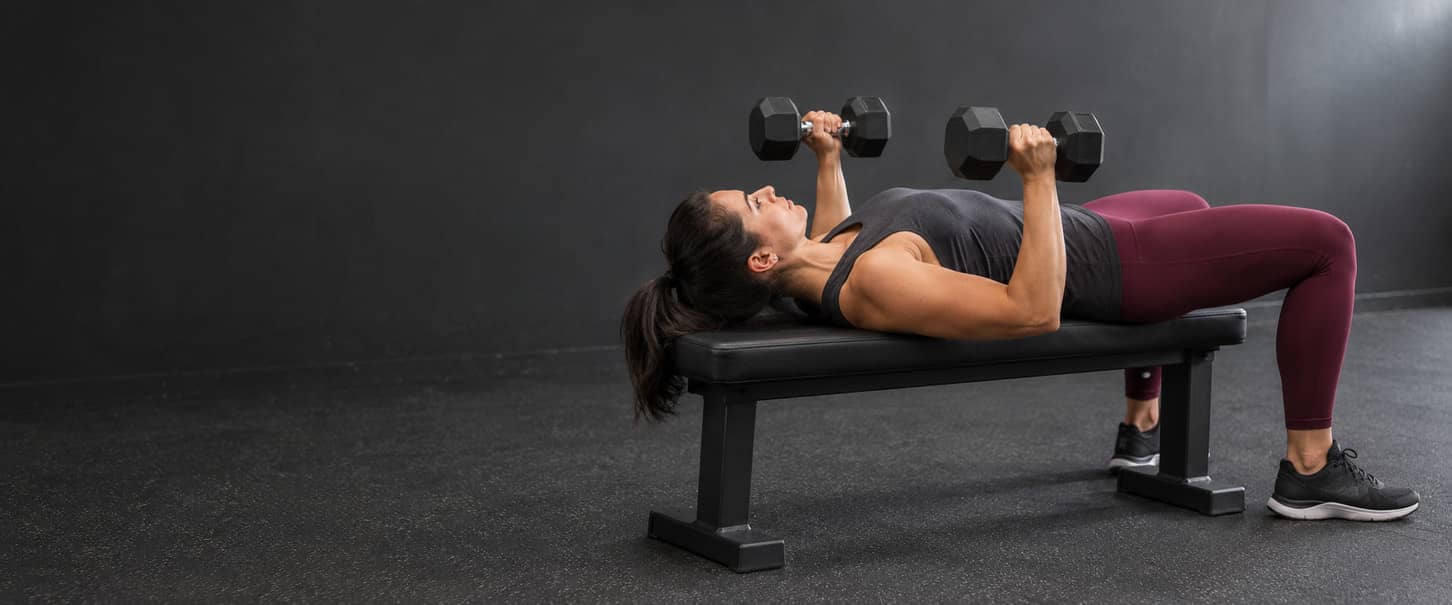
Flat Dumbbell Bench Press
Use a rated flat exercise bench, a matched pair of manageable dumbbells and clear space for the weights. This option removes the shared bar and rack-out, but it adds independent weight handling. Choose the pair by your ability to position and return it as well as your pressing strength.
- Check that the bench is stable and any adjustments are locked. Inspect the dumbbells, including adjustable-weight retention where relevant, and clear the floor around the bench. Plan a controlled entry and set-down, with competent help when needed.
- Sit with the weights controlled close to your body. Rehearse the transition onto the bench with light dumbbells, or arrange a trained handoff. Keep the head, upper back and pelvis supported and the feet stable; do not throw the weights into position.
- Hold each handle with fingers and thumb around it. Let the wrists stay supported over the forearms and choose a comfortable hand orientation. Settle both weights above the chest and shoulder region before beginning the repetition.
- Lower both dumbbells through a repeatable elbow path to a position you can reverse under control. Do not force an extreme flare, a prescribed elbow angle or a deep stretch below the torso.
- Press through controlled independent paths without crashing the weights together, twisting to finish one side or lifting the pelvis. Breathe and reset as needed while preserving the supported position.
- End while the rehearsed return to sitting or assisted set-down remains manageable. Do not force a loaded sit-up, drop the dumbbells or continue to a failed repetition with no controlled exit.
Use a lighter pair when the positioning or set-down limits the exercise. A fitted machine may solve that handling problem more directly. A palms-in grip can be a comfortable choice, but it is not a treatment for shoulder pain or proof that the exercise is safer for everyone. Record the load per dumbbell, the flat bench setup, the grip and the lower endpoint. Keep those features comparable when progressing. A different grip or range may be useful, but do not claim that changing the movement while lifting more proves the original press became stronger.
Machine Chest Press: When Guided Support Solves the Handling Problem
Machine Chest Press
Choose a chest-press station whose seat, back support, handles and permitted starting range fit you. It can remove the need to lift two dumbbells into position, but its mechanism still needs to be learnt. A shoulder-press machine or a chest-fly machine is not the same exercise.
- Read the actual station instructions or ask facility staff to demonstrate its adjustments and return procedure. Set the resistance while the load is resting. Use only the adjustments provided; do not assume every press has the same release pedal.
- Adjust the seat and any permitted start setting so the handles are reachable around chest level without forcing the upper arms far behind you. Check that your feet, pelvis and back can remain supported throughout the intended path.
- Use the machine's assisted-start control only if it has one and you have learnt that procedure. Take full comfortable grips with the wrists aligned over the forearms. Do not pull the handles into reach by twisting away from the backrest.
- Press along the designed path, extending the elbows under control while retaining the body support. Do not thrust with the legs, lift from the pad or force the handles to meet.
- Return steadily to the selected starting position without a stack crash or an uncontrolled backward pull on the shoulders. Use the same manageable range rather than stretching farther as you tire.
- Bring the resistance to rest and follow the station's exit procedure before releasing the handles, standing or changing a setting. Choose another option if the permitted adjustments cannot provide a workable start and finish.
A guided path is useful only when it fits. Do not compensate for an unreachable start by perching off the seat or removing the support that made you choose the machine. Use a lighter setting while learning the movement; no load number is a test of whether the station suits you. Record the exact machine and relevant seat, grip and start settings alongside its displayed resistance and unit. The explanation of gym-machine weight differences explains why displayed loads cannot be transferred directly between machines. The barbell's chest touch point also does not become a requirement to pull machine handles against your chest.
Dumbbell Floor Press: A No-Bench Option With a Different Lower Range
Dumbbell Floor Press
Use two manageable dumbbells and a firm nonslip floor or mat with enough room to position and put down the weights. The floor supports the torso and limits how far the upper arms can lower. That makes this a different press, not a full-range bench press performed without a bench.
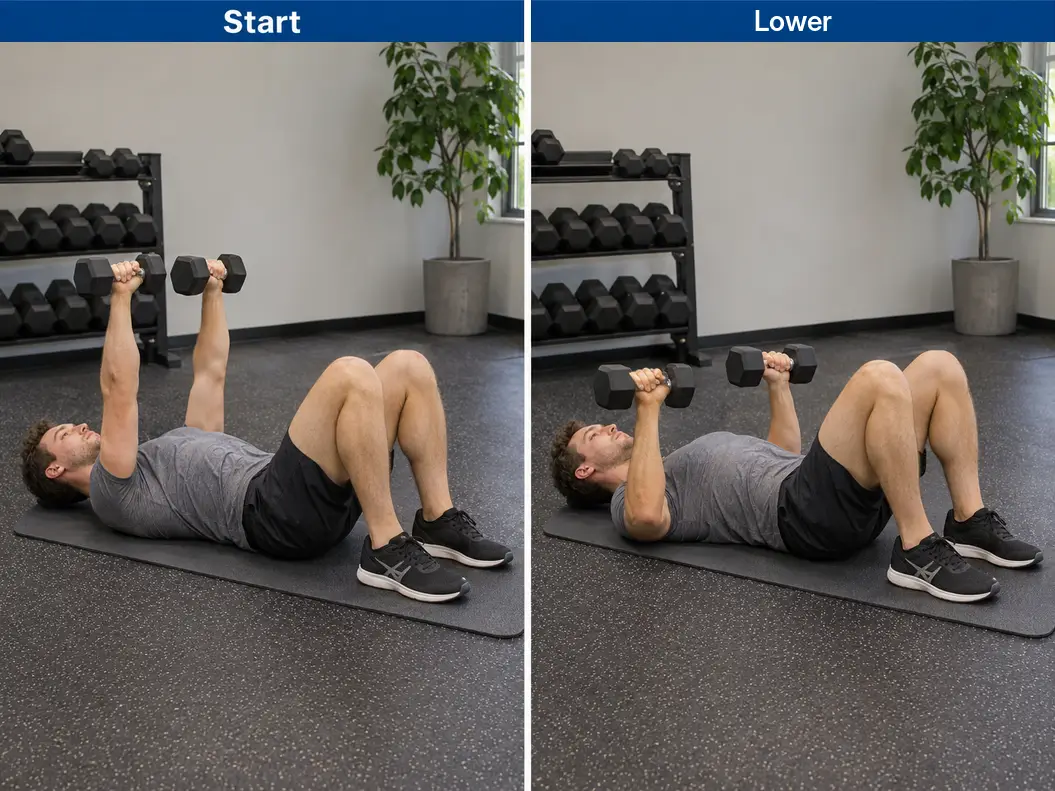
- Arrange a clear floor area and inspect the dumbbells. Sit with a light pair controlled close to the body and rehearse how you will lie back and put the weights down, using competent assistance when needed. Do not start with a heavy awkward pickup while already lying down.
- Settle onto your back with the head, upper back and pelvis supported. Bend the knees and plant the feet. Hold both weights securely above the chest with full grips and wrists supported over the forearms.
- Use a comfortable grip, including a palms-in grip when suitable, and lower through a controlled elbow path. Keep the weights clear of your face and do not let one arm fall faster than the other.
- Stop when the upper arms gently meet the floor, or at an earlier comfortable endpoint. Do not strike the elbows, bounce from the surface or lift the torso to create a deeper descent.
- Press the dumbbells back to a controlled top position while the pelvis stays on the floor. Do not bridge the hips, turn the movement into a fly or crash the weights together.
- Finish before the planned set-down becomes unreliable. Lower and put the weights down through the light-load route you rehearsed, then return to sitting under control. Reduce the load or choose a suitable push-up when that handling cannot be managed.
The floor limit can be useful when a bench is unavailable, but less downward travel is not a guarantee of pain-free pressing. A shorter lower range also changes the strength task; do not use a larger floor-press number as proof that your bench press has improved by the same amount. Use the mass per dumbbell and the actual lower endpoint in your record. The version taught here uses two weights together. With only one dumbbell, choose the taught push-up option or obtain a separately specified one-arm plan rather than silently changing the support and per-side prescription.
Push-Ups: A Pressing Alternative Without a Bench or Dumbbells
Push-Up
Use a firm nonslip floor for the regular hands-and-feet version. Keep enough clear space to lower and rest securely. A knees-down version on the floor, or a higher secure fixed hand support, can reduce the demand when the regular version is not manageable. The picture shows the regular floor version, not every possible regression.
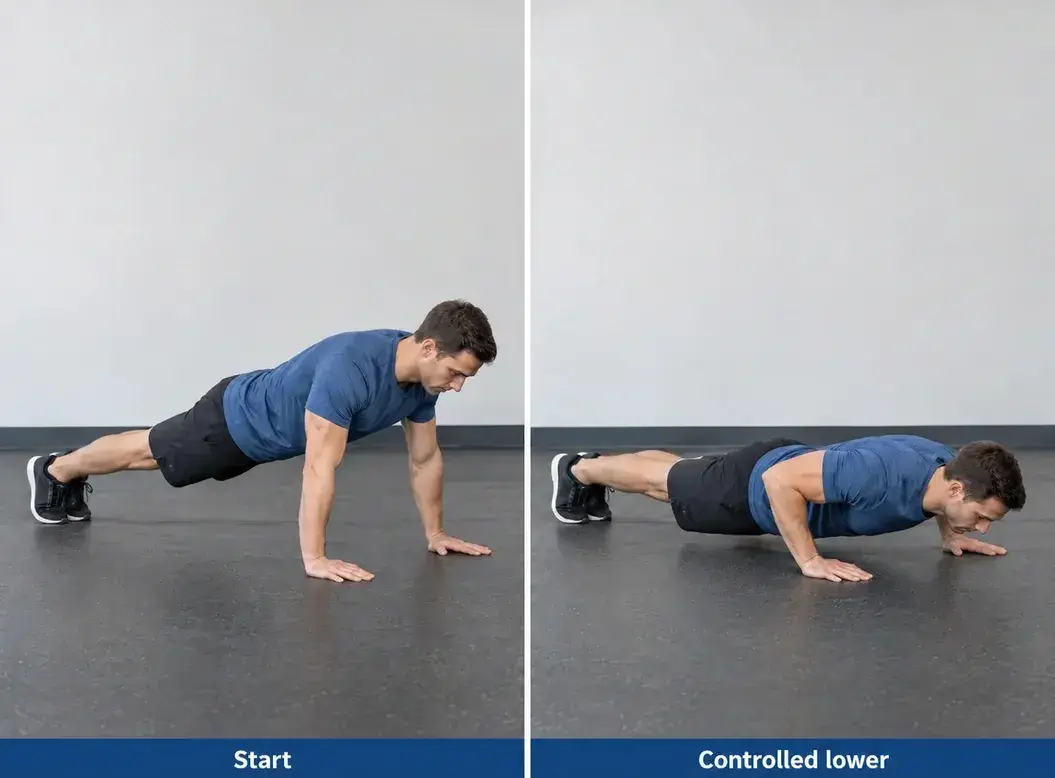
- Begin on hands and knees. Place the hands at a comfortable width, then extend the legs into a supported hands-and-feet position. Keep the head, trunk and pelvis aligned without forcing an exaggerated arch or holding the breath.
- Check that both hands and feet will stay secure and that you can return the knees to the floor under control. If the starting position is already too demanding, use the knees-down version described below or a suitable fixed hand support instead.
- Bend the elbows and lower the chest and trunk together. Let the elbows follow a comfortable path and keep the neck aligned rather than reaching the chin towards the floor.
- Stop at a repeatable depth before the hips sag, shoulder support collapses or the body reaches the floor uncontrollably. Chest contact is not compulsory, and the head must not bear the load.
- Press the floor away so the body rises together. Let the shoulder blades move naturally around the rib cage instead of forcing them into the supported position used on a bench. Keep the hand placement and body line consistent.
- End by returning to a stable top while you can still lower the knees to a supported rest. Stop earlier for lost control or symptoms rather than forcing another repetition to complete a number.
Adjust the support rather than forcing a failed repetition
For a knees-down push-up, keep the hands and knees supported, form a steady line from the head through the hips to the knees, and lower and raise that supported body together. Do not leave the hips folded back while moving only the chest. Use padding that does not slide and return to a comfortable kneeling rest when finished. For hands-elevated work, use an immovable wall or a fixed exercise support intended to bear the load. Place the hands securely, step the feet back to a manageable body angle, and lower and press the body as one unit. Keep your hands on the support while stepping your feet closer until you can stand securely, then release your hands. A higher hand position usually reduces the demand; loose chairs, sofas and rolling dumbbells are not substitutes for a secure support. Choose one version for the planned sets. Build controlled repetitions, then consider a lower secure hand support or another manageable progression. Do not pile loose weights on your back or make the body position increasingly uneven to force more difficulty. If the available version is too easy or too hard for the intended work, change the plan deliberately rather than pretending it matches a heavy bench set.
Understand What Incline Presses, Smith Machines, Cables and Flyes Change
The four complete tutorials cover common bench, rack, handling and no-equipment constraints. Other movements can be useful, but a name in an alternatives list is not enough instruction to perform one. Keep the role, required setup and exit clear before replacing the planned press.
| Option | What it can offer | Why it is not an automatic swap |
|---|---|---|
| Incline dumbbell or machine press | An inclined pressing task when that angle serves the plan | It changes the torso-to-arm relationship and may duplicate incline work already present. |
| Smith-machine bench press | Guided shared-bar travel on a fitted station | It still requires a suitable bench, learnt hooks and safety stops; rail direction and carriage resistance vary. |
| Standing cable chest press | Pressing from compatible outlets without a free-weight bench | It changes body support, balance and handle entry; one outlet is not automatically a two-handle setup. |
| Cable fly or pec deck | Chest-focused upper-arm closing with a relatively stable elbow bend | It does not preserve the repeated elbow-extension task of a press. |
| Parallel-bar dip | A different pressing movement on a purpose-built station | Access, body support and shoulder travel differ; it is not a default remedy for painful bench pressing. |
Use the Incline Bench Press guide for its taught inclined setups, not as instructions for a flat Smith bench. A machine's guided bar does not remove the need to learn its exact catch system, and a Smith station is not a no-bench solution merely because the bar is attached to rails. The cable chest-press instructions teach the site's two-outlet standing version. Follow those instructions rather than fastening two handles to an outlet that was not designed for that use. It is a standing press, not back-supported machine work. The chest exercise selection guide covers the separate fly and dip choices. Do not replace a press with a fly solely because both involve the chest, and do not add an incline press on top of an existing incline allocation without reviewing the complete workout. Choose the change for a specific need rather than collecting more variations.
Example 1: Use the Machine Alternative Already Listed in Upper A
The Upper/Lower Split Workout Plan already offers a machine option for its first exercise in Upper A. The row below is unchanged. It is one row from a seven-exercise workout, not a complete session or a new weekly prescription.
| Exercise | Sets & Reps | Rest | Tempo | Target Muscles | Notes |
|---|---|---|---|---|---|
| Barbell Bench Press or Machine Chest Press | 3 sets of 4–6 reps | 3–5 min | 2-1-X-0 | Chest, Triceps, Anterior Delts | Use safeties or a competent spotter; retain a repeatable touch point and range. |
Choose one option before the working sets
Suppose the planned barbell setup is unavailable, you have not started the pressing work, and you already know how to use a suitable chest-press machine. Choose that source-listed alternative, rehearse its settings and select the resistance on the machine itself. Retain the three working sets, repetition range, rest and tempo when that prescription remains suitable. Do not complete another three barbell sets when the bench later becomes free. The source note's rack, spotting and touch-point instructions apply where relevant to the barbell. On a machine, use its intended supports and return controls and keep a consistent fitted endpoint. Do not pull handles against the chest or invent a rack arrangement for a seated press.
Preserve the actual training rules
For this 2-1-X-0 press, lower for about two seconds, pause for one second at the controlled lower position, then press with purposeful acceleration under control. X describes intent, not guaranteed speed; zero means no deliberately prolonged top pause, not permission to bounce. Take the source's three to five minutes between working sets, with extra recovery when needed to preserve control. Use the source plan's intended effort and double progression. Build acceptable repetitions until all three sets reach six with the intended effort, support and range before considering the smallest suitable increase. A suitable increase is an option after those conditions are met, not an obligation to use the next machine setting. Leave the remaining workout order intact unless the wider plan is deliberately being reviewed. An unfamiliar machine may require an easier introductory session rather than the full strength-biased dose. The published row is not permission to learn an unknown mechanism under demanding resistance.
Example 2: Adapt a Pressing Slot When No Bench Is Available
A no-bench session needs a deliberate choice about the training goal. If the goal that day is general pressing rather than heavy barbell practice, a suitable floor press or push-up can be used with a prescription that fits it. Do not make a push-up awkwardly difficult just to reproduce a four-to-six-repetition target. The following is a separate teaching example for one pressing slot, not the strength-biased Upper A prescription. Choose one row only. The count stays at three sets, but the repetition range, tempo and rest are changed deliberately. Equal set counts do not establish an equal training effect.
| Choose one exercise | Sets & Reps | Rest | Tempo | Effort and setup |
|---|---|---|---|---|
| Dumbbell Floor Press | 3 sets of 8–12 reps | 2–3 minutes | 2-1-1-0 | About 2–3 good reps in reserve; two manageable weights and a controlled floor entry and exit. |
| Push-Up | 3 sets of 8–12 reps | 2–3 minutes | 2-1-1-0 | About 2–3 good reps in reserve; choose one secure floor, knees-down or hands-elevated version. |
Rehearse before the working sets and select resistance or body position that lets the lower target remain controlled. A newer lifter may need less work while learning the setup; three sets is not an obligation. Use straight sets rather than a circuit, and take the stated rest after each working set and before the next exercise, with more recovery when needed. The 2-1-1-0 tempo means lower for about two seconds, pause for one second at the comfortable lower position, press for about one second and use no deliberately prolonged top pause. The floor contact is gentle, not an impact, and a push-up does not need chest contact to satisfy the pause. An estimate of two or three good repetitions remaining refers to the same movement standard; the reps-in-reserve guide explains the limits of that estimate.
Decide whether the available version is actually usable
Suppose the selected hands-elevated push-up gives ten, nine and eight controlled repetitions at the intended effort. That is three working sets and twenty-seven repetitions in this example. Keep the same support and body position while building towards twelve in every set. These are hypothetical results, not a promise that a particular support height will produce them. If the first working set produces only five repetitions at the intended effort, it is still a performed set. Stop and reassess. When continuing remains appropriate, choose an easier secure version for at most the two remaining planned sets, recording the change. Do not erase the first set and perform three new ones. Symptoms or unreliable support mean stopping, not testing another variation. If a version permits twelve repetitions with many more repetitions remaining than intended, its demand is too low for this particular example. Use a manageable harder setup or a different planned press rather than adding endless repetitions or loose weight. A no-bench option that cannot be made suitable is not required merely to fill the slot.
Keep Completed Sets and Progress Each Replacement Separately
A change of equipment does not restart the allocation
For a planned three-set pressing slot, work already completed remains in the record. The examples below assume an equipment or access change, not an instruction to continue after pain or lost control. The remaining work is a limit to consider when continuing is appropriate, not a requirement to finish at any cost.
| Situation in a three-set slot | Work already completed | Replacement work still available | What the record means |
|---|---|---|---|
| Replacement chosen before any working set | 0 sets | Up to 3 suitable sets | One selected exercise occupies the slot. |
| Equipment changes after one working set | 1 set | Up to 2 suitable sets | One plus two gives 3, not a fresh three-set allocation. |
| Equipment changes after two working sets | 2 sets | Up to 1 suitable set | Two plus one gives 3; keep the earlier exercise entries. |
| Both complete three-set options are performed | 3 sets on the first exercise | Another 3 were added | Six sets were performed; this doubled the slot rather than replacing it. |
| Symptoms or an unsuitable setup end the work after one set | 1 set | No further pressing now | Record the incomplete session and address the problem; do not owe yourself catch-up sets. |
Rehearsing a genuinely light setup is preparation. A demanding working set cannot be renamed a warm-up simply because its repetitions missed the target. Keep the actual exercise, load or body position, repetitions and reason for stopping. Keep each exercise's results separate; do not combine sets from different exercises into one personal-best result.
Build a fresh record on the chosen machine
This hypothetical follow-up uses Example 1's machine choice for three sets of four to six repetitions. Assume the same machine, settings, range, tempo and suitable rest throughout, with about two good repetitions remaining when each set stops. That effort choice illustrates this record; it is not a universal machine prescription.
| Machine session | Resistance | Repetitions in sets 1 / 2 / 3 | Next decision |
|---|---|---|---|
| 1 | Initial suitable setting | 5 / 5 / 4 | Keep the setting and build controlled repetitions. |
| 2 | Same setting | 6 / 6 / 5 | Keep it; the third set has not reached six. |
| 3 | Same setting | 6 / 6 / 6 | Consider the smallest suitable increase only if effort, support and range also qualify. |
| 4 | A suitable higher setting | 4 / 4 / 4 | One possible later result; keep this setting and rebuild within the range. |
There is no conversion from the old barbell weight into the first machine setting, and no predicted number of visits between these sessions. If the next increment prevents the lower target or a controlled return, reduce the demand or retain the previous setting. Any working set already attempted remains part of that session's work. For the separate no-bench example, the upper repetition target is twelve, not six. Assess all three sets within that version and its chosen effort before increasing dumbbell load or changing the push-up support. A different machine, range or support position starts a new comparison; a normal resistance increase on the same setup does not require discarding its history.
Know When to Stop and How to Revisit the Barbell
Pain is not a reason to keep trying substitutes
Stop pressing for sharp or worsening pain, persistent tingling, unexpected weakness or loss of control. Settle the resistance securely and seek appropriate assessment rather than cycling through grips, machines and floor presses to diagnose the cause. A comfortable repetition is not a medical clearance or proof that an injury has healed. Seek urgent medical advice for sudden or severe shoulder pain, inability to move the arm, major swelling, a changed shoulder shape, lasting pins and needles or loss of feeling. Follow the appropriate local urgent-care arrangements. These examples are not an exhaustive checklist. Call the local emergency service for sudden chest pain or pressure that does not settle, chest pain spreading to an arm, the jaw or back, or chest pain accompanied by breathlessness, sweating, nausea or light-headedness. Do not assume that symptoms during a chest workout are simply muscle soreness.
Returning to a barbell is a new setup check, not a strength conversion
When the reason for changing was equipment access, return to barbell practice only with a suitable rack, supports, assistance arrangements and controllable load. When health symptoms caused the change, follow the advice relevant to that problem rather than treating success on another exercise as clearance.
- Confirm that the original constraint is resolved and that barbell practice still serves the plan. Use the barbell bench-press instructions for the complete rack-based method.
- Rehearse the unrack, pressing range and rerack with a genuinely manageable bar. Obtain qualified setup help when the equipment or assistance procedure is unfamiliar.
- Select the current barbell load from controlled preparation and the plan's intended effort. Neither the old personal best nor a newer machine record determines it automatically.
- Record the resumed barbell work separately from the alternative. Do not add a second full pressing allocation to catch up for the period spent using another exercise.
Keep the alternative when it continues to serve the goal and fits the complete plan. There is no compulsory date or machine-strength threshold that requires everybody to return to a barbell, and no requirement to make up omitted sets after a disrupted session.
Bench Press Alternatives FAQs
What is the best alternative to a barbell bench press?
Choose by the problem you need to solve. A fitted machine can simplify handling, dumbbells can use a suitable bench without a barbell rack, and a floor press or push-up can work without a bench. None is a universal winner or an automatic substitute for specific barbell practice.
Can I build my chest without barbell bench pressing?
Yes, suitable pressing can train the chest without a barbell. The exercise still needs manageable resistance, consistent execution and appropriate progression within the whole plan. Chest development and performance on a judged barbell bench press are different goals.
Is a dumbbell bench press a no-bench exercise?
No. The flat dumbbell bench press taught here still needs a stable exercise bench. A dumbbell floor press uses the floor instead and has a different lower range. Do not substitute household furniture for the bench.
What can I do with no bench and no weights?
Use a push-up version that provides a controllable challenge on a firm floor or secure fixed support. Choose the body position for the intended work rather than forcing the regular floor version. Do not add loose weight to compensate for an unsuitable setup.
Is the floor press the same as a bench press?
No. The floor limits the upper-arm descent and changes support and handling. It can provide useful pressing, but it does not recreate the bench's lower range or prove the same barbell performance. Keep a separate record.
Is a chest-press machine automatically safer?
No. It may make weight handling simpler, but the station must fit and its controls must be understood. Unreachable handles, damaged equipment or a path that cannot be controlled are reasons to choose something else, not to force the machine.
Can I replace the bench press with a pec deck or cable fly?
A fly changes the movement by keeping the elbow bend relatively stable rather than repeatedly extending the elbow. Use it when a fly role belongs in the plan, not as an unchanged pressing substitute merely because it trains the chest.
Does a Smith machine solve the lack of a bench or spotter?
It still needs a suitable bench and a properly learnt hook and safety-stop arrangement. Guided travel is not permission to ignore setup or rely on an improvised escape. It also uses a different resistance system from a free bar.
Should I use the same weight on the replacement?
No automatic conversion applies. Record total bar mass, per-dumbbell mass, the exact machine setting or push-up position as appropriate. Rehearse and select the new demand on that exercise rather than copying a number.
Should the replacement use the same sets and repetitions?
Keep an existing source-listed option's prescription when it remains appropriate. A different task may need a deliberate change, as in the separately labelled no-bench example. Preserve the work already completed and do not present an altered prescription as unchanged source wording.
What if I have already performed one of three working sets?
Keep that set in the record. When a change of equipment is appropriate and continuing remains suitable, at most two planned sets remain. Do not perform a fresh three-set allocation, and do not continue pressing when symptoms or loss of control require stopping.
Which alternative should I choose for shoulder pain?
This guide cannot diagnose the cause or prescribe a pain-free replacement. Stop the painful exercise and obtain appropriate advice, urgently when the symptoms warrant it. A neutral grip, floor limit or machine is not a treatment or a test that clears you to continue.