
Choose the Job Before Replacing the Machine
A useful leg-extension alternative must fit the job you need to replace. If you want seated knee straightening with little hip movement, a securely fitted ankle weight can supply resistance without a leg-extension machine. It needs a suitable training seat, a controllable cuff and enough clearance to move and put the foot down. A squat is another way to train the quadriceps, but it adds a different hip, trunk and support task. This guide teaches the ankle-weight setup from sitting down to removing the cuff. It then works through a specific two-set machine slot, an explicitly chosen per-leg adaptation, a weight increase that proves too large and records that change when the seat, cuff or range changes. Keeping existing compound work, retaining a suitable machine or leaving an unsuitable slot unperformed are usable choices. The equipment and load examples are hypothetical, not recommended starting weights, client results or a clinical trial of this complete process. This is general adult exercise information. An injury, recent surgery or an individual clinical restriction needs appropriate personal guidance; this page does not prescribe rehabilitation or establish that a movement is suitable for a particular knee.
Compare Knee-Extension Options and Their Limits
Start with the reason for changing the exercise: the machine is unavailable, its geometry does not fit, or you want a broader quadriceps movement. Equipment access and symptoms require different decisions. If pain is the reason, stop the painful work and use the assessment guidance later in this article rather than treating a new exercise as a diagnosis or cure.
| Choice | Movement task | Equipment and support | Useful when | Limit or next choice |
|---|---|---|---|---|
| Seated ankle-weight knee extension | One knee straightens while the thigh and pelvis stay supported. | A purpose-designed securely fastened ankle weight and a stable training seat or bench that fits the complete movement. | Direct knee-extension work is wanted and a permitted cuff mass fits the intended repetitions and effort. | The cuff range, increments or seat may not fit. Use the taught check before choosing this option. |
| Retain a fitted leg-extension machine | Seated knee extension against the station mechanism. | A suitable machine with usable seat, knee-axis, pad and range adjustments. | The available machine fits and its resistance is manageable. | Retaining the machine is valid; a different machine needs its own settings and load record. |
| Keep or select suitable compound quadriceps work | Knee and hip movement together, with the support and handling demands of the chosen squat or press. | The actual equipment and complete technique for that compound exercise. | The goal is broader leg work and the whole programme supports that choice. | It does not reproduce an isolated extension slot. Check existing squat and split-squat work before adding anything. |
| A purpose-designed band or cable setup | Depends on the actual arrangement, direction of pull and support. | Verified compatible cuff, resistance, anchor or pulley, seat and complete manufacturer-supported setup. | The real equipment supplies a complete taught arrangement and manageable resistance. | A band, ankle strap or low pulley alone is insufficient. This guide does not supply a generic anchor arrangement. |
| Leave this slot unperformed | No replacement work is added. | No extra equipment is needed. | No suitable setup, load, handling or symptom-free movement is available today. | Record the omission and reconsider the next session; there is no compulsory later catch-up. |
The Leg Press Alternatives guide covers the different task of replacing a compound press. A goblet squat, split squat or another press may be useful in a complete plan, but naming the quadriceps does not make every choice the same exercise. The worked Lower B session below already contains substantial compound work before the extension slot. A reverse Nordic or sissy squat has its own support, balance, range and loading demands. Neither is an automatic beginner substitute or a required next step after ankle weights. Do not trap a loose dumbbell between the feet, tie a band to improvised furniture or assume a door, bench leg or another person is an appropriate anchor. No paid app, supplement or download is needed to use the choices taught here.
Do Seated Knee Extensions With an Ankle Weight
Seated Ankle-Weight Knee Extension
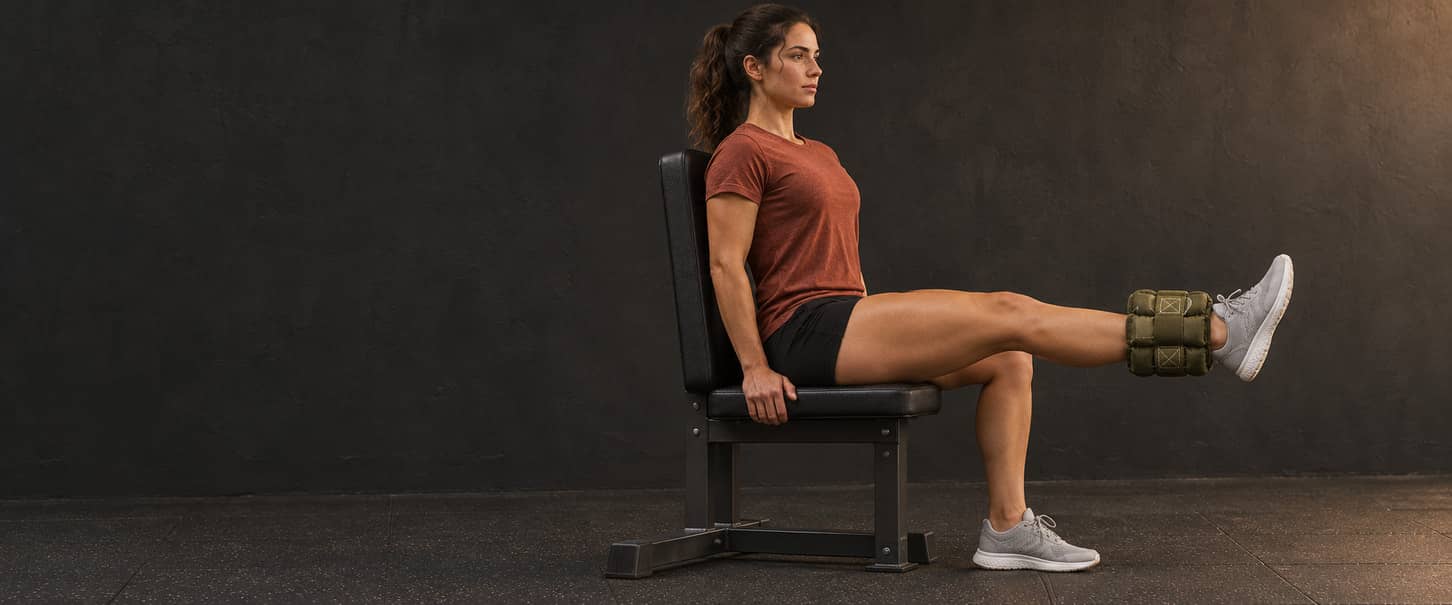
Use one purpose-designed ankle weight with an intact fastening and fully retained contents. Choose a stable purpose-built training seat or bench, on a firm nonslip floor, whose permitted seated use, load limit and locked adjustments suit you. For the version taught here, the backrest supports the back, the seat supports the pelvis and thighs, both feet can rest on the floor before starting, and the working knee and lower leg clear the seat and frame. No universal bench height or backrest angle establishes that fit. Inspect and rehearse the actual arrangement without the cuff first. You must be able to reach, fit and remove it while securely seated with the foot resting; obtain suitable assistance for that handling if needed. If the seat, cuff or reachable removal does not fit, use another suitable arrangement or leave the slot unperformed. A photograph cannot certify the fit of your equipment.
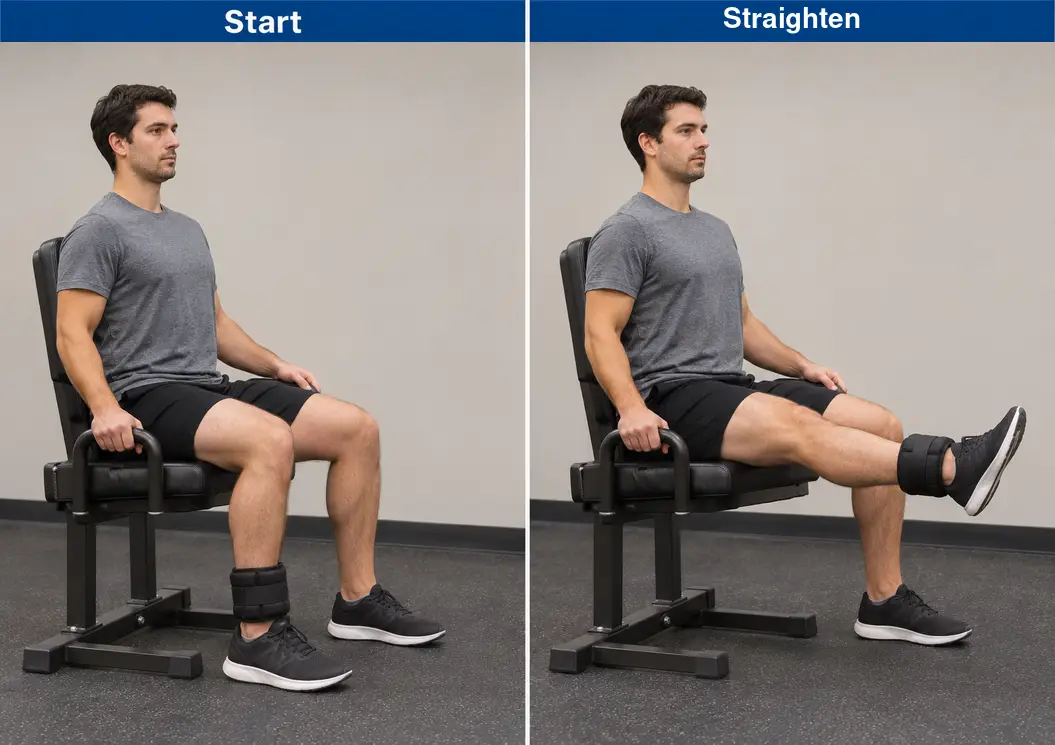
- Check the seat, backrest, feet, pins and locks under the equipment instructions. Clear the space in front and beside you. Inspect the cuff and any removable-weight pockets, confirm the stated mass for ONE cuff and keep only permitted inserts securely enclosed. Put the cuff within easy seated reach.
- Sit down without the cuff attached. Settle the pelvis and back against their supports, with the thighs supported and the knees clear of the seat edge. Rest both feet on the floor. The seat must stay still without rocking, sliding or pressure from an edge behind the working knee.
- Practise a few easy repetitions on each leg without added weight. Keep the thigh in place while straightening and bending the knee through a comfortable controllable range, then return the foot to the floor. Check clearance for the foot and the future cuff as well as a reliable normal finish; this rehearsal is not a demanding extra set.
- With the foot resting on the floor and the body securely seated, fasten the cuff around the lower leg above the ankle as its instructions require. Keep it snug enough to stay in place without painful pressure, tingling or numbness. Close every fastening and weight pocket fully. Do not hold a loose weight with the foot or add unsecured objects to the cuff.
- Keep the other foot planted and the working thigh supported. Rest the hands on suitable fixed seat surfaces, clear of adjustment parts; do not push on the knee to force a position. Begin from the comfortable bend checked in rehearsal, without sliding forward, lifting the thigh or leaning back to lift the weight.
- Straighten the working knee smoothly, taking about one second in the worked prescription below. Lift the lower leg while the thigh and pelvis remain in place. Finish within the repeatable range you can control, without snapping into a hard lock, forcing the leg horizontal or swinging the foot higher.
- Hold the controlled upper position for about one second in this prescription. Keep the cuff secure, the back supported and breathing comfortable. Do not rotate the foot to chase a particular quadriceps head or hold a prolonged maximal breath to complete the repetition.
- Lower the foot under control for about two seconds to the chosen starting bend, keeping it clear of the frame. Pause for about one second before the next repetition. Use the same endpoints without a kick, rebound or progressively shorter return; put the foot down deliberately when ending the set.
- Continue only while the chosen range, support and effort margin remain available. For the normal worked sets, finish with about two further good repetitions in reserve. A work set that ends below its target still counts as performed work; do not force another repetition to rescue the number.
- After the last controlled return, rest the foot fully on the floor. Keep it supported while loosening and removing the cuff, and place the cuff where it is secure and reachable without becoming a trip hazard. Change inserts only with the cuff removed and fully supported, then reclose it as directed. Do not stand or walk with it attached as part of this tutorial.
- Take the chosen rest, fit the cuff to the other resting leg and mirror the setup when that side is still suitable to train. Follow the recorded side order and remaining allocation rather than restarting both sides. After the final side, remove the cuff with the foot resting, settle both feet on the floor and stand using the seat's normal controlled exit. If symptoms occur, stop instead of completing the other side to make the record match.
The Leg Exercises machine tutorial remains the parent instruction for a fitted leg-extension machine. The cuff version uses gravity acting on the lower leg and cuff; its resistance changes through the arc and is not a replica of every machine. A cuff that is secure and manageable for one person can be too light, too heavy or the wrong shape for another.
Make the Cuff, Seat and Range Repeatable
A useful record identifies the actual cuff and seat, the mass of the one cuff being moved, its position above the ankle, the working side, range, repetitions, rest and effort. Record an adjustment instead of trying to recreate an unrecorded old setup from memory. The machine stack you used previously does not tell you which cuff mass to choose.
| Setting | Keep comparable | Meaningful change | Usable next choice |
|---|---|---|---|
| Cuff identity and retention | The same intended cuff, stated mass and fully secured contents. | Another cuff, uncertain label, loose insert, damaged fastening or a bulky shape that interferes with the movement. | Verify the actual item and permitted use; leave an unknown mass unknown and replace unsuitable equipment before working. |
| Cuff position | A secure repeatable position above the ankle under the product instructions. | Moving the cuff farther up the shin or allowing it to slide during the set. | Refit only with the foot resting and cuff unloaded; record a deliberate position change rather than claiming equal resistance. |
| Seat and body support | Supported back, pelvis and thighs; nonworking foot planted; knee and cuff clear of the seat and frame. | A deeper seat, different backrest, slipping pelvis or loss of foot contact. | Check fit without added weight and use a suitable seat; do not prop furniture on loose objects or force the old settings. |
| Movement and effort | The intended bend and upper endpoint, controlled tempo and about two good repetitions in reserve for normal work. | A shorter return, swinging lift, new thigh movement or an unrecorded effort margin. | Reduce or omit work when needed and establish an honest comparable record; do not fill missing details with estimates presented as facts. |
Cuff mass is only one part of the resistance. Its distance from the knee, the lower leg's position and the movement range also matter. A one-kilogram cuff is not one kilogram of knee-joint force, and adding half a kilogram does not specify a percentage change in joint stress, growth or safety. Read why gym machine weights differ when moving between a cuff, a leg-extension station or another machine. Keep each equipment history identifiable. A normal increase on the same suitable cuff arrangement can remain in the same history; a changed seat, cuff position or range must be labelled.
Check a Repetition Before Adding Resistance
The useful question is whether the whole set repeats the movement you intended, including the normal finish and cuff removal. An optional competent observer or permitted video may help you notice changes, but neither a recording nor an app is required. An observation is a training note, not a diagnosis.
- Check that the cuff stays fastened and clear of the seat and frame, with no loose or escaping contents. Stop to resolve a slipping cuff with the foot resting; do not hold it in place during a working repetition.
- Watch the thigh, pelvis and back. The knee straightens while these supports remain organised; a higher foot caused by lifting the thigh or leaning back changes the movement.
- Compare both endpoints and the controlled return. Do not count a shortened or kicked repetition as success at the earlier controlled range, and do not force the endpoint to match a drawing or photograph.
- Record each side's actual cuff mass, repetitions and rest. A demanding first left set followed by lighter work must remain a mixed-load record, not a total assigned to the heaviest cuff.
- Estimate how many more GOOD repetitions were available at the same range, support and control. Finish before those conditions deteriorate; do not test failure to validate the estimate or count an assisted lift as independent success.
The reps-in-reserve guide explains this approximate effort estimate. About two good repetitions in reserve is this guide's normal implementation within the source plan's broader isolation guidance. If the lightest cuff is already too demanding, a no-added-weight movement may be useful practice, but it is not automatically the same loaded work. If the permitted maximum is too easy, do not invent an overload attachment to force the target.
Use the Existing Lower B Extension Slot
In the Upper/Lower plan's exercise breakdown, Leg Extension is FIFTH of seven exercises in Lower B. It follows two deadlift sets, three secondary squat or leg-press sets, two split-squat or reverse-lunge sets per leg, and three leg-curl sets. The next exercises are three seated-calf sets and two trunk sets. This is a small late-session slot, not permission to add another complete leg workout. The following row reproduces the source prescription. Its note refers to the machine; the ankle-weight and per-side choices below are this guide's authored adaptation and do not alter that quotation.
| Exercise | Sets & Reps | Rest | Tempo | Target Muscles | Notes |
|---|---|---|---|---|---|
| Leg Extension | 2 sets of 12–15 reps | 60–120 sec | 2-1-1-1 | Quadriceps | Use a pain-free machine setup and controlled knee extension. |
The authored one-leg implementation
For the worked cuff example, choose TWO normal working sets of 12–15 repetitions on EACH leg, with about two good repetitions in reserve. Use one suitable cuff and perform left set 1, right set 1, left set 2, right set 2. Rest 60–120 seconds AFTER EACH SIDE before starting the next side. The examples use 90 seconds; if changing the cuff takes longer, record the actual rest rather than rushing its fit. This is four separately performed bouts and takes longer than two simultaneous bilateral machine sets. The selected 2-1-1-1 tempo means a controlled two-second lowering, a one-second pause at the chosen bend, a one-second straightening and a one-second controlled upper pause. It does not require a forced lock or an endpoint outside your manageable range. Keep the source's progression principle: all the normal sets must meet the upper repetition target with comparable effort, range, tempo, setup, handling and rest before a suitable smallest practical increase. With this chosen shared-cuff prescription, BOTH sets on BOTH legs must qualify. No mandatory second qualifying appearance or calendar increase is added. Use genuinely easy preparation to check the new movement. The source row does not prescribe a separate introductory one-set week, and this guide does not add one. You may stop with less work performed when that is the appropriate choice; a short or incomplete exposure is not qualification of four normal side sets. Choosing this adaptation is a deliberate programme decision, not an automatic conversion of any two bilateral sets into two sets per side. The earlier curl row still trains knee flexion. Leg Curl Alternatives addresses that separate slot; the seated straightening movement here does not replace it. If the whole Lower B session, the late-slot fatigue or the added setup time makes cuff work unsuitable, retain a workable original choice or omit the extension slot and review the complete plan.
Read All Four Sets Before Increasing the Cuff
This independent hypothetical person has completed easy preparation and selected the cuff adaptation above. Each record is one Lower B appearance, not a promised week. The same fitted seat, cuff position and manageable range are used, with the written 2-1-1-1 tempo and 90 seconds after each side. Except for the expressly identified demanding set, the recorded working repetitions leave about two good repetitions in reserve. The mass is for the ONE cuff on the working leg. The four entries in the mass column are left set 1 / left set 2 / right set 1 / right set 2; the actual performance order remains left 1, right 1, left 2, right 2. The first cuff setting is an illustrative one kilogram, not a recommendation. This person's intact adjustable cuff permits one- and one-and-a-half-kilogram settings, with no smaller permitted increase between them.
| Lower B record | Cuff kg: L1 / L2 / R1 / R2 | Left reps: set 1 / set 2 | Right reps: set 1 / set 2 | Performed reps: left + right | Decision |
|---|---|---|---|---|---|
| A1 | 1 / 1 / 1 / 1 | 13 / 12 | 12 / 12 | 25 + 24 = 49 | Retain the setting; the four sets have not reached 15. |
| A2 | 1 / 1 / 1 / 1 | 15 / 15 | 15 / 14 | 30 + 29 = 59 | Right set 2 is 14, so the shared increase does not qualify. |
| A3 | 1 / 1 / 1 / 1 | 15 / 15 | 15 / 15 | 30 + 30 = 60 | All four sets qualify under the stated conditions; consider the smallest suitable permitted increase. |
| A4 | 1.5 / 1 / 1 / 1 | 10 / 14 | 15 / 14 | 24 + 29 = 53 | The first left set at 1.5 kg leaves about one good repetition in reserve. It counts; the remaining suitable sets use 1 kg. |
| A5 | 1 / 1 / 1 / 1 | 15 / 15 | 15 / 15 | 30 + 30 = 60 | This person chooses a full return to the known setting. It is not a universal reset rule. |
| A6: possible later result | 1.5 / 1.5 / 1.5 / 1.5 | 12 / 12 | 12 / 12 | 24 + 24 = 48 | Hypothetical only: if a later suitable attempt produces these controlled sets at the intended margin, retain this setting and build repetitions. |
At A4, the ten-repetition first left work set uses one of that side's two bouts even though it misses the 12-repetition lower target and the intended effort margin. With no symptoms and handling still sound in this example, the person rests, removes the cuff with the foot supported and selects the permitted one-kilogram setting. Right set 1 then records 15, left set 2 records 14 and right set 2 records 14. Only ONE left bout and TWO right bouts remained after the first left set. Stopping instead was also valid. The combined 53 counts repetitions performed across different sides and loads; it is not 53 repetitions at 1.5 kg, an equal-stimulus score or a successful four-set qualification. A3 stays in the history. A5 is this person's chosen return, not a compulsory extra qualifying session or deletion of the earlier result. A6 is a possible future outcome, not a promised response to repeating A5 or an instruction to try the heavier cuff on a particular date. The cuff increase is 1.5 − 1 = 0.5 kg, and 0.5 ÷ 1 × 100 = 50% of the stated external cuff mass. It is not a 50% increase in total leg mass, joint force, effectiveness or risk. A small-looking absolute change may still be unsuitable. Retaining 1 kg is valid. A genuinely available suitable smaller increment could be considered after checking that equipment; do not create one with unsecured inserts, added objects or an incompletely closed pocket. If the available cuff can no longer provide appropriate work, reconsider the exercise rather than inventing a universal progression ladder.
Keep Equipment Changes Out of the Old Comparison
These four situations are independent examples, not later stages of A6. Keep an unknown measure unknown and identify the conditions that changed. A useful next action does not require recreating an old number at any cost.
| Independent situation | What is actually known | What it does not show | Usable next action |
|---|---|---|---|
| Only a much heavier cuff is available | The known arrangement used a 1 kg cuff; the only available intact cuff is marked 3 kg. | A tripled cuff mass is not a known equivalent machine load or a suitable next step. | Retain a usable machine, use an independently suitable arrangement or omit the slot. Do not test the heavy cuff to failure or attach loose objects to create another setting. |
| The old seat is unavailable | A different training seat has a deeper pad; the person cannot keep back support and clear the knee at the same time. | Matching the old cuff mass does not establish that this seat fits. | Check a different suitable seat without added weight. If fit remains unavailable, postpone this version; do not slide to an insecure edge or improvise a platform. |
| The cuff mass or position was not recorded | An older note says only “ankle weight”; neither the item nor its position is identifiable. | The current label or a guessed memory cannot measure the earlier load or resistance. | Identify and record the actual current cuff and fit. Start a labelled comparison from known conditions instead of inventing the missing old number. |
| More repetitions came from less range | Both sides recorded 15 / 15 with a shorter return, and the earlier effort margin is unknown. | 30 + 30 = 60 repetitions does not qualify the old range or establish its effort. | Use a manageable recorded range without forcing depth. A separate hypothetical restored-range result of left 12 / 12 and right 12 / 11 is 24 + 23 = 47 repetitions across four bouts, not failure to recover the shorter-range 60. |
Ordinary repetition changes can occur without an equipment change. The guide to reps dropping between sets helps interpret the record without turning a lower second set into permission for extra replacement sets. Keep actual rest and side order visible, and do not explain every change as injury, poor effort or loss of muscle. A known label of “2 × 1 kg” describes two one-kilogram cuffs; it does not make each cuff two kilograms. A label that gives only an unclear pair total needs checking. The workout record should identify the mass actually worn on the moving leg, not add both cuffs together or guess from their colour.
Count Each Working Side Once
For the deliberately selected two-set-per-leg cuff adaptation, a working bout is one continuous set on one side. Two sets of 12 on the left give 24 left repetitions; two sets of 12 on the right give 24 right repetitions. That is 48 combined repetitions across FOUR separately performed bouts. It is not four bilateral sets and does not measure equal muscle stimulus. Use the remaining-work ledger only while the movement, equipment and symptoms still permit further suitable work. “At most” is a ceiling within this chosen allocation, not a requirement to finish every row.
| Point in the selected slot | Left bouts done | Right bouts done | At most left remaining | At most right remaining |
|---|---|---|---|---|
| Before working sets | 0 | 0 | 2 | 2 |
| After the first left working set | 1 | 0 | 1 | 2 |
| After one working set on each side | 1 | 1 | 1 | 1 |
| After both working sets on each side | 2 | 2 | 0 | 0 |
A first left work set of five repetitions still counts as one left bout, even if the target was 12–15. Calling it a test, changing the cuff or shortening the next set does not erase it. One original left bout plus a fresh four-bout restart is FIVE bouts, including three on the left. Four original side bouts plus four replacement bouts is EIGHT, not four. If you keep the original machine version and perform its two sets with both legs together, its separate bilateral ledger is 0 + 2, 1 + 1, 2 + 0. Do not automatically translate a partially completed bilateral slot into a fresh or mechanically equivalent per-leg allocation. Two machine work sets followed by four new cuff side sets are SIX performed bouts and additional work, not a relabelled two-set slot. Decide a suitable remaining plan explicitly or stop and organise the next exposure. Genuinely easy preparation remains preparation; a demanding five-repetition trial is work. Symptoms after one left set mean stop, not a duty to catch the right side up. The workout-set counting guide keeps performed bouts, prescribed sets and muscle exposure distinct. An incomplete side record can be honest without becoming future debt.
Fit the Choice Around the Rest of the Week
Use the complete plan's schedule and workload, including the work before this slot. The source example uses Upper A on Monday, Lower A on Tuesday, Upper B on Thursday and Lower B on Friday. Wednesday and the weekend provide nonlifting days in that arrangement. Upper training is still training, even when it separates lower-body sessions. Keep recovery between repeated lower sessions and across the week boundary; additional recovery may extend the cycle rather than preserve four sessions in every seven days. For the arithmetic below, select separately performed split squats in Lower B's third row, a bilateral leg curl, bilateral seated calf raises and hanging knee raises for the trunk row. These are explicit counting choices. A per-side Pallof press or another implementation needs its own stated count; do not silently reuse this total.
| Selected Lower B illustration | Extension slot | Written set numbers across seven rows | Separately performed working bouts |
|---|---|---|---|
| Fitted machine version | 2 sets with both legs together | 2 + 3 + 2 per leg + 3 + 2 + 3 + 2 = 17 written sets | 2 + 3 + 4 + 3 + 2 + 3 + 2 = 19 bouts |
| Authored cuff adaptation | 2 sets on each leg | 2 + 3 + 2 per leg + 3 + 2 per leg + 3 + 2 = 17 written sets | 2 + 3 + 4 + 3 + 4 + 3 + 2 = 21 bouts |
The identical written total hides two extra separately performed bouts in the cuff adaptation. It does not establish identical time, effort, quadriceps stimulus or recovery. The first four rows already account for 2 + 3 + 4 + 3 = 12 bouts under these explicit choices. Substituting another squat after them adds a compound task to a session that already contains one; it is not an automatic way to preserve isolated knee-extension work. Suppose those first 12 bouts are completed and time runs out after the first left cuff set. Thirteen bouts have been performed. At most one left and two right cuff bouts, three calf bouts and two trunk bouts remain: 3 + 3 + 2 = 8 unperformed, and 21 − 13 = 8. They are not a debt to append to the next session. If symptoms caused the stop, assessment takes priority over finishing the arithmetic. The missed-workout guide covers broader interrupted-session decisions. Keep the current record, resume an appropriate schedule and adjust the next exposure if needed. Do not restart the entire Lower B session, add an automatic extra extension day or turn every unavailable-machine day into a longer leg workout.
Stop, Reassess and Return Without Catch-Up
Muscular effort and ordinary post-exercise soreness differ from joint pain, a cuff causing tingling or numbness, or a sudden change in movement. Stop the exercise when pain or concerning symptoms appear. Remove the cuff with the foot supported if you can do so safely; do not continue experimenting with loads or forcing the other side to match. Persistent or recurring pain, or symptoms affecting normal activity, warrant professional assessment. Seek urgent medical advice for a painful joint that is hot and swollen, for joint pain with fever or feeling generally unwell, or for a badly swollen knee, severe knee pain or inability to move it. These signs do not all have to occur together. Get immediate medical help if you cannot walk or put weight on the joint, if it has moved out of place, if severe joint pain follows a fall or injury, or if there is new tingling or loss of feeling around the joint after an injury. Get emergency help for severe breathing difficulty, fainting during exercise, sudden persistent chest pain, pain spreading from the chest, or chest pain with sweating, nausea, light-headedness or breathlessness. Other chest pain still needs medical assessment. Use the appropriate local urgent or emergency service, and do not use this guide to diagnose the cause.
- Keep the completed work and the reason for stopping in the record. Unperformed work is not owed to the other side or the next session; do not relabel a demanding attempt as a warm-up.
- Resolve the actual obstacle: equipment condition, seat fit, cuff handling, available resistance, time or symptoms. Obtain appropriate professional guidance for injury or persistent symptoms; no repetition test here provides rehabilitation clearance.
- When resuming is appropriate, check the complete setup and normal exit with manageable preparation. Choose suitable work for the present conditions and label changes in cuff, support, range or allocation instead of claiming an unchanged old performance.
- Finish the planned suitable work or stop again when needed, then record the result. Retaining a known setting, using another genuinely workable choice or leaving the slot out remains valid; no calendar or earlier total requires an increase.
Equipment support reduces some practical demands but does not guarantee suitability or prevent injury. A secure cuff and a clear tutorial do not replace individual advice when symptoms or clinical needs change the decision.
Leg Extension Alternative FAQs
What can I do instead of a leg extension without a machine?
A seated knee extension with a securely fitted purpose-designed ankle weight is the direct alternative taught here. It needs a suitable training seat, manageable resistance, repeatable range and a reliable way to fit and remove the cuff. Keeping existing compound quadriceps work or leaving an unsuitable slot unperformed may be more useful than adding another exercise.
Does this ankle-weight version need a bench or seat?
Yes. This version uses a stable purpose-built training seat or bench with suitable back and thigh support, knee clearance and both feet able to rest on the floor before starting. Its permitted use and locked settings must suit the person. Do not assume an arbitrary stool, folding chair, furniture stack or bench leg used as an anchor meets those conditions.
Are squats the same as leg extensions?
Squats combine knee and hip movement and introduce their own support, trunk and handling demands. They can train the quadriceps but do not reproduce every part of seated knee-extension work. If the plan already includes squats, presses and split squats, another compound exercise is not an automatic replacement for a small late isolation slot.
Can I hold a dumbbell between my feet?
Do not use a loose foot-trapped dumbbell for this method. The taught resistance is an intact cuff designed to fasten securely around the lower leg, with its contents retained and its use permitted. No available cuff means choosing another workable option or leaving the slot out, not improvising a grip with the feet.
Can a resistance band or cable replace the machine?
A suitable purpose-designed arrangement may provide resisted knee extension, but the actual compatible cuff, pull direction, support, anchor or pulley and full entry and release must be established. Owning a band or low pulley alone does not supply those details. Follow the actual supported setup; this page does not prescribe a generic door or furniture anchor.
Are reverse Nordics or sissy squats compulsory alternatives?
No. They have their own demands and are not automatic beginner options, guaranteed knee-friendly choices or a required progression from seated work. Choose an exercise because its complete setup, range, load and role fit the programme, not because it appears later on a ladder.
How many sets should I perform on each leg?
The worked adaptation deliberately selects two normal sets of 12–15 on each leg, with 60–120 seconds after each side. That is four side bouts within one selected extension slot. The quoted Upper/Lower source row itself says two sets and refers to a machine; the per-leg allocation is this guide's implementation, not a universal conversion rule.
When should I increase the ankle weight?
For this shared-cuff example, both normal sets on both legs must reach 15 at the intended effort and comparable range, setup, tempo, handling and rest. Then consider the smallest suitable permitted increase. Qualification does not require using an unsuitable jump, repeating a mandatory extra qualifying session or increasing on a calendar date.
What if the first set with a heavier cuff is too difficult?
It remains performed work. End the set under control, rest the foot and remove the cuff before making a permitted change. If continuing is suitable, use only that side's remaining allocation with a manageable setting; stopping is valid. Do not add a fresh two-set block to erase the attempt, and stop for symptoms instead of catching the other leg up.
What if the available ankle weights are all too light or too heavy?
Retain a workable setting, use a genuinely suitable different setup or reconsider the exercise within the full plan. No added weight can be useful practice when appropriate, but it does not automatically reproduce the loaded prescription. Do not exceed the cuff's limits, leave pockets partly open or attach loose weights to manufacture resistance.
Can I compare the cuff kilograms with the machine stack?
Keep separate identifiable records. A cuff, its distance from the knee and gravity through the movement create a different resistance arrangement from a machine mechanism. Cuff mass or a stack label alone does not measure knee-joint force, equal training stimulus or a safe conversion.
Do I need to make up a skipped set or a missed extension day?
No automatic catch-up is required. Keep the completed bouts in the record and choose the next suitable session within the complete schedule. Time, equipment and symptoms can justify less work; a missed number does not require a restart, an extra lower-body day or forced matching-side work.