
Choose Rear Delt Exercises That Fit Your Workout
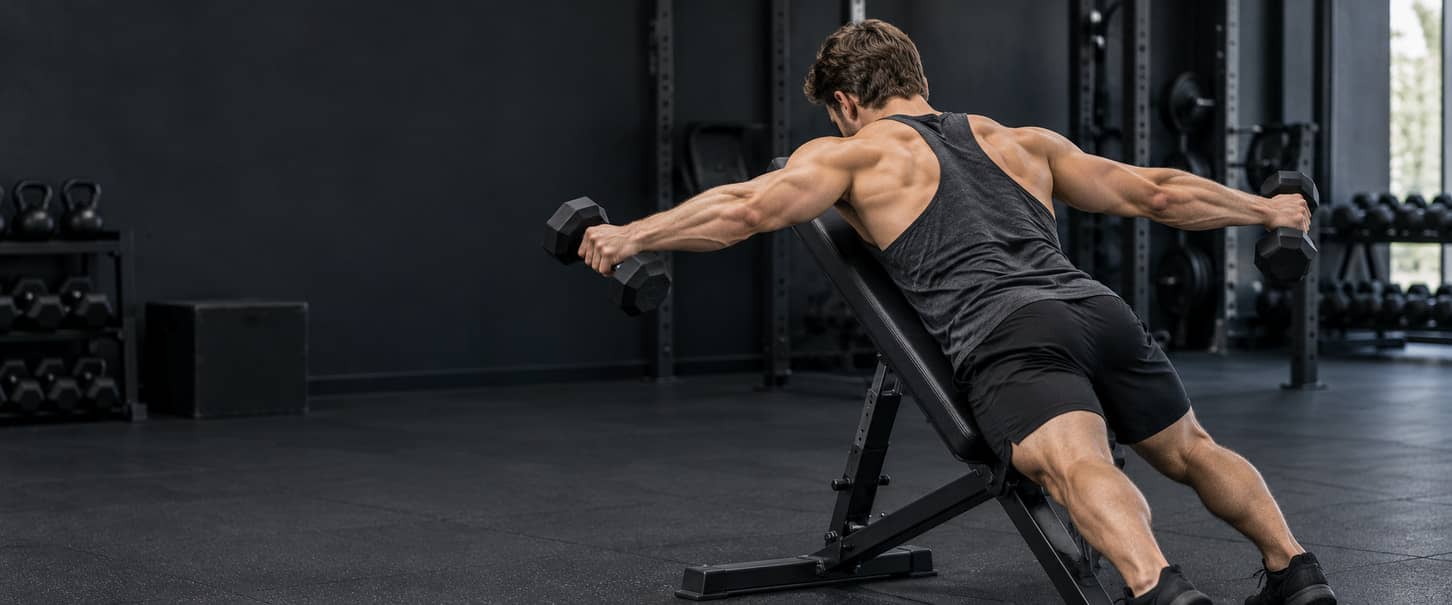
For direct rear-delt work, start with a reverse-fly option you can control: a fitted reverse pec deck, a single-arm cable fly, or a chest-supported dumbbell reverse fly. Use the bent-over dumbbell version when no bench is available and the hinge remains steady. A more-open row is useful when you need that rowing task, not simply because it lets you lift a heavier weight. The rear delts move the upper arms; the shoulder blades and upper-back muscles also contribute. Keep the elbow bend broadly stable for a fly and let it change deliberately for a row. Neither movement completely isolates the rear delts, and a face pull adds a different combination of pulling, elbow bending and shoulder rotation. Choose for the work your workout plan needs, then learn that setup and track it consistently. Existing rows may already provide substantial posterior-shoulder work. The comparison below helps you select an exercise without turning every listed option into another set to add.
Compare Rear Delt Exercises by Equipment and Support
Use this comparison to choose one option for work already allocated by your workout plan. The first five entries lead to complete tutorials in this guide. The face-pull row leads to a short movement comparison, not a sixth full tutorial. These are distinct choices, not six exercises to perform together.
| Exercise or option | Movement and support | Useful when | Main check |
|---|---|---|---|
| Standing Single-Arm Cable Rear-Delt Fly | One arm opens across a cable line with a broadly stable elbow bend; standing torso control. | One adjustable outlet is available and a separately tracked arm path fits. | Use the far arm, retain cable clearance, and allocate both arms explicitly. |
| Reverse Pec Deck | Bilateral guided reverse fly with chest support. | A suitable machine fits the starting reach and opening arc. | Keep the chest supported and use the intended rear-delt configuration. |
| Chest-Supported Dumbbell Reverse Fly | Both upper arms open against gravity while the chest rests on an inclined bench. | Independent hand paths and chest support suit the available dumbbells. | Keep the elbow bend steady and the weights clear of the bench. |
| Bent-Over Dumbbell Reverse Fly | Bilateral gravity-loaded fly while holding an unsupported hip hinge. | No bench is available and the torso position can be maintained. | Stop when hinge endurance, swing or a changing elbow bend alters the task. |
| Chest-Supported Dumbbell Rear-Delt Row | More-open upper-arm rowing with repeated elbow bending and chest support. | A posterior-shoulder and upper-back rowing role is deliberately needed. | Do not mistake another row for the same elbow-stable fly allocation. |
| Face pull comparison | A combined pull, elbow bend and selected external-rotation contribution. | That combined task, rather than a fly, is the role being selected. | Use the dedicated technique guide; do not treat it as isolated external rotation. |
A fitted reverse pec deck provides chest support when its reach and opening arc suit you. One adjustable cable outlet provides a separately tracked one-arm option. Dumbbells need either suitable chest support or a maintained hip hinge, while a rear-delt row adds value only when its distinct rowing role is wanted. When an existing row already fills the intended rowing role, adding another nearly identical row is not automatically complementary. Keep the most suitable productive option and its repeatable setup instead of cycling equipment for novelty. Use the shoulder exercise selection guide for broader front-, side- and rear-deltoid exercise selection.
How to Do a Single-Arm Cable Rear-Delt Fly
Standing Single-Arm Cable Rear-Delt Fly
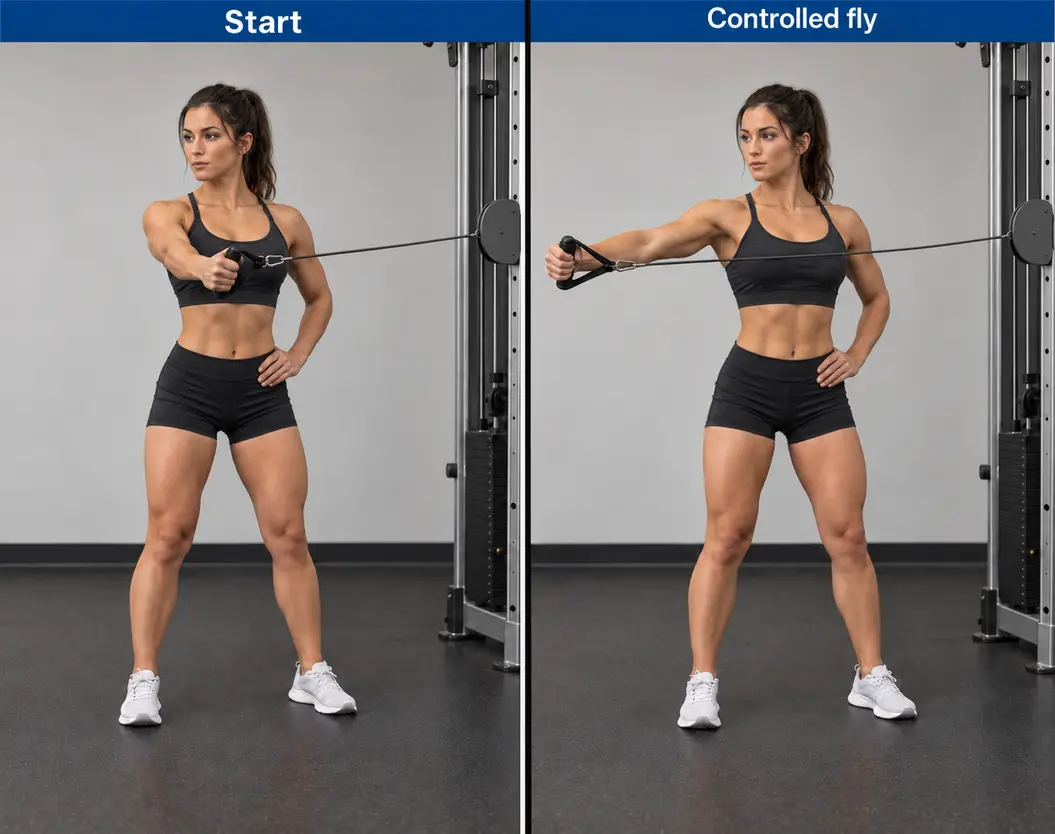
Use one adjustable cable outlet and one compatible single handle. Stand side-on with the working shoulder farther from the outlet, then open the working upper arm away from the front of the torso while keeping a small, broadly stable elbow bend. This is a reverse fly, not a cable row, lateral raise, pressdown, or pull towards the face.
- With the stack resting, inspect the cable, selector, and clip, attach one compatible single handle, and clear the arm arc and the route back to the station. Choose a light rehearsal setting; do not grasp an exposed clip or use an improvised connector as a handle.
- Set the outlet around the intended upper-arm movement height, often near shoulder level for this upright version. Treat that as fitting guidance, not a measured optimum. Stand side-on with the working arm farther from the outlet. For right-arm work, the outlet is to your left. Position yourself slightly behind the outlet's sideways line as needed so the cable runs in front of, rather than through or around, the torso.
- Take the handle in the working hand and establish stable feet, softly bent knees, and a near-upright torso. The free hand rests on the hip or remains clear of the cable; it does not pull the working arm. Move only far enough from the station to obtain usable cable travel and a controlled start, without using tension to hold your balance.
- Bring the working arm comfortably across the front of the body with a slight elbow bend and an aligned wrist. Use only a reach you can control without twisting the torso or forcing the shoulder forwards. Keep the cable and handle clear of the chest, neck, and other arm. The starting hand need not cross beyond the opposite shoulder, and the cable must retain usable travel from this endpoint.
- Open the working upper arm outwards and back relative to the torso, letting the hand follow a broad arc away from the front of the chest. Keep the elbow bend approximately unchanged. Allow coordinated shoulder-blade movement rather than holding the blade rigid or beginning with a maximal squeeze.
- Finish when the selected arm arc is complete without torso rotation, a growing shrug, elbow rowing, or an extra reach behind the body. Around the line of the torso can be a useful reference, not a mandatory endpoint. Keep the wrist supported, confirm that the cable remains clear with usable travel, and do not twist the hand to manufacture more shoulder movement.
- Guide the handle back through the same arc. Retain balance, the selected elbow bend, and cable clearance; do not let the stack crash or the cable drag the arm into a deeper stretch. One opening and controlled return by the working arm is one repetition.
- After the set, keep the handle secure and move towards the station deliberately as needed to settle the resistance before releasing it or changing sides. Mirror the setup for the other arm only after unloading. Follow the separately stated per-arm work and rest convention; do not count two arms as having worked when only one has moved.
Start with less resistance and a shorter comfortable reach when necessary. Changing the outlet or body distance alters the resistance direction; it does not make this a lateral raise, face pull, pressdown, or unchanged exercise on another station. Do not force an extreme cross-body stretch in pursuit of a stronger sensation. An upright dumbbell arm sweep is also a different gravity-loaded task because gravity acts downwards rather than along the cable line. Record the station, displayed load and units, outlet height, handle, body distance, working arm, stance, elbow bend, arc, repetitions, and actual rest. A load increase with those details unchanged stays in the same exercise history. A new station or deliberate change in geometry needs an identified baseline. See why gym machine weights differ for the station-specific loading explanation, not a conversion rule. This one-outlet version does not require a second cable column. A bilateral crossover needs two compatible outlets, suitable space, and its own entry, clearance, and loading instructions; do not manufacture it by connecting two handles to this one cable. The workout example later states explicitly how its one-arm adaptation is counted.
How to Do the Reverse Pec Deck
Reverse Pec Deck
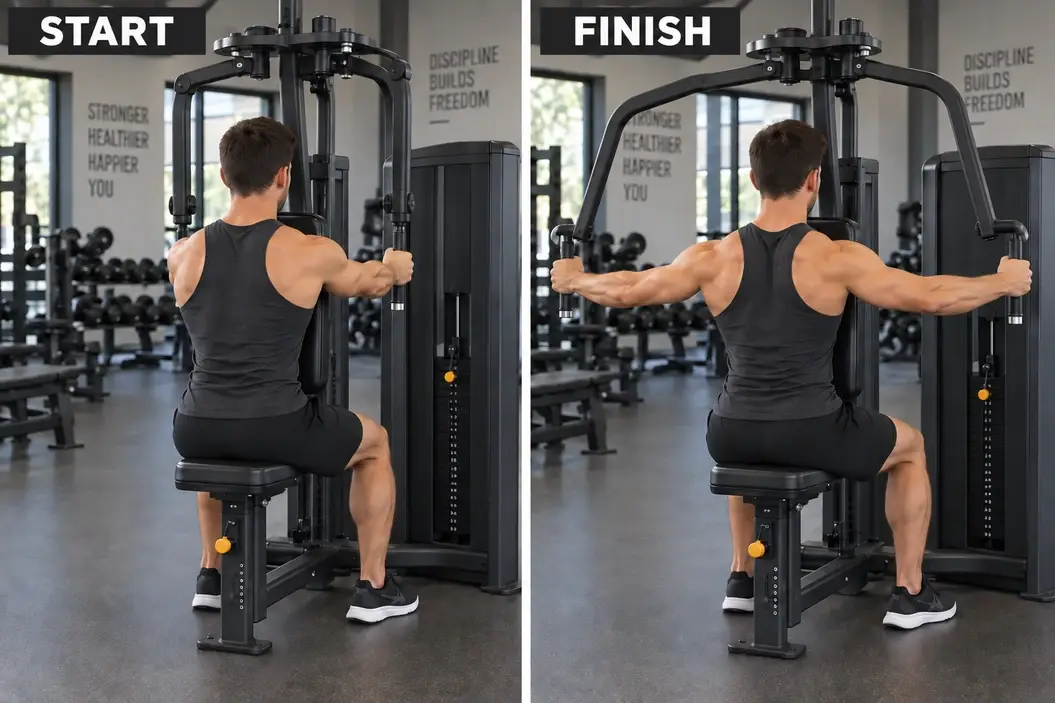
Choose a rear-delt-capable machine in its intended chest-supported configuration. The guided path is useful only when the seat, handles, and permitted starting position fit your body without an uncontrolled reach. Both arms work together in the version taught here.
- While the resistance is at rest, select the manufacturer's rear-delt configuration and adjust the starting arms or range stops as directed. Do not use the chest-fly orientation simply because the same machine can perform both exercises.
- Adjust the seat so the handles and upper-arm path can be reached comfortably, often around shoulder level. Sit facing the chest pad with the feet secure. Confirm that the chest can remain supported without restricting breathing or forcing the neck forwards.
- Take the intended handles with a comfortable full grip and establish a slight, repeatable elbow bend as the machine allows. Use only an approved neutral or pronated handle position that fits; a particular thumb direction is not a reason to force the shoulder or wrist.
- Open the upper arms outwards through the machine's available comfortable arc. Keep chest contact while the shoulder blades coordinate naturally. Do not add repeated elbow bending, a body heave, or a maximal shoulder-blade pinch to move the handles farther.
- Stop the opening before the torso leaves the pad or the shoulder is forced beyond the selected range. Guide the handles forwards through the same arc, retaining the elbow relationship and control instead of allowing the machine to pull you into its deepest possible reach.
- Complete the set with a controlled return, settle the stack, and release the handles only when they are safely at rest. Change settings only while unloaded. Reassess the load and machine fit when the start, finish, or exit cannot be repeated.
Reduce the load or adjust the permitted start when the last repetitions require a shorter arc or loss of chest contact. A machine that cannot fit after its intended adjustments is a reason to choose another suitable exercise, not to force its path. Keep the machine identity, seat, starting position, handle choice, displayed resistance, elbow bend, and movement range in your record. Neutral and pronated handles may change the task; neither creates a universal load scale or guarantees more growth. Use your workout plan's assigned sets, rest, and effort.
Dumbbell Rear-Delt Flyes With and Without a Bench
Chest-Supported Dumbbell Reverse Fly
Use a stable adjustable exercise bench and two light, manageable dumbbells. Chest support reduces the need to hold an unsupported hip hinge while each arm still controls its own movement. Choose the bench setting for usable support, breathing, and weight clearance rather than a compulsory incline number.
- Lock the bench securely and clear the floor. Check that the pad can support the chest while both dumbbells have room to hang and move without hitting the bench, floor, or feet. Arrange a controllable pickup and set-down before taking the weights.
- Settle chest-down with the feet stable and the neck comfortably aligned with the torso. Take one dumbbell in each hand using a secure full grip, and let the arms hang beneath the shoulders with a small elbow bend. Use lighter weights or a different arrangement when getting into position is not controlled.
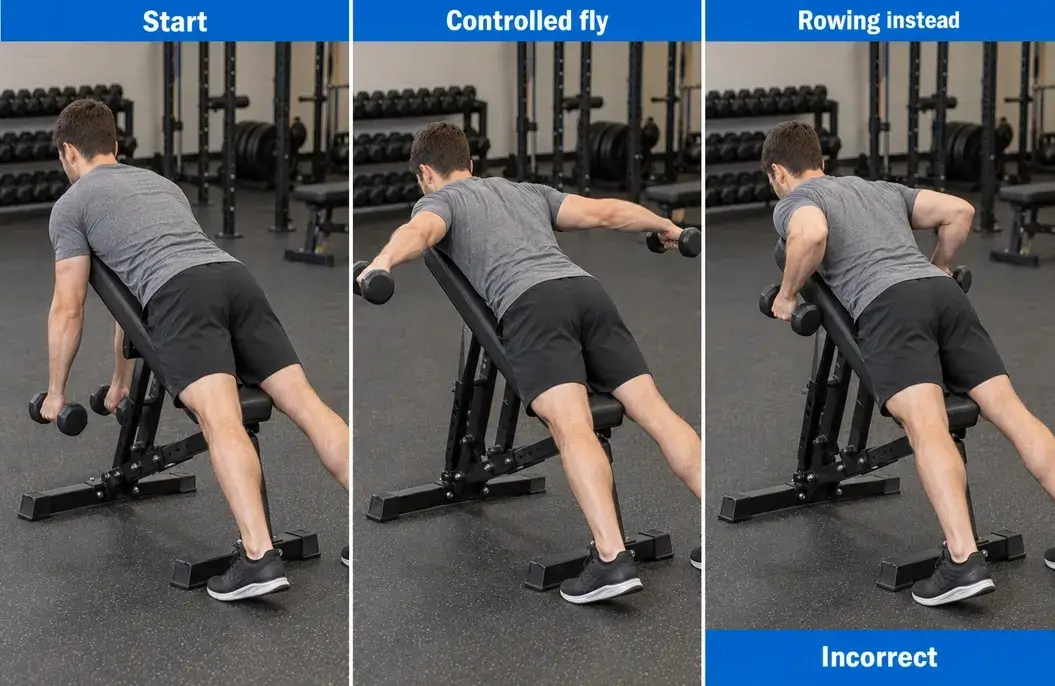
- Open the upper arms outwards relative to the supported torso. Let the hands follow the arc and keep the elbow angle approximately consistent. Allow normal shoulder-blade movement without pinning the blades together or lifting the chest off the support.
- Stop where you can retain the same chest contact, neck position, and arm path. The upper arms do not have to travel as far behind the torso as possible. Do not bend the elbows into a row to make the weights rise higher.
- Lower both dumbbells through the same arc with control. Keep the weights clear of the bench and floor and avoid dropping through the return. Both arms opening and returning together count as one bilateral repetition.
- Set the weights down securely through the prepared route before leaving the bench. End the set earlier when grip, support, or set-down control becomes uncertain; do not improvise a drop from the supported position.
Use smaller dumbbells or a shorter repeatable arc when the full selected movement is not controlled. Deliberately changing the elbow bend changes the lever and needs to be recorded; do not gradually turn late fly repetitions into heavier rows and count them as unchanged progress. Keep the bench setting, grip, elbow bend, endpoints, and load per dumbbell consistent. In the existing illustration, bending the elbows into a row is incorrect for the pictured reverse fly; it does not mean an intentionally selected rear-delt row is always wrong. A rear-delt row has its own purpose and performance record.
Bent-Over Dumbbell Reverse Fly
Use the unsupported version only when you can maintain a comfortable hip hinge while the arms move. Two light dumbbells and clear standing space replace the bench, but they do not recreate its chest support. The hinge demand remains part of this exercise, so keep it separate from the supported fly in your training record. It is not inherently superior or automatically a clinically safer choice.
- Pick up two manageable dumbbells through a controlled bend of the hips and knees and establish stable feet. Send the hips back into a maintained hinge with softly bent knees, enough floor clearance, and the arms hanging below the shoulders. The torso does not need to match a compulsory angle.
- Set a small, comfortable elbow bend and keep the neck aligned with the trunk. Open the upper arms outwards relative to the inclined torso while the hands follow the arc. Keep breathing and allow the shoulder blades to coordinate.
- Finish before the torso rises, the chest heaves, the neck reaches forwards, or the elbows repeatedly bend into a row. A smaller controlled arc is preferable to forcing the same apparent height as another lifter.
- Lower through the same path while retaining the hinge and elbow bend. Stop if holding the torso, grip, or balance prevents the intended shoulder movement; unsupported fatigue is not evidence that the rear delts received the same work as a supported set.
- Bring the dumbbells to a controlled hanging position, stand or bend down through the prepared handling route as appropriate, and set them safely at rest. Do not continue swinging repetitions after the hinge has become unreliable.
Reduce the weight or choose the supported fly, fitted machine, or suitable cable setup when the maintained hinge is the limiting task. Record the changed support rather than treating it as the same load comparison. With only one dumbbell, do not convert either bilateral tutorial into an untaught one-dumbbell fly. Without suitable weights, an unloaded arm sweep can rehearse the path but is not loaded rear-delt training, and household furniture is not a substitute for rated exercise support. A band requires its own permitted arrangement and instructions; a standing dumbbell movement across the room does not reproduce the cable's sideways resistance. For a complete dumbbell-based schedule with a documented no-bench branch, use the Five-Day Dumbbell Workout Plan as its own workout plan, not additional work to append to current training.
How to Use a Chest-Supported Rear-Delt Row
Chest-Supported Dumbbell Rear-Delt Row
Use this chest-supported row when a deliberately more-open upper-arm path serves a posterior-shoulder and upper-back rowing role. The elbows bend during the pull, so it is not an isolated rear-delt fly. A more-open supported row already appears in the Five-Day Dumbbell workout plan; this guide explains when to select it instead of another row and how to keep its own performance baseline. It remains a compound row with elbow-flexor and shoulder-blade muscle involvement, not a compulsory second row.
- Set a stable adjustable bench at a locked incline that supports the chest and leaves space for both dumbbells. Clear the pickup and set-down route and choose a manageable pair independently of the weight used for a nearer-torso row.
- Rest the chest on the pad, plant the feet, and hold the dumbbells beneath the shoulders. Keep the neck aligned and leave enough room to breathe. Begin from a controlled arm reach rather than an exaggerated shoulder stretch.
- Choose an upper-arm path that opens farther away from the sides than a nearer-torso row, within your comfortable range. Let the grip accommodate that path while the wrists remain supported. More open does not mean maximally flared or exactly 90 degrees, and it does not require a thumbs-down shoulder twist or elbows above the shoulders.
- Bend the elbows and move the upper arms outwards and back relative to the torso. Let the dumbbells follow beside the bench without striking it. Maintain chest contact and let the shoulder blades move naturally rather than beginning with a maximal squeeze.
- Finish while the selected path and support remain repeatable, before a shrug, chest lift, or extra shoulder reach replaces the pull. The dumbbells do not need to touch the chest, and the elbows do not need to travel far behind the torso.
- Lower the weights steadily as the elbows straighten and the upper arms return to the same starting reach. Keep the feet and chest in place and retain control of both dumbbells. One two-arm pull and return is one bilateral repetition.
- Set the dumbbells down safely before leaving the bench. Reduce the load or change the setup when the more-open path cannot be retained. Record this as the selected rear-delt row rather than combining its results with a nearer-torso row or reverse fly.
The upper-arm path helps define the rowing task, but it is not a muscle on/off switch. A nearer-torso row and a more-open row can both involve the rear delts, upper back, elbow flexors, and other supporting muscles in different proportions and positions. Feeling the upper back does not prove that the rear delts are inactive, and changing the grip alone does not isolate one region. Select the more-open row when that distinct rowing role is needed. When another row already supplies it, an elbow-stable reverse fly may add a different task, or no extra exercise may be necessary. Keep rows assigned for other pulling roles instead of deleting them solely because a reverse fly has been selected. Record the bench setting, chest support, grip, upper-arm path, endpoints, load per hand, repetitions, and actual rest. A larger dumbbell number does not prove a stronger rear-delt stimulus, and the row is not a cable-stack conversion or treatment for shoulder symptoms. Use the back exercise selection guide for broader compound-row and vertical-pull choices within the complete workout plan.
Rear Delts, Upper Back, and What Your Arm Path Changes
Identify the movement before deciding what role it serves in your workout plan. Horizontal upper-arm opening means the upper arm moves away from the front of the torso, as in a reverse fly. Shoulder extension means the upper arm moves backwards relative to the torso. Elbow flexion means the elbow bends, while scapular movement means the shoulder blade moves on the rib cage as the arm travels. The posterior deltoid is the back portion of the shoulder muscle, not another name for the rotator cuff. It can help move the upper arm outwards and backwards. Muscles that move and control the shoulder blades also contribute, and elbow flexors assist when a row or face pull bends the elbows. Their involvement does not make every exercise identical or establish complete isolation.
| Feature | What to observe | What it does not prove |
|---|---|---|
| Upper-arm opening | The upper arm moves away from the front of the torso during a reverse fly. | Complete rear-delt isolation or a universal ideal elbow height. |
| Upper-arm path in a row | A nearer-torso or more-open path accompanies repeated elbow bending. | An abrupt angle that switches the lats or rear delts on or off. |
| Shoulder-blade motion | The scapula moves with the arm instead of being permanently pinned. | That all handle travel came from the rear delts, or that upper-back involvement is a fault. |
| Elbow bend | The fly keeps a broadly stable bend; the row deliberately bends and straightens it. | That either exercise is wrong outside the specific task being demonstrated. |
| Grip and shoulder rotation | Hand orientation, wrist position and upper-arm rotation are related but different variables. | A neutral, pronated or thumbs-down grip that guarantees growth or safety. |
How Resistance Direction Changes the Task
Dumbbells are pulled downwards by gravity, so bench or torso angle, upper-arm position and limb length change the external demand. A cable pulls towards its outlet, so outlet height and body position change the line of resistance. Machine cams, lever arms and guided paths can change the demand again, even when two stations have the same exercise name. Constant cable tension does not mean constant joint torque or constant force from an individual muscle. Reaching farther across the body also does not automatically create more useful loading. These are qualitative mechanical distinctions, not measured force curves or a universal ranking. Select a setup with a repeatable path, support and range that fit the intended exercise.
How Face Pulls Differ From Reverse Flyes
A face pull combines an upper-arm pull, elbow bending and a selected external-rotation contribution. A reverse fly keeps the elbow bend broadly stable while the upper arms open. Neither task is pure external rotation, and sharing posterior-shoulder muscles does not make the movements or loads interchangeable. Use the face-pull technique guide for the complete combined-movement setup and instructions.
What the Reverse-Fly Grip Study Shows
A study by Schoenfeld and colleagues found higher mean posterior-deltoid muscle-activity readings with a neutral rather than pronated reverse-fly-machine grip. It did not measure muscle growth. Select a permitted, comfortable grip rather than treating an acute measurement as a universal ranking.
Rear Delt Sets, Reps, Weight, and Progression
The prescription below comes from the Upper/Lower Split Workout Plan. It appears as the fifth exercise of seven in Upper B and offers Reverse Pec Deck or Cable Rear-Delt Fly as an OR choice. The remaining presses, row, vertical pull, curl, and triceps work keep their own places and instructions. The source does not state a cable attachment, outlet position, arm-count convention, or between-side rest method. Those details must not be read into the quotation. The worked progression later in this section applies only to the bilateral Reverse Pec Deck option.
| Exercise | Sets & Reps | Rest | Tempo | Target Muscles | Notes |
|---|---|---|---|---|---|
| Reverse Pec Deck or Cable Rear-Delt Fly | 2 sets of 12–20 reps | 60–120 sec | 2-1-1-1 | Rear Delts, Scapular Muscles | Move through the shoulder rather than extending the lower back. |
Use non-fatiguing rehearsal or ramp-up sets as needed before the two prescribed working sets. They do not consume those working-set allocations. Choose a resistance that lets both sets reach at least 12 repetitions at the intended effort while preserving the selected range, support, elbow relationship, and controlled return. The source describes stable isolation work as often falling within 0–3 reps in reserve, but this is contextual guidance rather than a command to reach failure or a fixed target for every rear-delt exercise. Keep the quoted 60–120 sec between the bilateral working sets. Take sufficient recovery under the complete plan's adjustment rules and record the actual interval. A materially different rest period changes the comparison. In the later authored single-arm application, that interval is assigned after each arm; it is not an arm convention hidden inside this quoted row. For the selected fly, 2-1-1-1 means returning towards the forward reach for about two seconds, pausing there for one second without hanging on the joint, opening through the selected arc for about one second, and pausing at the controlled finish for one second. The first moving action from the prepared reach can be the opening phase even though the notation lists the forward return first. Neither pause calls for a forced stretch, maximal shoulder-blade squeeze, or dropped stack.
Progress the Bilateral Reverse Pec Deck Choice
The hypothetical log below applies to the bilateral Reverse Pec Deck option for two sets of 12–20. Exposures A through C use the same machine, seat, handles, starting range, load, elbow bend, endpoints, intended effort, and comparable rest. Exposure D is one possible result after a small permitted increase, not a customer record, study result, or promised timetable.
| Exposure | Set 1 | Set 2 | Decision |
|---|---|---|---|
| A | 16 | 15 | Retain the load and add controlled repetitions under comparable conditions. |
| B | 20 | 18 | Retain the load; the second set has not reached the upper boundary. |
| C | 20 | 20 | Consider a small permitted increase only when range, effort, rest and handling also qualify. |
| D | 15 | 13 | One possible result after a manageable increase, not a promised outcome or timetable. |
Reach 20 on both working sets before considering an increase, and require the same intended effort, machine setup, range, tempo, comparable rest, and secure handling. A result of 20/18 has not reached the upper boundary on both sets, even though the first set has reached 20. Record every result honestly after an increase. A hypothetical 14/11 misses the lower repetition boundary in the second set and should not be completed with shortened, assisted, or altered repetitions. A single final-set shortfall can justify repeating the load and reviewing recovery. A poor first set, an early miss, or a persistent decline across comparable sessions calls for a broader review of load, setup, preceding work, actual rest, and recovery. The source does not require an immediate reduction after every isolated late-set miss. When a new increment cannot support the selected range after appropriate recovery, use a smaller permitted increase or return to the previous manageable load. Record the machine, seat, handles, start position, load, elbow bend, endpoints, repetitions, actual rest, effort, and limiting factor. Ordinary resistance increases with those details unchanged remain in the same exercise history; a material setup change needs a clearly identified baseline. The complete workout plan controls frequency, total rear-delt work, and any regional priority. A rear-delt row keeps its own assigned rowing prescription rather than inheriting this reverse-fly row.
Fit Rear Delt Work Around Rows and Per-Arm Training
Keep the complete Upper B session intact when applying the fifth-row rear-delt choice. Its earlier third-row seated cable or machine row contributes three compound-row exercise sets, while the selected fifth-row reverse-fly option contributes two exercise sets. With the bilateral reverse pec deck selected, those two slots contain five exercise-set entries, not five isolated rear-delt sets and not the whole session or week. The earlier vertical pull also has three sets, but it serves a different pulling role. Do not remove it, assign it an invented exact rear-delt fraction, or treat its muscle involvement as identical to the row. The table below compares accounting choices; it is not a five-stage sequence to perform.
| Decision | Work received by each arm | Actual work bouts | Interpretation |
|---|---|---|---|
| Select the bilateral reverse pec deck | 2 sets | 2 bilateral bouts | One implementation of the source-listed machine choice. |
| Explicitly adapt the cable choice to the taught single-arm fly | 2 sets per arm | 4 single-arm bouts | The per-arm allocation and rest convention are specified here, not quoted from the generic source row. |
| Perform both of those full allocations | 4 sets per arm: 2 bilateral plus 2 single-arm | 6 bouts: 2 bilateral plus 4 single-arm | Added work, not a replacement; the resistance and stimulus are not identical. |
| Explicitly substitute a bilateral supported dumbbell fly | 2 sets | 2 bilateral bouts | An authored equipment substitution, not an additional source-listed option. |
| After one bilateral pec-deck set, deliberately complete one cable set per arm | 2 sets per arm: 1 bilateral plus 1 single-arm | 3 bouts: 1 bilateral plus 2 single-arm | A mixed-implementation modification; preserve the completed work instead of restarting a full allocation. |
The authored single-arm cable application uses 2 sets of 12–20 repetitions per arm, 60–120 seconds after each arm, and a 2-1-1-1 tempo. The generic source row does not state that per-arm convention. Each arm still receives two nominal sets, but the work occurs across four side-specific bouts. This does not claim equal load, fatigue, session time, or stimulus compared with the bilateral machine choice. One workable order is left set 1, rest, right set 1, rest, left set 2, rest, then right set 2 and the final rest before the next exercise. Settle the cable stack before changing sides and mirror the handling as well as the movement. At 15 repetitions in every bout, each arm completes 30 repetitions, while the four bouts contain 60 single-arm repetitions in total. Performing both full pec-deck and adapted cable allocations gives each arm four sets across six actual bouts, not four bouts. The two bilateral machine bouts and four side-specific cable bouts also differ in resistance, handling, fatigue, and time. Use the guide to counting workout sets when separating exercise sets, per-arm exposure, and actual work bouts. The bilateral supported dumbbell fly row is an authored substitution, not a source-listed option. Retaining 2 sets of 12–20 repetitions, 60–120 seconds, and 2-1-1-1 belongs only to this labelled adaptation; it does not create a cable or pec-deck load conversion. If one bilateral pec-deck set has already been completed, a deliberate switch to one cable set per arm preserves that completed work. Each arm then receives two sets across three bouts. This is a modified mixed implementation, not an identical source session and not a reason to restart a full allocation. Keep the other six Upper B rows, exercise order, schedule, recovery, and progression rules unchanged. The complete workout plan controls frequency. Do not invent a weekly multiplier or assign an exact fraction of compound-row or vertical-pull sets to the rear delts.
Rear Delt Technique Mistakes and Recovery Checks
| Observed problem | Practical response |
|---|---|
| A fly becomes progressively more bent-elbow rowing | Reduce resistance and restore the chosen elbow bend; log a deliberate row separately. |
| Torso rotation, chest lift or a rising hinge creates extra travel | Retain the selected support and torso position, or choose a suitable supported alternative. |
| A shrug replaces the intended upper-arm opening | Reassess the load and arm arc without trying to eliminate all normal shoulder-blade movement. |
| The return pulls the shoulder into an uncontrolled reach | Shorten the start to a repeatable range and recheck the machine or cable fit. |
| The cable, handle, weights or bench obstruct the path | Unload and correct the arrangement before repeating; do not force the movement around an obstruction. |
| The next resistance step loses the prescribed range | Record the actual result and review the increment and recovery; do not count altered repetitions as progress. |
| Performance declines across comparable sessions | Review prior rows, direct work, actual rest and wider recovery before adding more rear-delt sets. |
A technique error is a material change from the exercise standard you selected, such as growing elbow bend, torso movement or a shrug replacing the arm path. Normal coordinated shoulder-blade movement is not automatically a fault. Feeling the upper back also does not prove that the rear delts are inactive. One poor workout is not a plateau. Check the actual rest taken, prior pulling and shoulder work, the setup, the selected load, sleep and wider recovery before adding another exercise or more daily rear-delt work. Use the why reps drop between sets explanation for comparable performance and recovery checks, not as a medical source. Resolve cable, handle, dumbbell, bench or machine interference only after the resistance is safely unloaded. Do not twist, shift supports or work around an unsafe obstruction during a repetition. Rehearse the corrected path with a manageable load before resuming the assigned work in your workout plan. Stop and settle the resistance when grip, support or equipment control becomes uncertain. Persistent, worsening or otherwise concerning pain, radiating symptoms, numbness or unexpected weakness needs appropriate assessment rather than self-diagnosis, forced stretching or an improvised rehabilitation test.
Rear Delt Exercise FAQs
What are the best rear delt exercises?
A fitted reverse pec deck, the Standing Single-Arm Cable Rear-Delt Fly, and a chest-supported dumbbell reverse fly are practical direct-work candidates. A more-open row can serve a useful rowing role, but it is not an automatic addition or a universal winner. Choose the option that fits your equipment, support needs, repeatable arm path, and progression.
Do rows train the rear delts, or do I still need reverse flyes?
Rows can involve the posterior shoulder, with the demand changing according to the actual upper-arm path, elbow action, and support. A reverse fly keeps the elbow bend broadly stable rather than repeatedly bending it as the main movement distinction. Review the roles and progress already present in your workout plan before adding work, and do not count every row set as an identical rear-delt set.
Are cable rear-delt flyes better than dumbbells?
The evidence discussed here does not establish a universal muscle-growth advantage for cables or dumbbells. A cable pulls towards its outlet and can offer small station increments, while dumbbells are loaded downwards by gravity and may use chest support or a maintained hinge. One cable outlet can train one arm at a time. Choose the setup whose arc, clearance, support, and load progression can be repeated.
How do I do rear-delt flyes with only one cable pulley?
Use the Standing Single-Arm Cable Rear-Delt Fly setup: stand side-on with the working arm farther from the outlet, keep the cable clear in front of the torso, and retain a broadly stable elbow bend. Complete the set, settle the stack, then mirror the setup for the other arm. Do not join extra handles or invent a bilateral arrangement from one outlet.
What is the difference between a rear-delt row and a reverse fly?
A rear-delt row repeatedly bends the elbows while the upper arms travel along the selected rowing path. A reverse fly keeps a broadly stable elbow bend while the upper arms open relative to the torso. Using the same bench or dumbbells does not make them the same exercise. Rowing is an error within the demonstrated fly, not a universal ban on deliberately selected rows.
Should I squeeze my shoulder blades together or keep them still?
Allow normal coordinated shoulder-blade movement as the arms travel. Do not lock the shoulder blades permanently together or force a maximal pinch to finish the repetition. Observe the upper-arm movement relative to the torso as well as scapular motion. A sensation in one area cannot assign exact muscle contributions.
How high should my elbows be, and should my thumbs point down?
Use a comfortable, repeatable arm arc without forcing a right-angle flare, a highest possible endpoint, or a thumbs-down rotation. Hand orientation, wrist position, and upper-arm rotation are related but different variables. Grip direction alone does not establish an optimal growth position. Retain the intended exercise, support, and control.
How many sets and reps should I do for rear delts?
The exact Upper B example in this guide uses 2 sets of 12–20 reps, 60–120 sec rest, and a 2-1-1-1 tempo. That is one workout plan's prescription, not a universal rear-delt dose. The separately authored single-arm cable adaptation uses 2 sets per arm with 60–120 sec after each arm, creating four side-specific work bouts rather than two total single-arm bouts.
Can I train rear delts at home without a bench?
The fully taught bent-over dumbbell reverse fly uses two suitable light dumbbells and a maintained hip hinge. Removing chest support changes the task and its fatigue limits. Do not improvise household anchors or call an unloaded arm sweep equivalent to loaded work. A resistance band requires its own product-permitted setup, anchor, and instructions.
Should rear delts be trained on shoulder day, back day or every day?
Placement follows the selected complete workout plan, its exercise order, and the pulling work already present. The source example places the rear-delt choice in Upper B after earlier compound work. Do not add a compulsory daily routine, universal frequency, or automatic second allocation. Persistent or concerning symptoms need appropriate assessment rather than repeated exercise testing.